Over the years, Billboards around Mbare have promised renovation of the structures of the suburb. Often these have shown pictures of a “renovation” that would not leave much room for the present residents; luxury blocks of flats, each with its own swimming pool, or a “people’s market” that gives most of its space to car parking.
If we see or hears something like that once, we don’t take much notice. We have grown used to broken or forgotten promises, but when they are repeated and big names are mentioned in connection with the idea, we have good reason to suspect there may be some germ of a plan behind it all. In the past month we have seen signs of action. There may be a plan after all, but this regime has produced many plans that did not change into structures of bricks and mortar, so we must not jump too quickly to conclusions. First, one single block of Matapi Flats was plastered and painted on the outside and “work in progress” fences and ropes surrounded it to discourage passers-by from enquiring more closely. Apparently all the residents are still there, but nobody talks about what is going on inside.
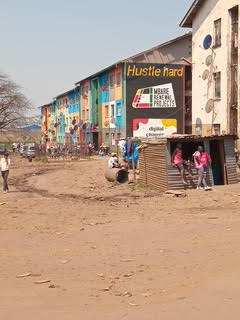
That is strange, because those flats were badly in need of new plumbing and you can’t do that while people still depend on the old plumbing to wash themselves and their clothes and to use the lavatories. It is worth remembering that these are not what urban planners or anyone else outside ZANU-PF circles would call flats. These were built in colonial times as “hostels for single men”; the hundred or so rooms in each block were meant as sleeping places for men whose families were left behind in the rural areas, or maybe even in Malaŵi. The ablutions and lavatory facilities were communal, occupying one designated space on each floor. The whole structure was designed to tell residents that they were only there temporarily, for as long as their labour was needed in town. There was nothing homely about those hostels. At independence, the government decreed that residents in the hostels, from then on to be called flats, were allowed to bring their families to live in Harare. That meant in the newly-named flats, because few of the workers who stayed there could afford any better accommodation.
Instead of each block housing about 400 compulsorily single men, it now contained a large number, which might have been 384 families, four per room. In fact, the number was never quite that high, but three families per room were and still are common. Having decreed that these blocks were now family flats, the authorities congratulated themselves and walked away. They had ended the scandal of men being separated from their families, but they did not follow through the way any other landlord changing the use of such buildings would have done, hence the rivers of sewage running down the stairs and gushing out over the outside wallsand a new scandal of three families force to share one room. A few years ago, a fire in one of these blocks offered an opportunity, which the Highest in the Land claimed they would take, to install adequate plumbing to meet the needs of all the residents. The Highest Himself was even photographed holding a paintbrush, to show he was serious. Did anybody dare to tell him that the time to use a paint brush was after, not before, installing new plumbing? Hazvinei, he packed up his paintbrush and went back to his mansion as if a job had been done.
The mystery in the blocks that are now being plastered and painted outside, with even a few slogans from the same paintbrush as the pro-CAB3 propaganda adorning so many of our kombis; fine sounding but empty phrases. There may be more action inside, but without moving the tenants it can’t be much more than painting and plastering the corridors. An engineer, apparently with a famous father, is supposed to be in charge of operations on four blocks, so we can expect a sharp rise in rentals, which the present residents cannot afford. What then? On past form, the residents might all remain, unchallenged and forgotten.
But they might be evicted. Meaning more families living on the streets, unless the chefs just forget them; in that case, expect them back in a few months. After all, where else can they go? Or, if there really is a sinister plan to install a higher class of tenants, that would mean a police operation to keep the evicted at bay while while the barrack-like rooms are converted into flats each with its own bathroom, kitchen and lavatory – and the road that leads past the blocks is rebuilt more thoroughly than we have seen yet anywhere, which would probably require overhauling the leaky sewers which created the monster potholes we see today. They are insensitive enough to choose this option, but they have never shown the staying power required to finish the job. In short this worst option makes the present residents losers, while noone else gains except the engineer contracted to do the job.
Source: A Mbare Mystery
The post A Mbare Mystery appeared first on Zimbabwe Situation.