Byo orders illegal vendors to relocate to designated markets within a week

The City of Bulawayo has ordered informal traders operating from undesignated areas to vacate their trading sites, giving them a week to relocate voluntarily to council-approved markets amid growing concerns over the impact of government-led clean-up operations on vulnerable livelihoods. The relocation exercise raises questions as to whether the designated markets can accommodate all affected […]

The post Byo orders illegal vendors to relocate to designated markets within a week appeared first on Zimbabwe Situation.

The City of Bulawayo has ordered informal traders operating from undesignated areas to vacate their trading sites, giving them a week to relocate voluntarily to council-approved markets amid growing concerns over the impact of government-led clean-up operations on vulnerable livelihoods.

The relocation exercise raises questions as to whether the designated markets can accommodate all affected traders and whether the transition will protect livelihoods while enforcing municipal regulations.

In a notice dated October 22, 2026, Bulawayo Town Clerk Christopher Dube said the directive was in line with instructions from the Ministry of Local Government and Public Works for illegal informal traders to move to designated trading sites.

The relocation period runs from October 26 to November 1, 2026 during which traders seeking accommodation at designated markets must register with the council.

“The City of Bulawayo would like to advise members of the public, all Micro, Small, and Medium Enterprises (MSMEs) and stakeholders that all illegal informal traders operating from undesignated areas should vacate these sites forthwith,” Dube said.

Council said trading from road servitudes, parking bays and pavements was prohibited under its by-laws, while encouraging affected traders to cooperate with authorities during the relocation process.

The directive comes amid a wider government-led campaign, known as Operation Chenesa, targeting informal trading and other structures considered illegal. 

The campaign has drawn criticism over the removal of vendors and the destruction of informal businesses and homes, raising fears of a repeat of the controversial 2005 Operation Murambatsvina.

The earlier operation resulted in the demolition of informal businesses and homes across Zimbabwe, leaving many people without shelter or livelihoods.

Critics have warned that the latest clean-up campaign risks addressing the visible manifestations of Zimbabwe’s economic crisis without tackling the underlying conditions that push people into informal trading, including unemployment and limited opportunities in the formal economy.

For many households across Bulawayo and the country vending provides a critical source of income in a difficult economic environment, making relocation a potentially disruptive process if suitable and affordable alternatives are not available.

Under the Bulawayo notice, verification of existing 2024 trading-bay allocations and consideration of new applications will be conducted through the Dugmore MSMEs Office.

Council said priority would be given to vulnerable groups, including child-headed and female-headed households, widows, orphans, unemployed people, elderly people, persons with disabilities and those with terminal illnesses.

Successful applicants will be required to provide police clearance and fingerprints, passport-sized photographs, a copy of their national identity document and proof of residence.

Traders handling food will also be referred to Khami Clinic for screening for communicable diseases before licensing.

Council has set annual trading licence fees at US$23 for the central business district (CBD) and US$11.50 for suburban sites, including Highlanders.

Monthly rentals will be US$11.50 for CBD sites and US$5.75 for suburban sites including Highlanders.

The fees and registration requirements will determine whether affected traders can secure alternative operating spaces within the relocation period.

“The City of Bulawayo would like to emphasise that, while it values the role played by MSMEs in supporting livelihoods, trading from undesignated places such as road servitudes, parking bays and pavements is not allowed,” said the town clerk.

“All MSMEs and stakeholders are encouraged to comply with By – Laws by moving their businesses to designated trading areas.

While council says it recognises the role of micro, small and medium enterprises in supporting livelihoods, its notice emphasises compliance with municipal by-laws and the need to move businesses away from undesignated locations.

“We urge all affected MSMEs to co-operate with the authorities during this transition period to ensure a smooth relocation process. Your understanding and compliance is greatly appreciated,” Dube said.

Traders seeking further information have been directed to the Town Planning Department’s MSMEs section at the ninth Tower Block Offices or contact 02922 75011 ext. 8027 or email tidube@citybyo.co.zw.

Source: Byo orders illegal vendors to relocate to designated markets within a week — CITEZW

The post Byo orders illegal vendors to relocate to designated markets within a week appeared first on Zimbabwe Situation.

Zimbabwe’s gun amnesty needs legal reforms, says MP

Zimbabwe’s month-long firearms amnesty will have limited impact on gun-related crime unless it is backed by reforms to outdated firearms laws, stronger enforcement and tighter controls on gun ownership, Dzivarasekwa legislator Edwin Mushoriwa has warned. President Emmerson Mnangagwa has granted a national firearms amnesty allowing members of the public to voluntarily surrender unregistered firearms and […]

The post Zimbabwe’s gun amnesty needs legal reforms, says MP appeared first on Zimbabwe Situation.

Zimbabwe’s month-long firearms amnesty will have limited impact on gun-related crime unless it is backed by reforms to outdated firearms laws, stronger enforcement and tighter controls on gun ownership, Dzivarasekwa legislator Edwin Mushoriwa has warned.

President Emmerson Mnangagwa has granted a national firearms amnesty allowing members of the public to voluntarily surrender unregistered firearms and ammunition to the Zimbabwe Republic Police (ZRP) by November 12, 2026, without facing criminal charges for unlawful possession.

Speaking on CITE’s This Morning on Asakhe programme, Mushoriwa welcomed the initiative but said the 30-day surrender window would not address the deeper causes of illegal firearm possession and gun-related violence.

“I want to start by agreeing that there is a need for us to review the current firearm laws that we have in the country. Our laws came into being in 1956 and were operationalised in 1957. You can actually tell that it has been long, and there have been also a lot of developments since then,” he said.

Mushoriwa said Zimbabwe needed legislation that reflected current security challenges, including the illegal movement of firearms across borders, gaps in licensing procedures and failure to adequately monitor some licensed gun owners.

“The situation as it stands, the 30-day period is good, but it’s just the tip of the iceberg. We are not getting deeper,” he said.

He questioned whether people who had used firearms in robberies and murders would voluntarily surrender weapons that could expose their involvement in criminal activities.

Mushoriwa said porous borders with neighbouring countries, including South Africa, Botswana, Mozambique and Zambia, provided potential routes for illegal firearms to enter Zimbabwe.

He also called for stronger screening of firearm applicants, particularly where there were reports of domestic violence, stalking, credible threats or other circumstances that could indicate a risk to public safety.

Citing Section 5 of the Firearms Act, which provides for the refusal of a firearms certificate where possession would endanger public safety, Mushoriwa said clearer procedures were needed to guide decisions on granting, refusing or suspending licences.

“If we cannot have it in the legislation, at least we should have a statutory instrument that guides those things. So that we introduce a clear procedure for risk assessment, license refusal, or suspension,” he said.

He also questioned Section 8(16) of the Act, which provides an exemption allowing a person to possess a firearm at their residence or place of business where their spouse holds a firearms certificate.

Mushoriwa argued that authorities should assess whether continued access to firearms was appropriate in cases involving domestic violence or credible threats.

Beyond legal reforms, he said stronger relationships between communities and the police were essential to tackling illegal firearms, adding that residents needed confidence that reports of suspected illegal gun possession would be acted upon.

“We should be saying the police is our police. And those bridges, in my view, need to be built,” he said.

Past amnesties raise questions

Nothiwani Dlodlo, chief lobbyist for the Xikolokolo Lobby Group, questioned the effectiveness of previous firearms amnesties, arguing that the number of weapons surrendered raised doubts about whether the initiatives had achieved their intended objectives.

“We have witnessed some three or four amnesties prior to this one. So, they were initially ignored because if you look at the number of guns which were voluntarily surrendered, you can tell those amnesties, especially the last amnesty, it was totally, totally a failure or ignored,” Dlodlo said.

He urged the government to intensify efforts to identify illegal firearms through community engagement and cooperation with traditional leaders, particularly in rural areas.

Dlodlo suggested that authorities consider more direct efforts to identify weapons held illegally in communities.

“So, I’m just praying to the central government that, if possible, it goes door to door. These guns are known and even I’m expecting the government must also give a directive to chiefs or even in rural communities, these guns are there,” he said.

He warned that failure to address illegal firearms could worsen insecurity and contribute to the emergence of increasingly violent gangs.

Calls for transparent reporting

Social and community development analyst Iphithule Maphosa said the success of the current amnesty should be assessed through transparent reporting, with the government publishing figures on the number of firearms surrendered and the outcomes of the exercise.

He said authorities should disclose their targets, the number of weapons recovered and how many were linked to violent crimes.

“Then government, after amnesty, they should publish figures to compare what was expected and what was actually achieved in an amnesty. People should be able to evaluate the data to see whether it presents progress or not,” Maphosa said.

He questioned the lack of publicly available information on previous amnesties, including the number of firearms surrendered and how many had been used in violent crimes.

“We don’t have that information and it becomes very difficult for us to measure the success of that particular amnesty. And if you repeat that even now, it will be very difficult for us to measure the success or failure of this particular one,” he said.

The three contributors said the amnesty’s impact would ultimately depend on what followed the surrender period, including legal reforms, effective enforcement, community cooperation and the publication of data to measure its results.

Source: Zimbabwe’s gun amnesty needs legal reforms, says MP — CITEZW

The post Zimbabwe’s gun amnesty needs legal reforms, says MP appeared first on Zimbabwe Situation.

ZINARA eyes new credit lines after clearing $206 million debt

HARARE – The Zimbabwe NationalAdministration (ZINARA) could unlock new lines of credit and joint-venture opportunities for road infrastructure development after clearing a US$206 million loan owed to the Development Bank of Southern Africa (DBSA), ending a 15-year-old debt obligation. The road authority settled the final US$1.3 million instalment on September 30, with the development being […]

The post ZINARA eyes new credit lines after clearing $206 million debt appeared first on Zimbabwe Situation.

HARARE – The Zimbabwe NationalAdministration (ZINARA) could unlock new lines of credit and joint-venture opportunities for road infrastructure development after clearing a US$206 million loan owed to the Development Bank of Southern Africa (DBSA), ending a 15-year-old debt obligation.

The road authority settled the final US$1.3 million instalment on September 30, with the development being announced by board chairman George Manyaya at the institution’s annual general meeting on October 20.

The loan was secured in 2011 to finance the reconstruction and rehabilitation of the Plumtree-Bulawayo-Harare-Mutare highway corridor.

The Corporate Governance Unit (CGU) in the office of the president and cabinet said clearing the legacy debt was expected to improve ZINARA’s financial standing and strengthen its prospects of accessing external financing for further development of Zimbabwe’s road network.

CGU secretary and head Allen Choruma said on Thursday: “The success of ZINARA in clearing this legacy debt is a clear testimony that our public entities, perceived to be a perennial burden to the fiscus, can be turned around by committed, dedicated, disciplined and hardworking board and management teams.”

He said the institution’s progress reflected the importance of corporate governance reforms, financial discipline and institutional integrity in improving the performance of public entities.

“ZINARA’s success story is also a demonstration that strengthened governance systems (i.e. stringent fiscal discipline, robust cash flow management and institutional integrity) can transform a public entity’s performance and service delivery outcomes,” he said.

Choruma said the debt clearance could help the authority attract fresh funding and partnerships for road infrastructure projects.

“Clearing the legacy debt is thus expected to improve ZINARA’s financial standing, and help unlock external funding and joint venture opportunities for further development of Zimbabwe’s road infrastructure,” he wrote.

The government and parliament have welcomed ZINARA’s transformation, with transport minister Felix Mhona commending the board and management for strengthening transparency, accountability and financial discipline.

Caston Matewu, a member of parliament’s Public Accounts Committee also praised the changes at the institution, which has previously faced scrutiny over corporate governance.

“ZINARA used to be an example of bad corporate governance, and we had battles with them until the forensic audit. I want to applaud the new ZINARA for the transformation we are witnessing,” Matewu said.

Manyaya attributed the progress to the government’s parastatal reform programme and support from the ministry of transport.

He said Mhona had set clear targets for the board when it was appointed five years ago, including repayment of the DBSA loan, transparency, automation and effective disbursement of funds to road authorities.

“When we were appointed five years ago, minister Mhona was clear and gave us targets, which included liquidation of the DBSA loan, transparency, automation and effective disbursement to road authorities. We thank everyone for the support,” Manyaya said.

The settlement removes a longstanding financial obligation and could strengthen ZINARA’s position in negotiations with development finance institutions and other potential partners.

The key test for the authority will be translating the improved financial standing into additional resources for road construction, rehabilitation and maintenance, while sustaining the governance reforms credited with its turnaround.

Source: ZINARA eyes new credit lines after clearing $206 million debt – Zimbabwe News Now

The post ZINARA eyes new credit lines after clearing $206 million debt appeared first on Zimbabwe Situation.

People-driven change and democratic renewal is happening in Zimbabwe – Zimbabwe News Now

AS WE look on at the disastrous Constitution of Zimbabwe (Amendment) Act (No. 3), 2026 project, the theatric Zanu Conference, the zviganada phenomenon and the reported King Munhumutapa prospect, it is necessary to unpack how Zimbabwe’s democratic governance crisis actually manifests and affects ordinary citizens and how Zimbabweans themselves are slowly and quietly reclaiming their […]

The post People-driven change and democratic renewal is happening in Zimbabwe – Zimbabwe News Now appeared first on Zimbabwe Situation.
AS WE look on at the disastrous Constitution of Zimbabwe (Amendment) Act (No. 3), 2026 project, the theatric Zanu Conference, the zviganada phenomenon and the reported King Munhumutapa prospect, it is necessary to unpack how Zimbabwe’s democratic governance crisis actually manifests and affects ordinary citizens and how Zimbabweans themselves are slowly and quietly reclaiming their power back in ways that are not so apparent.

The governance crises manifest in several profound ways.

The first is the struggle to get a job, put food on the table, pay rent, send kids to school, makes ends meet.

The second is in subjecting the entire struggling and impoverished country to a daily unending menu of opulence and decadence and nauseating splurge by a small political and economic elite that has captured the state and its treasury.

The third is the youth unemployment, drugs and alcohol crisis affecting young people in both rural and urban areas.

The fourth is the gold mining crisis (driven by predatory elites) across the entire country: the unavoidable lure of the dangerous makorokodza/gweja phenomenon, its destruction of the rural landscape including grazing and farming, its environmental degradation, its exploitative and risky nature for young people and the exploitation of young adolescent women it promotes. In essence, it’s destruction of rural life as we know it.

The fifth is the economically exploitative and environmentally destructive Chinese mining model, the corrupt alliances it has with political leaders. The excavation of mountains, historical and ancestral sites, the ecological damage to rivers and river basins, the permanent disruption of waterways and water security, the gaping holes it leaves across the entire country dangerous for humans and livestock.

The sixth is a State that is completely absent when it comes to providing services (health, water, electricity, education, education) and omnipresent when it comes to suppressing fundamental freedoms, and corruptly extracting rents from all national and local economic activity and plundering the treasury.

Naming or identifying the problem is one thing, but “what is to be done” as Lenin asked in 1901?

It is time the approach to the country’s democratic deficits changed and shifted from an assumption of a silver political bullet that expects the solution to people’s problems to come from the same politicians who have caused them.

History has shown that it is Zanu PF politicians that have been the root and cause of all these problems. The assumption that the same Zanu PF politicians and their oligarch allies that have impoverished Zimbabweans and continue to corruptly empty the treasury and fill their private bank accounts instead of fixing roads, hospitals, electricity, water, education etc can and will fix them is misplaced. So is the long held assumption that one simply has to replace Zanu PF with the opposition for Zimbabwe’s problems to be solved. This false logic has shaped the nature of political contestation in Zimbabwe for far too long. It has been a gross error for people to expect politicians to solve the same problems they have caused. There has to be a new approach:

In the democratic governance crisis, there is no doubt that a shift in political leadership remains key. Zimbabwe needs leaders who care about the people, leaders who are there to serve the people and who are not there to serve themselves. The current political system that priorities pillaging of public resources and primitive accumulation by a handful has to be appended and overthrown. This is non-negotiable. This predatory political system is incapable to ensuring that the state is positively present in people’s lives, delivers health, education, electricity, water and other services, because it sees the state as being solely for its own interests, benefit and enrichment.

The destructive nature of mining is intrinsically linked to the governance model that sees communities (rural and urban) solely as sites of exploration and extraction. So the solution to this problem also lies in disruption of the existing corrupt, predatory and exploitative zviganada governance model.

But it does not end there. For far too long Zimbabweans have essentialised politics as the one and only avenue and vehicle for economic transformation. Whilst the nature and type of politics undoubtedly determines the type of economics and development in any country, society and community, politics is not the only thing that shapes economic development. People do. With or without politicians. Sometimes people must counter or work around politicians.

Zimbabwe and indeed other countries are littered with examples of people taking charge of their own local economic development. People deciding to sidestep and ignore politicians, people and communities coming together to collectively agree on the most pressing priorities and agreeing on plans to collectively address them. From village to district to town, communities have come together to fix roads, build dams, clinics, schools, drill boreholes, establish community and neighborhood watch and safety units and drive anti-drug and anti-alcohol campaigns that centre alternatives and recreation for young people. Zimbabweans across the world are investing time, money, collective effort, in their own local areas.

In places like Tsholotsho the local community has come together to repair 60km of the Siphepha-Zabagwadi Road and in Nyabane, Plumtree, the local community has teamed up with diaspora to build a clinic that provides free health care.

There’s good news. Much of what needs to shift is already shifting – quietly, significantly, irreversibly. The absent predatory state, and the pernicious and exploitative nature of its key actors has driven people and communities to look inward for solutions. That process itself has been a process of democratic renewal. A rediscovering of new forms of organising and participation that are directly linked to tangible local economic development outcomes. The orientation maybe economic but the proceeses are democratic.

Across the breath and scope of the country examples abound of people democratically harnessing the collective power of the local and diaspora communities to organise, plan, act together to bring back local economic development to their local areas or communities. The power of technology cannot be understated here.

People are reclaiming their power in far more profound and meaningful ways that bring tangible change to their own lives. They may not be on the streets protesting but they are on social media- identifying, discussing organising to fix real problems, mobilising financial and other resources from across the globe for their communities. This is a welcome shift in democratic participation. It anchors change in local participation, self-action and local development activism. It is not a replacement of national political engagement but a crucial reconfiguration of politics as we have always known it. It is also a crucial building block to what can become a new new national politics. It negates political polarisation, promotes collaboration, and essentialises economic transformation.

It rightly can, should and will redefine politics going forward. Local leaders emerge from these processes – inside the country and in the diaspora. Local economies are revitalised bringing new meaning to impactful democratic participation. Local pride and self worth recultivated. Local agency rebuilt. New sites and forms of resistance to pernicious and extractive elites mobilized. It is a model that must be supported and encouraged. It is a model that can and should outlive the defunct national politics that must be permanently eliminated.

So to conclude – the most significant political and economic change happening across Zimbabwe is invisible to the naked eye but profoundly tangible to the people driving and experiencing its impact.

Siphosami Malunga is a human rights lawyer

Source: People-driven change and democratic renewal is happening in Zimbabwe – Zimbabwe News Now

The post People-driven change and democratic renewal is happening in Zimbabwe – Zimbabwe News Now appeared first on Zimbabwe Situation.

Zimbabwe Vigil Diary 17th October 2026

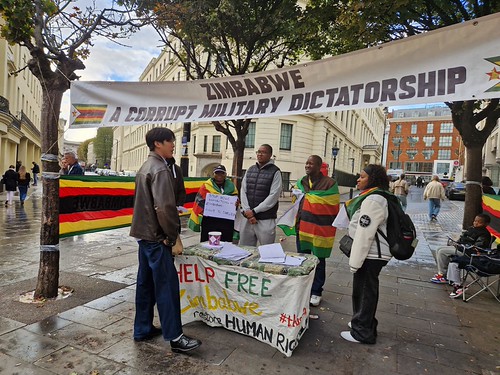
Once again Vigil activists met outside the Zimbabwe Embassy in London to continue our protest against the human rights abuse and lack of democracy in Zimbabwe perpetrated by ZANU PF, the ruling regime. https://www.flickr.com/photos/zimbabwevigil/55598984896/sizes/m/ A special thank you to Tatenda Tsumba who brought the Vigil table, register, banners and posters. Thanks also to the others […]

The post Zimbabwe Vigil Diary 17th October 2026 appeared first on Zimbabwe Situation.

Once again Vigil activists met outside the Zimbabwe Embassy in London to continue our protest against the human rights abuse and lack of democracy in Zimbabwe perpetrated by ZANU PF, the ruling regime.

https://www.flickr.com/photos/zimbabwevigil/55598984896/sizes/m/ A special thank you to Tatenda Tsumba who brought the Vigil table, register, banners and posters. Thanks also to the others who came today: Blessing Harry, Jonathan Kariwo, Philip Maponga, Tatenda Nyakudziwanza, Rumbidzai Nzvere and Talent Tsatse.

Photos: https://www.flickr.com/photos/zimbabwevigil/albums/72177720336248304/. Vigil activist Mazvita Shoniwa comments: The Zimbabwe “Patriotic Act” and what It means to civic activists with Restoration of Human Rights (ROHR) and the Zimbabwe Vigil

On 14 July 2023, President Emmerson Mnangagwa signed into law the Criminal Law (Codification and Reform) Amendment Act—commonly known as the “Patriotic Act.” The law criminalises certain meetings or communications between Zimbabwean citizens and foreign representatives where sanctions, military intervention or the overthrow of the Government are allegedly discussed. On paper, it claims to protect Zimbabwe’s sovereignty. In practice, its broad wording risks turning legitimate civic engagement into a suspected crime. As a civic activist, my role is to advocate for fellow Zimbabweans on issues that oppress them.

This may require speaking to journalists, diplomats, human-rights organisations and international institutions. But when phrases such as “injuring the national interest” are open to wide interpretation, how can activists know when lawful advocacy might be labelled unpatriotic? Zimbabwe’s Constitution guarantees freedom of expression, including the right to seek, receive and communicate ideas. Yet a right written on paper means little when citizens are afraid to exercise it.

The greatest danger of this law may not be prosecution alone—it is the silence created by fear. When activists must measure every sentence, fear every meeting and reconsider every international conversation, freedom of speech has already been weakened. Criticising a government is not betraying a country. Government and country are not the same thing. Speaking about corruption, injustice or human-rights abuses is not an attack on Zimbabwe—it is a demand for Zimbabwe to do better. True patriotism is not blind loyalty to those in power. It is the courage to defend the people and demand accountability. Every 14 July, we must therefore ask: Does this law truly protect Zimbabwe—or does it protect those governing it from the voices of Zimbabweans?

For Vigil pictures check: http://www.flickr.com/photos/zimbabwevigil/. Please note: Vigil photos can only be downloaded from our Flickr website. Events and Notices: • Next Vigil meeting outside the Zimbabwe Embassy. Saturday 7th November from 2 – 5 pm. We meet on the first and third Saturdays of every month. On other Saturdays the virtual Vigil will run. • The Restoration of Human Rights in Zimbabwe (ROHR) is the Vigil’s partner organisation based in Zimbabwe. ROHR grew out of the need for the Vigil to have an organisation on the ground in Zimbabwe which reflected the Vigil’s mission statement in a practical way.

ROHR in the UK actively fundraises through membership subscriptions, events, sales etc to support the activities of ROHR in Zimbabwe. • The Vigil’s book ‘Zimbabwe Emergency’ is based on our weekly diaries. It records how events in Zimbabwe have unfolded as seen by the diaspora in the UK. It chronicles the economic disintegration, violence, growing oppression and political manoeuvring – and the tragic human cost involved. It is available at the Vigil. All proceeds go to the Vigil and our sister organisation the Restoration of Human Rights in Zimbabwe’s work in Zimbabwe.

The book is also available from Amazon. • Facebook pages: • Vigil : https ://www.facebook.com/zimbabwevigil • ROHR: https://www.facebook.com/Restoration-of-Human-Rights-ROHR-Zimbabwe-International-370825706588551/ The Vigil, outside the Zimbabwe Embassy, 429 Strand, London meets regularly on Saturdays from 14.00 to 17.00 to protest against gross violations of human rights in Zimbabwe. The Vigil which started in October 2002 will continue until internationally-monitored, free and fair elections are held in Zimbabwe.

Source: Zimbabwe Vigil Diary 17th October 2026

The post Zimbabwe Vigil Diary 17th October 2026 appeared first on Zimbabwe Situation.