People-driven change and democratic renewal is happening in Zimbabwe – Zimbabwe News Now

AS WE look on at the disastrous Constitution of Zimbabwe (Amendment) Act (No. 3), 2026 project, the theatric Zanu Conference, the zviganada phenomenon and the reported King Munhumutapa prospect, it is necessary to unpack how Zimbabwe’s democratic governance crisis actually manifests and affects ordinary citizens and how Zimbabweans themselves are slowly and quietly reclaiming their […]

The post People-driven change and democratic renewal is happening in Zimbabwe – Zimbabwe News Now appeared first on Zimbabwe Situation.

AS WE look on at the disastrous Constitution of Zimbabwe (Amendment) Act (No. 3), 2026 project, the theatric Zanu Conference, the zviganada phenomenon and the reported King Munhumutapa prospect, it is necessary to unpack how Zimbabwe’s democratic governance crisis actually manifests and affects ordinary citizens and how Zimbabweans themselves are slowly and quietly reclaiming their power back in ways that are not so apparent.

The governance crises manifest in several profound ways.

The first is the struggle to get a job, put food on the table, pay rent, send kids to school, makes ends meet.

The second is in subjecting the entire struggling and impoverished country to a daily unending menu of opulence and decadence and nauseating splurge by a small political and economic elite that has captured the state and its treasury.

The third is the youth unemployment, drugs and alcohol crisis affecting young people in both rural and urban areas.

The fourth is the gold mining crisis (driven by predatory elites) across the entire country: the unavoidable lure of the dangerous makorokodza/gweja phenomenon, its destruction of the rural landscape including grazing and farming, its environmental degradation, its exploitative and risky nature for young people and the exploitation of young adolescent women it promotes. In essence, it’s destruction of rural life as we know it.

The fifth is the economically exploitative and environmentally destructive Chinese mining model, the corrupt alliances it has with political leaders. The excavation of mountains, historical and ancestral sites, the ecological damage to rivers and river basins, the permanent disruption of waterways and water security, the gaping holes it leaves across the entire country dangerous for humans and livestock.

The sixth is a State that is completely absent when it comes to providing services (health, water, electricity, education, education) and omnipresent when it comes to suppressing fundamental freedoms, and corruptly extracting rents from all national and local economic activity and plundering the treasury.

Naming or identifying the problem is one thing, but “what is to be done” as Lenin asked in 1901?

It is time the approach to the country’s democratic deficits changed and shifted from an assumption of a silver political bullet that expects the solution to people’s problems to come from the same politicians who have caused them.

History has shown that it is Zanu PF politicians that have been the root and cause of all these problems. The assumption that the same Zanu PF politicians and their oligarch allies that have impoverished Zimbabweans and continue to corruptly empty the treasury and fill their private bank accounts instead of fixing roads, hospitals, electricity, water, education etc can and will fix them is misplaced. So is the long held assumption that one simply has to replace Zanu PF with the opposition for Zimbabwe’s problems to be solved. This false logic has shaped the nature of political contestation in Zimbabwe for far too long. It has been a gross error for people to expect politicians to solve the same problems they have caused. There has to be a new approach:

In the democratic governance crisis, there is no doubt that a shift in political leadership remains key. Zimbabwe needs leaders who care about the people, leaders who are there to serve the people and who are not there to serve themselves. The current political system that priorities pillaging of public resources and primitive accumulation by a handful has to be appended and overthrown. This is non-negotiable. This predatory political system is incapable to ensuring that the state is positively present in people’s lives, delivers health, education, electricity, water and other services, because it sees the state as being solely for its own interests, benefit and enrichment.

The destructive nature of mining is intrinsically linked to the governance model that sees communities (rural and urban) solely as sites of exploration and extraction. So the solution to this problem also lies in disruption of the existing corrupt, predatory and exploitative zviganada governance model.

But it does not end there. For far too long Zimbabweans have essentialised politics as the one and only avenue and vehicle for economic transformation. Whilst the nature and type of politics undoubtedly determines the type of economics and development in any country, society and community, politics is not the only thing that shapes economic development. People do. With or without politicians. Sometimes people must counter or work around politicians.

Zimbabwe and indeed other countries are littered with examples of people taking charge of their own local economic development. People deciding to sidestep and ignore politicians, people and communities coming together to collectively agree on the most pressing priorities and agreeing on plans to collectively address them. From village to district to town, communities have come together to fix roads, build dams, clinics, schools, drill boreholes, establish community and neighborhood watch and safety units and drive anti-drug and anti-alcohol campaigns that centre alternatives and recreation for young people. Zimbabweans across the world are investing time, money, collective effort, in their own local areas.

In places like Tsholotsho the local community has come together to repair 60km of the Siphepha-Zabagwadi Road and in Nyabane, Plumtree, the local community has teamed up with diaspora to build a clinic that provides free health care.

There’s good news. Much of what needs to shift is already shifting – quietly, significantly, irreversibly. The absent predatory state, and the pernicious and exploitative nature of its key actors has driven people and communities to look inward for solutions. That process itself has been a process of democratic renewal. A rediscovering of new forms of organising and participation that are directly linked to tangible local economic development outcomes. The orientation maybe economic but the proceeses are democratic.

Across the breath and scope of the country examples abound of people democratically harnessing the collective power of the local and diaspora communities to organise, plan, act together to bring back local economic development to their local areas or communities. The power of technology cannot be understated here.

People are reclaiming their power in far more profound and meaningful ways that bring tangible change to their own lives. They may not be on the streets protesting but they are on social media- identifying, discussing organising to fix real problems, mobilising financial and other resources from across the globe for their communities. This is a welcome shift in democratic participation. It anchors change in local participation, self-action and local development activism. It is not a replacement of national political engagement but a crucial reconfiguration of politics as we have always known it. It is also a crucial building block to what can become a new new national politics. It negates political polarisation, promotes collaboration, and essentialises economic transformation.

It rightly can, should and will redefine politics going forward. Local leaders emerge from these processes – inside the country and in the diaspora. Local economies are revitalised bringing new meaning to impactful democratic participation. Local pride and self worth recultivated. Local agency rebuilt. New sites and forms of resistance to pernicious and extractive elites mobilized. It is a model that must be supported and encouraged. It is a model that can and should outlive the defunct national politics that must be permanently eliminated.

So to conclude – the most significant political and economic change happening across Zimbabwe is invisible to the naked eye but profoundly tangible to the people driving and experiencing its impact.

Siphosami Malunga is a human rights lawyer

Source: People-driven change and democratic renewal is happening in Zimbabwe – Zimbabwe News Now

The post People-driven change and democratic renewal is happening in Zimbabwe – Zimbabwe News Now appeared first on Zimbabwe Situation.

Zimbabwe Vigil Diary 17th October 2026

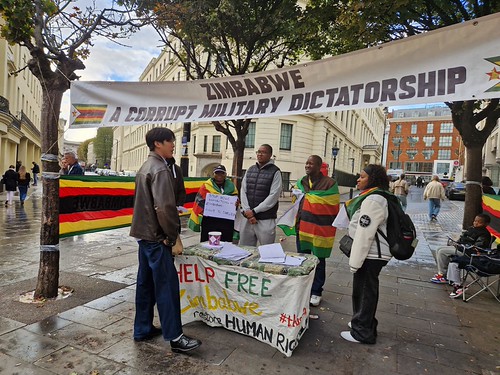
Once again Vigil activists met outside the Zimbabwe Embassy in London to continue our protest against the human rights abuse and lack of democracy in Zimbabwe perpetrated by ZANU PF, the ruling regime. https://www.flickr.com/photos/zimbabwevigil/55598984896/sizes/m/ A special thank you to Tatenda Tsumba who brought the Vigil table, register, banners and posters. Thanks also to the others […]

The post Zimbabwe Vigil Diary 17th October 2026 appeared first on Zimbabwe Situation.

Once again Vigil activists met outside the Zimbabwe Embassy in London to continue our protest against the human rights abuse and lack of democracy in Zimbabwe perpetrated by ZANU PF, the ruling regime.

https://www.flickr.com/photos/zimbabwevigil/55598984896/sizes/m/ A special thank you to Tatenda Tsumba who brought the Vigil table, register, banners and posters. Thanks also to the others who came today: Blessing Harry, Jonathan Kariwo, Philip Maponga, Tatenda Nyakudziwanza, Rumbidzai Nzvere and Talent Tsatse.

Photos: https://www.flickr.com/photos/zimbabwevigil/albums/72177720336248304/. Vigil activist Mazvita Shoniwa comments: The Zimbabwe “Patriotic Act” and what It means to civic activists with Restoration of Human Rights (ROHR) and the Zimbabwe Vigil

On 14 July 2023, President Emmerson Mnangagwa signed into law the Criminal Law (Codification and Reform) Amendment Act—commonly known as the “Patriotic Act.” The law criminalises certain meetings or communications between Zimbabwean citizens and foreign representatives where sanctions, military intervention or the overthrow of the Government are allegedly discussed. On paper, it claims to protect Zimbabwe’s sovereignty. In practice, its broad wording risks turning legitimate civic engagement into a suspected crime. As a civic activist, my role is to advocate for fellow Zimbabweans on issues that oppress them.

This may require speaking to journalists, diplomats, human-rights organisations and international institutions. But when phrases such as “injuring the national interest” are open to wide interpretation, how can activists know when lawful advocacy might be labelled unpatriotic? Zimbabwe’s Constitution guarantees freedom of expression, including the right to seek, receive and communicate ideas. Yet a right written on paper means little when citizens are afraid to exercise it.

The greatest danger of this law may not be prosecution alone—it is the silence created by fear. When activists must measure every sentence, fear every meeting and reconsider every international conversation, freedom of speech has already been weakened. Criticising a government is not betraying a country. Government and country are not the same thing. Speaking about corruption, injustice or human-rights abuses is not an attack on Zimbabwe—it is a demand for Zimbabwe to do better. True patriotism is not blind loyalty to those in power. It is the courage to defend the people and demand accountability. Every 14 July, we must therefore ask: Does this law truly protect Zimbabwe—or does it protect those governing it from the voices of Zimbabweans?

For Vigil pictures check: http://www.flickr.com/photos/zimbabwevigil/. Please note: Vigil photos can only be downloaded from our Flickr website. Events and Notices: • Next Vigil meeting outside the Zimbabwe Embassy. Saturday 7th November from 2 – 5 pm. We meet on the first and third Saturdays of every month. On other Saturdays the virtual Vigil will run. • The Restoration of Human Rights in Zimbabwe (ROHR) is the Vigil’s partner organisation based in Zimbabwe. ROHR grew out of the need for the Vigil to have an organisation on the ground in Zimbabwe which reflected the Vigil’s mission statement in a practical way.

ROHR in the UK actively fundraises through membership subscriptions, events, sales etc to support the activities of ROHR in Zimbabwe. • The Vigil’s book ‘Zimbabwe Emergency’ is based on our weekly diaries. It records how events in Zimbabwe have unfolded as seen by the diaspora in the UK. It chronicles the economic disintegration, violence, growing oppression and political manoeuvring – and the tragic human cost involved. It is available at the Vigil. All proceeds go to the Vigil and our sister organisation the Restoration of Human Rights in Zimbabwe’s work in Zimbabwe.

The book is also available from Amazon. • Facebook pages: • Vigil : https ://www.facebook.com/zimbabwevigil • ROHR: https://www.facebook.com/Restoration-of-Human-Rights-ROHR-Zimbabwe-International-370825706588551/ The Vigil, outside the Zimbabwe Embassy, 429 Strand, London meets regularly on Saturdays from 14.00 to 17.00 to protest against gross violations of human rights in Zimbabwe. The Vigil which started in October 2002 will continue until internationally-monitored, free and fair elections are held in Zimbabwe.

Source: Zimbabwe Vigil Diary 17th October 2026

The post Zimbabwe Vigil Diary 17th October 2026 appeared first on Zimbabwe Situation.

Did African leaders fight colonialism to create personal kingdoms?

There is something troubling about our motherland. When African liberation movements waged bitter, bloody struggles against European colonial powers in the mid-twentieth century, the promise made to millions was unequivocal.   To directly receive my articles please join my WhatsApp Channel on: https://whatsapp.com/channel/0029VaqprWCIyPtRnKpkHe08   Self-determination, constitutional democracy, and an end to ruler-and-subject tyranny.    Men […]

The post Did African leaders fight colonialism to create personal kingdoms? appeared first on Zimbabwe Situation.

There is something troubling about our motherland.

When African liberation movements waged bitter, bloody struggles against European colonial powers in the mid-twentieth century, the promise made to millions was unequivocal.  

To directly receive my articles please join my WhatsApp Channel on: https://whatsapp.com/channel/0029VaqprWCIyPtRnKpkHe08  

Self-determination, constitutional democracy, and an end to ruler-and-subject tyranny.    Men and women marched into the bush under the banner of sovereign republics, where power would belong to the electorate, not a ruling dynasty.    Decades later, a bitter historical irony confronts the continent.   Did the founding fathers and their successors sacrifice so much to end European imperial rule only to build private family fiefdoms on its ashes?  

Across the continent, constitutional democracy is increasingly treated as a inconvenient formality.    In nation after nation, long-serving presidents have stripped away term limits, hollowed out judiciaries, and converted state security organs into family guards.    Equatorial Guinea remains under the iron grip of Teodoro Obiang Nguema Mbasogo, who has groomed his son, Teodorin, to inherit the state apparatus alongside its immense oil wealth.   

In Togo, Faure Gnassingbé inherited power directly after his father’s 38-year rule, proving that the hereditary transmission of power can be successfully operationalized in a nominal republic.   Where political office is not handed over outright, the military is deployed to enforce bloodline continuity.    In Chad, the sudden death of Idriss Déby saw constitutional succession discarded instantly so his son, General Mahamat Déby, could seize the helm.   

In Uganda, Yoweri Museveni’s son, General Muhoozi Kainerugaba, openly uses his military authority to post campaign manifestos on social media, positioning himself as heir apparent while the regime suppresses opposition figures.    From Congo-Brazzaville to Gabon—where the Bongo dynasty ruled for over five decades before a palace coup finally disrupted the sequence—republican institutions have been systematically transformed into ancestral properties.   This toxic feudal drift is no longer confined to overt dictatorships; it is creeping into nations with rich histories of constitutional struggle.   

In Zimbabwe, where liberation fighters defeated colonial rule under the promise of one person, one vote, alarming rhetoric has surfaced from political sycophants and party ideologues.    Proposals are openly floated suggesting the country shed its republican constitutional framework in favor of an “indigenous consultative democracy”—a thinly veiled euphemism for establishing a formal monarchy.    Sycophantic quarters have actively championed declaring President Emmerson Mnangagwa as the modern “Munhumutapa,” seeking to wrap personal lifetime tenure in the sacred mythology of the ancient pre-colonial empire.  

The official gazetting of the sitting president’s birthday as ‘Munhumutapa Day’ into law, alongside the sweeping constitutional amendments enacted to extend presidential tenure, signals a dangerous ideological shift.   By dressing up personalized rule in the robes of pre-colonial royal heritage, regime apologists attempt to dismiss constitutional democracy as an imported Western imposition.    Yet, this feudal revisionism fundamentally betrays the liberation struggle itself.    The brave men and women who died fighting colonial rule did not shed their blood so that one ruling family or faction could claim divine right over the republic’s wealth and laws.   The motivation behind this surge in hereditary governance is simple: fear and greed.   

Having spent decades entrenching state capture, looting national resources, and neutralizing democratic checks, autocratic elites fear life after office.    Relinquishing power to an independent successor carries the terrifying risk of prosecution, asset forfeiture, or exile.    Handing the keys of the treasury and the armed forces to a son, daughter, or designated proxy is viewed as the ultimate life insurance policy for an incumbent regime.   Africa’s struggle for independence was an anti-feudal, anti-authoritarian moral crusade.   

The transformation of sovereign republics into hereditary monarchies under the guise of Pan-Africanism or traditional preservation is a profound desecration of that legacy.    A true republic is built around the dignity and sovereignty of the citizen; a kingdom is built around the appetite of the ruler.    Until citizens reject the myth that tyrannical rule becomes acceptable under the guise of political patronage, the true promises of the liberation struggle cannot be realized.    Only when political accountability takes precedence over blind loyalty will sovereign republics finally belong to their people.  

Tendai Ruben Mbofana is a social justice advocate and writer. Please feel free to contact him on +263715667700 or mbofana.tendairuben73@gmail.com

Source: Did African leaders fight colonialism to create personal kingdoms?

The post Did African leaders fight colonialism to create personal kingdoms? appeared first on Zimbabwe Situation.

What the Wicknell-Sugar Sugar controversy teaches us: a gift may not actually be legally yours

There are always teachable moments in life. The ongoing drama surrounding sungura musician Sugar Sugar and the Toyota Fortuner handed to him by the late tenderpreneur Wicknell Chivayo has gripped the Zimbabwean public.   To directly receive my articles please join my WhatsApp Channel on: https://whatsapp.com/channel/0029VaqprWCIyPtRnKpkHe08    The hitmaker revealed that he does not hold […]

The post What the Wicknell-Sugar Sugar controversy teaches us: a gift may not actually be legally yours appeared first on Zimbabwe Situation.

There are always teachable moments in life.

The ongoing drama surrounding sungura musician Sugar Sugar and the Toyota Fortuner handed to him by the late tenderpreneur Wicknell Chivayo has gripped the Zimbabwean public.  

To directly receive my articles please join my WhatsApp Channel on: https://whatsapp.com/channel/0029VaqprWCIyPtRnKpkHe08   

The hitmaker revealed that he does not hold the registration book for the vehicle and claimed he was asked to return it because the purchase price was never settled with the supplying dealership.    While car dealers involved have clarified the state of affairs regarding unpaid debts left behind as Chivayo’s estate is finalised, the situation exposes a sobering reality.   

Many people who receive lavish presents operate under the dangerous assumption that physical possession automatically equals legal ownership.   Under Roman-Dutch common law, a gift is legally classified as a donation.    While anyone is free to give away property, the law strictly enforces the principle of nemo dat quod non habet, meaning no one can transfer a better title to property than they themselves hold.   

If a donor acquired a car, house, or land on credit, under an installment plan, or through a contract with a reservation of ownership clause, the seller retains title until the final cent is paid.    A donor who does not fully own an asset cannot legally give it away.    Furthermore, when a donor passes away or faces insolvency, creditors are protected under insolvency law.   

Transactions involving unpaid liabilities or gifts made when a donor was accumulating massive debts can be reviewed or set aside by executors and liquidators to satisfy outstanding obligations.   This brings us to a fundamental question that affects many recipients of high-value gifts.   Without formal proof of ownership, can an asset like a car or a house be considered legally yours?    The plain answer is no.    Merely holding the keys, driving a car, or living inside a house does not confer civil title.   

In Zimbabwe, even a motor vehicle registration book carries a explicit disclaimer stating that it is an administrative document rather than absolute proof of legal ownership.    Being named on the logbook establishes accountability for traffic licensing and police checks, but it does not override civil property rights.    For real estate, the law under the Deeds Registries Act is even more uncompromising, as legal ownership of immovable property transfers strictly upon formal registration of a Title Deed at the Deeds Registry.   

Until that document is endorsed in your name, the house legally belongs to the registered titleholder or their estate, regardless of any verbal assurances or ceremonial handovers.   To make a gift legally unassailable and protect it from repossession, debt recovery, or to ensure you can lawfully sell it, the transaction must undergo formal perfection.    For a motor vehicle, this requires a clear paper trail showing full financial settlement from the seller, a written contract of donation, ZRP clearance, and the completion of official Central Vehicle Registry transfer procedures.   

For houses, it requires conveyancing by a registered legal practitioner, payment of Capital Gains Tax to secure a ZIMRA clearance certificate, local authority rates clearances, and the issuance of a new Title Deed.    For exceptionally valuable gifts, executing a Notarial Deed of Donation registered with the Deeds Office provides public legal proof that a genuine, irrevocable gift was completed while the donor was solvent.  

This Sugar Sugar controversy carries lessons that extend far beyond public figures or high-profile tenderpreneurs.    We see similar informal gifting in intimate relationships, where spouses, lovers, or romantic partners present each other with cars, land, or residential properties.    Partners frequently accept these gifts without demanding proper legal paperwork out of trust or fear of appearing ungrateful.    The dangers of doing so are severe.   If a relationship sours, the partner who retained the title deed or ownership documentation in their own name or company name can simply repossess the vehicle or evict the other.   

If the gifting partner unexpectedly passes away, their surviving family or estate executors will act strictly according to the law.    Informal gifts lacking updated ownership documentation or deeds will be treated as part of the deceased person’s estate and reclaimed to pay off debts or distribute to legal heirs.    Additionally, if a partner incurs commercial liabilities or tax arrears, court sheriffs can attach and auction assets registered in their name, even if a lover has been driving or living there for years.   To protect ourselves, we must approach high-value gifts with legal clarity rather than sentimentality.    Never rely on promises that papers will be updated later, and demand immediate formal transfer of the logbook or Title Deed into your personal name.    Before accepting major assets, confirm that the purchase was fully settled and free from bank floorplan liens or corporate encumbrances.   

For relationships outside of formal marriage, partners should execute a signed, written Agreement of Gift drafted by a legal practitioner.    In civil marriages, structuring asset ownership through clear marital property contracts prevents personal gifts from being consumed by a spouse’s business debts.    Where you contribute financially toward a gifted asset, keep thorough records of bank transfers and receipts to preserve your legal claim.   A gift wrapped in ceremony but stripped of legal paperwork is not a blessing.   But a borrowed luxury waiting to be reclaimed.  

Tendai Ruben Mbofana is a social justice advocate and writer. Please feel free to contact him on +263715667700 or mbofana.tendairuben73@gmail.com

Source: What the Wicknell-Sugar Sugar controversy teaches us: a gift may not actually be legally yours

The post What the Wicknell-Sugar Sugar controversy teaches us: a gift may not actually be legally yours appeared first on Zimbabwe Situation.

Beyond South Africa’s Economic Shadow: How Zimbabwe, Zambia and Malawi Can Build a New African Industrial Powerhouse Within COMESA

Southern Africa has an economic geography problem that has persisted for more than six decades. Zimbabwe, Zambia and Malawi possess complementary resources, established commercial relationships, agricultural potential, industrial capabilities and a considerable reservoir of human capital. Yet their economies remain less integrated than their geography would suggest. They trade with one another, but they have […]

The post Beyond South Africa’s Economic Shadow: How Zimbabwe, Zambia and Malawi Can Build a New African Industrial Powerhouse Within COMESA appeared first on The Zimbabwe Mail.

Southern Africa has an economic geography problem that has persisted for more than six decades. Zimbabwe, Zambia and Malawi possess complementary resources, established commercial relationships, agricultural potential, industrial capabilities and a considerable reservoir of human capital. Yet their economies remain less integrated than their geography would suggest. They trade with one another, but they have not sufficiently organised themselves into a single competitive production space capable of challenging the industrial advantages enjoyed by much larger economies.

By Brighton Musonza | Business and Economic Analyst

The consequences are visible in almost every sector. A Zimbabwean manufacturer seeking to expand production frequently confronts a domestic market too small to justify investment in modern machinery. A Zambian copper producer may export raw or partly processed minerals while importing sophisticated equipment from overseas. A Malawian agricultural processor faces similar difficulties achieving the volumes necessary to compete with established international suppliers. Meanwhile, South African businesses, supported by a larger domestic market, deeper financial institutions and extensive distribution networks, are better positioned to serve all three countries.

This is not simply a story about South Africa’s economic dominance. It is a story about the failure of neighbouring countries to organise their markets in ways that allow their own industries to grow.

As I previously discussed with Zimbabwean industrialist Busisa Moyo, the central challenge is not necessarily the absence of productive capacity. It is the fragmentation of demand, investment and infrastructure across national borders.

The solution requires a different understanding of regional integration. Africa does not become economically integrated merely because governments sign trade agreements or presidents attend regional summits. Integration becomes meaningful when a manufacturer can produce in Harare, source components from Lusaka, finance the transaction through a regional bank and sell the finished product in Lilongwe, Nairobi or Kampala without confronting a succession of unnecessary administrative and financial obstacles.

The opportunity now lies in transforming Zimbabwe, Zambia and Malawi from neighbouring national markets into interconnected centres of production serving a much wider African economy.

The federation’s economic legacy — and its political contradictions

Between 1953 and 1963, Southern Rhodesia, Northern Rhodesia and Nyasaland formed the Federation of Rhodesia and Nyasaland, commonly known as the Central African Federation.

The arrangement brought together territories with different economic strengths. Southern Rhodesia possessed a comparatively developed manufacturing sector, commercial agriculture, transport infrastructure and administrative institutions. Northern Rhodesia’s copper industry generated substantial export earnings, while Nyasaland supplied agricultural production and labour to the wider regional economy.

In economic terms, the federation attempted to organise these territories around a larger market, shared infrastructure and coordinated development.

Railways, electricity systems, financial institutions and commercial networks operated across territorial boundaries. The Kariba hydroelectric project, developed during the federation era, remains one of the most enduring examples of cross-border infrastructure connecting what became Zimbabwe and Zambia.

The larger economic space also created opportunities for industrial specialisation and investment that would have been more difficult to sustain within three isolated markets.

But it would be historically misleading to romanticise the federation as an equitable model of African economic cooperation.

Its political institutions were dominated by white settler interests, while African populations were denied meaningful political representation. Economic development was unevenly distributed, and the allocation of investment and resources reflected profound inequalities of political power.

Northern Rhodesian and Nyasaland African nationalists opposed the arrangement partly because they regarded it as an instrument of Southern Rhodesian settler influence.

The federation’s dissolution in 1963 was therefore not simply an economic setback. It was also part of the wider struggle for political self-determination.

The lesson for contemporary policymakers is not that the federation should have survived. It is that independent African states have yet to reproduce some of the economic benefits of regional scale within a framework of democratic sovereignty and mutually beneficial development.

Political independence was essential. Economic fragmentation was not inevitable.

Why market size determines industrial competitiveness

Economies of scale are among the most important principles in industrial economics.

A manufacturing business typically incurs substantial fixed costs before producing its first unit. These include factory buildings, machinery, engineering systems, research, quality certification and management infrastructure.

When output increases, those fixed costs can be spread across a larger number of products, reducing average production costs until the enterprise approaches its efficient operating scale.

Consider a simplified example.

Suppose a Zimbabwean food processor invests US$10 million in a modern production facility and incurs US$2 million annually in fixed operating costs.

If it produces five million units annually, the fixed operating cost alone amounts to US$0.40 per unit. At 20 million units, that cost falls to US$0.10.

The difference is commercially decisive in industries where retailers and consumers are highly sensitive to price.

A manufacturer serving only Zimbabwe’s domestic market may struggle to achieve the necessary sales volume. But the same factory, serving Zimbabwe, Zambia, Malawi and selected COMESA markets, could operate at a much more competitive scale.

The illustration is simplified; actual costs also depend on transport, energy, labour productivity, capacity utilisation and the cost of capital. Nevertheless, it demonstrates why market integration is an industrial policy instrument rather than merely a diplomatic aspiration.

South African manufacturers have historically benefited from a larger domestic consumer base and more developed supplier networks. Their advantage is reinforced by cumulative investment, stronger logistics systems and access to relatively sophisticated financial services.

Zimbabwe, Zambia and Malawi cannot overcome those structural advantages through import restrictions alone.

They must create conditions in which their own firms can achieve competitive production volumes, attract investment and specialise in products where they possess genuine economic advantages.

COMESA offers a market larger than any national economy

The Common Market for Eastern and Southern Africa provides an institutional foundation for this transformation.

With 21 member states stretching across Eastern, Central, Southern and parts of North Africa, COMESA connects economies with substantial populations, mineral resources, agricultural production and expanding consumer markets.

Its headquarters in Lusaka gives Zambia an important institutional role in regional economic coordination.

Zimbabwe’s membership places it within a trading arrangement that extends far beyond its immediate neighbours.

The strategic significance is considerable.

A Zimbabwean manufacturer need not think exclusively in terms of the country’s domestic purchasing power. It can develop products, pricing strategies and distribution systems around access to a broader regional market.

But membership alone does not guarantee unrestricted trade. Rules of origin, national tariff schedules, non-tariff barriers, transport costs and overlapping regional agreements continue to shape the actual conditions under which goods move.

The practical challenge is to convert COMESA’s institutional framework into measurable commercial opportunities.

For example, a Zimbabwean agricultural equipment manufacturer could develop distribution partnerships in Zambia, Malawi, Kenya and Uganda. A local pharmaceutical company could pursue regional regulatory approvals and expand production volumes. A packaging producer could supply food processors operating across several member states.

Such opportunities are commercially plausible, but they require more than tariff preferences.

They require dependable transport, affordable trade finance, recognised product standards and enforceable commercial contracts.

The market must become accessible in practice, not merely large on paper.

From trade agreements to functioning regional markets

There is an important difference between a free trade area, a customs union and a fully functioning common market.

A free trade area reduces or removes tariffs on qualifying goods traded among participating countries. A customs union adds a common external tariff, while a common market goes further by facilitating the movement of capital, services, labour and investment.

COMESA established its free trade area in 2000, but its customs union has not become fully operational. Its members also participate in other regional arrangements, creating overlapping obligations and opportunities.

The objective should therefore be to make existing agreements commercially useful before announcing another ambitious integration project.

A company exporting electrical equipment from Zimbabwe to Zambia should be able to establish its tariff treatment before the goods leave the factory. A Malawian food processor should not need to obtain substantially different laboratory certifications for every neighbouring market. A regional trucking company should not encounter unpredictable transit procedures each time its vehicles cross a border.

These are not minor administrative inconveniences. They are costs that ultimately appear in the price of manufactured goods.

The World Bank’s 2026 analysis of African integration makes precisely this broader point: fragmented customs procedures, transport regulations, standards and payment systems can prevent regional agreements from producing meaningful commercial integration.

For Zimbabwe, the question is how to turn preferential market access into actual exports.

Building a regional industrial system around complementary strengths

The three former federation economies need not reproduce the industrial structures of the 1950s. Their comparative advantages have evolved, and a modern regional economy should be organised around competitive specialisation rather than political centralisation.

Zimbabwe has established capabilities in food processing, metal fabrication, packaging, chemicals, engineering services, commercial agriculture and financial services. Zambia possesses substantial copper resources, mining-related industrial demand and growing opportunities in energy and agricultural processing. Malawi has considerable agricultural potential, particularly in crops that can support food processing, textiles and other downstream industries.

These strengths could form the basis of cross-border value chains.

Consider the copper industry. Zambia is a major copper producer, while Zimbabwe has experience in engineering, metalworking and industrial manufacturing. Rather than treating copper solely as an export commodity, businesses could examine opportunities to produce electrical cables, transformers, industrial motors, switchgear and other equipment for regional infrastructure projects.

Such investment would require detailed feasibility studies. The presence of copper deposits does not automatically make downstream manufacturing competitive. Energy costs, technology, production volumes, capital requirements and access to customers all matter.

But the strategic opportunity is clear: a region that produces critical industrial minerals should examine how much additional value it can capture before those materials leave Africa.

Agriculture offers another possibility.

Malawi could supply selected agricultural inputs to processors in Zimbabwe and Zambia, while regional manufacturers produce packaging, machinery, fertiliser and irrigation equipment. Finished products could then be distributed across COMESA markets.

The goal is not to allocate industries artificially among countries. It is to allow firms to locate different activities where they can be performed most efficiently while retaining access to a larger market.

This is how competitive production networks develop.

Zimbabwe’s manufacturing opportunity extends beyond its borders

Zimbabwe’s industrial recovery cannot be sustained by domestic demand alone.

A factory built to supply only Harare and Bulawayo may struggle to compete with imports manufactured for markets many times larger. Its machinery may operate below capacity, while fixed costs are spread across relatively few products.

Regional exports can change that calculation.

The country’s food manufacturers offer an obvious starting point. Businesses such as National Foods, Dairibord and Cairns operate in product categories where regional demand, distribution efficiency and brand recognition can support expansion.

But market entry must be based on commercial realities.

A Zimbabwean biscuit manufacturer cannot assume that consumers in Kenya or Malawi will purchase its products merely because the countries belong to the same trading bloc. It must compete on quality, price, packaging, distribution and consistency of supply.

Similarly, a Zimbabwean pharmaceutical producer seeking regional sales would need appropriate manufacturing standards, regulatory approvals and reliable access to inputs.

Government can assist by negotiating mutual recognition arrangements, improving border efficiency and supporting export promotion. It should not attempt to substitute political declarations for customer demand.

The central objective is to move Zimbabwean industry from import substitution towards export competitiveness.

Import substitution may provide an initial market for local producers. But without competition and access to larger markets, protected industries can become expensive, inefficient and dependent on continued government intervention.

An export-oriented manufacturing strategy imposes a different discipline: firms must produce goods that customers outside Zimbabwe are willing to buy at competitive prices.

That is the foundation of sustainable industrialisation.

Energy integration may be more important than tariff reductions

No serious industrial strategy can ignore electricity.

Manufacturers require reliable energy not only to operate machinery but also to maintain quality, manage production schedules and fulfil delivery commitments.

Electricity shortages impose costs through interrupted production, diesel generation, equipment damage and lost sales.

Zimbabwe and Zambia already share the Kariba hydroelectric system, but their exposure to drought illustrates the danger of relying too heavily on a limited set of generation sources.

A more resilient regional energy system would combine hydroelectricity with solar, thermal generation where economically justified, storage and stronger cross-border transmission infrastructure.

Regional electricity trade could allow countries to purchase power from neighbouring systems when it is cheaper or more reliable than domestic alternatives.

This is particularly relevant to industrial investment.

A factory’s competitiveness depends on the cost and reliability of electricity over many years. Investors therefore examine energy supply before committing capital to large manufacturing projects.

Zimbabwe, Zambia and Malawi should treat regional electricity integration as an industrial development priority, not merely a response to temporary power shortages.

Joint planning of transmission infrastructure, generation capacity and industrial demand could produce benefits that isolated national investments cannot achieve.

The Southern African Power Pool already provides an institutional platform for electricity cooperation. The challenge is to strengthen the infrastructure, market rules and financial arrangements needed to translate that cooperation into reliable industrial power.

Trade corridors should connect factories, not merely ports

Regional integration is often discussed in terms of roads, railways and border posts. Yet the commercial purpose of infrastructure is frequently overlooked.

A transport corridor is valuable because it connects production centres to suppliers, customers and ports.

For Zimbabwe, Zambia and Malawi, the relevant geography extends in several directions.

The North–South Corridor links Southern African economies through major road and rail routes. The Beira Corridor connects Zimbabwe and neighbouring markets to Mozambique’s coast. The Nacala Corridor provides another important route serving Malawi and extending towards Zambia.

The World Bank identifies the North–South and Nacala corridors among Africa’s priority regional connectivity systems.

These routes should be understood as potential industrial corridors.

A modern freight system connecting Harare, Lusaka, Lilongwe and the Mozambican ports could support manufacturers that source inputs in one country, process them in another and distribute finished products across the region.

However, physical infrastructure alone is insufficient.

Border delays, inconsistent vehicle regulations, fragmented customs documentation and unpredictable transit charges can undermine the benefits of improved roads.

A truck that travels efficiently for several hundred kilometres but spends an excessive period awaiting clearance at a border is still operating within an inefficient logistics system.

Governments should therefore measure corridor performance through indicators such as border clearance times, freight costs per tonne-kilometre, rail reliability and the predictability of delivery schedules.

The objective should be a commercially competitive journey from factory to customer.

Afreximbank and the missing industrial finance market

One of the most significant obstacles facing African manufacturers is the cost and availability of long-term capital.

Industrial projects frequently require financing over periods extending well beyond the normal maturity of commercial bank loans.

Machinery, factory expansion, energy systems and export infrastructure may take years to generate sufficient cash flows to repay the original investment.

Many African banking systems remain better equipped to finance short-term trading activities than long-term industrial transformation.

This creates a structural disadvantage.

A manufacturer importing finished goods may obtain short-term financing more easily than an entrepreneur attempting to build a factory capable of producing those goods locally.

The African Export-Import Bank offers an important mechanism for addressing this imbalance.

Afreximbank maintains a Harare office and has strengthened its Southern African regional leadership presence in Zimbabwe. The bank appointed Peter Adeshola Olowononi as its Harare-based Director for Regional Operations, Southern Africa, in September 2026.

Zimbabwe should regard this presence as more than an institutional distinction.

It provides an opportunity for banks, manufacturers and government agencies to develop commercially viable regional investment projects capable of attracting trade and development finance.

A Zimbabwean manufacturer supplying mining equipment to Zambia, for example, may require financing for machinery, raw materials, production and the period between delivery and customer payment.

A regional financing structure could combine investment loans, export credit, guarantees and receivables financing.

The important principle is that funding should follow credible business opportunities.

Development finance cannot make an uncompetitive project profitable simply by offering cheaper loans. But it can help commercially viable enterprises overcome financing constraints that prevent them from reaching efficient scale.

Zimbabwe’s financial institutions should therefore develop stronger capabilities in export finance, project appraisal, credit insurance and regional transaction banking.

This would position the country to export financial services alongside manufactured goods.

The ZiG and the economics of regional currency convertibility

Zimbabwe’s ambition to establish the ZiG as a credible national currency should eventually be connected to its regional trade strategy.

A currency acquires international usefulness when other economic agents are willing to hold it, accept it in payment and exchange it at predictable prices.

That confidence cannot be created through legislation alone.

It depends on monetary stability, adequate liquidity, credible institutions, access to foreign exchange and confidence that the currency can be converted without arbitrary restrictions.

Regional trade offers a potential route towards greater acceptance of the ZiG, but the process must be gradual.

Consider a Zimbabwean manufacturer exporting US$1 million worth of goods to Zambia.

The Zambian importer might prefer to pay in kwacha, while the Zimbabwean exporter requires dollars to purchase machinery or imported raw materials. If both businesses must use expensive correspondent banking arrangements, the transaction incurs additional costs.

An efficient regional payment system can reduce some of those costs without requiring the importer and exporter to use the same domestic currency.

Zimbabwe already has a potentially important institutional advantage.

The COMESA Clearing House is headquartered in Harare and operates the Regional Payment and Settlement System, or REPSS. The system facilitates cross-border payments through participating central banks, with settlement currently conducted in internationally convertible currencies, principally US dollars and euros. Zimbabwe, Zambia and Malawi are among its participating countries.

This infrastructure provides a practical starting point for deeper financial integration.

The COMESA Clearing House is also developing a Digital Retail Payment Platform intended to support more accessible cross-border payments, including local-currency settlement capabilities.

However, participation in a regional payment arrangement should not be confused with full currency convertibility.

The ZiG cannot become regionally convertible merely because Zimbabwe belongs to COMESA. Foreign banks and businesses must have confidence that they can obtain, use and exchange the currency without undue financial risk.

The appropriate sequence would begin with sustained domestic monetary stability, transparent foreign exchange markets and credible reserve management. Zimbabwe could then explore bilateral arrangements for selected trade transactions, supported by participating commercial banks and appropriate settlement guarantees.

Over time, stronger regional demand for Zimbabwean goods could create an economic reason for foreign businesses to hold limited ZiG balances.

This is the critical relationship between the real economy and the monetary system.

A currency becomes more useful when the economy behind it produces goods and services that others want to purchase.

Zimbabwe should therefore approach regional ZiG convertibility as a long-term consequence of successful monetary reform and export expansion, not as an administrative shortcut to monetary credibility.

Banking, retail and financial services offer another export frontier

Zimbabwe’s regional ambitions should not be confined to manufacturing.

Banking, insurance, retail distribution, logistics, information technology and professional services are all potentially exportable activities.

A Zimbabwean bank with established expertise in corporate lending, payments and agricultural finance could develop regional operations serving manufacturers and traders.

But regional banking expansion requires sufficient capital, strong governance, effective risk management and compliance with host-country regulations.

The same applies to retail.

Zimbabwean businesses with experience in supermarket distribution, food wholesaling and consumer goods could expand into neighbouring markets through partnerships, franchising or direct investment.

A regional retail network can itself become an instrument of industrial integration.

For example, a supermarket chain operating in Zimbabwe, Zambia and Malawi could source selected food products from manufacturers across all three countries, allowing suppliers to achieve larger production volumes.

The commercial benefits would be greater if payment systems, product standards and logistics arrangements were sufficiently integrated.

Regional service exports can also reduce the dependence of economic growth on commodity prices.

Software development, accounting, engineering, healthcare services, education and business-process outsourcing offer opportunities for skilled professionals to serve customers beyond their national borders.

Zimbabwe’s human capital is a potentially important advantage, but skills alone do not generate export earnings.

They must be combined with investment, reliable digital infrastructure, internationally recognised qualifications and access to paying customers.

South Africa should be a partner, not an economic adversary

The argument for stronger economic integration among Zimbabwe, Zambia and Malawi should not be mistaken for an argument against South Africa.

South Africa remains an important source of investment, industrial inputs, financial services, technology and consumer goods for its neighbours.

Its manufacturers and financial institutions have developed capabilities that other countries can learn from and participate in.

The problem arises when regional economic relationships become excessively concentrated around one production centre.

A diversified regional economy would provide more opportunities for specialisation, competition and investment.

Zimbabwean manufacturers could supply South African companies with competitively produced components. Zambian mining companies could purchase machinery manufactured in Zimbabwe. Malawian agricultural producers could supply food processors serving several regional markets.

South African firms could themselves invest in these cross-border production networks.

The objective should be economic interdependence on more balanced terms, rather than the replacement of one dominant economy with another.

There is also a distinction between industrial ambition and protectionism.

A regional strategy built around permanently excluding South African products would risk raising costs for consumers and manufacturers.

A more productive approach would be to improve competitiveness so that regional firms can win market share through quality, efficiency and price.

Competition should become the discipline through which industrial integration delivers lasting economic benefits.

What governments should do differently

The region does not need another broad declaration promising industrial transformation. It needs a limited number of measurable commitments capable of changing business decisions.

First, Zimbabwe, Zambia and Malawi should establish a joint industrial competitiveness programme. Rather than attempting to develop every industry simultaneously, the governments should identify a small number of commercially promising value chains, including agro-processing, mining equipment, electrical components, packaging and pharmaceuticals. The selection process should involve manufacturers, financiers and independent technical specialists, with projects assessed against export demand and expected productivity.

Second, regional trade facilitation should become a measurable economic policy objective. Governments should establish common performance indicators for border clearance, customs processing and freight costs. Digital documentation, risk-based inspections and mutual recognition of product standards would help businesses operate across borders more predictably.

Third, industrial finance should be organised around bankable regional projects. Commercial banks, Afreximbank and other development finance institutions should work with manufacturers to structure investment and export-financing facilities. Public guarantees, where used, should be transparent, limited and subject to proper risk assessment.

Fourth, the three countries should coordinate energy and transport investment. Industrial zones, electricity transmission projects, rail improvements and logistics facilities should be assessed according to their contribution to cross-border production and trade, rather than solely their location within national boundaries.

Fifth, Zimbabwe should develop a credible strategy for exporting financial and professional services. Banking regulation, payment interoperability, professional recognition and digital infrastructure should support firms seeking to serve customers throughout COMESA.

Sixth, regional monetary integration should proceed through market confidence rather than political deadlines. The Reserve Bank of Zimbabwe should prioritise domestic currency credibility while exploring commercially justified settlement arrangements with regional counterparts. Wider ZiG acceptance should follow demonstrable demand and reliable convertibility.

Finally, governments must make regional integration accountable to businesses. Annual assessments should publish changes in intra-regional exports, manufacturing investment, border delays, electricity reliability and the number of firms participating in cross-border supply chains.

Without measurable outcomes, regional integration risks becoming an exercise in institutional diplomacy rather than economic transformation.

Conclusion: Political independence must now be matched by economic scale

The dissolution of the Federation of Rhodesia and Nyasaland was an important chapter in the struggle for African political self-determination. Its racially unequal political foundations made it unsuitable as a model for the independent states that followed.

Yet the economic question that existed before the federation’s creation remains unresolved: how can neighbouring territories with complementary resources organise production on a scale sufficient to compete internationally?

Zimbabwe, Zambia and Malawi have spent more than six decades pursuing development within national economies that are often too small, too fragmented and too financially constrained to sustain the full range of modern industrial activities.

COMESA provides a framework through which some of these constraints can be addressed. Afreximbank offers potential access to regional trade and industrial finance. Existing transport corridors and payment systems provide infrastructure on which deeper integration can be built.

None of these institutions can substitute for sound economic management, competitive businesses or credible investment policies.

But together they create an opportunity to pursue a development model in which Zimbabwean industry serves markets far beyond Zimbabwe, Zambian mineral resources support regional manufacturing, and Malawian agriculture becomes part of more sophisticated production and distribution networks.

For Zimbabwe, this vision also has monetary implications. A country that exports more competitive goods and services strengthens its capacity to earn foreign exchange, support its banking system and build confidence in its domestic currency.

The long-term credibility of the ZiG will ultimately depend less on declarations of monetary sovereignty than on the productive capacity, institutional credibility and external competitiveness of the economy that supports it.

The next stage of African industrialisation should therefore be judged not by the number of regional agreements signed, but by the factories established, the products exported, the jobs created and the costs removed from doing business across borders.

South Africa’s economic strength should be a benchmark and a commercial opportunity, not a permanent ceiling on the ambitions of its neighbours.

Our greatest economic disadvantage is not a shortage of resources. It is the fragmentation of markets, capital and production systems that prevents us from transforming those resources into industrial scale.

The next generation of Zimbabwean economic policy must begin to overcome that fragmentation.

About the Author

Brighton Musonza is a Zimbabwean business and economic analyst, journalist and media entrepreneur. He is the founder of The Zimbabwe Mail and The Zimbabwe Financial Mail, independent publications focused on Zimbabwean business, financial markets, economic policy and regional development.

He holds an MBA from the University of Bradford, alongside a BSc in Business Management, and has professional experience in financial accounting and business management. His work examines the intersection of industrialisation, regional trade, investment, monetary policy and economic governance, with a particular focus on how African economies can convert their natural resources, human capital and entrepreneurial capacity into competitive industries and sustainable growth.

Through his publishing work and economic commentary, Musonza advocates evidence-based debate, stronger regional economic integration and policies that expand markets, deepen capital formation and improve Africa’s competitiveness in the global economy.

Disclaimer

The views and opinions expressed in this article are those of the author, Brighton Musonza, and do not necessarily represent the official position of The Zimbabwe Mail or The Zimbabwe Financial Mail. The article is intended for general information, economic analysis and public discussion; it does not constitute financial, investment or legal advice. While every effort has been made to ensure accuracy, readers should independently verify relevant information before making decisions based on the analysis presented. Economic forecasts, policy proposals and interpretations are the author’s own assessments and are subject to changing circumstances.

The post Beyond South Africa’s Economic Shadow: How Zimbabwe, Zambia and Malawi Can Build a New African Industrial Powerhouse Within COMESA appeared first on The Zimbabwe Mail.