UK MPs moot Zim bailout 

Source: UK MPs moot Zim bailout | The Sunday Mail Lincoln Towindo Senior Reporter ZIMBABWE’s commitment to mend diplomatic and political ties with the United Kingdom has attracted a growing constituency in the British legislature with some parliamentarians asking the Conservative government to soften its hardline stance and extend a financial rescue package to Harare. […]

The post UK MPs moot Zim bailout  appeared first on Zimbabwe Situation.

Source: UK MPs moot Zim bailout | The Sunday Mail

UK MPs moot Zim bailout

Lincoln Towindo
Senior Reporter

ZIMBABWE’s commitment to mend diplomatic and political ties with the United Kingdom has attracted a growing constituency in the British legislature with some parliamentarians asking the Conservative government to soften its hardline stance and extend a financial rescue package to Harare.

Further debate in the House of Lords also triggered sentiments that the Britain government needed to reflect on the economic sanctions regime on Zimbabwe as it is hurting innocent people.

Liberal Democratic member Jonathan Oates (Baron Oates) last week asked London to consider facilitating an international financial bailout package for Zimbabwe in return for enhanced economic and political reforms by Harare.

He also asked the British government to weigh the option of collaborating with the European Union and the United States to tie up a financial package for Harare modelled along the post-World War II Marshall Plan.

The Marshall Plan, also known as the European Recovery Programme (ERP), was a US-funded reconstruction bailout handed to Western Europe following the World War 2 devastation.

The brainchild of then US Secretary of State George Marshall, after whom it was named, it provided more than US$15 billion to help finance rebuilding efforts in the EU.

Authorities in Harare say they would welcome such a package, as long as it does not compromise national interests.

Posing a question during last week’s Question and Answer session in the House of Lords, Lord Oates asked for a similar reconstruction programme for Zimbabwe, which is tied to specified reform  criteria.

Acknowledging the impact of climate change on Zimbabwe’s food security and general state of the economy, Lord Oates said London should consider facilitating a bailout  for Zimbabwe.

“As he will be aware, the situation in Zimbabwe is now absolutely desperate,” said Lord Oates.

“Does the minister agree that, in addition to the restrictive measures against individuals who (are alleged to) abuse human rights and continue to loot the country, we also need a positive offer to give hope to the Zimbabwean people in their struggle for political and economic justice?

“Will the government, therefore, work with our European and other international partners to agree on an economic rescue package — a Marshall Plan — that would be made available to any Zimbabwean government who met specified criteria.”

Responding to the question, Deputy Leader of the House, Frederick Richard Penn Curzon (Lord Howe) also acknowledged the need for such a bailout.

“My Lords, I acknowledge the noble Lord’s longstanding and close interest in Zimbabwe and its people, and I agree that we must continue to give hope and encouragement to all those who want to see genuine political and economic change in Zimbabwe,” said Lord Howe.

“However, we have to face the reality that no package of external support will deliver for the Zimbabwean people without fundamental reforms, as he rightly says.

“Therefore, the onus must remain on the Government of that country to demonstrate true commitment to change.”

Contributing to the debate, David Howell (Baron Howell) of Guildford asked his government to investigate how sanctions imposed by the EU and the US are “making the food situation even worse” in Zimbabwe.

“Could my noble friend say a little more about the workings of EU and American sanctions, which, as the noble Lord, Lord Collins, just pointed out, are being increased at the moment?,” asked Lord Howell.

“I know the intention is that they should hit entities and officials, and maybe they are doing so, but there are suggestions that one outcome is that this is making the food situation even worse for many innocent people.

“Can he explain how sanctions are working and whether we are satisfied with how they are operating?”

In response, Lord Howe said the UK would review its position on sanctioning Zimbabwe at the end of the year.

The development comes as Government is accelerating the implementation of political and electoral legislative reforms, to further entrench democracy and personal freedoms.

An Inter-Ministerial Taskforce on Political, Electoral and Legislative Reforms set up last year and chaired by Justice, Legal and Parliamentary Affairs Minister Ziyambi Ziyambi is fast-tracking sweeping legislative changes to replace laws considered repressive or anti-business in an audacious bid by authorities to entrench democracy and a business-friendly environment.

Most of the new laws are expected to be either in place or before Parliament by June.

Foreign Affairs and International Trade Deputy Minister David Musabayana told The Sunday Mail that there was a growing constituency within the British establishment that is open to normalising relations with Zimbabwe.

“We are amenable to such an undertaking (the proposed bailout),” said Deputy bMinister Musabayana.

“This is the whole essence of re-engagement where we are looking for strategic partners who are willing to assist in areas of need.

“As you know, the reason why we are in the situation that we are in right now is because of legacy issues; where the Lancaster House Conference had made an undertaking that the British were going to provide about £1 billion towards land reform, but there was a change of government between the Conservatives and the Labour Party, which came into power and refused to honour that agreement.

“Even the US had pledged to provide around US$75 million a year towards the Land Reform Programme, again that was never released.

“So, those are some of the gaps that were created. Like we always say, re-engagement is a process. I think there is a constituency within the British establishment that has realised the need (to assist) and have realised the reforms that we are undertaking.

“But beyond reform, we also need financial packages. So as Government as long as it is a financial package that goes towards development and is without any strings attached and does not compromise the national interest of Zimbabwe, we are amenable to that.”

Harare has long insisted on its commitment to political and economic reforms, pointing out that reform was a process and not an event.

Last week, Minister Ziyambi told The Sunday Mail that Government cannot “short circuit” legislative processes.

The post UK MPs moot Zim bailout  appeared first on Zimbabwe Situation.

Police officer challenges women to recognise their value

Source: Police officer challenges women to recognise their value – The Standard By Grant Moyo Police officer Saul Utete (pictured) is calling for women to appreciate and recognise their value in society before they expect men to respect them. He bares it all in his anthology titled Reading Printout from the Invisible where he tackles […]

The post Police officer challenges women to recognise their value appeared first on Zimbabwe Situation.
Source: Police officer challenges women to recognise their value – The Standard

By Grant Moyo

Police officer Saul Utete (pictured) is calling for women to appreciate and recognise their value in society before they expect men to respect them. He bares it all in his anthology titled Reading Printout from the Invisible where he tackles pressing issues affecting both the young and elderly people in African society.

Utete is also a reputable fingerprint expert under the Ministry of Home Affairs in the Zimbabwe Republic Police CID Department. His love for writing started in 1990 and his writing style is inspired by Chinua Achebe and Ngũgĩ wa Thiong’o. He writes about anything or anyone, it could be politics, social life or economics. In this regard, he gives clarity to particular poems in the anthology specifically dedicated to women.

In the poem titled Girl Child, Utete questions the negligence of morals in the modern times. He is deeply concerned at the rate at which young women are used for sexual immorality and as a source of attracting attention. Utete is curious to know why young women allow men to publish their nudity publicly. He gives reference to strip clubs, music videos, modelling shows and certain private parties where girl children dance naked in exchange of money. Concerning sexual immorality, Utete suggests that if people feel like indulging they need to protect their dignity by at least finding a building to go to, somewhere far from the public eye.

“I wrote the poem while walking from work going home. On my way I pass through a bushy area where people indulge in vehicles and under trees,” said Utete.

“When I see women indulging in public I’m like ‘girl child why are you easily taken and left, why? You are a sacred human being whose body is not just to be exposed anyhow’.

“Yes, some are hiding behind that during the Iron Age we were moving naked, but we are past that time.

“We are in current times where decency counts, we move clothed, may we cover up those private parts?

“When I was writing, I was trying to say girl child don’t just let yourself loose, protect your dignity, there is more to you, preserve yourself.

“If one is to say ‘let’s go under a tree, meaning to say you are being devalued, what value do you have? Why do you let people strip you off your value?’”

Utete applauds the present day generation for having regard towards young and elderly women unlike in the past. He challenges the girl child to complement the efforts being put by the government and civil society to appreciate her.

“Now that girl child you have been given a chance, everyone is crying for you to be somebody,” he said.

“What are we doing as girl children? So many prominent women are being known for making money through showing their private parts, but what is that to the world?

“We are devaluing our mothers. Is there no other way to be doing some activities that will go with decency and dignity of your characters?

“Girl child, sit down look at yourself, see what you want to be, your vision and mission in life. Remember you are sacred and of great value.”

After experiencing one of the most disheartening incidents in his family, Utete put his emotions into writing in the poem titled My Sister.

The shattering poem is clearly dedicated to a close family member who was infected with HIV. It is an encouragement to her not to mind what is in her body for flesh will rot with time, but her spirit is just as pure as it was from the day she was born.

“In the poem I was trying to console my sister to mould and nurture her spirit not to think and ponder about the disease in her system,” Utete said.

“I was urging her to look into the future, have love and forgive whoever infected her.”

The poem titled African Woman is in praise of every woman of African origin. Utete urges women to enrich their dignity such that society has mothers who nurture and give proper guidance in terms of how children should behave and carry themselves with dignity. He encourages women to portray decency arguing that for a state to be habitable it should have attributes found in a woman which are peace, love, and compassion.

“A woman encompasses everything and tries her best to give it all in whatever circumstance,” Utete said.

“Looking at every mother, I have so much respect for women to the extent that I told myself that I will never put my hand on a woman no matter how much she wrongs me because she is of value.

“I bestow honour to African women, to say mothers you are not just women, but you are mothers to continents. You are a ‘she’ representing a mother who carries a human life for nine months, thereafter nurture it until the human form is taken back to the soil.”

Topical issues concerning gender equality and women rights have been trending for a while worldwide. The world knows that somehow the girl child has been deprived of certain privileges, independence and status in their life. Calls by civil society and women for the government to enforce policies and laws that protect and empower girl children are loud and clear. Awareness has been raised — it is up to the young and elderly women to entirely engage.

l Grant Moyo is a prolific writer, innovative media personality, entrepreneur and a creative artist who is passionate about using his creative mind for the betterment of society. Follow him on Twitter: @TotemGrant

The post Police officer challenges women to recognise their value appeared first on Zimbabwe Situation.

Cyclone Idai: Trauma, broken promises

Source: Cyclone Idai: Trauma, broken promises – The Standard BY JAIROS SAUNYAMA A year after Cyclone Idai ripped through eastern Zimbabwe, Tsitsi Mungana (65), popularly known as Mbuya Chovha in the Skyline area, is still traumatised. The two graves about a stone’s throw from her house, reminds her of how she became a widow on […]

The post Cyclone Idai: Trauma, broken promises appeared first on Zimbabwe Situation.

Source: Cyclone Idai: Trauma, broken promises – The Standard

BY JAIROS SAUNYAMA

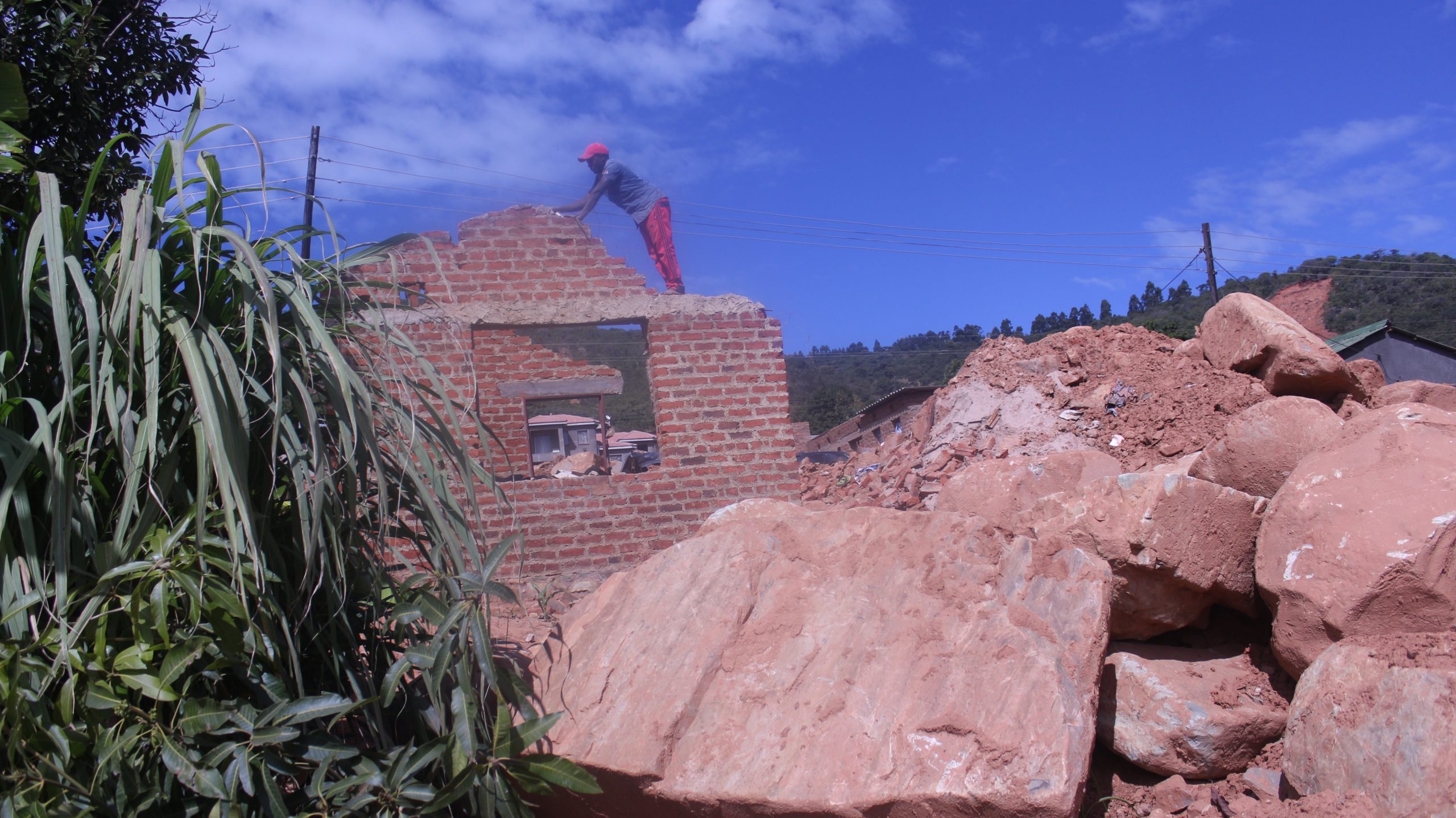
A year after Cyclone Idai ripped through eastern Zimbabwe, Tsitsi Mungana (65), popularly known as Mbuya Chovha in the Skyline area, is still traumatised.

The two graves about a stone’s throw from her house, reminds her of how she became a widow on March 15 last year.

“I was not at home when disaster struck. I was told that my husband and grandchild were missing after our house was destroyed,” Mungana said.

“The body of my grandchild was found seven days later. Unfortunately, they were both buried in my absence.”

Mungana has since erected a makeshift house made of mud and stones as she waits for a miracle for her to get a decent house.

The makeshift house is situated just a few metres from the one that was destroyed by the floods.

“I pray that one day I will have a decent house,” she said. “World Vision gave me some roofing sheets.

“However, they came back and took them away, saying they had given me the wrong sizes. I am still waiting for the sheets.”

Mungana is one of the thousands of people still smarting from the effects of Cylcone Idai exactly a year after disaster struck in Manicaland and some parts of Masvingo.

Thousands of people died and some bodies were washed away into Mozambique after torrential rains caused flooding and mudslides.

Houses and infrastructure were destroyed with Chimanimani being the hardest hit.

Driving to Chimanimani via the Wengezi route today can be deceiving to many. The first two rehabilitated bridges near Nedziwa can be misleading to those without knowledge of what lies ahead.

But the sad reality is at St Charles Lwanga Secondary School. The signs are visible for everyone to see.

The school has lost its glitter following the disaster, which saw buildings being destroyed and children being forced to go back home before the term was over.

It is at this learning institution where two pupils died after a mudslide tore into the boys’ hostels claiming their lives and injuring some.

Today, it has turned into an ordinary school without boarding facilities, which had in the past attracted parents from across the country to send their children to St Charles Lwanga.

A visit to the school on Friday painted a gloomy picture where rubble from the destroyed boys’ hostel and dining hall is yet to be removed.

Inside the hostels there were various items like clothes hangers, abandoned school trunks and broken bunk beds.

“We plead with the school authorities to consider clearing the rubble as it constantly reminds us of what transpired and how we lost our colleagues.

“It is a bad sight for all of us,” said Blessed, a Form 4 pupil who was tasked to show journalists from The Standard the damage that is still visible at the school.

This year the school opened its doors to both boys and girls and has an enrolment of 147 pupils.

“We all wanted it to be a boarding school as before, but it is now only for day scholars.

“The school is mulling reconstructing at another site in Nedziwa.

“We attended the ground-breaking ceremony sometime back, but construction is yet to commence.”

At Ngangu township where houses were destroyed by the cyclone, victims are still waiting for government to deliver on its promise to construct new houses for them.

A visit to one of the three camps, which still houses displaced residents, revealed that victims of the cyclone had lost hope of being relocated to Nedziwa growth point, about 50km away from Ngangu.

“It is not easy to stay in a tent for a long time. During the summer it is hot inside and in winter, the tents are too cold.

“We are tired of lies by the authorities, who are taking long to relocate us.

“We were given some stand numbers and that is it. Some have left the camps and are renting out the tents to desperate home seekers,” said a woman at the camp.

Most of the victims, who spoke to this paper, revealed that they were still traumatised by the March 15 disaster.

According to the Zimbabwe Idai Recovery Project (ZIRP), the rehabilitation of damaged infrastructure and reconstruction of damaged homes will cost between US$548 million and US$622 million.

Over 50 000 households were destroyed, directly affecting 270 000 people, including 60 000 who were forced out of their homesteads and farmland.

The World Bank has since provided a US$72 million grant funding to the ZIRP to reach out to the most affected communities across nine districts.

As time moves, Mungana is not contemplating leaving her small house despite fears of similar natural disasters occurring in future.

For her, being close to the graves of her most loved ones is all that she needs.

Meanwhile, millions of people are still struggling to rebuild their lives a year after Cyclone Idai hit Mozambique, Zimbabwe and Malawi in one of southern Africa’s worst ever weather-related disasters, aid groups said last week.

In a new report ahead of today’s anniversary, Oxfam said more than 100 000 remain in makeshift shelters and destroyed or damaged homes across the region; some roads, water supplies and schools are still in tatters; and nearly 10 million people are “in desperate need of food”.

“The people of Mozambique, Zimbabwe and Malawi are trying to piece their lives back together in the face of huge challenges,” said Nellie Nyang’wa, Oxfam’s regional director for southern Africa.

“Politicians in the region, and across the globe, need to match their commitment.”

Drought conditions in the region have impacted people’s recovery – as have the torrential rain and flash floods that have struck Mozambique in recent months, destroying cropland.

— Additional reporting by The New Humanitarian

The post Cyclone Idai: Trauma, broken promises appeared first on Zimbabwe Situation.

Govt injects more cash to fight COVID-19

Source: Govt injects more cash to fight COVID-19 | Sunday Mail (Top Stories) Kuda Bwititi Chief Reporter TREASURY has a $3,2 billion kitty to fund social protection programmes for vulnerable members of society and also bankroll contingency measures against the spread of coronavirus. The resources were generated from Government’s cash surplus position, as authorities continue […]

The post Govt injects more cash to fight COVID-19 appeared first on Zimbabwe Situation.

Source: Govt injects more cash to fight COVID-19 | Sunday Mail (Top Stories)

Kuda Bwititi
Chief Reporter

TREASURY has a $3,2 billion kitty to fund social protection programmes for vulnerable members of society and also bankroll contingency measures against the spread of coronavirus.

The resources were generated from Government’s cash surplus position, as authorities continue ramping up ongoing fiscal consolidation measures.

Coronavirus, known as Covid-19, has been spreading rapidly in different parts of the world.

This has heightened calls for authorities in Zimbabwe to step up preventive measures against the pandemic.

Last week, 24 coronavirus cases were recorded in South Africa and with millions of Zimbabweans living in the neighbouring nation, there are fears the disease could spread into the country.

In an interview with The Sunday Mail, Finance and Economic Development Minister Professor Mthuli Ncube said Zimbabwe’s finances were on a sound footing and there were adequate reserves to deal with the coronavirus threat.

“The point that I need to make is that Government is in a cash positive situation. I can say with confidence that the fiscus is well run. We are a solvent Government and currently we have a surplus of $3,2 billion in our accounts. We are going to spend $3,2 billion on key programmes such as the health sector. We need to fight the impact of the coronavirus and we need to put some money into that,” he said.

Asked how much would be allocated from the fund to fight Covid-19, Prof Ncube said authorities were still to decide the amounts.

“We need to decide on that. Obviously it’s not me alone who has a say. We have to make an assessment with other colleagues in Government and obviously the Ministry of Health has to be involved,” he said.

Prof Ncube said outside of the fight against coronavirus, Treasury will also spend the surplus on other undertakings to cushion the public from the harsh economic environment.

Sectors identified for social protection include health, education as well as the welfare of civil servants.

“We are going to spend it on the education sector, we are also going to spend it to meet even the salary demands of civil servants,” he said.

In an earlier statement which he presented on Wednesday on the establishment of the currency stabilisation taskforce, Prof Ncube said Government was mindful of the fact that unrestrained increases in money supply were one of the fundamental causes of inflation and the depreciation of the exchange rate.

He noted that hyperinflation prior to 2009 was triggered by failure to achieve fiscal consolidation.

Prof Ncube said fiscal and monetary discipline would be reinforced through maintaining a cash budgeting framework to minimise fiscal deficit so that Government can continue maintaining a surplus to fund its programmes.

To that end, the education sector has already received a boost and on Wednesday, Government said it would pay 53 percent of June and November examination fees for all candidates in public schools following an outcry over increases by the Zimbabwe School Examinations Council (Zimsec).

The unprecedented move will see the State forking out 53 percent of all examination fees for candidates at Government, local authority and mission schools for those sitting for Grade 7, O-Level and A-Level examinations.

“Government is releasing $150 million to Zimsec with immediate effect to get the preparations for the 2020 June and November examinations going and will avail the balance to Zimsec once the total candidature from the public schools for the June and November examinations is ascertained.

“I would now like to advise all parents and guardians of schoolchildren in Grade 7, Ordinary and Advanced Levels that in 2020, Government will be contributing 53 percent of the examination fees for candidates in public schools, while parents and guardians will take up 47 percent,” said Primary and Secondary Education Minister Cain Mathema.

Calls for the enhancement of prevention measures against Covid-19 have been growing and in Parliament last week, legislators advocated for immediate interventions including sanitisers in the August House.

Magunje MP Cde Cecil Kashiri recommended mandatory testing for all MPs and other public officials.

“We as parliamentarians come from different parts of the country. It is prudent that if it were possible through the Minister of Health, we have compulsory testing every week here in Parliament so that we know our status since we sit here three days a week,” he said.

In its update on Covid-19, the Ministry of Health and Child Care said as of last Thursday, 8 700 travellers had been screened at ports of entry and put under surveillance.

The ministry also encouraged people to exercise good personal hygiene and avoid unnecessary travel outside Zimbabwe.

The post Govt injects more cash to fight COVID-19 appeared first on Zimbabwe Situation.

Lessons from War 

It’s no surprise to me that the Chinese business Community uses a military handbook from the early years of Chinese history as a manual for Chinese business practice in the 21st Century. We fought a guerrilla war for the Independence of Zimbabwe from about 1962 to 1980. Source: Lessons from War – The Zimbabwean Eddie […]

The post Lessons from War  appeared first on Zimbabwe Situation.

It’s no surprise to me that the Chinese business Community uses a military handbook from the early years of Chinese history as a manual for Chinese business practice in the 21st Century. We fought a guerrilla war for the Independence of Zimbabwe from about 1962 to 1980.

Source: Lessons from War – The Zimbabwean

Eddie Cross

Many of us found ourselves in some form of uniform holding a gun. As individuals we learned many things from that experience and I want to remember some of these things and apply those lessons to the struggles we find ourselves locked into today.

The first was how war levelled us in the field. It did not matter who you were or what position you held in civilian life, in the battle lines we were all one. Black, white, rich or poor, war is a great leveller and creates an environment where the only thing that matters is how you react under fire. That is why the Second World War spurred the flag of freedom throughout the world as black and Indian soldiers came back from conflict knowing they were no less human than the white man. In many ways out of that conflict came the struggle for Independence and dignity.

I remember a meeting addressed by Ndabaningi Sithole in Harare in 1974 when he recounted how nervous he was when he first flew in an Executive Jet sent for him by President Kaunda and found it had an all black crew. In the meeting he was asked by an elderly Pastor “what does a young man need to learn to be a pilot?” I will never forget his answer “Mdala” he replied “Independence!” One word and it said it all; only the struggle would bring freedom to be who we are as individuals.

The second lesson for me is one that I use frequently today to explain why I refuse to be defeatist or pessimistic about our situation or our future. It is quite simple really, I think I have a little influence in my society and community and as such I have a responsibility to not only believe in what I am doing but to commit myself to achieving those goals. Who on earth would go into a fight with a Stick of Commando’s under a leader who did not believe in what they were doing or that they were going to do their best, no matter what. No one would, if they did they would be crazy.

That is why all war situations create opportunity for amazing acts of courage and ingenuity which overcome seemingly impossible odds. It is the collective effort of countless such acts that bring victory and peace. In many ways we can all be proud of what our men and women did in war. War is almost always the responsibility of stupid political decisions but it is how we act in response to being drawn into a conflict that is not of our making, that makes the difference.

In Berlin, Germany, there is a memorial to the German soldier in the Second World War. It is not well known but I have been there and watched as German families, most of whom were born after the war was ended, came to remember uncles, grandfathers and others who fought for Germany. It was deeply moving, and every day – even now, 75 years later, the Municipality has to haul away a truckload of flowers. We may not like to think so but the German soldier was one of the most amazing features of German Nazi madness.

I have also been to the Memorial in Washington to the 53 000 men and women who died in the Viet Nam War. Like the memorial in Berlin this is a deeply moving place and watching ordinary Americans lining up to feel the names on that long black wall, even now, so many years later, makes us remember men and women who gave their lives for a cause they believed in. Did not succeed, but the heroism and sacrifice is remembered.

I think we as a Nation need to sponsor memorials to all who were engaged in our war – the Rhodesian Army and Police, the Airforce and the Zipra and Zanla armed forces. We should allow families to sponsor the names of loved ones who gave their all in a fight they all believed in. Not just the victors. I can well remember attending a Service in the Chapel at Plumtree school a few years ago where the Head Boy read out the role of honour mentioning the names of every Plumtree school boy who had lost his life in a battle somewhere, Europe, Malaysia, Zimbabwe. All 600 boys, all black, all born well after the war standing. It was deeply moving. Most white families would find such a memorial a healing experience and somehow we need that as a country.

Then there is the importance of communications. I remember once being in a unit who were expecting to be ambushed in the Eastern Highlands. When we were informed of the intelligence and set off, I was amazed at the clarity of the communications we suddenly had. Every word was clear and audible. I subsequently learned that we were placed on a special system that was used for specialist forces engaged in real fire fights. We were just a Police Reserve Unit on call up and did not usually get such treatment. It was comforting and had we run into trouble (we did not) it would have been very helpful to know that someone knew where we were and what was happening and if we needed help.

Then there is the importance of ground cover and support. Ground cover simply means you have to have boots in the field. The Americans have learned that in many tough places and in our war, it was no less true. Where you did not have people on the ground you lost territory. If you were in a small unit on the ground and ran into trouble against overwhelming odds, then it was essential to know that you could radio for help and that this would materialise in a short period of time. I was once involved in a land mine incident followed by an ambush and we were able to contact a unit nearby who responded and we were able to hand over to them; they were real soldiers and quickly took the initiative.

So what do these lessons from war teach us who are engaged in the struggle for development and growth with stability and peace in Africa. For me there are several, others I am sure would draw many other lessons from their experience. The first is that we must work together, a unit that is not unified in its vision and target, will never get anywhere. This is a struggle that calls for us to work as one nation – our fight is for development and growth in competition with the rest of the world. If our children are going to able to survive and even thrive in this new world they need a decent education – are we preparing them for that role?

Secondly we need leadership, leaders who will sacrifice their interests, even their lives for their fellow employees or people. We need servant leadership that earns the right to lead by example. Thirdly we need discipline. Just look at how the Chinese have handled this new virus – yesterday 8 new cases in the whole of China. No army can win without discipline, not one imposed from above but one given freely and in the interests of the Unit. Our problems as a country stems from leaders who are looking after their own interests first and who totally disregard any need for self-discipline and control.

We need to recognise that we must have good communications – top down and bottom up. We need to know where we are going and how we are going to get there and our leaders need to listen carefully to their people on the ground. Beyond listening to each other we need fast action. Then finally, we need to recognise that in the struggle for development and growth there will be casualties – we are opening up the economy, liberalising our financial markets and this will open up new opportunities but also bring new challenges. When they do, those troops on the front line need to know they have our support and that help is forthcoming.

This is a war we all have an interest in winning. Let’s put aside our differences and fight together for our collective futures.

The post Lessons from War  appeared first on Zimbabwe Situation.