Game over for 2 gunmen who robbed residents of cars and cash amounting to US$86 455 and ZW$193 675

LUCK finally ran out for two suspected Norton armed robbers who had terrorised various parts of the city stealing motor vehicles, cash and other valuables amounting to US$86 455 and $193 675. Each time the two struck in the company of their six alleged…

LUCK finally ran out for two suspected Norton armed robbers who had terrorised various parts of the city stealing motor vehicles, cash and other valuables amounting to US$86 455 and $193 675. Each time the two struck in the company of their six alleged accomplices who are on the run, they would threaten to shoot […]

“It’s lucrative”: Zimbabwe’s farmers turn to social media to stop the rot 

Source: “It’s lucrative”: Zimbabwe’s farmers turn to social media to stop the rot – African Arguments Many farmers can no longer sell their produce due to the lockdown, but some are managing through online marketing and home deliveries. Examples of farmers in Zimbabwe marketing their produce through social media. Since Zimbabwe started lockdown measures on 30 March, […]

The post “It’s lucrative”: Zimbabwe’s farmers turn to social media to stop the rot  appeared first on Zimbabwe Situation.

Source: “It’s lucrative”: Zimbabwe’s farmers turn to social media to stop the rot – African Arguments

Many farmers can no longer sell their produce due to the lockdown, but some are managing through online marketing and home deliveries.
zimbabwe farmers lockdown coronavirus

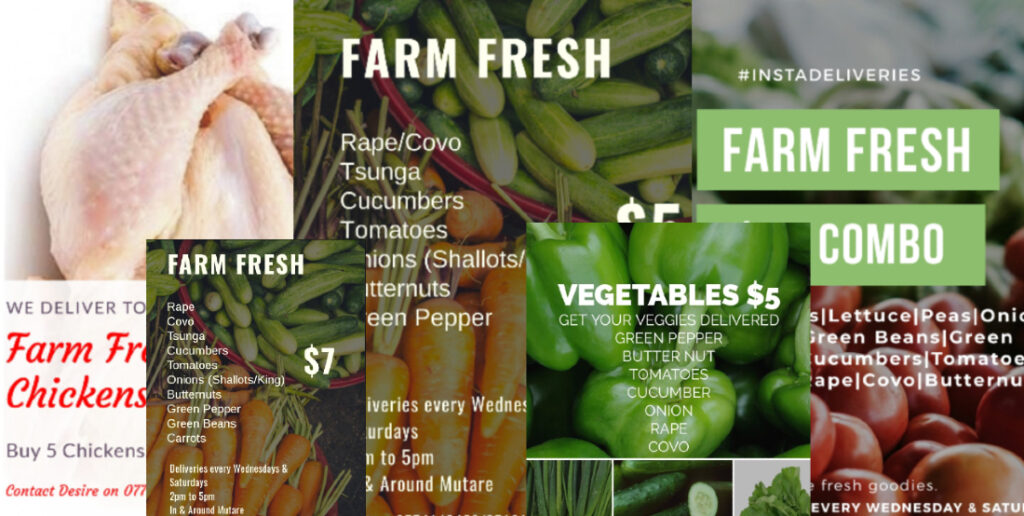
Examples of farmers in Zimbabwe marketing their produce through social media.

Since Zimbabwe started lockdown measures on 30 March, farmers have been struggling to sell their produce. With restaurants closed and people staying away from markets, tonnes of tomatoes, avocados and other fruit and veg have been rotting in piles across the country. Since COVID-19, many farmers have recorded losses of thousands of dollars.

Some, however, have adopted new strategies to sell their produce. In the past few weeks, marketing posters have increasingly been popping up across social media platforms like Twitter, Facebook, and WhatsApp advertising direct home deliveries. From about $5 to $20, depending on the combination and number of vegetables, Zimbabweans trying to avoid infection from coronavirus can get farmers to bring food straight to their door.

Desire Jongwe, a farmer in eastern Zimbabwe, adopted this strategy after his usual ways of selling his produce became untenable. He had been preparing a batch of chickens for sale when the lockdown was announced.

“I asked myself ‘where can I get the market?’”, he says. “I had already discussed with restaurant owners and they had said they would take my chickens…I devised a plan on how I can sell my chicken online using social media.”

He created an ad and started sharing it. He followed this up with more posts, advertising basic vegetable packages for $5, $7 or $10 and allowing customers to choose a combination of leaf vegetables, cucumbers, tomatoes, onions, squashes and peppers.

Soon, people began responding. Many were in the diaspora and wanted to buy food for their family members in Zimbabwe. They transferred money to Jongwe who delivered packages to their relatives. He says he is now making 10 to 15 deliveries three days a week. In the long run, Jongwe believes his income from this way of doing things will compare to his earnings before the lockdown.

“For me, the cost of production is lower than the prices of vegetables…The market value of vegetables is high and it’s lucrative,” he says.

Tichaona Saungweme, who lives close to the city of Mutare, is more cautious. He also turned to marketing his goods online after the lockdown was imposed.

“People are afraid of contracting coronavirus,” he says. “The only thing we can do as farmers is to reach the customers in the comfort of their homes through social media.”

This approach has enabled Saungweme to continue selling some of his goods, but he says it is not always straightforward and points out that many people are not online.

“It’s working but it still has some teething problems,” he says. “The social media market is still small.”

Charles Dhewa is the CEO of Knowledge Transfer Africa whose flagship initiative eMKambo helps spread agricultural information through mobile and internet networks. He says that online adverts are becoming an increasingly important part of Zimbabwe’s food supply chain model. This trend has been supercharged by the lockdown.

“Virtual marketing is being embraced significantly,” he says. “Basically if one needs any commodity, there may be no need to visit Mbare [a market in Harare] because we can directly link him or her with diverse sellers and deals are sealed.”

Dhewa points out, however, that not all farmers in Zimbabwe can utilise this approach. A large proportion, he says, have suffered greatly from the lockdown. This includes many who sell fresh produce, those who live in peri-urban and rural areas, and chicken and egg and dairy farmers.

“Those into pork production have also suffered from low uptake by butcheries and gochi-gochi [barbecue] places which have been locked down,” he adds.

The livelihoods of huge swathes of the population in Zimbabwe, including many farmers and poor people, have been devastated by the coronavirus lockdown. But for those with the right resources, online marketing and home deliveries have offered a rare lifeline. According to Mutare’s mayor Blessing Tandi, this innovation along with decentralising wholesale vegetable markets have been crucial in helping contain the spread of COVID-19 in the city.

“It’s ideal in implementing social distancing,” he says. “This will mean our people in [the high density suburbs of] Chikanga or Dangamvura will not travel to Sakubva [Market] for vegetables.”

The post “It’s lucrative”: Zimbabwe’s farmers turn to social media to stop the rot  appeared first on Zimbabwe Situation.

‘Proper tobacco selling can stabilise economy’

Source: ‘Proper tobacco selling can stabilise economy’ | Herald (Business) Enacy Mapakame Business Reporter Proper management of the recently opened tobacco selling season will help bring some level of stability in the economy, at a time the country is battling devastating effects of Covid-19 induced problems, analysts have said. Increased liquidity in the official channels will […]

The post ‘Proper tobacco selling can stabilise economy’ appeared first on Zimbabwe Situation.

Source: ‘Proper tobacco selling can stabilise economy’ | Herald (Business)

Enacy Mapakame Business Reporter

Proper management of the recently opened tobacco selling season will help bring some level of stability in the economy, at a time the country is battling devastating effects of Covid-19 induced problems, analysts have said.

Increased liquidity in the official channels will bring some relief to the economy and eventually push down the exchange rate on the illegal market in line with the rule of supply and demand and bring stability to prices of goods.

This year’s selling season is a peculiar one with farmers required to make a single delivery weekly as part of measures to reduce the spread of the deadly disease that has affected over two million people across the globe.

Among the key measures put in place by authorities include implementation of decentralised floors to reduce the number of people coming to Harare.

There are concerns if unchecked that the decentralised floors may be a breeding ground for unscrupulous buyers promoting side marketing, prejudicing the economy of its true foreign currency earnings.

Economists who spoke to this publication are, however, of the view that proper management of the selling season will enhance liquidity in the official channels, and bring some level of stability on the forex market.

“Farmers are urged to sell their crop at the authorised auction floors and put US$ proceeds to good use especially by procuring equipment for increased productivity. This will help avert the vulture tendencies of middlemen, which if unchecked, can cause a surge in parallel market rate hence causing a spike in prices,” said Pan African Chamber of Commerce board member Langton Mabhanga.

The official foreign currency exchange rate is pegged at $25 against the greenback while the parallel market is trading at a premium ranging from $39 to $46 depending with the mode of transaction.

The tobacco selling season opened on Wednesday. Tobacco is one of the country’s top foreign currency earners being the second single largest export earner after gold.

Economist Persistence Gwanyanya said while the globe battles effects of the Covid-19 which have brought radical changes to the way of doing business, this also presented an opportunity for the Zimbabwe crop.

There is likely to be increased demand for the golden leaf as Covid-19 disrupted operations which may push the process of the crop on the commodities market hence benefiting the country.

In addition to that, the selling season will be staggered throughout the year as one of the measures to contain the spread of the pandemic. This means the country will have foreign currency inflows for a longer period.

“Major challenge is there is high risk of side marketing due to the decentralisation of markets.

“But a smooth staggering of cash flows will solve one of Zimbabwe’s cash problems.

“Depending on the dynamics of supply and demand, our tobacco may actually fetch more money on the market.

“But this needs proper management and RBZ also has an important role to play in ensuring smooth flow of business,” said Mr Gwanyanya.

Another analyst Dr Prosper Chitambara said: “I think the onset of the tobacco selling season which will result in improved foreign exchange inflows into the country will have a moderating effect on the parallel market exchange rate.

However, diminished commodity prices owing to the Covid-19 will mean reduced foreign exchange inflows for the country.

Tobacco earnings go a significant way in enhancing the country’s trade balance, which has averaged minus US$233 million between 1991 and 2019, before posting a record high of US$293 million last December. Deliveries, which totalled 258 million kilogrammes last year, are projected to decline 20 percent this year due to the negative impact of spells of dry weather and drought on crop development experienced in many parts of the country.

The post ‘Proper tobacco selling can stabilise economy’ appeared first on Zimbabwe Situation.

LOCKDOWN : TRUCK DRIVERS SMUGGLING PASSENGERS

Haulage truck drivers ferrying essential commodities
countrywide are abusing the privilege, smuggling passengers who are not
exempted to travel during the Covid-19 national lockdown, The Herald has
established.

They are violating social distancing…

Haulage truck drivers ferrying essential commodities countrywide are abusing the privilege, smuggling passengers who are not exempted to travel during the Covid-19 national lockdown, The Herald has established. They are violating social distancing rules, putting themselves and the passengers at risk of being infected with the virus. Trucks have become a form of public transport, replacing

SOME 3460 ZIMBAS IN NEED OF FOOD AID IN SA

An estimated 3 460 Zimbabweans living in South Africa are
in need of food assistance, while 2 191 are requesting repatriation back home.
These figures were revealed by the Zimbabwean Embassy in South Africa in their
latest update on how Zimbabweans i…

An estimated 3 460 Zimbabweans living in South Africa are in need of food assistance, while 2 191 are requesting repatriation back home. These figures were revealed by the Zimbabwean Embassy in South Africa in their latest update on how Zimbabweans in the country are faring in this Covid-19 pandemic. In the update, the embassy says more numbers are expected. “As of April 19, 2020, 839 people