4,3 MILLION ZIMBAS WILL NEED FOOD AID

ZIMBABWE’S food crisis is expected to worsen and reach new
lows by June this year, with about 4,3 million citizens expected to be food
insecure.

According to the Global Report on Food Crises for the year
2020 which was produced and recently releas…

ZIMBABWE’S food crisis is expected to worsen and reach new lows by June this year, with about 4,3 million citizens expected to be food insecure. According to the Global Report on Food Crises for the year 2020 which was produced and recently released by the Food Security Information Network, the country’s situation was now galloping to alarming levels. Government, the report says, is

NURSES FUME AS FLEXI HOURS ARE CANCELLED

NURSES at Marondera Provincial Hospital have rapped their
employer, the Health ministry, for cancelling flexi hours on Monday without any
consultations.

Early this year, the Health Services Board and the unions
representing nurses entered into an …

NURSES at Marondera Provincial Hospital have rapped their employer, the Health ministry, for cancelling flexi hours on Monday without any consultations. Early this year, the Health Services Board and the unions representing nurses entered into an agreement allowing underpaid health workers across the country to work two days a week. The arrangement was arrived at as a compromise after

WE ARE BEING SENT TO THE SLAUGHTER : MINE WORKERS

MINING workers unions have raised concern over employees’
safety after President Emmerson Mnangagwa gave reprieve for the sector to
operate during the national lockdown.

Zimbabwe Diamonds Allied Workers Union secretary-general
Justice Chinhema sai…

MINING workers unions have raised concern over employees’ safety after President Emmerson Mnangagwa gave reprieve for the sector to operate during the national lockdown. Zimbabwe Diamonds Allied Workers Union secretary-general Justice Chinhema said opening up mines could jeopardise the health of the workers. “Employers have not been meeting minimum standards of safety before this pandemic

Zimbabwe’s currency plans upended as it fights on two fronts 

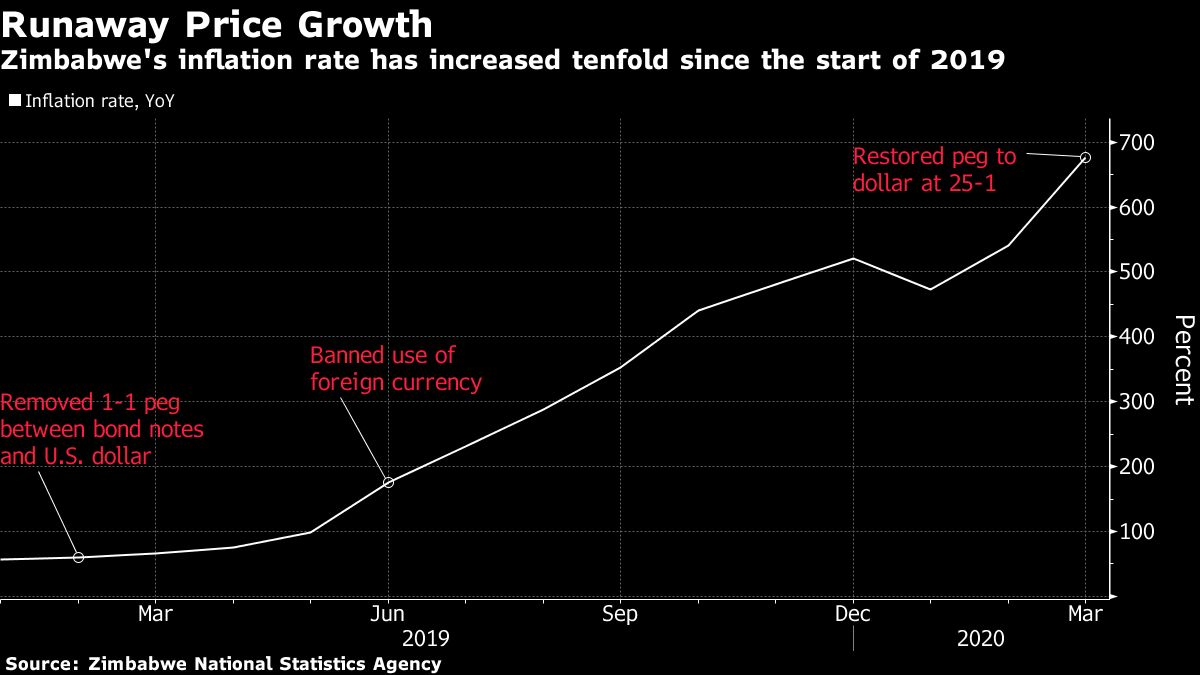
Zimbabwe’s inflation rate has increased tenfold since the start of 2019. Source: Zimbabwe’s currency plans upended as it fights on two fronts – Moneyweb Zimbabwean five and two dollar bond banknotes, nicknamed zollars, are displayed in an arranged photo in Harare, Zimbabwe. Image: Waldo Swiegers/Bloomberg The fallout from the coronavirus pandemic has upended Zimbabwe’s plans […]

The post Zimbabwe’s currency plans upended as it fights on two fronts  appeared first on Zimbabwe Situation.

Zimbabwe’s inflation rate has increased tenfold since the start of 2019.

Source: Zimbabwe’s currency plans upended as it fights on two fronts – Moneyweb

Zimbabwean five and two dollar bond banknotes, nicknamed zollars, are displayed in an arranged photo in Harare, Zimbabwe. Image: Waldo Swiegers/Bloomberg

Zimbabwean five and two dollar bond banknotes, nicknamed zollars, are displayed in an arranged photo in Harare, Zimbabwe. Image: Waldo Swiegers/Bloomberg

The fallout from the coronavirus pandemic has upended Zimbabwe’s plans to enforce the use of its own currency and left it scrambling to find money to tackle twin crises of economic collapse and famine.

A global slump spurred by the outbreak of the virus has come with the southern African nation’s economy in its worst state since at least 2008. Already trying to raise $400 million to buy grain after the most-severe drought in 40 years threatened to leave half of its people without enough food, it now needs another $220 million to deal with the impact of Covid-19, according to Finance Minister Mthuli Ncube.

On the eve of major protests, which were called by the main opposition party over plunging living standards, Ncube said the country would establish a Monetary Policy Committee within a month that will cut interest rates, begin selling bonds with maturities of as long as 30 years, and proceed with a plan to privatise everything from state telecommunications companies to timber plantations.

“We are working with the two crises, we are fighting on both fronts,” he said in an April 16 interview. “Our issue is just financial resources.”

Zimbabwe’s economy has been in free-fall as a shortage of foreign currency led to scarcity of fuel and wheat. Conditions worsened after the government removed a 1-1 peg between a quasi-currency known as bond notes and the dollar more than a year ago and in June banned the use of foreign exchange as it sought to reintroduce the Zimbabwe dollar that had been scrapped in 2009.

The situation has been compounded by the imposition of a national lockdown to curb the spread of the disease. The International Monetary Fund estimates the economy contracted 8.3% last year.

Now, to contain the fallout the local currency has been pegged at 25 to the dollar, still well below the black-market rate, and the ban on the use of foreign currency has been lifted.

Derailed plans

“You are allowed to keep your US dollars under your pillow” and they can be used in shops, Ncube said. “Our plans are derailed. We are determined to get back on track once the Covid-19 outbreak” is over, he said.

The decision may improve trading as retailers were reluctant to accept local currency that couldn’t be used to import goods.

“It means we can easily buy from our suppliers,” said Mikey Goredema, 28, who sells building materials in an outdoor market in Harare, the capital. “The US dollar was what people wanted, even when it was illegal.”

It’s a setback for Ncube, an economist who has lectured at the University of Oxford and who tried to instill financial discipline since accepting the post in September 2018. He has slashed government spending, set up a monetary policy committee and introduced a benchmark interest rate.

Despite those measures, the country failed to attract significant foreign investment, has external debt of $8 billion that it can’t repay and annual inflation surged to 676% in March. Ncube admits a target of double-digit price growth by the end of the year may be difficult to attain.

“It has all been complicated by Covid-19,” he said. “It’s very hard to get our targets.”

The country isn’t eligible for funding from the IMF, due to arrears to other multilateral lenders, but has received some assistance from the European Union and the UK as well as from a number of organisations, Ncube said.

The post Zimbabwe’s currency plans upended as it fights on two fronts  appeared first on Zimbabwe Situation.

‘We’re sitting on COVID-19 time bomb’ 

Source: ‘We’re sitting on COVID-19 time bomb’ – NewsDay Zimbabwe OVER 30 000 plus frontline health workers in the country are vulnerable to coronavirus after government reportedly ignored a court order to provide them with personal protective equipment (PPE), with healthcare providers warning that this was a ticking time bomb. Alfonce Mbizwo/Nkululeko Sibanda/Everson Mushava Already, […]

The post ‘We’re sitting on COVID-19 time bomb’  appeared first on Zimbabwe Situation.

Source: ‘We’re sitting on COVID-19 time bomb’ – NewsDay Zimbabwe

OVER 30 000 plus frontline health workers in the country are vulnerable to coronavirus after government reportedly ignored a court order to provide them with personal protective equipment (PPE), with healthcare providers warning that this was a ticking time bomb.

Alfonce Mbizwo/Nkululeko Sibanda/Everson Mushava

Already, two heath workers in Bulawayo, identified as case numbers 15 and 19 last week tested positive for the novel virus but thousands are facing increased risk as they deal with the rising number of returning residents from COVID-19 hotspots and community transmission cases.

“The PPE situation remains very critical. We have not received any positive feedback from health workers countrywide (that government had started supplying the equipment),” Fortune Nyamande, the chairman of the Zimbabwe Association of Doctors for Human Rights (ZADHR) told NewsDay yesterday.

He said there has been no indication from government how it wanted to proceed. “We are consulting with our lawyers how to seek enforcement of the High Court order in view of the continued exposure of health workers.”

The exposure of health workers to coronavirus has become an issue of concern internationally. More than 27 000 health workers in Spain have tested positive for coronavirus, according to that country’s emergency co-ordination centre. The Centres for Disease Control and Prevention in the United States figures show that nearly 9 300 healthcare workers contracted COVID-19 during the course of their work and 27 have died in that country while in Italy, more than 41 doctors died while over 5 000 doctors and nurses had tested positive to the deadly virus. In the United Kingdom, at least 100 healthcare workers have died of coronavirus, according to Nursing Notes, a platform run by nurses in that country.

In Zimbabwe, on April 14 the High Court ordered the government to provide personal protective equipment for frontline health workers across the country to protect them against contracting COVID-19 while attending to patients after ZADHR went to court to argue that the State was putting them at risk by not providing them with PPE.

The government was also not carrying out tests on the frontline health personnel, putting them and patients at risk of infection, while ZADHR argues that it did not use proper equipment to screen a few.

“A few health workers were screened using the rapid diagnostic test kits last week. The numbers are still very low and almost insignificant,” Nyamande said.

“The tests used are also not the diagnostic PCR tests which are the gold standard in diagnosing COVID-19. All registered health workers in Zimbabwe are at risk, both private and public practitioners.”

Zimbabwe Nurses Association (Zina) president, Enock Dongo told NewsDay that failure by government to avail PPE to heath workers was creating a breeding ground for the fast-spreading virus.

“Government officials will be quick to point out that no health worker in the country has tested positive for the virus or is affected in one way or another. It is easy to say that but mind you, none of the essential healthcare workers have been tested so far for COVID-19,” Dongo said.

He said efforts to raise the issue with government had fallen on deaf ears as none of the senior government officials was keen on taking the association’s advice seriously.

“Zina has been advising government to ensure that there is testing of the nurses who are the first instance persons when it comes to the coronavirus. Nurses are the first ones who observe the patients and check them every time they go to a hospital with symptoms of the coronavirus.

“If those nurses contract the virus, they are in a very big risk of spreading it around themselves and among patients and the only way to avoid this is to test them and be sure that none of them have contracted the virus.

The challenge is that no one in government is listening to our advice,” Dongo added.

The Zina boss said the few kits that his organisation’s members had received were inadequate, with some of the members mostly working without the protective gear.

“The kits for personal protection are highly adequate. Most of our members are exposed to this pandemic because there are no protective clothing kits. Testing of nurses has been poor so far. It seems nobody cares at all.

“If the nation fails to take care of those that are in the first line of defence, it means very little care is taken about all the other people who are also likely to contract the virus. We are worried as Zina as to why government is failing to focus on those issues that concern health workers,” Dongo said.

He warned that coronavirus cases in the country would likely spike if government continuously fails to act.

“We have said a lot and nobody seems to be listening. Should we continue as if everything is normal. We are at a high risk of having a massive rise in the numbers of those that have the virus,” Dongo said.

“We have to look at the spread ratios of this pandemic. If we don’t contain it at the first level and we leave nurses so exposed, they will infect others who will in turn infect others and the infection chain will continue to grow. In the end, we will have an unmanageable situation which we could have avoided had our government listened to what we tell them.”

The post ‘We’re sitting on COVID-19 time bomb’  appeared first on Zimbabwe Situation.