An Easter crisis 

Where is God in all this? Every question is related to the one asking it! So here we can reply to this question with another one: where are you expecting God to be? Are you expecting him to have prevented this? Source: An Easter crisis – The Zimbabwean Or are you expecting him to come […]

The post An Easter crisis  appeared first on Zimbabwe Situation.

Where is God in all this? Every question is related to the one asking it! So here we can reply to this question with another one: where are you expecting God to be? Are you expecting him to have prevented this?

Source: An Easter crisis – The Zimbabwean

Or are you expecting him to come to our rescue now? As has often been pointed out, a crisis is a moment of decision (from the Greek krino, decide). A cyclone, a drought, an economic collapse – all these are crises in the sense we often use the word, meaning a disaster.  But a crisis is also an opportunity, an opportunity to choose.

While the world is in mourning for the many who have died and the countless millions whose lives have been affected, many have commented on the beneficial effects of the corona virus pandemic. Suddenly we breathe the clean air of our cities and can hear the birds sing.  Suddenly people are becoming aware of each other and their dependence on each other, not just for the benefits of daily life but even for survival. And people are asking what all this means at a deeper level for the choices we have made as people of the twenty first century.

This year Good Friday will be different, not just for Christians who pause to consider the Lord’s death and who come to venerate his cross, but for everyone. You can see it in the media.  The world’s leaders are putting their grand plans in the ‘PENDING’ tray while they grapple with, what they may see as, this unwelcome intrusion. Maybe it is unwelcome? But it is a moment of truth: a moment when, not only leaders, but all people who have the power to choose (the majority don’t) look hard at the decisions we have made in designing the way we live on our planet.

There are two decisions we have to look at. First there was God’s decision in creating this wonderful world which he planned for us to prepare us for an even more wonderful fullness we can only dimly glimpse at the moment. The second decision was ours. How would we receive this gift? In a word, we messed up. His plan went horribly wrong and, to go back to the question in the first paragraph above, he intervened. He did this in an almost incredible way by coming in the flesh, bearing all our burdens and showing us the way. We, being who we are, rejected him and led him out of the city and killed him. But God, being who he is, remained faithful to his plan and broke out of the tomb and made his purpose clear in a way people could never have grasped before.

The first decision is unalterable. The second still depends on us.  Each year at Easter we are asked, ‘Will you come with me?’ Will you make this world a better place for my brothers and sisters? If you say ‘yes’ and mean it, if you ‘lose your life’ in your decision, you will find it is a far better place for you too.

12 April 2020              Easter Sunday

Acts 10:34 … 43         Colossians 3:1-4          John 20:1-9

The post An Easter crisis  appeared first on Zimbabwe Situation.

Emcoz advocates dialogue

Source: Emcoz advocates dialogue | The Herald Mr Murefu Tendai Mugabe Senior Reporter Employers and employees should negotiate a viable resolution on salaries and other terms of employment relating to leave days in light of the 21-day lockdown meant to curb the spread of Covid-19, the Employers Confederation of Zimbabwe (Emcoz) has said. Companies that were […]

The post Emcoz advocates dialogue appeared first on Zimbabwe Situation.

Source: Emcoz advocates dialogue | The Herald

Emcoz advocates dialogue
Mr Murefu

Tendai Mugabe Senior Reporter

Employers and employees should negotiate a viable resolution on salaries and other terms of employment relating to leave days in light of the 21-day lockdown meant to curb the spread of Covid-19, the Employers Confederation of Zimbabwe (Emcoz) has said.

Companies that were not classified as essential service providers have not been operating since the lockdown announced by President Mnangagwa last week, while those that are operating have scaled down staffing levels.

Most workers are at home without clear legal status on their leave.

Employers Confederation of Zimbabwe (Emcoz) president Mr Israel Murefu told The Herald yesterday that whatever agreement employers and employees settled for should be within the confines of the Labour Act.

He said the national lockdown had not suspended the Labour Act, but there was need for the two parties to reach a viable agreement considering the production time lost during the lockdown.

“In light of the current situation, we are encouraging employers to save jobs as much as they can,” he said.

“There is no one size fits all approach on this matter but we are encouraging employers and employees to engage on what to do – whether to put employees on paid leave or not but all that has to be within the confines of law. The situation differs from organisation to organisation.”

Mr Murefu said some businesses such as the hospitality industry had completely stopped operations owing to the Covid-19 pandemic.

He said negotiations between employers and employees in that sector should be done considering the situation obtaining on the ground.

“We are doing a survey together with other business organisations to establish the number of workers who have been affected by the national lockdown. We hope we will be done by next week and we will be able to advise Government and employers accordingly.”

Confederation of Zimbabwe Industries president Mr Henry Ruzvidzo said: “The lockdown was announced over a weekend and no opportunity was given for discussion with employees and for putting together formal arrangements with respect to the lockdown period.”

The lockdown took effect from 31 March and will run until April 20.

The post Emcoz advocates dialogue appeared first on Zimbabwe Situation.

Over 10,000 confirmed COVID-19 cases in Africa; Zimbabwe and South Sudan among most vulnerable

The World Health Organization (WHO) warned on Wednesday that the number of COVID-19 cases in Africa has now risen to more than 10,000, claiming more than 500 lives. Source: Over 10,000 confirmed COVID-19 cases in Africa; Zimbabwe and South Sudan among most vulnerable | UN News WFP/Tatenda Macheka A mother homeschools her children in Shamva […]

The post Over 10,000 confirmed COVID-19 cases in Africa; Zimbabwe and South Sudan among most vulnerable appeared first on Zimbabwe Situation.

The World Health Organization (WHO) warned on Wednesday that the number of COVID-19 cases in Africa has now risen to more than 10,000, claiming more than 500 lives.

Source: Over 10,000 confirmed COVID-19 cases in Africa; Zimbabwe and South Sudan among most vulnerable | UN News

WFP/Tatenda Macheka
A mother homeschools her children in Shamva district, Zimbabwe, during the COVID-19 pandemic.


Dr Matshidiso Moeti

✔@MoetiTshidi

cases in have risen to more than 10,000. Tackling this pandemic requires a decentralised response. Communities must be empowered and get the resources/expertise needed to tackle outbreaks locally. https://www.afro.who.int/news/covid-19-cases-top-10-000-africa …

View image on Twitter

The virus was slow to reach the continent compared to other parts of the world, but infection has grown exponentially in recent weeks and continues to spread, the UN health agency said.

Africa’s first case of new coronavirus was recorded in Egypt on 14 February. Since then a total of 52 African countries have reported cases and “a significant number” have reported cases in multiple provinces.

“COVID-19 has the potential not only to cause thousands of deaths, but to also unleash economic and social devastation”, warned Matshidiso Moeti, WHO Regional Director for Africa.

She called for communities to be empowered by local authorities, and for provincial and district levels of government to ensure that they have the resources and expertise to respond to outbreaks.

To help combat the virus, WHO is working with governments across Africa to boost surveillance, testing, isolation, contact tracing, infection prevention and control, together with risk communication and community engagement.

The UN health agency reported that so far that Ghana, Kenya, Ethiopia, Egypt, Morocco, Tunisia and Nigeria have expanded national testing to multiple labs, allowing for a decentralized and more efficient system.

Supporting Zimbabwe

At the same time, urgent international support is needed to prevent millions of desperate Zimbabweans from plunging deeper into hunger.

According to the World Food Programme (WFP), as COVID-19 takes hold, the country’s already severe climate- and recession-induced hunger crisis is becoming even more profound.

“With most Zimbabweans already struggling to put food on the table, the COVID pandemic risks even wider and deeper desperation”, said Eddie Rowe, WFP’s Country Director.

Cereal production in 2019 was half that of 2018, and less than half the national requirement. Experts predict that the upcoming 2020 harvest will be even poorer.

With unprecedented hyperinflation having pushed the prices of staples out of reach for most Zimbabweans, increasingly desperate families are eating less, selling off precious belongings and going into debt.

Moreover, COVID-19 threatens to exacerbate Zimbabwe’s dire economic and hunger crises, drastically affecting the lives of people in both urban and rural areas.

And while the UN agency supports communities afflicted by “crisis” and “emergency” food insecurity, more funding is needed.

“We must all do our utmost to prevent this tragedy turning into a catastrophe”, he warned.

WFP is appealing for $130 million to sustain an emergency operation through August to prevent millions of the most vulnerable from plummeting even further

COVID-19 spread threatens South Sudan

Confirmation earlier this week that the new coronavirus pandemic has reached South Sudan has prompted UN-appointed human rights experts to renew their call for an end to fighting there.

In an appeal to the authorities to step up efforts to contain the spread of the virus, the Commission on Human Rights in the world’s youngest country warned that 1.5 million people who’ve fled years of violence are at greater risk than ever.

Commission chair Yasmin Sooka said that it was unrealistic to even “talk about strict social distancing” at the moment.

So many displaced persons still live in tents, she said, “often inches apart from one other, and subsisting on rapidly diminishing humanitarian aid”.

They have only limited access to healthcare, water, hygiene and sanitation, food, and adequate housing, with women and children among the worst affected by these shortages, Ms. Sooka explained.

To halt the spread of the virus, the independent experts, which report to the Human Rights Council, urged the new Transitional Government of National Unity to quell intercommunal violence.

They should demonstrate “resolute leadership” by involving local communities in the public health response and encourage a shared national identity, the UN panel underscored.

WHO/D. Elombat
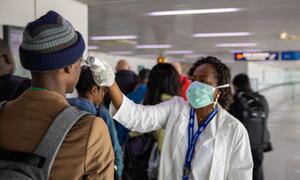
Passenger screening at Maya Maya international airport, Brazzaville, Republic of Congo.

The post Over 10,000 confirmed COVID-19 cases in Africa; Zimbabwe and South Sudan among most vulnerable appeared first on Zimbabwe Situation.