Insurers, pension funds pay out $1,26bn

Source: Insurers, pension funds pay out $1,26bn | The Herald Grace Muradzikwa Tawanda Musarurwa Senior Business Reporter Zimbabwe’s insurance companies and pension funds were largely able to skate around the effects of currency adjustments last year to meet contractual obligations of at least $1,26 billion. Official figures from the sector regulator — the Insurance and Pensions […]

The post Insurers, pension funds pay out $1,26bn appeared first on Zimbabwe Situation.

Source: Insurers, pension funds pay out $1,26bn | The Herald

Insurers, pension funds pay out $1,26bn
Grace Muradzikwa

Tawanda Musarurwa Senior Business Reporter

Zimbabwe’s insurance companies and pension funds were largely able to skate around the effects of currency adjustments last year to meet contractual obligations of at least $1,26 billion.

Official figures from the sector regulator — the Insurance and Pensions Commission (IPEC) — show that insurance firms paid out claims to the tune of $850 million, while pension benefits amounted to $416 million in 2019.

Total membership to pension schemes closed 2019 at 800 000.

Players in the local insurance industry (short-term direct insurers, funeral assurers, life direct assurers and micro-insurers) totalled 30 over the same period.

Significant fiscal and currency shifts from 2016 through 2019 ushered in conversion challenges, that were particularly felt by the insurance and pensions industry.

But unlike the hyper-inflationary period circa 2008 when the regulator failed to provide guidance, this time around IPEC issued several guidance papers to the insurance and pensions industry on how to deal with some of the conversion challenges.

One of the major criticisms of the Justice Smith Commission of Inquiry Report, was that the regulator failed to intervene in order to correct market failures and guide the industry and thus resulted in failure by the industry to institute financially sound systems and procedures.

But last year, IPEC issued 10 regulatory circulars to guide the industry on supervisory expectations; and developed supervisory frameworks including: The Troubled Institutions Resolution Framework; the Disclosure Guidelines for both Insurance and Pensions; and the Guideline on Adjusting Insurance and Pension Assets and Liabilities in line with Currency Reforms.

These perhaps contributed in protecting — to some extent — the insured and pensioners’ hard-earned savings. IPEC Commissioner Dr Grace Muradzikwa, said the level at which insurers and pension funds met their contractual obligations in 2019 point to a functional sector.

“For insurance claims, the industry paid close to a billion, $850 million to be precise, and in addition, pension pay-outs amounted to $416 million,” she said.

All things being equal, an insurer or pension fund should ensure that monies that are put in at the accumulation phase correspond or are better off at the de-accumulation stage.

However, in so far as these entities operate within the prevailing economic environment, outputs have not been up to par. In respect of the local pensions sector, for instance, the depreciation of the Zimbabwe dollar against the United States dollar has affected the imputation of assets held through defined benefit retirement plans.

A defined benefit pension plan is a type of pension plan in which an employer promises a specified pension payment, lump-sum or combination thereof on retirement that is predetermined by a formula based on the employee’s earnings history, tenure of service and age.

To this extent, an inflationary environment such as the one Zimbabwe is presently undergoing affects the purchasing power of the pension.

On the other hand, defined contribution (DC) plans — which are a type of retirement plan in which the employer, employee or both make contributions on a regular basis, and future benefits fluctuate on the basis of investment earnings – have also not been spared by the weakening currency because a significant number of pension funds are heavily invested on the capital markets, which have been under-performing in line with the depressed economic performance.

The post Insurers, pension funds pay out $1,26bn appeared first on Zimbabwe Situation.

Disaster as boy (12) drowns while swimming with his brother in pit (VIDEO)

A boy (12) drowned yesterday in a pit between Nketa 8 and Nkulumane 5 suburbs where Bulawayo City Council (BCC) is undertaking sewer upgrade works. Residents say the pit was dug three months ago. BCC is said to have contracted a security company to gua…

A boy (12) drowned yesterday in a pit between Nketa 8 and Nkulumane 5 suburbs where Bulawayo City Council (BCC) is undertaking sewer upgrade works. Residents say the pit was dug three months ago. BCC is said to have contracted a security company to guard the pit and yesterday’s drowning occurred when a security guard […]

Radio dramas shaped Zim arts

Source: Radio dramas shaped Zim arts | Herald (Top Stories) Aaron Chiundura-Moyo Tafadzwa Zimoyo Senior Arts Reporter Veteran arts practitioner Aaron Chiundura-Moyo has said radio dramas played a pivotal role as they helped shape arts and society in the late ‘80s. Chiundura-Moyo, who saw some of his books turned into plays, said the arts sector should […]

The post Radio dramas shaped Zim arts appeared first on Zimbabwe Situation.
Source: Radio dramas shaped Zim arts | Herald (Top Stories)

Aaron Chiundura-Moyo

Tafadzwa Zimoyo Senior Arts Reporter

Veteran arts practitioner Aaron Chiundura-Moyo has said radio dramas played a pivotal role as they helped shape arts and society in the late ‘80s.

Chiundura-Moyo, who saw some of his books turned into plays, said the arts sector should adopt and adapt to various changes that can see it develop better.

In an interview, he said although back then it was not easy to penetrate the arts sector because it was white dominated, independence opened doors for everyone.

“Radio drama was very popular among the black community for obvious reasons,” said Chiundura-Moyo. “I became popular by writing drama scripts for radio, but never did film and television production at that time.

“It was not easy to get your script published in Rhodesia because there were fewer publishers who operated on less meaningful themes since there was no freedom of speech. Manuscripts had to pass through too many hands before being accepted.

“I remember receiving a lot of rejections until my book, “Uchandifungawo” was accepted for publication in 1974.”

Chiundura-Moyo said it was after independence that more doors started to open for radio, television and book publishing.

“Some of us started submitting drama scripts to radio, television and manuscripts for new books,” he said.

Chiundura-Moyo said he was groomed by a number of natural factors back then.

“Growing up, my father would make us sit around the fire while listening to him narrating a story,” he said. “Later on, he bought a radiogram and made us listen to different programmes. We were also introduced to films by the whites which we could watch three times a week at certain places in our locality.

“I would say my inspiration into writing books came from primary school teachers who read us books while grooming us. As fate has its own way, I started creating my own drama scripts at a farm school called Shoe Shine where I was doing Standard 2, with my first story in Grade 7 at Connemara Government School in 1979.

“I then went to Mambo School in Gweru and submitted my manuscript, then moved to Sandara School for my Form 2 and my short story got read on radio and I won two pounds. I then wrote books, short stories and dramas for radio. Television content was for whites and very few blacks owned a television set at that time.”

Chiundura-Moyo, who is also an actor, said Zimbabwe has witnessed a number of changes since independence, as different forms of arts are now being taught in schools and colleges.

“It is good that Government is taking a serious interest in the creative industry,” he said. “We have the Broadcasting Authority of Zimbabwe which has gone around the country empowering aspiring screen producers and script writers, as well as established ones, and what is left for us artists is to find a sober way of persuading a number of relevant ministries and organisations to help fight piracy.

“Art must be looked at in the same way as other disciplines like sport, hence it is a profession. We should appreciate and respect itn.”

Chiundura-Moyo said so far he has published 19 books covering four different genres, but his favourite book is “Yaive Hondo”, although his taste keeps changing.

“Not less than nine of my books were read at different platforms in schools and six of them were read or serialised on radio and two were dramatised on television. I sincerely believe that I communicated a lot with the society.

“As for television production, “Chiwoko Muhomwe” was my first script and it featured me as the main actor in 1987. In 1989, ZBC appreciated my radio and television dramas and decided to employ me and this changed my world view very much. I also created popular soap Studio 263.”

Chiundura-Moyo pleaded with young people to be proud of their identity.

“They should stop this funny way of thinking that they can successfully market their work of art if they change their local names into English or portray what they are not,” he said.

“If the media is quiet about this, then in 10 years we will have lost the plot as Zimbabwean artists.”

The post Radio dramas shaped Zim arts appeared first on Zimbabwe Situation.

‘Living on the Edge’ – Zimbabwe Vigil Diary

Source: ‘Living on the Edge’ – Zimbabwe Vigil Diary: 14th March 2020 A valiant group braved coronavirus to hold the Vigil outside the Zimbabwe Embassy despite the UK gradually going into lockdown as the disease claims more victims. Airliners are being grounded and large gatherings cancelled to reduce the chances of infection. People are urged […]

The post ‘Living on the Edge’ – Zimbabwe Vigil Diary appeared first on Zimbabwe Situation.

Source: ‘Living on the Edge’ – Zimbabwe Vigil Diary: 14th March 2020

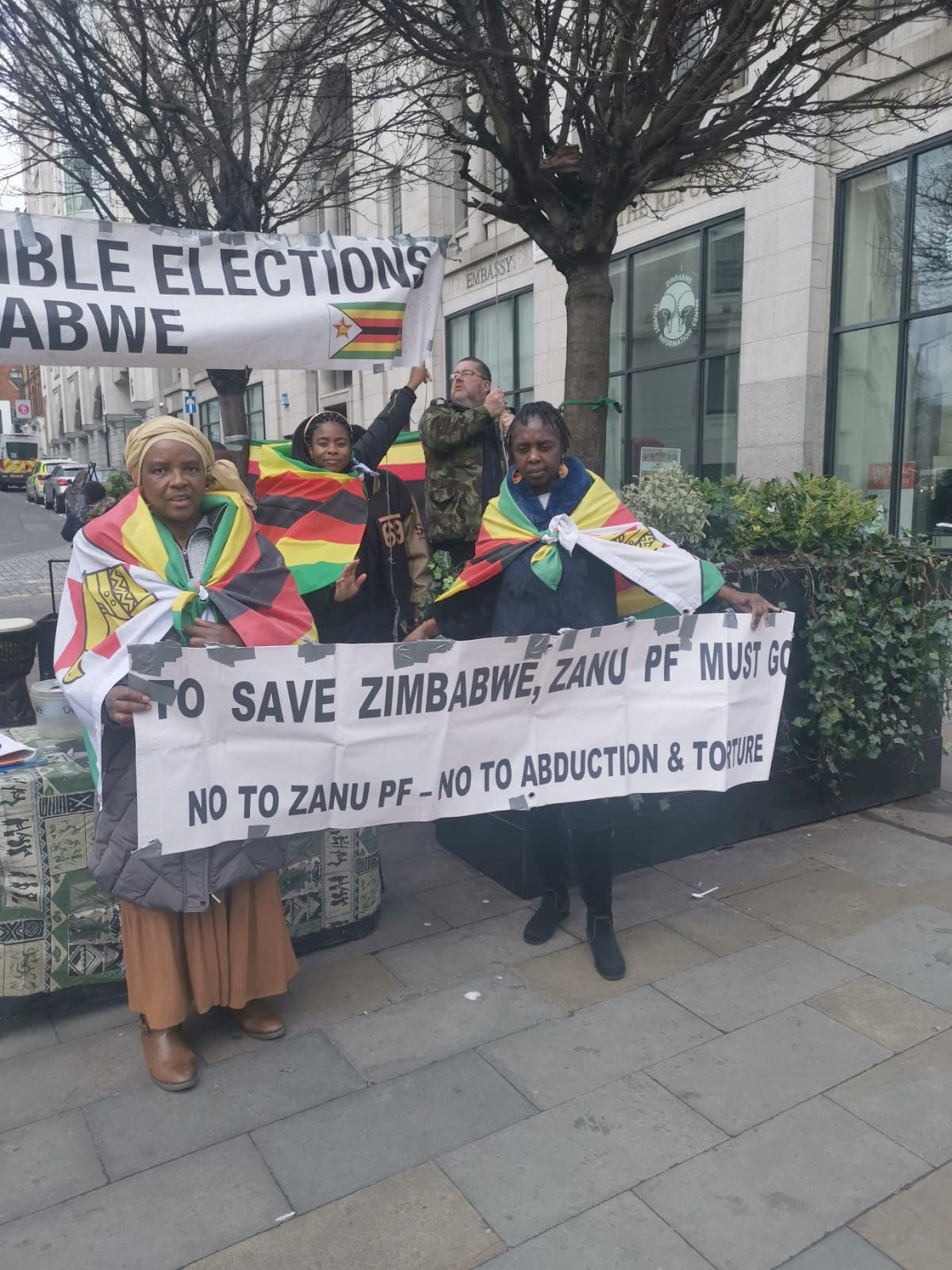
A valiant group braved coronavirus to hold the Vigil outside the Zimbabwe Embassy despite the UK gradually going into lockdown as the disease claims more victims.

Airliners are being grounded and large gatherings cancelled to reduce the chances of infection. People are urged to wash their hands frequently, not to shake hands and, indeed, keep a metre distance from others – difficult if crowded into a bus or train.

These precautions are being taken in countries with sophisticated health services. What will happen when the coronavirus hits Zimbabwe fills us with trepidation, given the state of its health service and the weakened immune system of so many malnourished people.

Whether this troubles the Zanu PF elite is open to doubt. After all, President Mnangagwa, instead of investing in hospitals, has wasted money on hiring three expensive public relations companies to campaign for the removal of US sanctions. The Americans have now extended them, including Owen Ncube, the security minister accused of ordering security services to abduct and mistreat members of the opposition.

The US Secretary of State, Mike Pompeo, urged the Zimbabwe government to ‘immediately end state-sponsored violence including against peaceful protesters, civil society, labour leaders and members of the opposition in Zimbabwe, and to investigate and hold accountable those responsible for human rights violations and abuse.’ (See: https://uk.reuters.com/article/uk-usa-zimbabwe-sanctions/u-s-blacklists-zimbabwe-officials-over-human-rights-abuse-idUKKBN20Y2D7).

To mark the 5th anniversary of the abduction of the human rights campaigner Itai Dzamara, the European Union has demanded action by the Zimbabwe government. The response was a bizarre statement by the police that investigations into the matter were continuing and that law enforcement agents had submitted ‘over 113 fortnightly updates to the High Court’! (See: https://www.herald.co.zw/police-submit-over-100-reports-on-dzamara/.)

An equally bizarre comment came from Zimbabwe’s Defence Minister Oppah Muchinguri who said coronavirus was the work of God punishing countries which imposed sanctions. She added: ‘They are now staying indoors. Their economies are screaming just like they did to our economy’. (see: https://www.enca.com/news/coronavirus-work-god-punishing-west-zimbabwe-minister.)

Other points

  • During the week a number of Vigil activists attended a meeting of the Mike Campbell Foundation at the Royal Geographical Society. Under the title ‘Living on the Edge’ there was a discussion on the rule of law in Zimbabwe. Chief Felix Ndiweni gave a moving account of his legal persecution. The late Mike Campbell was one of the farmers beaten up when his land was seized. We doubt that he would be convinced by the government’s announcement offering land to dispossessed farmers (see: https://www.bloomberg.com/news/articles/2020-03-13/zimbabwe-offers-land-to-recompense-dispossessed-white-farmers). Those who attended from the Vigil and MDC were: Cephas Maswoswa, Charles Mararirikwenda, David Kadzutu, Delice Gavazah, Dennis Benton, Esther Munyira, Handsen Chikowore, Martin Chinyanga, Mary Muteyerwa, Mercy Mukaririrwa, Patricia Masamba, Rose, Benton, Rosemary Maponga and Tapiwa Muskwe. Special thanks to Rose Maponga for bringing a drum.
  • Thanks to those who arrived early to help set up the Vigil today: Miriam Gasho, Rosemary Maponga, Philip Maponga, Patricia Masamba, Tapiwa Muskwe, Farai Mutumburi, Sithobekile Sikhosana and Kevin Wheeldon. Thanks to Rosemary and Miriam for looking after the front table, to Farai, Kevin, Netsayi Makarichi and Sithobekile for handing out flyers, to Patricia for taking photos, to Miriam for prayers and to Rosemary for providing hot drinks.
  • For latest Vigil pictures check: http://www.flickr.com/photos/zimb88abwevigil/. Please note: Vigil photos can only be downloaded from our Flickr website.

FOR THE RECORD: 10 signed the register.

EVENTS AND NOTICES:

  • ROHR general members’ meeting. Saturday 12th April from 11.30 am. Venue: Royal Festival Hall, South Bank Centre, Belvedere Road SE1 8XX. Contact: Ephraim Tapa 07940793090, Patricia Masamba 07708116625, Esther Munyira 07492058107.
  • The Restoration of Human Rights in Zimbabwe (ROHR) is the Vigil’s partner organization based in Zimbabwe. ROHR grew out of the need for the Vigil to have an organization on the ground in Zimbabwe which reflected the Vigil’s mission statement in a practical way. ROHR in the UK actively fundraises through membership subscriptions, events, sales etc to support the activities of ROHR in Zimbabwe. Please note that the official website of ROHR Zimbabwe is http://www.rohrzimbabwe.org/. Any other website claiming to be the official website of ROHR in no way represents us.
  • The Vigil’s book ‘Zimbabwe Emergency’ is based on our weekly diaries. It records how events in Zimbabwe have unfolded as seen by the diaspora in the UK. It chronicles the economic disintegration, violence, growing oppression and political manoeuvring – and the tragic human cost involved. It is available at the Vigil. All proceeds go to the Vigil and our sister organisation the Restoration of Human Rights in Zimbabwe’s work in Zimbabwe. The book is also available from Amazon.
  • Facebook pages:

    Vigil: https://www.facebook.com/zimbabwevigil
    ROHR: https://www.facebook.com/Restoration-of-Human-Rights-ROHR-Zimbabwe-International-370825706588551/
    ZAF: https://www.facebook.com/pages/Zimbabwe-Action-Forum-ZAF/490257051027515

The post ‘Living on the Edge’ – Zimbabwe Vigil Diary appeared first on Zimbabwe Situation.