LATEST: Education Minister Cain Mathema speaks on June and November 2020 examinations

Preparations for the 2020 June and November examinations are going on as scheduled, Primary and Secondary Education Minister Cain Mathema has said. He said the Zimbabwe School Examinations Council (Zimsec) has provided an electronic platform for the su…

Preparations for the 2020 June and November examinations are going on as scheduled, Primary and Secondary Education Minister Cain Mathema has said. He said the Zimbabwe School Examinations Council (Zimsec) has provided an electronic platform for the submission of candidate entry data and proof of payment. “The Ministry of Primary and Secondary Education would like […]

Zimbabwe welcomes UN call for sanctions removal 

Source: Zimbabwe welcomes UN call for sanctions removal | The Herald Minister Moyo Farirai Machivenyika, Senior Reporter Government has welcomed recent calls by top United Nations officials for the removal of sanctions on Zimbabwe and other countries in the face of the Covid-19 pandemic that is ravaging the world. UN Secretary General Antonio Guterres and High […]

The post Zimbabwe welcomes UN call for sanctions removal  appeared first on Zimbabwe Situation.

Source: Zimbabwe welcomes UN call for sanctions removal | The Herald

Zimbabwe welcomes UN call for sanctions removalMinister Moyo

Farirai Machivenyika, Senior Reporter
Government has welcomed recent calls by top United Nations officials for the removal of sanctions on Zimbabwe and other countries in the face of the Covid-19 pandemic that is ravaging the world.

UN Secretary General Antonio Guterres and High Commissioner for Human Rights Michelle Bachelet last week called on the international community, principally the US, to roll back sanctions imposed on many countries, with Zimbabwe being one of them.

They said such embargoes were hampering the fight against the pandemic that has so far killed over 36 000 people and infected at least 800 000 worldwide.

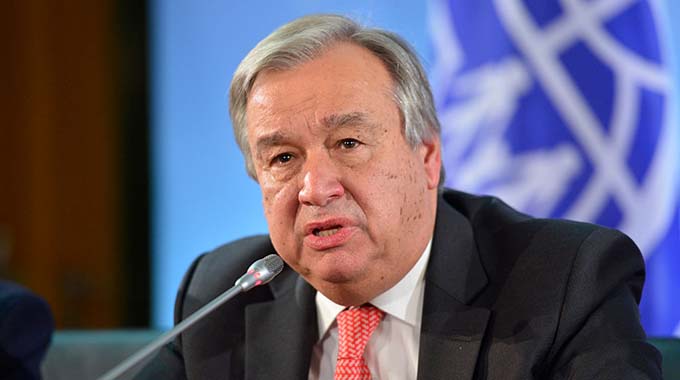
UN Secretary-General Antonio Guterres

In a statement yesterday, Foreign Affairs and International Trade Minister Dr Sibusiso Moyo said the removal of sanctions was essential.

“The two leaders encouraged the waiving of sanctions imposed on countries like Zimbabwe to ensure that they access food, essential health supplies and Covid-19 medical support,” he said.

“The Government welcomes the UN observation that sanctions have a debilitating impact on the health sector and that, in the context of a global pandemic, impeding medical efforts in one country heightens the risk for all of us. It must be recalled that this has always been Zimbabwe’s, SADC’s and the AU’s message.”

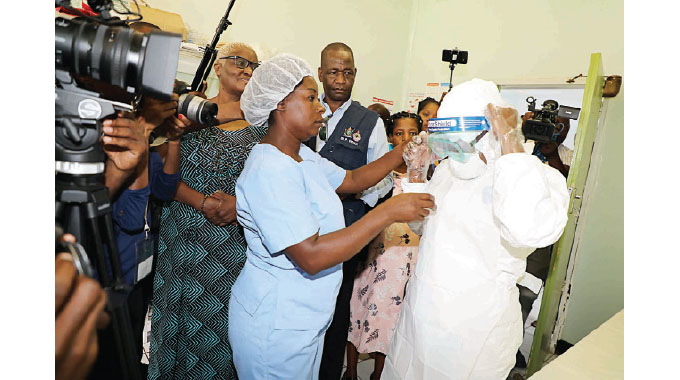
The Health and Child Care Parliamentary Committee chaired by Dr Ruth Labode (left) tours Wilkins Hospital to assess preparedness towards coronavirus while being led by City health director Dr Prosper Chonzi recently

Minister Moyo said many countries had acknowledged that sanctions were contrary to the UN Charter and the principle of the sovereign equality of states.

He said the sanctions undermined international free trade by interfering with the right of third party countries and private entities to make their own decisions on trading with the affected countries.

“It is common knowledge that the performance of the Zimbabwean economy has been constrained due to the phenomenon of sanctions which have worked to worsen the socio-economic environment, with the poor and the vulnerable groups being the hardest hit,” said Minister Moyo.

He said Zimbabwe’s access to international credit markets was blocked effectively after the enactment of the Zimbabwe Democracy and Economic Recovery Act (Zidera) and the country can not borrow even in times of dire need.

“As a country operating virtually from hand to mouth, there has been a significant build up in external arrears,” said Minister Moyo. “This unfavourable development in the external sector has worsened the country’s creditworthiness as the country’s risk profile was heightened.

“Zimbabwe’s ongoing watershed reforms meant to turnaround the fortunes of the country, after decades of decline, are taking place in this most unsupportive environment.”

Zimbabwe’s private sector is bearing the brunt of the sanctions, as they find it difficult to access offshore lines of credit because of the perceived country risk.

The few that get the lines of credit are usually charged punitive interest rates.

Minister Moyo said the impact of the sanctions on the country was worse during a crisis such as the Covid-19 pandemic, with the country’s Strategic Preparedness and Response Plan severely hampered.

“The capacity to import test kits, medicines, face shields and other protective kits has been limited. Even the private sector, which has a strong tradition of ploughing back into the community, has not been able to respond massively to this pandemic,” he said.

The post Zimbabwe welcomes UN call for sanctions removal  appeared first on Zimbabwe Situation.

Zimbabwe’s white farmers angered by ‘racist’ edict 

The farmers are demanding nearly $7 billion in compensation for their properties. Source: Zimbabwe’s white farmers angered by ‘racist’ edict – The East African Lawyer David Drury leads a group of white Zimbabwean commercial farmers, on trial for resisting eviction from land targeted for seizure, into Chegutu Magistrates Court outside Harare, February 5, 2008. PHOTO […]

The post Zimbabwe’s white farmers angered by ‘racist’ edict  appeared first on Zimbabwe Situation.

The farmers are demanding nearly $7 billion in compensation for their properties.

Source: Zimbabwe’s white farmers angered by ‘racist’ edict – The East African

Lawyer David Drury leads a group of white

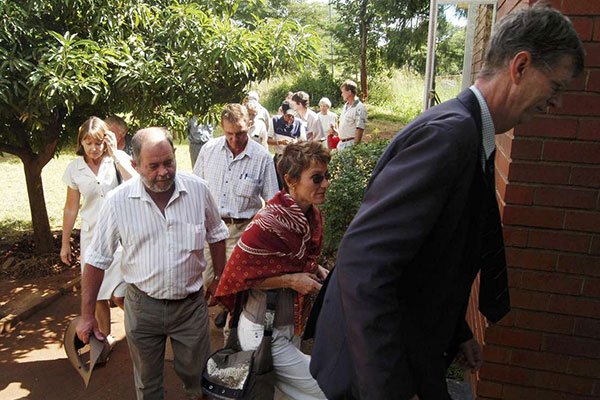
Lawyer David Drury leads a group of white Zimbabwean commercial farmers, on trial for resisting eviction from land targeted for seizure, into Chegutu Magistrates Court outside Harare, February 5, 2008. PHOTO | PHILIMON BULAWAYO | REUTERS

A fortnight ago, President Emmerson Mnangagwa’s government a said it was offering about 800 commercial farms as compensation to farmers who had lost their land during the violent land seizures that began in 2000 under then President Robert Mugabe.

The offer sparked heated debate in parliament, with legislators demanding that for it to be viable, the country’s constitution had to be changed to reverse the land reform programme.

The Sadc Tribunal Rights Watch, a group that had successfully challenged Mugabe’s land seizure in international courts, however, now says the new regulations to apparently restore farms to their owners “are misleading and provide false hope to dispossessed farmers, many of whom are now destitute.

The group, representing nearly 4,500 dispossessed commercial farmers, said the new regulations only affect ‘’indigenous’’ farmers and foreigners protected by Bilateral Investment Promotion and Protection Agreements (BIPPAs) and Bilateral Investment Treaties (BITs).

Misleading

The farmers are demanding nearly $7 billion in compensation for their properties.

Ben Freeth, the Sadc Tribunal Rights spokesperson, said the farmers will reject government’s offer because it was racist and did not offer dispossessed farmers any legal protection.

“Regrettably, this piece of misleading legislation is another attempt at window dressing to make it appear that the Zimbabwe government is going to return farms to their owners and re-establish property rights – but this is not the case,” Mr Freeth said.

“More than 40 years after Independence, one would legitimately expect that Section 56 of our Constitution concerning ‘equality and non-discrimination’ would apply with full force.

“The reality is that so-called ‘indigenous’ Zimbabweans have more rights than ‘white’ citizens who have been deprived of their homes, businesses and livelihoods, as well as compensation for their losses.”

He said the regulations also favoured foreign land owners whose farms were covered under BIPPAs and BITs as the white Zimbabweans who were violently thrown out of their farms during the Mugabe era.

“As such, this legislation is discriminatory,” Freeth said. “It also goes against the Southern African Development Community (Sadc) Treaty and the landmark Campbell Case judgment of November 2008 in the SADC Tribunal, the regional human rights court.”

The Sadc Tribunal ruled that Zimbabwe violated the regional body’s treaty by denying the dispossessed farmers access to the courts. It also said Zimbabwe’s land reforms discriminated against the southern African country’s white minority population.

“Discriminatory laws can quickly lead to institutionalising racial discrimination. We need to do everything we possibly can to test these counterproductive laws against our Constitution and international law,” said Freeth.

“Furthermore, the government cannot convince international investors from countries like the UK ̶ who are discriminated against because there’s no bilateral investment treaty ̶ that Zimbabwe is a secure investment destination when it fails to respect the rights of both international investors and its own citizens.”

Protected

Some of the dispossessed farmers were from Germany, Netherlands and Switzerland, and whose properties were protected by treaties between Harare and Western countries.

“While the regulations do not define the meaning of the term ‘’indigenous,’’ the government has consistently referred to ‘’black’’ Zimbabweans exclusively as ‘’indigenous’’ persons,” the Sadc Tribunal Rights Watch said.

“This is despite the fact that the standard definition of ‘’indigenous’’ applies to persons born and residing in a particular place or region, and is not exclusive to a particular race, gender or ethnicity.

“A significant number of the dispossessed white farmers were born in Zimbabwe and many were second, third or even fourth generation who knew no other home,” the group said.

Agriculture minister Perrance Shiri said 440 farms belonging to ‘’indigenous’’ people were seized during the land reform programme.

Mr Shiri said 350 of the farmers were still on the acquired land while 90 farms had resettled people, but the Sadc Tribunal Rights Watch said only three black farmers were forced off their land.

For years, Zimbabwe has ignored rulings by regional and international courts compelling it to reverse the takeover of farms protected by BIPPAs and BITs.
The International Centre for Settlement of Investment

Disputes (ICSID) – part of the World Bank Group – in 2009 and 2015 ruled against Zimbabwe in cases involving Dutch farmers.

In 2008, the now defunct Sadc Tribunal ruled that Zimbabwe’s land reform programme was patently racist and Harare was ordered to compensate the dispossessed farmers.

“The reason that BIPPA and BIT-protected properties are now being considered for compensation is that the bankrupt government needs the support of foreign donors and international lending institutions,” the Sadc Tribunal Rights Watch added.

The EU, Britain and the US put the issue of compensation of the white commercial farmers as one of the pre-conditions for re-engagement with Zimbabwe after Mugabe’s fall in a military coup in 2017.

International lenders such as the International Monetary Fund and the World Bank have also emphasised that Zimbabwe must compensate the dispossessed land owners if it wants loans.

Mr Mugabe, who had ruled Zimbabwe since Independence from Britain in 1980, championed the land reform programme saying it was meant to correct colonial injustices.

Critics, however, say the government parcelled the productive farms to ruling party officials and supporters who had no interest in farming.

A land audit initiated by President Mnangagwa showed that a number of top politicians owned multi-farms that remained underutilised. Some of the multiple-farm owners include Mugabe family members. President Mnangagwa hinted late last year that former first lady Grace Mugabe owned at least 16 farms.

He said the farms would be taken back in line with the government’s “one family, one farm” policy. The government has also been seizing farms owned by Mugabe’s loyalists who fled into exile during the military coup.

The agrarian reforms led to the collapse of the country’s agriculture-based economy and cased mass food shortages that persist to date. Aid agencies say at least eight million Zimbabweans or half the population will need food aid this year after consecutive seasons of poor harvests.

The post Zimbabwe’s white farmers angered by ‘racist’ edict  appeared first on Zimbabwe Situation.

White Africans 

When my Great grandfather came out to South Africa in 1877 as a Baptist Pastor, I am sure he did not regard this as a long term move. A year later his wife joined him in the Eastern Cape and they never returned to their beloved Ireland. Source: White Africans – The Zimbabwean Eddie Cross […]

The post White Africans  appeared first on Zimbabwe Situation.

When my Great grandfather came out to South Africa in 1877 as a Baptist Pastor, I am sure he did not regard this as a long term move. A year later his wife joined him in the Eastern Cape and they never returned to their beloved Ireland.

Source: White Africans – The Zimbabwean


Eddie Cross

He became very much part of the life of South Africa where people of European extraction had lived for over 400 years. When he died and was buried in the Transvaal, he left behind a family who all went on to live and work in South Africa, my Grandfather going on to play a very significant role in the country, speaking Afrikaans like a native and a friend and colleague to many prominent South Africans in all spheres of life.

My father, started work in the Cape but when the Great Depression struck the country, he moved to Rhodesia in 1933 and remained here until he died. In fact, he never held any other passport than that of what was Rhodesia and then Zimbabwe. He never left Africa for any purpose. I was born in 1940 and have lived in Zimbabwe on a continuous basis ever since. All my education was here and my entire working life has been in Zimbabwe. We know no other home.

Yet when I was growing up, even though 95 per cent of the population was of a darker complexion and had a cultural background totally different from my own, to me the only truly indigenous people I knew were our domestic workers. Even then they were just shadows without personality or character – just servants who from the age of about 2 would call me Inkosaan and take orders from me. As a young white African I grew up in a segregated world with little or no contact with the majority population and certainly not at a personal level. When I married my wife at the age of 23, she, although totally raised in Africa, including Zambia, had never shaken hands with a black man.

It was only when I went to the University of Rhodesia and Nyasaland that I encountered people of a different colour to myself who were my equals in every way. It was a shock but I quickly adjusted and made friends from all quarters of the country. It was an encounter with a young radical, who had just returned from Training in Algeria, that my transition was made complete. Through his eyes I saw the conditions under which the majority were living and understood the pain of second class citizenship and discrimination in every sphere of life. He became a Christian and I became a radical. Quite a swop.

The rest is history – struggle, conflict, international intervention and transition. We emerged out of this period as Zimbabwe with a new democratically elected Government where the local population of African extraction was, for the first time since 1890, in charge.

By this time the white populations of Kenya and other African States that had come to Independence from their former colonial masters, had shrunk to insignificant levels. The great majority of people with foreign passports and origin had returned to their home countries or migrated to countries where the majority of the population looked like them. In Zimbabwe this process was well underway by the time we came to Independence in 1980, it hesitated for a short while and then resumed. By 1990, less than third of the people of European extraction remained in the country.

In South Africa the situation was very different – there was a much larger population of people of so called “mixed race” and of European extraction. They had been there for nearly 600 years and were deeply entrenched. Half spoke an African language, Afrikaans, that is only spoken in South Africa and is a mix of many languages. Today, even 26 years after Mandela came to power, there are perhaps 5 million “white” people and even more people of mixed race.

We generally fall into two broad categories – those that remain because of ties to the land or assets and those who chose to remain. I fall into the latter and we as a family made that decision (it is a decision) in 1976 after our first family holiday to Europe where we found, to our surprise, that we were not at home there, we were strangers.

We are remnants of the colonial powers efforts to dominate and control and exploit for their own benefit, the resources of the new World. They ruthlessly carved up Africa and subjugated the people, bringing with them all sorts of things that were totally foreign to Africa. Education, health services, law, constitutional government, limited forms of democracy, Christianity, racial restrictions and exclusions, foreign languages, literature, modern arms and organisation. Suppressing the indigenous languages, cultures and religion and making all decisions – often with little or no consultation with the majority population. A sense of racial superiority and implied inferiority.

Now with Independence we had to face the reality that in African culture things are done differently, that we had failed in our most important responsibility – that of preparing the majority for their responsibilities when they came, as inevitably they would, to power. The result has been a total mess. We tend to forget that in many African countries the colonial powers left behind situations where only a handful had education and even fewer experience in how to run a modern economic system. They have had to gain those things by making mistakes – of which there have been many.

But gradually, actually the process is quite fast by historical standards, Africa is growing up and increasingly able to stand on its own in a very tough and competitive world. Africans have more confidence in themselves and are starting to take their place in the global economy as players.

But what of the White Africans? Actually we are anything but white – pink or brown would be more apt. We are still here and still a bit lost but finding our feet. Last night Janet Cawood died on her Ranch, Kleinbegin in the Beitbridge District. She and her husband Sam, settled in the District many years ago and were in every way outstanding examples of men and women who had made their homes here. Both spoke Venda fluently, both had families with deep roots in Africa going back hundreds of years, both loved their land and their country and its people. They were deeply respected by the local tribal leadership and played a key role in the general welfare of the Community. Building schools and clinics and providing care and services to all.

Many people of European extraction live like that and in no way can anyone argue that they are not Africans – they are and should recognised and treated as such. But we have much penance to pay for our past, but also should be recognised for what we achieved in such a short time. We have to accept we are a minority without power, only influence. We still have a role to play but we need to accept that we are no longer decision makers or in control. Like minorities anywhere in the world and throughout history, we have to look after ourselves and our families. If you cannot do that, you cannot live in Africa, if you can, we still have a life to live and the ability to contribute and in many ways we have a better quality of life here, than almost anywhere else in the world. Most of all, this is, in every way, home.

The post White Africans  appeared first on Zimbabwe Situation.

Spare a thought for vulnerable groups during lockdown

Source: Spare a thought for vulnerable groups during lockdown – NewsDay Zimbabwe ZIMBABWE began its lockdown yesterday following the outbreak of the virulent coronavirus (COVID-19), which has ravaged some countries, with China, Italy, Spain, France and the United States accounting for the highest numbers of fatalities and infections. NewsDay Comment In Africa, several countries implemented […]

The post Spare a thought for vulnerable groups during lockdown appeared first on Zimbabwe Situation.

Source: Spare a thought for vulnerable groups during lockdown – NewsDay Zimbabwe

ZIMBABWE began its lockdown yesterday following the outbreak of the virulent coronavirus (COVID-19), which has ravaged some countries, with China, Italy, Spain, France and the United States accounting for the highest numbers of fatalities and infections.

NewsDay Comment

In Africa, several countries implemented lockdowns, but these were well thought-out in that the governments ensured that the poor and other vulnerable members of society were well taken care of during the lockdown, getting cash pay outs and food hand-outs in some cases.

While we commend President Emmerson Mnangagwa for proclaiming the lockdown as part of measures to halt the spread of COVID-19 in Zimbabwe, our concern is that the move may further impoverish vulnerable groups.

The majority of Zimbabweans are now earning a living in the informal sector, and for the majority, it is just hand to mouth. These draw their sustenance and livelihoods from the informal sector. This lockdown, though necessary from the public health front given the threat posed by COVID-19, should have provided safety nets for these vulnerable groups.

For them, the lockdown is like a death knell because while they will be protected from potential infection, they will be exposed to hunger and death as they are not able to earn a living during this period.

There has been no announcement on an economic plan to cushion the ordinary citizen as yet. Although other countries have already dealt with that, we have not heard of similar plans from our own government, which has not offered any package to assist those that need cushioning.

It is, indeed, critical for government to have a fund for a time as this, but in a country like Zimbabwe, where leaders are more concerned with lining their own pockets than the welfare of ordinary citizens, this may be asking for far too much.

But the COVID-19 outbreak should be a lesson for the future. The Department of Social Welfare, which may have been tasked with such a duty, is also struggling to assist those that currently need a helping hand even without any natural disaster. But what has happened shows it needs capacitation.

It will, however, remain impossible to achieve this as long as individuals with political connections are allowed to continue stealing from the coffers of the country, whose resources should be sufficient enough to build a war chest to be used in times like these.

If the situation remains as is for the next week or so, it won’t be surprising to see these vulnerable members of our society breaking the lockdown in search of food and other amenities. If they had the means, they could have stocked up like their peers ahead of the lockdown.

The post Spare a thought for vulnerable groups during lockdown appeared first on Zimbabwe Situation.