Coal mining, flooding threats for Hwange game reserves

Source: Coal mining, flooding threats for Hwange game reserves | The Standard (Local News) By Oscar Nkala It may have been 19th century adventurism that led American Scout Frederick Rusell Burnham to discover the Hwange coal fields of modern-day Zimbabwe in 1895. Coal mining around Hwange began in 1902, and it has never stopped. Until […]

The post Coal mining, flooding threats for Hwange game reserves appeared first on Zimbabwe Situation.

Source: Coal mining, flooding threats for Hwange game reserves | The Standard (Local News)

By Oscar Nkala

It may have been 19th century adventurism that led American Scout Frederick Rusell Burnham to discover the Hwange coal fields of modern-day Zimbabwe in 1895.
Coal mining around Hwange began in 1902, and it has never stopped.

Until 2010, the partly State-owned Hwange Colliery Company Limited (HCCL) enjoyed a virtual monopoly, supplying coal for power generation, business and domestic consumption.

A century later, modern exploration has found larger coal deposits inside Hwange National Park (HNP), sparking a scramble for mining licences in the game reserve.

Hwange National Park is Zimbabwe’s major tourist drawcard, which hosts rare plant and wildlife species.

Hwange is home to over 100 mammalian and 400 bird species.

These include elephant, rhino, lion, giraffe buffalo, leopard, antelope, impala, kudu and eland, among others.

The game reserve and HCCL co-existed while pursuing two different land-uses until 2009 when the coal miner announced plans to boost production by expanding into six new concessions deep inside the game reserve.

However, the HCCL expansion drive worries tourism operators who fear the expansion of coal mining will scar the land and destroy wildlife habitats.

They are concerned that coal mining will pollute the air, environment and water resources while tearing up pristine forests to make way for roads, mines and worker housing.

Despite their concerns, the scramble for coal mining concessions has not slowed down.

According to the Mines and Mining Development ministry, 85 coal prospecting licences were received between 2010 and 2019.

To date, 28 prospecting and mining licences have been granted in wildlife areas in Hwange, Lower Dete and the Gwayi Conservancy.

In addition to HCCL, Makomo Resources, Zambezi Coal and Gas, South China Mining, KW Blasting, Western Coal, China Africa Sunlight Energy and Chilota Colliery have also been granted mining licences.

Zimbabwe Zinghxon Coking Company, Appex Mining, Glotech Engineering, Clidder Mining, Discovery Investments, Coal Brick and Mackrock and Sable Mining also hold mining licences in Hwange National Park, Gwayi and Lower Dete Valley game reserves.

However, only Makomo Resources, Zambezi Coal and Gas, Galpex as well as HCCL have started mining the new concessions. The rest are at various stages of exploration and development.

Capitalising on new coal concessions inside the park, HCCL aims to boost production from a monthly average of
75 000 tonnes per month in 2019 to
110 000 per month in 2020.

Makomo Resources plans to raise monthly output from 85 000 tonnes in 2019 to 120 000 tonnes per month this year.

Zambezi Gas and Coal is aiming to double output to 60 000 tonnes monthly in 2020.

All four are active members of the Coal Producers Association (CPA), which is angling to meet a production target of 20 million tonnes in 2020, up from 10 million tonnes in 2019.

However, tour operators fear such growth targets will be achieved at their expense.

In terms of Zimbabwean law, mining is a strategic sector which takes precedence over any other land use.

The law also states that no exploration or mining activities can commence without Environmental Impact Assessment (EIA) certification.

Six new coal mining licences have been granted in Gwayi.

The biggest is Liberation Mining Private Limited, located on Special Grant 4 977 in Bulawayo mining district covering Hankano, Gwayi, Mazwa and Gundwane farms.

Its four mines of the Lubimbi Coal Fields hold a combined underground resource estimated at 22 billion tonnes. Gwayi-Dete-Hwange Safari Operators Association chairman Langton Masunda said coal mining will kill the animals, the local communities and the tourism industry.

“Photographic safari operations inside Hwange have dropped since 2010 when Makomo [Resources] started mining up the Sinamatella area,” Masunda said.

“The introduction of blasting, heavy equipment movements and human settlements caused noise and air pollution which forced out the elephants, buffaloes and plains game that previously lived there.

“That migration permanently upset the natural distribution of wildlife in Hwange, causing massive losses to safari operators.

“Tourists who used to come to Sinamatella for the wildlife experience do not visit anymore because it is now an industrialised excursion instead of the undisturbed nature they pay to see.”

Besides killing the tourism sector, Masunda believes coal mining in Hwange National Park poses new public health hazards arising from the contamination of rivers and underground water resources and chemicalised air pollution.

“Wherever it occurs, coal is a major pollutant,” he added. “It contains benzene, tar, ammonia and several other chemicals which poison the water and environment enough to make it unhealthy for both people and wildlife in the vicinity.

“Polluted water kills wildlife and people. It affects wildlife breeding patterns and causes forced migrations.

“Any outward displacement of animals from natural habitats worsens the human-animal conflict as the animals move to human settlements.”

Tourism operators want the government to weigh the benefits of mining against the tour industry in order to determine the most sustainable land-use for mineral-endowed wildlife areas like Hwange National Park.

“Coal takes up to two million years to form, but runs out within a short time, often leaving ravaged and poisoned environments behind,” Masunda added.
“It’s non-renewable, but wildlife is.

“Where coal mining destroys the environment, wildlife tourism keeps the environment natural.

“So our position is ‘no’ to mining or any transformative activity in wildlife areas.”

Apart from mining, the Gwayi Conservancy and parts of southern Hwange National Park will be submerged upon the completion of the Gwayi-Shangani dam 37km downstream of the conservancy.

The dam is a critical component of the Matabeleland Zambezi Water Project, a century-old government project to channel water from the Zambezi River to Bulawayo, about 330km to the south.

When complete, the dam will have a water throwback zone of 75km, which will submerge the entire Gwayi and Lower Dete Valley wildlife areas.

“We are only 37km from the dam wall. That means all animals in Gwayi and most of southern Hwange National Park will drown with us. So will all six new coal mines within a 40km radius of the Gwayi-Shangani dam wall,” Masunda said.

“When the dam fills up, the mines will be drowned and release chemical pollutants into the water, rendering it unusable.

“So, the dam project must stop because it will kill local livelihoods, the wildlife, the environment and the tourism industry.”

According to a research paper published by the Minerals and Sustainable Development Project of the University of Zimbabwe and the Southern Africa Geology Department in August 2001, environmental impacts of mining include changes in topography, surface drainage and long-term soil compaction.

Mining also induces ground subsidence, changes in vegetation cover, surface water pollution, increased salt content, acidity and reduced alternative land-use capacity.

“The surface effects of underground mining are mostly associated with localised subsidence, sinkholes, rock bursts and earth tremors, while roof collapse of shallow underground room and pillar coal mine seams can promote spontaneous combustion in the residual coal.

“Mining operations have several adverse hydro-geological impacts including changes to local (and sometimes regional) groundwater dynamics in terms of both quality and quantity of water as well as its direction of flow,” reads the paper entitled An Overview of The Impact Of Mining and Mineral Processing On Water Resources and Water Quality in The Zambezi, Limpopo and Olifants Catchments in Southern Africa.

Most changes in groundwater quality are linked to de-watering when mines extract large volumes of underground water to improve mine safety.

“The environmental effects of de-watering include lowering water tables, formation of sinkholes and localised [ground] subsidence,” the paper says.

“More hydrological impacts result from improper placing of open-cast and waste disposal facilities such as tailings dams and slurry pounds on the surface or in open pits.

“This gives rise to seepage, which decreases water quality and changes the rate and direction of groundwater movement.

“In general, mining processes release environmental pollutants that were previously immobile.

“Potential sources of acid mine drainage include surface run-off from open-cast mines, seepage from leach ponds, run-off from residue dumps and drainage from underground mines.

“Water quality changes are the most significant consequence of mining activities,” the paper stated.

Further, the research found that constructing and erecting mining infrastructure caused large-scale alteration of landscapes, landscape fragmentation and the dispersal of biological habitats and wildlife populations and ecosystems.

Other impacts include the release of wind-borne dust, gases, radioactive and metallic vapours which are primarily related to health and ecosystems damage.

In a July 2016 report titled Environmental Impact Assessment Report for Hwange Coal Mining: Special Focus on Hwange Colliery Company, the Centre for Natural Resource Governance (CNRG) said mining had ravaged the environment while polluting the air and aquatic systems in Hwange.

“Soil and land degradation from mining has disrupted the aesthetic elements of the landscape, resulting in unnatural and discontinuous configurations, while underground smouldering of coal often produces fires which have detrimental long-lasting economic, social and ecological impacts,” CNRG said.

Hwange residents reported a high frequency of ground sink or collapse incidents, which damaged critical infrastructure and buildings.

Hydric contamination and chemical water pollutants were also found to be seeping into the Deka river ecosystem from HCCL mines.

A tributary of the Zambezi, the Deka supplies water to thousands of people and livestock downstream from the coal mines.

“A swamp has formed in the mining area as a result of the disruption of soil formations by mining.

“This has resulted in Acid Mine Drainage (AMD) of the Deka, posing severe health hazards for humans and animals.

“Viral food poisoning is a common concern as all crops grown along the river are contaminated with pollutants,” reads part of the CNRG report .

The study also found that women in Hwange were collecting the acidic coal dust and slurry from the river for sale as a sexual stimulant to women elsewhere in Zimbabwe.

This posed the danger of new coal-derived diseases erupting among women.

Due to exposure to coal dust, a high incidence of pneumoconiosis and black lung disease has been recorded among Hwange miners and their relatives.

The people are also at the risk of contracting cardiopulmonary diseases, chronic obstructive pulmonary disease, hyper-tension, lung and kidney disorders.

“Toxic levels of arsenic, flourine, mercury and selenium emitted by coal fires in Hwange spread through the waterways and enter the air and food chains of the people, with harmful general and mental health consequences,” CNRG report added.

In its Fifth National Biodiversity Report submitted to the United Nations Convention on Biological Diversity in 2018, the Zimbabwean government said coal mining had fragmented wildlife habitats around Hwange.

“Mineral exploration in protected areas such as Hwange and Mana Pools has led to land use conflicts with conservancies. For example, conservancy owners are lobbying government to address the harmful effects of mining on wildlife movements and breeding in the Gwayi Valley Conservancy.

“Other concerns relate to potential biodiversity loss caused by permanent transformation of landscapes due to open-cast mining.

“Open-cast mining in the Gwayi and Shangani rivers system has triggered fears of pollution and siltation of waterways, increased and easier access for poachers and expanding encroachment of human populations into undisturbed habitats,” the report stated.

The post Coal mining, flooding threats for Hwange game reserves appeared first on The Standard.

The post Coal mining, flooding threats for Hwange game reserves appeared first on Zimbabwe Situation.

Grand heist: Multi-million Zisco assets stripped as Mnangagwa is sucked in

Source: Grand heist: Multi-million Zisco assets stripped as Mnangagwa is sucked in | The Standard (Local News) news in depth:BY EVERSON MUSHAVA A fresh probe has revealed that the government facilitated a shady US$225 million deal meant to strip the comatose Zimbabwe Iron and Steel Company (Zisco) of its critical assets. The investigation that The […]

The post Grand heist: Multi-million Zisco assets stripped as Mnangagwa is sucked in appeared first on Zimbabwe Situation.

Source: Grand heist: Multi-million Zisco assets stripped as Mnangagwa is sucked in | The Standard (Local News)

news in depth:BY EVERSON MUSHAVA

A fresh probe has revealed that the government facilitated a shady US$225 million deal meant to strip the comatose Zimbabwe Iron and Steel Company (Zisco) of its critical assets.

The investigation that The Standard, carried out in partnership with Information for Development Trust, established that President Emmerson Mnangagwa had full knowledge of the deal and gave it a nod as some of his allies benefited.

Last May, little-known ZimCoke, headquartered in Harare’s Ballantyne Park, paid only $1 as a transaction fee that helped it grab the multi-million dollar coke ovens and an array of other key assets from the integrated steel company.

There is a twist to the scandal, though, as Gift Mugano, the current Zisco board chairperson, is now seeking a review of the deal that his predecessor Nyasha Makuvise’s board seems to have been arm-twisted into approving.

Mugano, it was established, is insisting that the ZimCoke takeover did not adhere to best corporate governance practices and is worried that Zisco will effectively die out if its interdependent units were unbundled in line with the deal.

Mugano was this week adamant that all assets purported to have been taken over by ZimCoke remain on Zisco’s books.

Today The Standard details how the controversial deal never went through tender procedures, was railroaded through Cabinet and deliberately leapfrogged the Zisco board and management amid protests and boycotts.

The colonial government of Rhodesia and Nyasaland established the Rhodesian Iron and Steel Commission (Riscom) in 1942.

Riscom’s name changed to Rhodesia Iron and Steel Company (Risco) in 1967 and, at independence in 1980, it was renamed the Zimbabwe Iron and Steel Company (Zisco).

Documents show that the Zimbabwean government had an 89% stake in the integrated Zisco, with the remainder belonging to numerous, largely unheralded local and regional entities.

The other shareholders are named as Tonexon Investments (Pvt) Ltd, Franconian Investments Limited, Louth Minerals (South Africa), Amzim Iron and Steel Limited, Lancashire Steel (Pvt) Ltd and Zambia Copper Investments Limited.

It could not be immediately established if any of those companies are linked to army generals, but there are indications that unnamed military officers had grabbed some iron ore claims.

A dossier written by Eddie Cross, a former Zisco consultant-turned-board member, on September 26, 2018, months after the ZimCoke deal was signed, noted that the shady ownership of the claims was one of the factors that frustrated a US$10 billion deal with an Indian investor, Essar Africa Holdings.

Essar was in November 2010 roped in to resuscitate the steelworks through a deal that would have seen government shedding off a 60% stake, but the investor packed bags and left quietly five years later.

“No sooner had the ink dried on the deal than the Essar team discovered that they had to deal with a shadowy system of individuals with vested interests,” Cross wrote.

“The iron ore claims that were an essential part of the deal and were listed in the Zisco balance sheet had been ‘transferred’ to individuals, many of them in the military leadership.”

The individuals “demanded hundreds of millions of dollars” so as to surrender the claims to Essar, Cross added, but the investor refused to pay.

Essar, which assumed a liability of US$1 billion, including the US$300 million Zisco debt plus salary liabilities, had pumped in US$60 million for a four-year period.

With the Zimbabwe Revenue Authority on its back for all imported equipment, the Indian firm packed its bags and left, leaving the steel-making giant in ruins.

Government was also blamed for demanding a huge stake in the poorly negotiated deal.

Zisco had the capacity to produce at least a million tonnes of liquid steel from blast furnaces 3 and 4, but stopped operations in 2008 due to power outages, lack of capital to recapitalise and mismanagement.

Cross blamed the collapse on “criminal” incompetence, corruption and sabotage.

Government tried to lure an external investor, Global Steel Holdings, as early as 2004 as Zisco’s misfortunes worsened, but the deal fell through under unclear circumstances.

The search for an investor to sell a streamlined Zisco continued the same year and government brought in other suitors like R&F from China that offered to take over Zisco, but minus the coke ovens and its subsidiaries that included Lancashire Steel.

A ballooning debt to a German bank, KFW GMBH, based in Frankfurt, then forced government to scout for a third party to acquire the coke ovens and produce coke to settle the US$225 million debt in a controversial debt swap that would see Zisco pay the remainder of its overall debt amounting to around US$500 million.

That is when ZimCoke came in.

Cross said when the Essar deal finally collapsed, an unidentified group of people with longstanding links to Zisco discussed the possibility of leasing the coke ovens on site to produce metallurgical coke for the South African market.

The deal that started off as casual talk but was subsequently endorsed by Cabinet during the Government of National Unity, was not subjected to any tender, Cross noted.

“I had a casual discussion with one of the group (sic) and suggested that they consider a debt swap.

“I was on the parliamentary committee dealing with Zisco liabilities and I thought that a deal was possible involving the German bank KFW, which was owed nearly US$200 million for equipment and work on Zisco blast furnaces 15 years ago,” Cross said.

“They said they would be interested and I spoke to the minister of Finance (Patrick Chinamasa), who said it sounded like a good idea.

“In fact, he said to me that he was surprised anyone would want to pay real money for that pile of junk.”

A lean Cabinet committee chaired by Chinamasa was set up, eventually leading to the creation of ZimCoke.

“The decision was made in the context of a Cabinet decision not to try and sell the entire Zisco group, as had been the case with Essar, but to break up the company and do separate deals for each separate operation.

“The ZimCoke takeover was to be the first,” Cross revealed.

ZimCoke was founded by the late Bill Moore, who worked for a South African company, Fosbel, which repairs coke oven batteries.

Moore was contracted to repair Zisco’s oven batteries before his contract was terminated by the coming-in of Essar.

The Indian company intended to come up with new technology to replace the four batteries with 55 ovens each, but again, like the predecessor deals, it died a still-birth in 2015.

Desperate for another investor after government was forced to assume the ever-rising Zisco debt through a Cabinet decision on November 24, 2016, Moore offered to take over the coke ovens and produce coke in a $225 million KFW debt swap.

Moore’s son, Peter, is now the CEO at ZimCoke, while one of its former directors, Philemon Nhachi, now sits on the board appointed on December 11 last year.

ZimCoke negotiated directly with the Ministry of Industry and Commerce and no tendering was conducted, nor was there valuation of assets.

Minutes of board meetings show that neither the Zisco management nor board were consulted before the deal, which started under former president Robert Mugabe when Mike Bimha was Industry and Commerce minister, was agreed.

The deal was later railroaded by Mnangagwa and signed last May when Mangaliso Ndlovu, who refused to comment on the matter, was Industry and Commerce minister, after a series of negotiations between government and the investor without the involvement of Zisco management.

“Outstanding minority shareholders issue, contents of the tripartite agreement between KFW, ZimCoke and government of Zimbabwe were not availed to the Zisco board,” part of the minutes of the May 27 board meeting read, explaining why the board refused to sign for the transfer of assets from Zisco to ZimCoke.

Paper trail shows that ZimCoke was in direct, albeit informal, contact with Mnangagwa as the deal panned out.

In one of the letters by Nhachi that were obtained by The Standard, Mnanagagwa was eager to do a ground-breaking ceremony marking the Zisco takeover.

“This is an essential and urgent part of the process and needs to be completed before the ground-breaking ceremony.

“Informal contact with President Mnangagwa indicates that he would like to perform the ground-breaking and a formal invitation via the Ministry of Industry is in hand,” read part of a letter by Nhachi to the former managing director of Zisco, Alois Gowo, on April 30, 2018.

According to the deal, ZimCoke would use the ovens to produce coke, sell it and pay the KWF debt.

Apart from grabbing the coke ovens, ZimCoke would also take over 400 housing units plus 15 executive houses, 48% shareholding in ZimChem (a strategic subsidiary of Zisco) all refractory materials, which were purchased by the steelworks when it was repairing the batteries, pipes and electrical equipment.

The asset strip would also see Zisco losing granulated slag, which accumulated over the years and is used mainly by cement manufacturing companies, chilled pool iron (pig iron) produced from the furnace and Zisco wagons at the Dabuka hump marshalling yard as well as over 3 000 hectares of land.

There has been a furore over these deal contents, though.

A Zisco official who refused to be named said: “Ziscosteel has sold the houses and now remains with flats.

“So they (ZimCoke) are aiming to take over the flats and in the event Zisco is to be resuscitated, it will now have to rent flats for its workers from ZimCoke.
“The 15 executive houses are all that remains for the Ziscosteel executives.”

Government agreed to the transaction and a signing ceremony was conducted on May 30, 2019, graced by Ndlovu, Local Government minister July Moyo and Midlands provincial minister Larry Mavhima, all considered to be strong Mnangagwa allies.

The signing ceremony was done three days after Makuvise’s board, on May 27, resolved not to sign the asset transfer to ZimCoke, raising several questions about its viability.

The board was dissolved the following day, and the commissioning of ZimCoke came immediately after.

“The board led by Makuvise refused to sign on May 27 and was summoned to Harare that same evening by Ndlovu who, in the company of Finance minister Mthuli Ncube, allegedly ordered the chairperson to sign the asset transfer document on claims that it was a Cabinet decision,” a Zisco insider revealed.

“The very Thursday, which the Makuvise board’s term expired, there was commissioning of the coke ovens project but, suspiciously, the outgoing board did not turn up.”
Minutes of the May 27 board meeting further revealed the Makuvise board was not happy with the transfer of ZimChem, cola wagons and land to ZimCoke.
“Management foresaw challenges in hiving off the ovens from the rest of the integrated steelworks as production processes were very much interlinked and interrelated.

“Of note was the fact that ZimCoke representatives and R&F properties specialists (in coke ovens) had both visited the works on 17th April 2018 indicating the need to resolve the issue urgently,” part of Zisco board minutes of November 30, 2018 read.

And minutes of a board meeting on May 27, 2018 say “the Zisco board resolved not to sign the above letters (transfer of assets to ZimCoke) and wrote to the permanent secretary (Ministry of Industry and Commerce)” citing its reasons.

The Makuvise board was, among other things, miffed by the plan to give special power of attorney to ZimCoke, in addition to the transfer of shares and stock to the suitor.

Allocation of an operating licence number 003883 to ZimCoke by the Zimbabwe Investment Authority on March 13, 2018 was academic.

Government had already approved the deal way back in 2017, as shown in an August 2017 email message from Cross to Daniel Mackenzie Ncube, a ruling Zanu PF functionary. Nicholas Ncube, believed to be Mackenzie’s relative, is now the ZimCoke board chairperson.

*The next installment looks at the viability challenges associated with the ZimCoke deal and how Mnangagwa’s cronies grabbed some Zisco assets.

The post Grand heist: Multi-million Zisco assets stripped as Mnangagwa is sucked in appeared first on The Standard.

The post Grand heist: Multi-million Zisco assets stripped as Mnangagwa is sucked in appeared first on Zimbabwe Situation.
Strict measures to fight Covid-19

Source: Strict measures to fight Covid-19 | Sunday Mail (Top Stories) Sunday Mail Reporters PRESIDENT Mnangagwa has implored Zimbabweans to take maximum precautions to prevent the spread of coronavirus by limiting travel and outdoor activities as the country braces for the introduction of stringent and disruptive public health safety measures to fight Covid-19. Two cases […]

The post Strict measures to fight Covid-19 appeared first on Zimbabwe Situation.

Source: Strict measures to fight Covid-19 | Sunday Mail (Top Stories)

Sunday Mail Reporters

PRESIDENT Mnangagwa has implored Zimbabweans to take maximum precautions to prevent the spread of coronavirus by limiting travel and outdoor activities as the country braces for the introduction of stringent and disruptive public health safety measures to fight Covid-19.

Two cases of Covid-19 had been recorded in Zimbabwe as of yesterday afternoon, according to Health and Child Care Minister Dr Obadiah Moyo.

The first case, announced on Friday night, was of a Victoria Falls resident who recently returned from Manchester, the United Kingdom, while a 30-year-old man who visited the United States in February also tested positive yesterday.

In an interview with The Sunday Mail soon after arriving in Harare from Windhoek where he attended the inauguration of Namibian President Hage Geingob yesterday, President Mnangagwa said confirmation of the two cases obliges the country to adopt stern measures to fight the pandemic.

“We appeal to all Zimbabweans to restrict their movements. We can only move for essential and critical reasons. Otherwise we recommend that our communities, both urban and rural, remain where they are and not travel. The spread of this pandemic is so quick and fast, so we are appealing to our people to avoid travelling. Let us keep at home and only move either to buy food or medicines.

“I will discuss with my Minister of Health to hear the circumstances surrounding these two cases in order to take corrective measures to contain the spread of Covid-19.”

Some of the stringent measures set to be introduced to combat Covid-19 include mandatory screening at all public buildings and temporary closure of overcrowded informal markets.

Government has now directed local authorities to increase potable water supply, drill additional boreholes and decongest informal and formal markets.

Also, police are intensifying a clampdown on gatherings of more than 100 people at public spaces, churches, funerals and recreational places.

Government is not discounting the possibility of citywide lockdowns should there be a large-scale localised outbreak.

President Mnangagwa announced the introduction of mandatory screening at all Government-owned premises while launching Government’s US$26 million Covid-19 National Preparedness and Response Plan on Thursday.

“Our preparedness measures have been stepped up through heightened surveillance systems at national, provincial and district levels. We have special focus on all ports of entry throughout the country with mandatory screening of visitors having already started and all our Government buildings and infrastructure should be screened with immediate effect,” said President Mnangagwa.

Announcing the second confirmed case at a press conference in Harare yesterday afternoon, Dr Moyo said the man was admitted into isolation at Wilkins Hospital on Friday after exhibiting mild symptoms of Covid-19.

“Today the 21st of March 2020, the national microbiology reference at Sally Mugabe Central Hospital reported yet another case of Covid-19, which brings to two the number of Covid-19 cases in Zimbabwe,” he said.

“This second patient is a 30-year-old male resident of Harare who had travelled to New York, United States of America, on the 29th of February 2020 and returned home in Harare on 9 March via Johannesburg.”

The man, said Minister Moyo, was advised by his doctor to self-isolate at home before the doctor alerted the local Covid-19 Rapid Response Team which went to assess him.

“Our teams are now engaged in contact tracing and as with the first case, are being assisted by the patient himself. Once again, we call upon everyone to remain calm as we manage these confirmed cases of Covid-19 in Zimbabwe.”

As part of the nationwide response, The Sunday Mail has gathered that some private companies have begun asking their employees to either work from home where possible or report for duty in small groups.

According to the national preparedness and response plan, Government has a plan for four transmission scenarios: the no case scenario; sporadic cases scenario; cluster of cases scenario and the community transmission scenario, which is the highest level.

While the no case scenario has already been overtaken by events — the main aim of this stage was to stop transmission and prevent spread. During this phase, authorities would among other things prepare to treat patients, ready hospitals for a potential surge and promote self-isolation of people with mild respiratory symptoms.

Zimbabwe is now at the sporadic cases scenario — this is when the country has recorded one or more cases either imported or transmitted locally.

Here authorities will test all suspected cases and all contacts of confirmed cases, and at this stage treatment of cases will commence while self-isolation of suspected cases is heightened.

The third stage, cluster cases scenario, is when the country has cases of local transmission. Here emergency response mechanisms will be scaled up, while active case finding is intensified and contact tracing and monitoring, quarantining of contacts and isolation of cases begins.

Authorities will: “Enhance triage procedures, activate surge plans for health facilities, designate referral hospitals, defer elective procedures. Promote self-isolation of people with mild respiratory symptoms to reduce the burden on health systems,” reads the response plan in part.

The community transmission scenario is when the country would have large outbreaks and is unable to relate confirmed cases through chains of transmission for many cases.

At this stage contact tracing is scaled up especially in newly infected areas. Quarantine of contacts and isolation of cases is enhanced while symptomatic individuals are urged to apply self-initiated isolation.

Government has already banned gatherings of over 100 people for the next 60 days, while schools and tertiary institutions will close on Tuesday.

National police spokesperson Assistant Commissioner Paul Nyathi said police had begun patrols to discourage large public gatherings.

“We have teams that are patrolling and monitoring the situation to ensure that there are no gatherings of more than 100 people,” said Asst Comm Nyathi.

“We are also working with the Ministry of Health and Child Care as well local authorities in monitoring the situation at funerals, drinking spots and any other public places.

“We would like to urge members of the public to inform the police of any gathering of more than 100 people. Members of the public should understand that the measures have been put in place for their own safety thus there is a need for them to comply.”

Local Government and Public Works Deputy Minister Marian Chombo said Government has activated all Provincial and District Civil Protection Committees while provision of potable water is being heightened.

“This requires putting in place a raft of measures which look at provision of basic municipal services such as water and repairing all damaged sewer infrastructure,” said Minister Chombo.

“All local authorities have been instructed to make frantic efforts to improve water supply even if it means drilling more boreholes. At areas such as Mupedzanhamo where there is overcrowding, ways and means need to be devised to manage the numbers. The law enforcement agencies must work together with public vehicle operators to maintain distances.”

Health and Child Care secretary Dr Agnes Mahomva said only the President can order citywide lockdowns at the professional recommendation of the Health Ministry.

She said the response plan will continue to be updated as the situation evolves, drawing from the experiences of other countries fighting the pandemic.

“That document is a living document. That is version three from our side. We decided it needed to be launched so that people see it and we continue updating,” said Dr Mahomva.

“So based on the lessons from China and Europe, we continue updating on what then needs to happen, it is not a one size fits all. There is always room for that (a lockdown); we continue looking.

“We are giving the President daily detailed updates. We prepare written Cabinet memos where those kinds of decisions are made. So it is not for us to decide on those (decisions). We give the guidance and then that national decision is made and then we implement.”

Harare City Council acting water director, Engineer Phakamile Mabhena Moyo, said they are frantically working to improve water supplies.

“We have challenges with water treatment chemicals but we are in talks with authorities on how we can deal with that,” he said.

“We are also working on a number of issues such as water infrastructure so that water production increases soon. We are engaging our various partners who have assisted during such emergencies as cholera outbreaks to assist with water tanks to the various hotspots.”

The post Strict measures to fight Covid-19 appeared first on Zimbabwe Situation.

Satisfactory headway on Makuti-Chirundu Road

Source: Satisfactory headway on Makuti-Chirundu Road | Sunday Mail (Top Stories) Walter Nyamukondiwa Kariba Bureau THE ongoing upgrade of the first 6,5km of a 21km stretch along Makuti-Chirundu Road — a vital route on the North-South Corridor linking the country to Sadc, Comesa and East Africa — is progressing well. The project initially hit a […]

The post Satisfactory headway on Makuti-Chirundu Road appeared first on Zimbabwe Situation.

Source: Satisfactory headway on Makuti-Chirundu Road | Sunday Mail (Top Stories)

Walter Nyamukondiwa
Kariba Bureau

THE ongoing upgrade of the first 6,5km of a 21km stretch along Makuti-Chirundu Road — a vital route on the North-South Corridor linking the country to Sadc, Comesa and East Africa — is progressing well.

The project initially hit a snag when contractors failed to secure river sand after Hurungwe Rural District Council (HRDC) demanded sand abstraction fees. However, Government officials in Hurungwe broke the impasse after they indicated the project had been granted national project status.

“The Ministry of Transport and Infrastructural Development indicated that the project had national project status and we agreed that they could go ahead while negotiations are underway, because the community has to benefit as well from this economic activity,” said HRDC chief executive officer Mr Luke Kalavina.

When The Sunday Mail visited the site, workmen were using heavy equipment to chisel part of the Zambezi Escarpment.

Financed under a US$21 million grant from Japan, the project covers the stretch from Marongora to Hellsgate — commonly known as the Tsetse Boom Gate —  and involves constructing climbing lanes and smoothening sharp curves.

It also includes construction of a 70-metre wide road, 35 metres on each side, to ensure fast movement of vehicles, including trucks transporting equipment and other goods to and from ports such as Durban and Beira.

Hairpin curves and steep gradients on the construction stretch have resulted in serious accidents and delays due to slow-moving traffic as loaded trucks struggle with the terrain.

Preparations to construct safety barriers are underway, with two steps being built on the mountain sides on the road, while concrete structures are being embedded in the ground to strengthen the road. Drainage systems were also being installed before road construction begins.

Engineers from Japan and those from the Ministry of Transport and Infrastructural Development are working on the project.

Government has prioritised infrastructure development, with at least five major road projects being supported in each province every year. The Makuti-Chirundu project, which is expected to be complete by year-end, has already created employment for hundreds of people.  Meanwhile, work on the first 10km section of the Karoi-Binga Road, which is being funded by Government, is almost complete, with only priming and laying of tar remaining for the last kilometre.

Gravelling of some sections, including from Magororo to Sanyati Bridge, has already been done by another contractor, which is expected to help in significantly covering more ground.

Tarring is now at Zvipani Business Centre.

Contractors, who include the District Development Fund (DDF), are waiting for priming material to finalise the last kilometre.

“The project is progressing well but intermittent challenges in getting some vital material at times has resulted in delays,” said a worker at one of the contracted companies.

Ward 25 Councillor Edmore Nyamukumba said the road project had prompted the local authority to move a motion to give Zvipani Business Centre Growth Point status.

Mrs Tendai Nebiri of Matau Village said the road would result in reduced costs associated with transporting produce to the market.

“This development has seen transport to our area improving and the gravelling that has taken place has ensured availability of transport to Siakobvu, although it will be much cheaper when it is fully tarred,” she said. It costs $50 from Karoi to Zvipani and $150 to Siakobvu, a distance of about 160km.

The fares are expected drop markedly as more transporters ply the route.

The post Satisfactory headway on Makuti-Chirundu Road appeared first on Zimbabwe Situation.

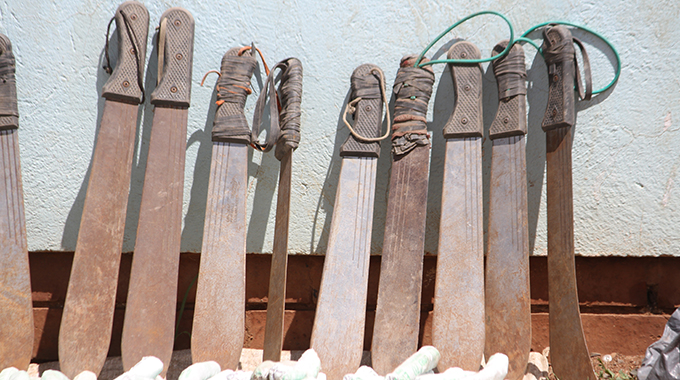
Machete gangsters go underground

Source: Machete gangsters go underground | The Standard (Local News) By Brenna Matendere Hundreds of militias in the gold mining sector who were responsible for waves of terror nationwide have significantly retreated after a recent police clampdown. The militias were notorious for brutal attacks on illegal mining rivals and innocent civilians using machetes, guns and […]

The post Machete gangsters go underground appeared first on Zimbabwe Situation.

Source: Machete gangsters go underground | The Standard (Local News)

By Brenna Matendere

Hundreds of militias in the gold mining sector who were responsible for waves of terror nationwide have significantly retreated after a recent police clampdown.

The militias were notorious for brutal attacks on illegal mining rivals and innocent civilians using machetes, guns and home-made spears.

From early 2019, The Standard, in conjunction with Information for Development Trust, a non-profit making media organisation, carried out a series of investigative and follow-up stories that tracked the machete gangsters’ origins and modus operandi.

The stories outed top politicians who were sponsoring the gangsters, raising security red flags that finally forced the government to mount sting operations that, according to the police spokesperson, Paul Nyathi, led to the arrest of more than 6 000 militias at the time of going to print.

The machete gangsters became pronounced around 2003, manifesting as illegal mining rival groups in Kwekwe that were competing for rich gold pits at the Gaika mine and other gold-rich spots in and around the Midlands city.

Some powerful Zanu PF politicians then took advantage of the fights and backed the rival group that was known as Al-Shabab.

The group was given access to all the rich gold pits it wished and protection from arrest of its members, who assaulted or murdered anyone in a gold-rush.

Other groups then started emerging in similar style around the Midlands province such as Anaconda based in Kwekwe’s Amaveni suburb and Mashurugwi group, which originated at Wonderer mine in the Shurugwi mining town.

At first the Zanu PF politicians held sway over the groups and could even unleash them to torture political opponents ahead of elections.

Over time, the machete gangsters became more independent and by the time the police blitz began a few months ago, the militias were advancing into urban areas, robbing and raping residents.

Last year marked the peak of the militia violence as the gangsters were slowly upgrading to heavy guns banned for private use, in addition to the machetes, spears, knobkerries, catapults and other home-made weapons.

They had spread from the Midlands, President Emmerson Mnangagwa’s home province, to other regions like Mashonaland West, Mashonaland Central, Manicaland and Matabeleland where gold deposits are common.

State security inaction was largely blamed for the fast spread of machete violence, and since the police in early January sent out its troops to arrest illegal gold panners and known militias through an operation called Chikorokoza Chapera (Stop Illegal Mining), citizens are reporting a marked decrease in gang activities, with some saying they have completely gone under.

Nyathi told The Standard that a total of 6 356 machete criminals had been nabbed in the on-going operation.

“At last, we have brought sanity to troubled areas like Mashonaland Central, Mashonaland West, Manicaland and Midlands.

“In those areas, we used to have serious crimes such as murder, rape, robbery and kidnapping,” he said.

“Besides the arrests, we have also managed to arrest criminals who were long on our police wanted list for serious crimes.

“For instance, in Shurugwi, we arrested a criminal wanted for a case of murdering a headman and he also had four other attempted murder cases.”

Journalists in Kwekwe were under siege from the machete gangs and could not exercise their duties freely due to intimidation and abuses by the gangsters for reporting the violence.

But Zimbabwe Union of Journalists secretary-general Foster Dongozi said cases of intimidation had paled into insignificance.

“We, however, hope that the situation will remain like that and we will continue to monitor the situation in Kwekwe just in case media practitioners there wake up to a resurgence of the harassment and abuses by artisanal miners,” Dongozi said.

Settlement Chikwinya, the lawmaker for Mbizo and a repeated victim of the militias, concurred that there was now normalcy in areas where the machete gangsters had turned into warlords.

“It is unfortunate that the police took long to react,” Chikwinya said.

“Worryingly, they knew the perpetrators (of machete violence),” he said.

But the recession in violence has had a downside for some.

Daniel Mabonga, a Shurugwi businessman who spoke to The Standard, said the raids on illegal gold panners had drastically reduced the base of his clients.

“The so-called machete gangs were big money spenders. They could buy all the goods or liquor in a shop at once,” he said.

Anti-Corruption Trust of Southern Africa (ACT-SA) programmes officer Munyaradzi Bhidi urged police to involve communities in order to conclusively end machete wars.

“There is remarkable police visibility and the gangs have gone underground,” Bhidi said.

“While police intervention is commendable, their operation has no ‘community face’ as it is not inclusive enough to incorporate communities and other requisite stakeholders necessary in peace and conflict resolution.

“The mere fact that these gangs have gone underground does not mean that the problem has been solved.”

The post Machete gangsters go underground appeared first on The Standard.

The post Machete gangsters go underground appeared first on Zimbabwe Situation.