Starlink Closes In on Fibre as Zimbabwe’s VSAT Subscriptions Hit Record 86,488

Source: Starlink Closes In on Fibre as Zimbabwe’s VSAT Subscriptions Hit Record 86,488 – Space in Africa Starlink has narrowed the gap to the fibre subscriber base in Zimbabwe, driving the country’s VSAT subscriptions to a record 86,488 in Q1 2026, according to POTRAZ’s Q1 2026 sector report. The figure sits just 17 subscriptions behind the […]

The post Starlink Closes In on Fibre as Zimbabwe’s VSAT Subscriptions Hit Record 86,488 appeared first on Zimbabwe Situation.

Source: Starlink Closes In on Fibre as Zimbabwe’s VSAT Subscriptions Hit Record 86,488 – Space in Africa

Source: Starlink

Starlink has narrowed the gap to the fibre subscriber base in Zimbabwe, driving the country’s VSAT subscriptions to a record 86,488 in Q1 2026, according to POTRAZ’s Q1 2026 sector report. The figure sits just 17 subscriptions behind the country’s 86,505 active fibre connections, marking one of the clearest signs yet of how rapidly Elon Musk’s satellite internet service has reshaped Zimbabwe’s broadband market.
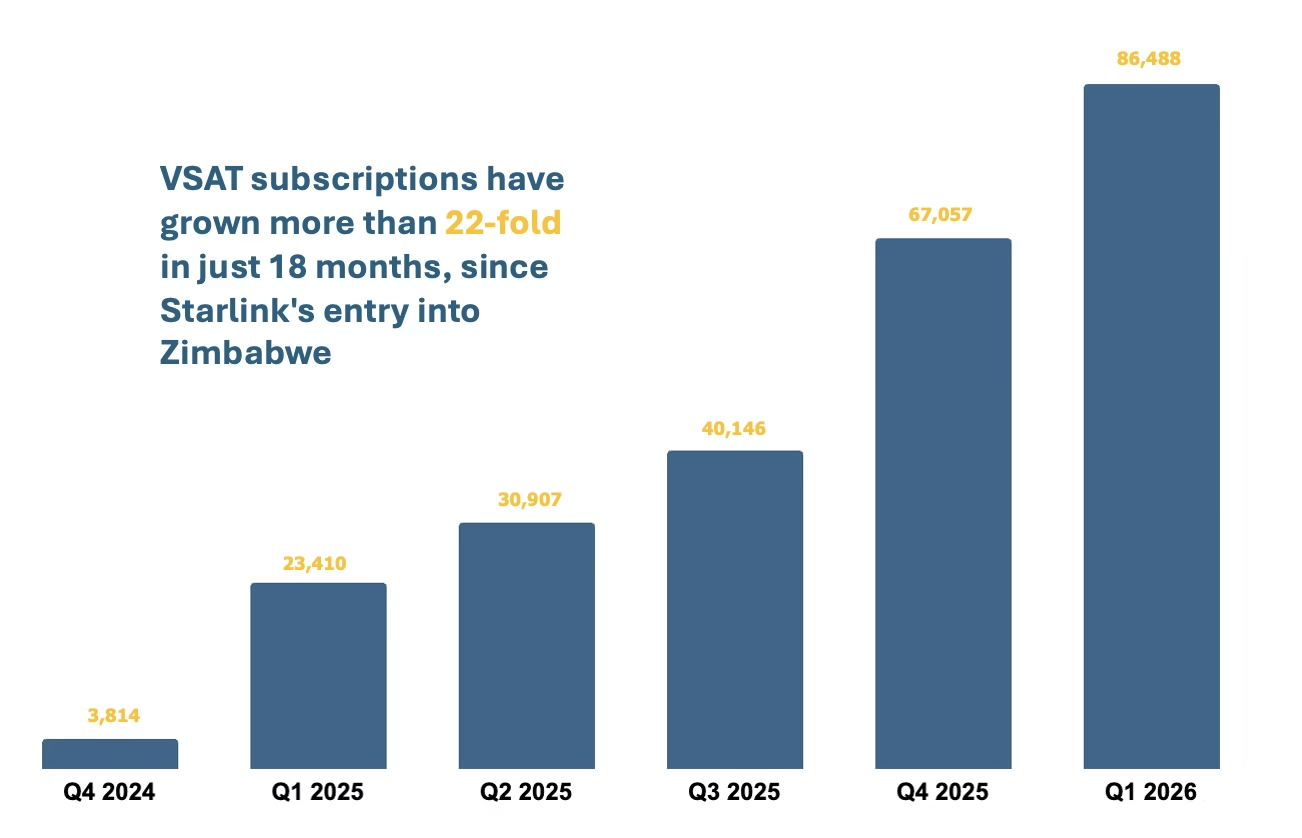
Growth trend in Zimbabwe’s VSAT subscriptions (including Starlink). Data source: POTRAZ. Illustration: Space in Africa.

VSAT subscriptions grew 28.98% quarter-on-quarter, from 67,057 in Q4 2025 to 86,488 in Q1 2026, making it the fastest-growing internet technology provider in the country. That growth rate is nearly three times that of fixed LTE, the second-fastest-growing technology over the same period. Every other provider in the quarter. The pattern points to a shift in consumer preference toward Starlink’s combination of higher speeds and comparatively affordable pricing, and suggests the service is not just adding new broadband users but actively pulling users away from competing options.

Before Starlink’s entry into Zimbabwe, VSAT subscriptions were a negligible slice of the broadband market. In the quarter Starlink launched, the category jumped from 3,814 to 23,410 subscriptions. That step change, sustained across every subsequent quarter, is what allows VSAT subscription data to be treated, but cautiously, as a useful proxy for Starlink’s footprint in the country, even though POTRAZ does not report Starlink subscriptions as a standalone line item.

Starlink’s Growth in Context

Using that proxy, Starlink added 19,431 users in Zimbabwe in the last single quarter alone, a scale of growth that took Kenya, one of the continent’s more digitally advanced markets, roughly 12 months to match. On that single-quarter metric alone, Zimbabwe’s Q1 2026 Starlink subscribers would rank among the largest in Africa, trailing only larger and more established markets such as Nigeria, Zambia, Ghana and Kenya.

The milestone cements Zimbabwe as Starlink’s fastest-growing market in Africa, with its subscriber base recording an average quarterly growth rate of more than 100% since launch. It also gives Zimbabwe the second-largest reported Starlink subscriber base on the continent, behind Nigeria’s 98,642 subscriptions in Q2 2026. However, the comparison is not on a like-for-like quarterly basis. Nigeria’s figure is for Q2 2026, one quarter ahead of Zimbabwe’s Q1 2026 data, while Nigeria’s Q1 2026 subscriber figure was not publicly released by the Nigerian Communications Commission.

That gap, however, is narrower than it looks. Even a modest 20% quarter-on-quarter increase, well below Zimbabwe’s latest growth rate of 28.98%, would put its Q2 2026 VSAT subscriptions at well over 100,000, surpassing Nigeria’s reported Q2 2026 count. At that pace, Zimbabwe would not just be closing the gap with Africa’s largest Starlink market, but would be on track to overtake it.

On a broader scale, Starlink’s subscriber base in Zimbabwe now surpasses that of New Zealand, which recorded 85,000 subscribers in Q2 2026, putting Zimbabwe among Starlink’s larger markets globally. At its current growth trajectory, Zimbabwe could also overtake the UK’s 110,000 subscribers, recorded in Q4 2025. Reaching that level would place Zimbabwe’s subscriber base ahead of a significantly more mature Starlink market, highlighting the unusually rapid pace of adoption in the Southern African country.

Reshaping Zimbabwe’s Broadband Market

Zimbabwe’s fixed broadband market grew from 286,271 subscribers in Q3 2024 to 417,892 in Q1 2026, an increase of 131,621 connections. Satellite accounted for nearly two-thirds of the net increase, adding 82,674 subscribers, while fixed LTE contributed another 66,951. Fibre, by comparison, added just 7,043 subscribers, while DSL lost 14,048 connections over the period.
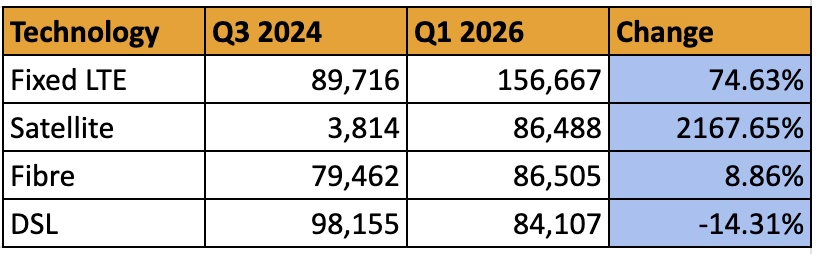
The shift is also becoming evident at the provider level. Starlink has overtaken TelOne’s ADSL subscriber base, underscoring how quickly satellite connectivity has gained ground among Zimbabwean internet users. At the broader technology level, however, satellite and fibre remain neck and neck, separated by just 17 subscriptions.
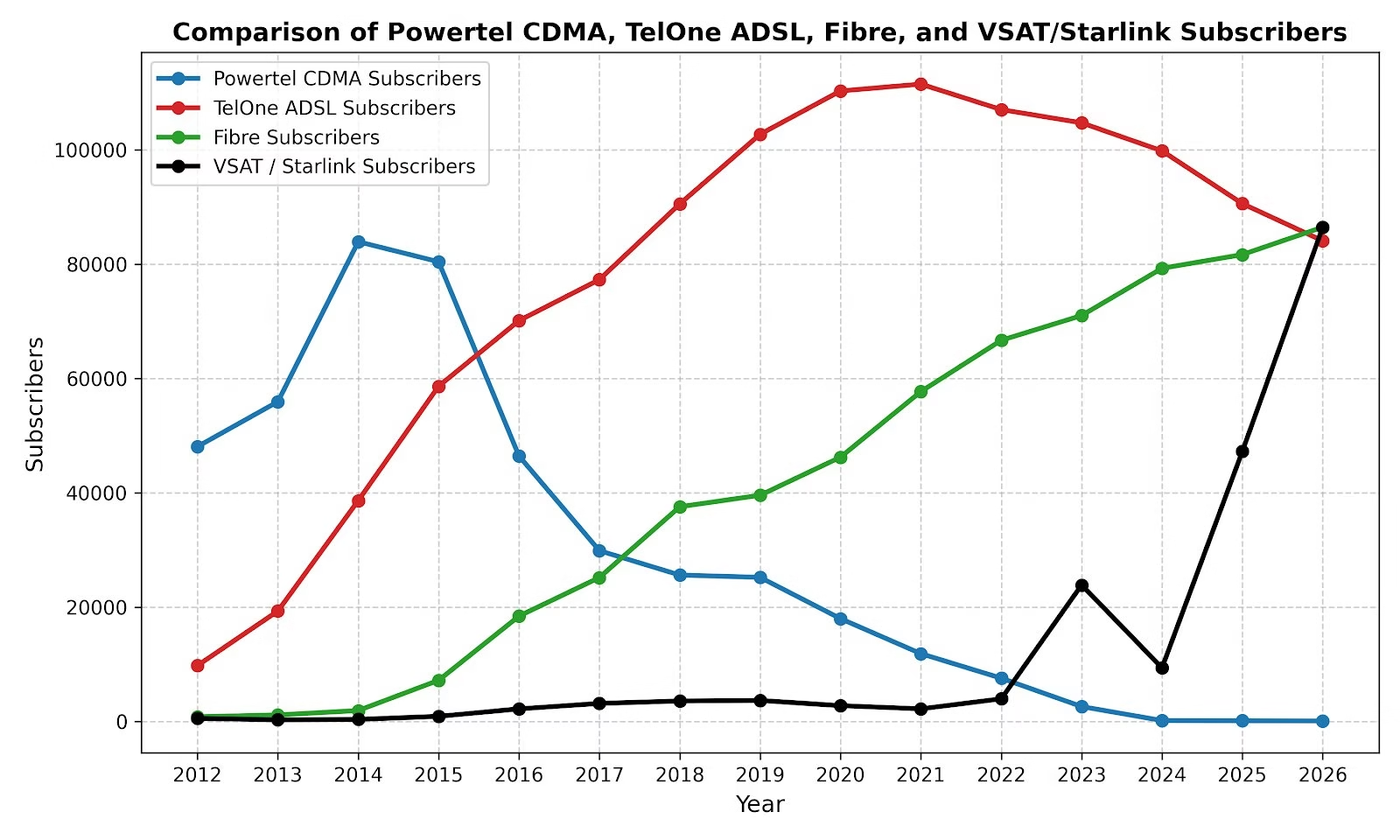
Image courtesy of Willard Shoko. Based on data published in POTRAZ quarterly reports.

That breakdown complicates a simple reading of the data as “fibre being replaced by Starlink”. Fibre did not shrink, but it grew by 7,043 subscribers over the same period, while satellite gained 82,674. That makes the rise of satellite look less like a direct substitution for fibre and more like a combination of two things: the expansion of the addressable broadband market itself and the erosion of DSL’s base, which lost subscribers outright. Consumers appear to be sorting across technologies on price, availability and performance rather than migrating from a single incumbent option.

Why is Starlink Growing So Rapidly In Zimbabwe?

Starlink’s advantage in Zimbabwe is partly rooted in the cost and reach of terrestrial infrastructure. Fibre and fixed wireless networks require infrastructure to reach individual communities and premises, making expansion into underserved areas slower and more capital-intensive. Starlink faces less of this constraint. Once a customer has the required equipment and a clear view of the sky, the service can be activated without waiting for a new terrestrial network to be built. This gives Starlink access to customers that existing providers may be unable to serve, allowing it to add subscribers across a much wider geographic area at a faster pace.

Price has further strengthened that proposition. When Starlink launched in September 2024, its standard residential service cost USD 50 per month for unlimited data, while the Mini plan cost USD 30 per month, with advertised speeds of up to 200 Mbps and 100 Mbps, respectively. At the time, local providers were charging significantly more for comparable unlimited packages. TelOne’s top package was priced at USD 300 for up to 50 Mbps, while Liquid Home’s unlimited fibre package cost USD 439. Econet subsequently introduced an unlimited LTE package for USD 45, with speeds up to 50 Mbps. The gap has since narrowed as local providers responded to Starlink’s entry, but the initial combination of price, speed and nationwide availability gave the satellite service a significant competitive advantage.

The post Starlink Closes In on Fibre as Zimbabwe’s VSAT Subscriptions Hit Record 86,488 appeared first on Zimbabwe Situation.


Masimirembwa pushes to end VP Chiwenga’s political career

Source: Masimirembwa pushes to end VP Chiwenga’s political career … Who controls Zanu PF when Mnangagwa eventually leaves office… President Emmerson Mnangagwa’s ally and Zanu PF Harare Provincial chairman, Godwills Masimirembwa, has tightened the political noose around Vice-President Constantino Chiwenga by endorsing Mnangagwa’s continued leadership beyond the next scheduled party congress.The move could further frustrate […]

The post Masimirembwa pushes to end VP Chiwenga’s political career appeared first on Zimbabwe Situation.

Source: Masimirembwa pushes to end VP Chiwenga’s political career

… Who controls Zanu PF when Mnangagwa eventually leaves office…

President Emmerson Mnangagwa’s ally and Zanu PF Harare Provincial chairman, Godwills Masimirembwa, has tightened the political noose around Vice-President Constantino Chiwenga by endorsing Mnangagwa’s continued leadership beyond the next scheduled party congress.
The move could further frustrate Chiwenga’s long-standing succession ambitions and deepen the factional struggle over who will eventually succeed Mnangagwa.

Zanu PF Harare Province yesterday resolved that the party’s National Congress, currently due in 2027, should be postponed to 2030 to align the party’s electoral cycle with the country’s amended constitutional framework.
More significantly, the province unequivocally endorsed Mnangagwa as its preferred candidate for First Secretary and President of Zanu PF at the next congress in 2030.
“We have resolved that until the next congress he remains President and First Secretary of the party and at that congress he will be our nominee as party leader,” Masimirembwa said at a Zanu PF inter-district meeting in Harare.
The resolution comes against the backdrop of an increasingly bitter succession struggle within Zanu PF, with 2030 emerging as the new political battleground.
The succession question has deep roots in the ruling party. The 2017 military-assisted removal of former president Robert Mugabe followed an intense struggle over who would succeed him, pitting factions around then-Vice-President Emmerson Mnangagwa against the G40 grouping associated with Grace Mugabe.
Then-General Chiwenga played a central role in the military intervention that ultimately brought Mnangagwa to power.
Eight years later, the two men find themselves on opposite sides of another succession contest.
Mnangagwa is constitutionally due to leave office after completing his second term in 2028. However, Zanu PF has pursued constitutional changes that would shift the electoral cycle from five to seven years, effectively moving the next general elections to 2030.
The amendment process has become a major flashpoint between Mnangagwa loyalists and forces perceived to be aligned with Chiwenga.
For Chiwenga, the political danger is not simply that the presidential election could be delayed.
By keeping Mnangagwa at the helm until 2030, his allies could also prolong the President’s control over Zanu PF structures and potentially weaken Chiwenga’s ability to position himself as the natural successor.
Harare’s latest resolution therefore carries significance beyond the party’s constitutional housekeeping.
It effectively signals to the Chiwenga camp that the succession question is being pushed further down the road while Mnangagwa’s political machinery remains firmly in control.
The irony is that Chiwenga himself has become one of the most vocal critics of the political and economic elite he has labelled “Zvigananda” — a term he has used to describe individuals who accumulate enormous wealth through questionable or unexplained means.
In 2025, Chiwenga described Zvigananda as people who grow “big tummies” through ill-gotten wealth and questionable morals, drawing a distinction between them and ordinary citizens and liberation-war veterans.
Chiwenga subsequently used the term to attack what he described as phantom entrepreneurs and politically connected businesspeople whose wealth has no clear economic foundation.
The term has since acquired a wider political meaning, with critics using “Zvigananda” to describe networks of politically connected elites accused of benefiting from state patronage.
That rhetoric has now fed into the broader succession struggle, as rival Zanu PF factions accuse each other of using wealth, patronage and political influence to consolidate power.
Harare Province’s resolutions therefore represent another front in the battle.
The province also endorsed resolutions calling for the Zanu PF constitution to be reviewed and aligned with the amended Constitution of Zimbabwe, including provisions dealing with the tenure and electoral cycles of party structures.
According to the province, the proposed alignment is intended to promote “constitutional harmony, institutional consistency, stability and continuity.”
The province further called for the expeditious implementation of Constitutional Amendment No. 3, which has become central to the dispute over Zimbabwe’s political succession.
Zanu PF Secretary for Education, Research and Ideology Charles Tawengwa said the province had requested that the party constitution be aligned with Amendment No. 3 as part of its draft resolutions to be considered at the party’s annual National Conference.
“I want to commend the provincial structures for supporting the recently enacted Constitution of Zimbabwe Amendment Act No. 3,” Tawengwa said.
He said the resolutions adopted in Harare were intended to advance the party’s programme while supporting the attainment of National Vision 2030.
“The circular is clear; we want new resolutions that further the revolutionary process while also assessing whether our previous resolutions have been implemented,” he said.
Masimirembwa thanked Harare party members for supporting the constitutional amendment.
But beneath the language of constitutional alignment, party unity and Vision 2030 lies a much more consequential political question:
Who controls Zanu PF when Mnangagwa eventually leaves office — and will Chiwenga still be in a position to claim the succession?
With provinces increasingly declaring their support for Mnangagwa’s continued leadership, the answer is becoming less certain for his deputy.
For Chiwenga, the danger is that the succession battle may be decided not at the next election, but gradually through the reshaping of Zanu PF’s structures, alliances and political timetable.
That could leave the general who helped engineer the 2017 transition facing a very different battle — one in which the political machinery he helped bring to power is increasingly being turned against his own succession ambitions.

The post Masimirembwa pushes to end VP Chiwenga’s political career appeared first on Zimbabwe Situation.

Zimbabwe’s failure to pay BEAM exposes the death of its soul!

Source: Zimbabwe’s failure to pay BEAM exposes the death of its soul! I write this piece with a heavy, aching heart. Nelson Mandela famously declared that there can be no keener revelation of a society’s soul than the way in which it treats its children. To directly receive my articles please join my WhatsApp Channel on: https://whatsapp.com/channel/0029VaqprWCIyPtRnKpkHe08 […]

The post Zimbabwe’s failure to pay BEAM exposes the death of its soul! appeared first on Zimbabwe Situation.

Source: Zimbabwe’s failure to pay BEAM exposes the death of its soul!

I write this piece with a heavy, aching heart.

Nelson Mandela famously declared that there can be no keener revelation of a society’s soul than the way in which it treats its children.
 
To directly receive my articles please join my WhatsApp Channel on: https://whatsapp.com/channel/0029VaqprWCIyPtRnKpkHe08

 
It was a profound moral declaration, asserting that a government’s true character is not measured by grand speeches, glittering infrastructure, or high-sounding slogans.
 
But by its commitment to protecting its most vulnerable youth. 
 
By this definition, Zimbabwe’s governance has reached a devastating moral low. 
 
The latest revelations regarding the catastrophic breakdown of the Basic Education Assistance Module (BEAM) expose a state that has not merely failed in its administrative duties, but has effectively abandoned the nation’s children to a cycle of poverty and despair.
 
When a government accumulates an astounding debt exceeding US$292 million in unpaid school fees, exam costs, and educational levies for millions of underprivileged children, it ceases to be a mere fiscal constraint. 
 
It becomes a profound ethical failure. 
 
This staggering total—comprising unpaid dues stretching continuously from 2023 through to 2025—represents far more than numbers on a ledger. 
 
It represents real children, with real dreams, being systematically robbed of their basic human right to education.
 
The defense offered by government officials, citing limited fiscal space and budgetary constraints, rings exceptionally hollow. 
 
This is a nation that never seems to lack funding for luxury government fleets, lavish foreign trips, or costly political jamborees. 
 
The money is always found when it comes to prioritizing elite comfort and maintaining political patronage. 
 
Millions of dollars never run dry when siphoning public funds into scandalous contracts for favoured tenderpreneurs.
 
Yet, when the time comes to settle the bill for the education of a poor orphan in a rural village, the state suddenly discovers that its coffers are empty. 
 
What does it say about a country’s priorities when the luxury vehicles of government officials are fully funded, while the education of millions of impoverished children is treated as an afterthought?
 
The consequences of this neglect are devastating public schools across the country. 
 
School heads are left stranded without operational funds to purchase basic stationery, maintain decaying infrastructure, or buy essential learning materials. 
 
To survive, many public schools are forced to demand fees directly from impoverished families who were placed on the BEAM program precisely because they have no income. 
 
In dozens of mainstream schools, as many as 80 percent of BEAM-supported learners are regularly turned away at the school gate or sent home in humiliation.
 
It is sheer hypocrisy for government ministers to issue empty directives prohibiting school heads from turning away BEAM beneficiaries or withholding their national examination results. 
 
Expecting schools to operate on air while the Treasury sits on a US$292 million debt is both unrealistic and destructive. 
 
The state is forcing school administrations into an impossible position, effectively shifting the burden of its own unpaid debt onto the shoulders of underfunded educational institutions and desperate parents. 
 
Passing the administrative bucket between ministries does nothing to solve the problem; it merely masks a chronic lack of political will.
 
Education is universally recognized as the single most effective ladder out of poverty. 
 
By failing to honor its commitment to BEAM, the government is deliberately kicking that ladder away from those who need it most. 
 
Hundreds of thousands of bright, capable children are being forced out of the classroom, pushed into early marriages, child labor, and substance abuse, or simply condemned to a lifetime of intergenerational poverty. 
 
They are being punished not for any fault of their own, but because their government has chosen to default on their future.
 
A nation that abandons its children to secure the luxuries of its ruling elite has lost its moral compass. 
 
The ongoing BEAM crisis is not an isolated administrative error; it is a mirror held up to a political system that has lost touch with basic human empathy. 
 
Mandela was right about the soul of a nation.
 
And as millions of Zimbabwean children stand outside closed school gates today, the message could not be clearer.
 
Tthe soul of our nation is dying.
 
Tendai Ruben Mbofana is a social justice advocate and writer. Please feel free to contact him on +263715667700 or mbofana.tendairuben73@gmail.com

The post Zimbabwe’s failure to pay BEAM exposes the death of its soul! appeared first on Zimbabwe Situation.

Here are names and ages of people who died in Chivhu kombi accident as death toll rises to 28

Police have released the names of 25 people killed in the Chivhu kombi accident, as the death toll from the head-on collision rose to 28 after another injured passenger died in hospital. The crash happened at about 8.30pm on August 28 near the 132km pe…

Police have released the names of 25 people killed in the Chivhu kombi accident, as the death toll from the head-on collision rose to 28 after another injured passenger died in hospital. The crash happened at about 8.30pm on August 28 near the 132km peg along the Harare-Masvingo Road, close to Honeyspruit Bridge. The commuter […]

The post Here are names and ages of people who died in Chivhu kombi accident as death toll rises to 28 first appeared on My Zimbabwe News.

Newly appointed Supreme Court judge’s son and friends charged with killing and robbing popular Ximex Mall cellphone dealer

Two men accused of taking part in the killing of popular Harare cellphone dealer Sipho Million Ncube have been ordered to mount their defence after the High Court found that the State had presented enough evidence for the case to continue. Elvin Dongo …

Two men accused of taking part in the killing of popular Harare cellphone dealer Sipho Million Ncube have been ordered to mount their defence after the High Court found that the State had presented enough evidence for the case to continue. Elvin Dongo Saungweme and Dellon David Balani had asked the court to discharge them […]

The post Newly appointed Supreme Court judge’s son and friends charged with killing and robbing popular Ximex Mall cellphone dealer first appeared on My Zimbabwe News.