ZACC nabs 5 in airport bribery storm

Prosper Dembedza-Herald Correspondent FIVE Zimbabwe Revenue Authority (ZIMRA) officials appeared in court yesterday on allegations of soliciting bribes from returning residents and visitors at Robert Gabriel Mugabe International Airport. Sithabiso Ncube (47), Aquisilia Mbira (40), Norman Chepi (45), Ratidzo Danda (48), and Tafadzwa Ngwenya (44) were charged with criminal abuse of duty as public officers […]

The post ZACC nabs 5 in airport bribery storm appeared first on Zimbabwe Situation.

Prosper Dembedza-Herald Correspondent

FIVE Zimbabwe Revenue Authority (ZIMRA) officials appeared in court yesterday on allegations of soliciting bribes from returning residents and visitors at Robert Gabriel Mugabe International Airport.

Sithabiso Ncube (47), Aquisilia Mbira (40), Norman Chepi (45), Ratidzo Danda (48), and Tafadzwa Ngwenya (44) were charged with criminal abuse of duty as public officers when they appeared before Harare magistrate Mrs Marehwanazvo Gofa. They were granted US$200 bail each.

The court heard that on November 9, 2026, the Zimbabwe Anti-Corruption Commission (ZACC) received a tip-off from ZIMRA alleging that some of its officials stationed at the airport were unlawfully soliciting money from incoming travellers.

Following the report, ZACC officers went to the ZIMRA Command Centre at ZB Centre, corner First Street and Kwame Nkrumah Avenue in Harare, to view closed-circuit television (CCTV) footage monitoring the country’s ports of entry.

While watching live footage from the airport around 1:30pm, ZACC and ZIMRA officers allegedly observed the five accused soliciting and receiving money from passengers arriving on an Ethiopian Airlines flight.

Acting on the footage, officers went to the airport, identified, and arrested the five suspects. Subsequent searches recovered various sums of money in different currencies and denominations from their handbags, pockets, and persons.

The State alleges that the officials accepted bribes to give travellers preferential treatment, allowing them into the country without producing requisite documentation or undergoing mandatory luggage searches.

Source: ZACC nabs 5 in airport bribery storm – herald

The post ZACC nabs 5 in airport bribery storm appeared first on Zimbabwe Situation.

Zimbabwe’s next banking crisis: will we heed Paraguay’s warning?

Zimbabwe must confront conflicts of interests among public officials and build stronger institutions to protect the public’s savings By Trevor Ncube Zimbabweans should not have to lose their savings again before those in authority confront the dangerous entanglement of political power, banking interests and financial regulation. When a financial institution collapses, the impact reaches far […]

The post Zimbabwe’s next banking crisis: will we heed Paraguay’s warning? appeared first on Zimbabwe Situation.
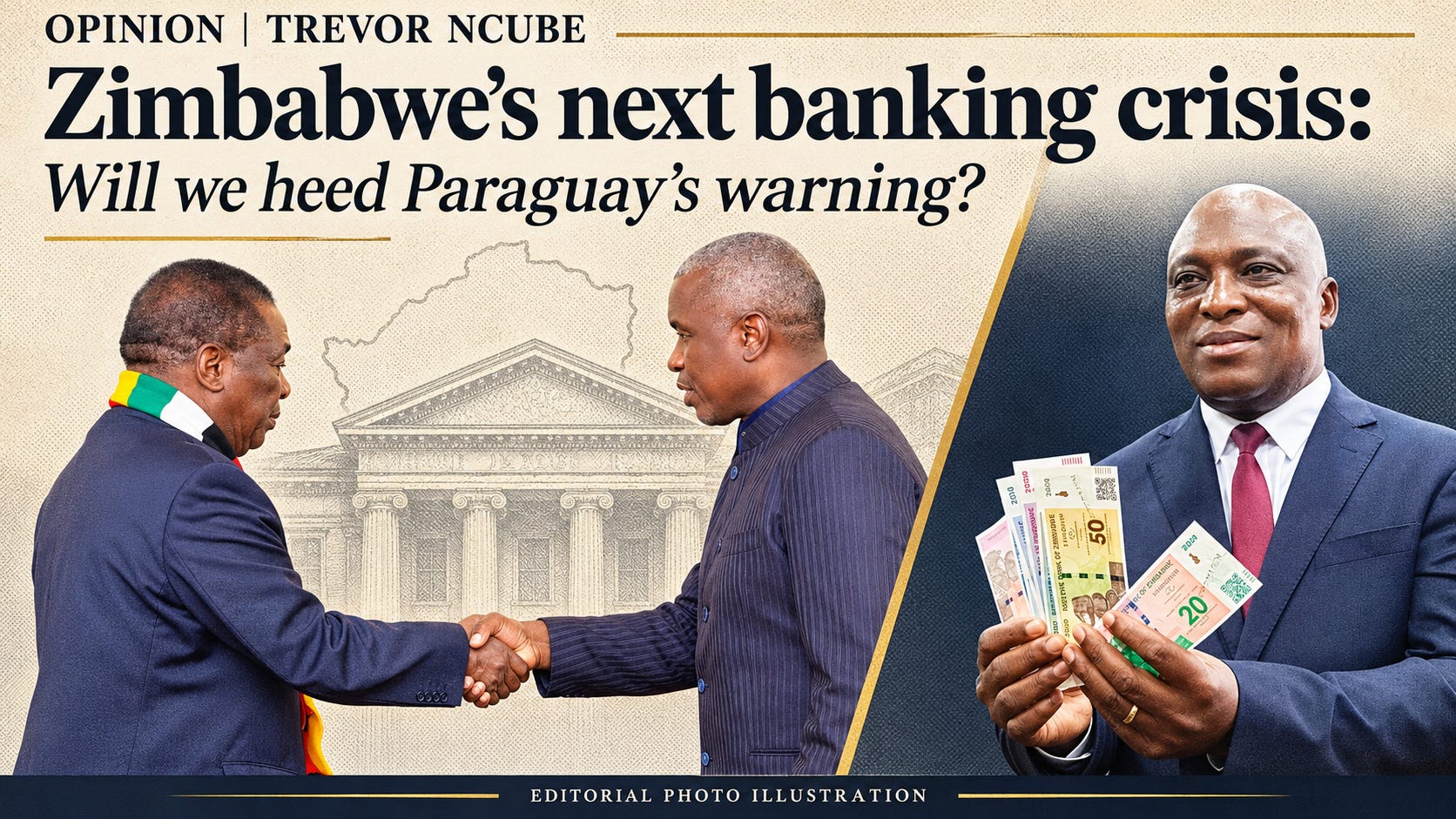
Zimbabwe must confront conflicts of interests among public officials and build stronger institutions to protect the public’s savings

By Trevor Ncube

Zimbabweans should not have to lose their savings again before those in authority confront the dangerous entanglement of political power, banking interests and financial regulation.

When a financial institution collapses, the impact reaches far beyond its shareholders. It enters kitchens, classrooms and hospital wards. What happened in Paraguay last week should trouble our national conscience. We have suffered enough financial trauma to recognise a warning without waiting for it to become our own emergency. On November 6, President Santiago Peña was impeached and placed under house arrest following the collapse of Ueno Bank. The bank served approximately 2.94 million customers, equivalent to about 60% of Paraguay’s adult population. Its accounts were frozen, and substantial public and pension funds were caught in the crisis.

Peña previously held shares in the business group behind Ueno and says he sold his interest in 2025. He appointed Carlos Carvallo, a former head of Ueno, as central bank governor. Lawmakers have alleged preferential treatment of the collapsed Ueno Bank and improper handling of public funds. Reuters also reports the central bank’s position that Carvallo recused himself from Ueno decisions. The institutional question remains: how effectively can a regulator supervise a bank when the relationships surrounding it reach into the highest offices of government? Zimbabwe needs to answer that question now. We carry our own painful history: Barbican, Trust, Royal, Interfin, Allied, AfrAsia, Genesis and Tetrad. Their experiences differed, encompassing curatorship, disputed restructuring, liquidation and surrender of licences.

They cannot honestly be reduced to one explanation. There is documented evidence of both banking misconduct and unlawful regulatory action. In 2012, the RBZ attributed Interfin’s distress partly to non-performing insider and related-party exposures, inadequate capital and poor oversight. In the Trust Bank litigation, the Supreme Court found the sale and transfer of its assets to ZABG unlawful, even though it dismissed the appeal on procedural grounds. That history demands safeguards against reckless bankers and regulators who exceed their powers. Depositors need competent, independent supervision, enforceable rules and lawful intervention. Institutional independence must be enhanced by accountability.

The present concerns begin with Reserve Bank Governor John Mushayavanhu and FBC.Mushayavanhu previously led FBC Holdings. A 2020 stock exchange disclosure recorded his indirect beneficial shareholding through Tirent Investments. FBC’s 2023 annual report identified him in the beneficiaries column against Tirent’s 6.82% holding. The group’s 2025 annual report, on page 203, again lists Tirent with 6.82%, approximately 45.84 million shares. This time the beneficiary is identified as the Mushayavanhu Family Trust. These are the company’s published disclosures. Mushayavanhu denied holding an interest in FBC in an interview reported by the Zimbabwe Independent in April 2024. That denial must be recorded alongside the disclosures.

The 2025 report does not establish his present entitlement to trust benefits or control over its decisions. It does establish the need for an authoritative and exhaustive explanation of those arrangements. Ethical and principled leadership demands this transparency and accountability. Zimbabweans should not have to guess whether the person overseeing their banks retains an interest in one of the groups he supervises. And we must not be shy to ask these important questions of those who serve the public. At a minimum, they owe the public this much.

The slightest whiff of suspicion erodes public trust and must be avoided at all times. Section 16(a) of the RBZ Act disqualifies a shareholder, director, officer or employee of a banking institution from serving as Governor or Deputy Governor. Its application to interests held through a holding company or family trust requires independent legal scrutiny. Parliament should obtain and publish that assessment. Any incompatibility must be remedied; any ambiguity concerning indirect beneficial ownership must be resolved. The law must mean the same thing to the politically connected and powerful as it does to the man on the street.

The allegations concerning President Emmerson Mnangagwa’s ownership interest in FBC remain unverified on the evidence available to me. I will not turn rumour into fact. The Presidency can help resolve the uncertainty through an authoritative declaration of relevant interests .Kudakwashe Tagwirei’s position continues a trend of entangled interests and raises a further question of public duty. A close ally and confidant of President Mnangagwa, Tagwirei was recently appointed as Minister of Economic Development and Investment Promotion.

Tagwirei has also been linked to investments in CBZ Holdings and ZB Financial Holdings, the groups behind CBZ Bank and ZB Bank.Zimbabwe Independent reporting on NSSA’s 2020 disposal of ZB shares described speculation linking him to the transaction and reported him as a major CBZ shareholder. The companies’ disclosures establish something narrower. CBZ’s 2025 annual report lists Akribos Wealth Managers Nominees with 18.35%. ZB’s shareholder analysis lists Datvest Nominees with 34%. Both figures are dated December 31, 2025. Neither entry, by itself, identifies Tagwirei as the ultimate beneficial owner. Nominee accounts can hold shares for different clients.

In August 2026, Nehanda Radio, citing NewsHawks, reported his denial of a purported CBZ share sale: “I have not sold anything. It’s not true.” A denial of a sale settles neither the existence nor the extent of a current holding.I therefore cannot responsibly assign him a verified current percentage in either group. The distinction between published allegations and demonstrated ownership matters.

So does the obligation of all public officials to answer legitimate questions. Holding public office or owning a publicly traded asset carries a burden of accountability. Journalists asking questions are merely carrying out their duty of informing stakeholders. Section 106 of our Constitution prohibits ministers from exposing themselves to situations involving a risk of conflict between their official responsibilities and private interests. It addresses the risk itself. It does not require the nation to wait for a scandal before demanding preventive action. Unfortunately, this is one aspect of the Constitution that is mostly ignored by Cabinet ministers, past and present. Tagwirei should publish a verified declaration of his current beneficial interests in banking and other businesses relevant to his portfolio, including interests exercised through nominees, trusts or controlled companies.

My position is clear: he should divest any banking interests that conflict with his ministerial responsibilities. If he cannot resolve those conflicts, he should relinquish the ministerial office. Transferring a name on paper while retaining control or economic benefit would not resolve the underlying problem. Alternatively, Tagwirei should place his interests in a blind trust until such time as he is out of public office. This should apply to all government ministers with business interests that present potential conflicts of interest. Public service requires accepting limits on private advantage. Business success cannot purchase an exemption from that principle. My primary concern is the transparency and quality of the safeguards protecting the entire system, particularly the investing public and the clients of these institutions.In our small and timid society, a supervisor might hesitate to challenge an institution associated with a powerful superior.

A minister’s commercial interests might benefit from decisions over which he has influence. Pension trustees might mistake political proximity for financial security. Competitors might reasonably question whether the rules are applied equally. These are legitimate and foreseeable risks. Responsible leadership designs institutions capable of resisting them. When Gideon Gono appeared on In Conversation With Trevor, he described the central bank’s lack of independence as “the elephant in the room”. He specifically identified control by a line ministry as a weakness.

Tag suspicions about bank ownership by the Governor to the elephant, and you have an acute entanglement of interests. Our law helps explain the problem. The President appoints the Governor and the appointed members of the RBZ board after consulting the responsible minister. The Act also makes the Governor’s management functions subject to general policy directions from the minister or board. This soup is crying out for urgent reform if we are really open for ethical and principled business.

I propose an independent statutory appointments board, constituted through an open process with safeguards against political and commercial capture, to appoint the Governor and RBZ board. Candidates should face published competence requirements, disclosure of interests and public parliamentary hearings. Appointments should require parliamentary confirmation. The Governor should have a protected term and be removable only on specified, demonstrable grounds through a fair process. The RBZ should report publicly to Parliament, with audited accounts and meaningful scrutiny of its decisions. In making these suggestions, I am alive to the urgent need to reform Parliament to ensure it has the right calibre of individuals to push back against executive overreach.

This is a proposed model for Zimbabwe. International practice does not prescribe one universal appointments mechanism. Its essential test is whether supervision can operate independently, competently and accountably. A new appointments process will achieve little if officials still receive informal instructions about which institutions or borrowers are beyond scrutiny. Interference must be documented, investigated and sanctioned. Forty-six years after independence, we should have the maturity to build institutions that serve the public beyond the tenure of any president, minister or governor. We are all imperfect. Good intentions do not remove temptation. The purpose of sound institutions is to make doing the right thing easier and abusing power harder.

Further reforms must follow established international standards. Zimbabwe must enforce limits on connected lending and require commercial terms, independent approvals and proper aggregation of exposures. Several companies controlled by the same interests cannot become separate risks merely by acquiring different names. Pension and public funds require particular vigilance. FBC’s 2025 report lists the National Pension Scheme with 35.13% and Public Service Fund 2–OLDM with 11.33%. Together, they own 46.46% of FBC.

This is a sobering reminder of whose money is at stake. Trustees must assess total exposure, publish investment criteria and resist political pressure. Workers’ retirement contributions must never become a convenient source of financing for favoured interests. Parliament should now hold public hearings on the disclosed and alleged interests discussed here, secure the relevant records and publish findings on compliance and necessary reforms. The Governor, Tagwirei, the Presidency and the banks should answer the documented questions and have their responses fairly examined.

President Mnangagwa has a particular responsibility to ensure that his appointees meet the Constitution’s standards and that public institutions can operate without fear or favour. Those of us in business, the professions, churches and the media also have responsibilities. We cannot demand investment and confidence while treating uncomfortable questions about powerful people as bad manners. Access to authority is a poor bargain if its price is our silence.No one can confidently identify where Zimbabwe’s next banking shock might originate. That uncertainty makes sound institutions more urgent.

Paraguay’s depositors are paying for a crisis whose full causes are still being investigated. Zimbabwe has the opportunity to act while reform remains a choice. Our people deserve to work, save and retire with confidence. Building that confidence requires principled leaders and institutions strong enough to restrain them when courage and principle fail. We should not need another queue of frightened depositors to remind us whom public power is supposed to serve.

Trevor Ncube is the Founder of Trevor & Associates, Chairman of Alpha Media Holdings and the anchor of In Conversation With Trevor.

Source: Zimbabwe’s next banking crisis: will we heed Paraguay’s warning?

The post Zimbabwe’s next banking crisis: will we heed Paraguay’s warning? appeared first on Zimbabwe Situation.

How Makona Ranger Station protects wildlife in Zimbabwe

IFAW’s partnership with ZimParks began with the Makona Ranger Station. It enabled patrols to reach areas once considered too remote and fundamentally changed one of Hwange National Park’s most important landscapes. The goal of the partnership wasn’t merely the infrastructure—rather, it was about what it made possible. Conservation is rarely transformed by a single building, but […]

The post How Makona Ranger Station protects wildlife in Zimbabwe appeared first on Zimbabwe Situation.

IFAW’s partnership with ZimParks began with the Makona Ranger Station. It enabled patrols to reach areas once considered too remote and fundamentally changed one of Hwange National Park’s most important landscapes. The goal of the partnership wasn’t merely the infrastructure—rather, it was about what it made possible. Conservation is rarely transformed by a single building, but it is changed by the people who work from it, the communities who benefit from it, and the wildlife it protects.

A landscape that demanded action 

Long before Makona became a symbol of hope, it represented one of Hwange’s greatest conservation challenges. Situated in the park’s southern reaches, Makona is vast, remote, and ecologically significant. Its importance extends far beyond the park’s boundaries. As part of the Kavango–Zambezi Transfrontier Conservation Area (KAZA TFCA), Makona lies within the Hwange–Makgadikgadi wildlife dispersal area, a vital landscape that enables elephants, lions, African wild dogs, and other wide-ranging species to move between Zimbabwe and Botswana. Protecting Makona therefore helps secure a connected landscape—ensuring that animals can continue to roam, ecosystems remain resilient, and communities benefit from a thriving natural heritage.  

Yet its remoteness also made it vulnerable. The devastating cyanide poisoning of 300 elephants and other species in Hwange National Park in 2013 shocked Zimbabwe and the world. While wildlife crime was never confined to one location, the tragedy exposed the realities facing those tasked with protecting such an enormous landscape, including vast distances, limited infrastructure, and resources spread too thin. For ZimParks, strengthening the management of Makona became both a conservation priority and a national responsibility. For IFAW, it became an opportunity to invest not only in wildlife protection, but in the systems and communities that make conservation effective. 

Building capacity, not just infrastructure 

When IFAW and ZimParks signed their partnership agreement in 2019, the objective was bigger than constructing buildings. Our vision was to strengthen the ability of Zimbabwe’s protected area authority to conserve the park over the long term, and Makona became the foundation.  We supported the construction of a modern ranger station, providing accommodation for 22 full-time rangers and their families. It included offices, operational facilities, and the infrastructure needed to maintain a permanent conservation presence in this once-isolated part of Hwange National Park. We knew that protected areas are only as strong as the teams entrusted to safeguard them. 

One investment became many 

The completion of the Makona Ranger Station became the catalyst for something much bigger. Over the past six years, the IFAW–ZimParks partnership has continued to respond to evolving conservation priorities while advancing a shared vision for the Greater Hwange Landscape. Guided by IFAW’s Room to Roam initiative, the partnership has invested in protecting and connecting landscapes, strengthening conservation institutions, supporting communities, and securing safe movement for wildlife across one of Africa’s most important ecological corridors. Our work has included fixing patrol roads, providing operational vehicles, restoring the Nyamandlovu Pan, and upgrading the Hwange canine unit.

The partnership has also expanded its footprint beyond Hwange National Park into the adjacent Matetsi Safari Area–Unit 5, a strategically important landscape within the Greater Hwange ecosystem. Here, investments in ranger accommodation, wildlife monitoring, and elephant collaring help strengthen protected area management while supporting landscape connectivity across the wider Hwange–KAZA conservation landscape. At the same time, we’ve also strengthened tourism infrastructure, enhancing the visitor experience while reinforcing the value of conservation-led tourism. Each investment strengthens ZimParks’ ability to conserve wildlife and protect the landscapes that sustain both people and nature. This work is made possible through strong partnerships. Alongside ZimParks, IFAW collaborates with organisations including Speak Out For Animals (SOFA), Wild is Life, Dete Animal Rescue Trust (DART), BirdLife Zimbabwe, and local communities, bringing together complementary expertise to advance wildlife conservation, community development, and human-wildlife coexistence. 

Conservation begins with people 

Perhaps the greatest lesson I take away from Makona is that conservation cannot succeed inside a protected area alone; it must also succeed beyond its boundaries. Communities neighbouring Hwange National Park experience both the benefits and the challenges of living alongside wildlife: elephants damage crops, predators kill livestock, water is often scarce, and livelihood opportunities can be limited. 

Having recognised this, our partnership has expanded its focus beyond park infrastructure to include community well-being. We’ve supported the installation of predator-proof bomas, solar-powered boreholes, and community gardens. In addition, we’ve provided students with school fees, textbooks, and bicycles, while strengthening primary response teams to mitigate human-wildlife conflict.  “Together, we’ve also helped deploy GPS satellite collars and EarthRanger software, transforming how conservation teams understand elephant movements and mitigate risks.” 

The journey continues 

In 2023, IFAW renewed our partnership with ZimParks and signed a 20-year co-management agreement for Matetsi Safari Area Unit 5, reinforcing our shared commitment to securing one of the region’s most important wildlife landscapes. Makona shows what’s possible when government, communities and conservation partners work towards a common goal. But the work is far from over. Climate change, wildlife crime and increasing human-wildlife conflict continue to test the resilience of both people and nature. That’s why we remain committed to building on what we’ve started—strengthening conservation, supporting communities, and securing connected landscapes where wildlife and people can thrive together. “When people think about Makona, they often see the ranger station,” states ZimParks Director General Professor Edson Gandiwa. “What I see is something much bigger. I see rangers better equipped to protect wildlife, communities working alongside conservation, elephants moving through a safer landscape, and a partnership that has continued to grow from one investment into a long-term commitment to Hwange. Conservation is never finished. Every milestone creates the opportunity—and the responsibility—to do more.”

Source: How Makona Ranger Station protects wildlife in Zimbabwe

The post How Makona Ranger Station protects wildlife in Zimbabwe appeared first on Zimbabwe Situation.

Zimbabwean Gang Leader Jailed for 13 Years Over £150,000 London Phone Shop Robberies

LONDON — Zimbabwean national Samuel “Sammie” Govera has been sentenced to 13 years and six months in prison for his role in a series of organised robberies targeting mobile phone shops across London, in a case that has resulted in 10 convictions. Govera was described as the ringleader of a criminal gang that stole mobile […]

The post Zimbabwean Gang Leader Jailed for 13 Years Over £150,000 London Phone Shop Robberies appeared first on The Zimbabwe Mail.

LONDON — Zimbabwean national Samuel “Sammie” Govera has been sentenced to 13 years and six months in prison for his role in a series of organised robberies targeting mobile phone shops across London, in a case that has resulted in 10 convictions.

Govera was described as the ringleader of a criminal gang that stole mobile phones and other electronic devices estimated to be worth £150,000 during a robbery spree across the capital.

The gang was eventually brought down following an investigation by the Metropolitan Police’s Flying Squad, whose detectives assembled CCTV footage, forensic evidence and mobile phone data to identify and track those involved.

The investigation culminated in 10 convictions, with Govera receiving a substantial custodial sentence for his part in the criminal operation.

The Zimbabwe Mail notes that the sentence represents a significant loss of personal freedom and opportunity. Thirteen years and six months behind bars is a considerable portion of a person’s life to surrender through organised criminal activity.

The case also illustrates how advances in forensic investigation, digital evidence and police intelligence can help authorities dismantle organised robbery networks.

The post Zimbabwean Gang Leader Jailed for 13 Years Over £150,000 London Phone Shop Robberies appeared first on The Zimbabwe Mail.

ConCourt Sets November 18 Hearing in Zimbabwe Term Extension Case

HARARE – Zimbabwe’s Constitutional Court has postponed hearings on two legal challenges to constitutional amendments that could keep President Emmerson Mnangagwa in office until 2030, setting November 18 for the next stage of proceedings after concerns emerged over the composition of the bench. The postponement followed a case management meeting on Wednesday chaired by Deputy […]

The post ConCourt Sets November 18 Hearing in Zimbabwe Term Extension Case appeared first on The Zimbabwe Mail.

HARARE – Zimbabwe’s Constitutional Court has postponed hearings on two legal challenges to constitutional amendments that could keep President Emmerson Mnangagwa in office until 2030, setting November 18 for the next stage of proceedings after concerns emerged over the composition of the bench.

The postponement followed a case management meeting on Wednesday chaired by Deputy Chief Justice Paddington Garwe, with the court agreeing to prioritise an application challenging the legality of provisions that expanded the number of Constitutional Court judges.

The dispute centres on Constitutional Amendment Act changes signed into law in July, which extended Mnangagwa’s current presidential term by two years, from 2028 to 2030, and also extended the tenure of MPs who supported the legislation.

According to reporting by ZimLive, lawyer Professor Lovemore Madhuku, who represents the applicants, said the court had raised the question of whether judges appointed under the contested amendments should participate in deciding their constitutionality.

The applicants indicated that they preferred the challenge to be heard without the additional judges appointed under the disputed provisions. The issue has become central to the proceedings because the amendments increased the Constitutional Court’s membership beyond its previous seven-member composition.

Madhuku said the parties had agreed to give priority to an application filed by Vhurande Mahlupeko, which challenges aspects of the amendments, including allegations that several provisions were introduced without appearing in the Government Gazette publications setting out the proposed changes.

He said approximately nine or 10 provisions were allegedly added during the legislative process, including the provision increasing the number of Constitutional Court judges. These remain allegations to be determined by the court.

The second challenge, brought by Prince Dubeko Sibanda, raises a separate constitutional question: whether the amendments can lawfully extend the terms of the president and parliamentarians who were already in office when the changes were adopted.

Sibanda argues that such an extension would violate Section 328(7) of the Constitution, which restricts amendments to presidential and parliamentary term limits from benefiting incumbents who were in office when the changes were made.

The applicants are seeking direct access to the Constitutional Court, allowing the disputes to be heard by the country’s highest court without first commencing proceedings in the High Court. The court must determine whether the applications qualify for that procedure before moving to the substantive constitutional questions.

Madhuku said the applicants had no objection to Justice Antonetta Guvava sitting on the bench, arguing that her elevation followed the retirement of former Chief Justice Luke Malaba rather than the disputed expansion of the court.

The next hearing is expected to proceed before a bench that excludes the additional judges appointed under the contested amendments, according to Madhuku’s account of the discussions.

“We really think that it’s now time for this matter to be determined,” he said, according to ZimLive.

Attorney General Virginia Mabhiza attended Wednesday’s proceedings, although the Government’s legal representation was handled by private lawyers.

The cases carry significant implications for Zimbabwe’s constitutional framework, the 2028 electoral timetable and the balance of power between the executive, legislature and judiciary. A ruling on the legality of the amendments could determine whether the changes withstand constitutional scrutiny and how their provisions may be applied.

The Zimbabwe Mail’s assessment is that the dispute extends beyond the political question of Mnangagwa’s tenure. At its heart is the constitutional principle that amendments to the supreme law must follow the prescribed procedures and that courts must be able to examine their validity without questions about judicial independence or institutional conflicts undermining public confidence.

The immediate focus, however, is procedural. The Constitutional Court must first decide whether to grant direct access and establish the appropriate bench before it can determine the substantive challenges. The November 18 proceedings are therefore an important next step, but they should not be mistaken for a final ruling on the constitutionality of the amendments.

The post ConCourt Sets November 18 Hearing in Zimbabwe Term Extension Case appeared first on The Zimbabwe Mail.