Ingwebu on brink of collapse, loses US$250 000 a month

Source: Ingwebu on brink of collapse, loses US$250 000 a month – herald Sunday News Reporter INGWEBU Breweries is technically insolvent and losing about US$250 000 every month, with the City of Bulawayo warning that the struggling municipal-owned company could collapse unless it urgently secures private investment of up to US$5 million. The revelations are […]

The post Ingwebu on brink of collapse, loses US$250 000 a month appeared first on Zimbabwe Situation.

Source: Ingwebu on brink of collapse, loses US$250 000 a month – herald

Sunday News Reporter

INGWEBU Breweries is technically insolvent and losing about US$250 000 every month, with the City of Bulawayo warning that the struggling municipal-owned company could collapse unless it urgently secures private investment of up to US$5 million.

The revelations are contained in a confidential council report submitted by the Town Clerk to council on July 13, detailing the deteriorating financial and operational position of the brewery.

According to the report, Bulawayo mayor, Councillor David Coltart revealed that the City was not in a financial position to inject the capital required to rescue Ingwebu and directed the company’s board to urgently engage potential investors,

“He (Clr Coltart) directed the Board to urgently engage with both Mutapa and Innscor and obtain formal written investment proposals without delay to facilitate informed decision- making.

“He advised that, should the company fail to secure satisfactory investment proposals, the Board should immediately initiate corporate rescue proceedings to safeguard the business and its stakeholders. The Mayor cautioned that the company had only a narrow window of opportunity to secure its future and stressed that urgent action was required,” reads the report.

The mayor further revealed that the company is now insolvent and is incurring losses of approximately US$250 000 per month.

He said the brewery required a substantial capital injection of approximately US$5 million to restore operations, adding that cost-cutting measures already implemented were insufficient to reverse its deteriorating financial position.

The revelations come as Ingwebu struggles with ageing machinery, unreliable production equipment, inadequate working capital, poor distribution and declining product quality, while employees have reportedly gone without salaries.

The brewery’s board chairperson, Mr Kalani Ndlovu told the meeting that the company was facing “significant operational and financial challenges”, with previous investments failing to be strategically co-ordinated and ageing machinery severely affecting production capacity.

“He emphasized the need to attract private equity investment and recommended actively engaging potential investors. He informed the meeting that Mutapa, Inscor and Delta had expressed interest in investing in the company. However, he noted that progress with Mutapa had been delayed due to Government processes. Despite the institution having requested the company’s documentation and indicating its willingness to provide funding.

“The board chairperson further recommended that a forensic audit be undertaken before any investment transaction proceeded. He proposed that a comprehensive investment proposal, supported by evaluated cash flow projections, be prepared within 30 days,” reads the report.

The board chairperson revealed that Ingwebu had failed to secure additional funding from Ecobank and that its weak financial position meant shareholders would need to inject fresh capital.

The brewery’s managing director, Mr Dumisani Mhlanga painted an equally bleak picture of the company’s production capacity.

Of the six boilers the brewery originally operated, only one remains functional, with the remaining unit described as unreliable.

The boiler reportedly operates for about two days before breaking down and requiring between three and four days of repairs, severely disrupting brewing operations.

“As a result, production capacity has declined, leading to poor product quality He noted that customers had increasingly complained about the quality of Ingwebu products, with many switching to competing brands

“The managing director also identified poor distribution as another major challenge, explaining that the company’s delivery trucks frequently broke down, affecting product availability He emphasized that distribution challenges should be addressed as a priority. He also noted a shortage of refrigeration equipment despite customer preference for chilled products,” reads the report.

Despite the challenges, management believes Ingwebu can still be revived.

A two-phase recovery plan has been developed, with the first phase requiring an estimated US$2,7 million.

The funding would include about US$180 000 for a second-hand boiler, among other interventions.

Management also proposed the installation of a pasteurisation plant to improve the shelf life of the company’s Cream Tataa product, which currently lasts only 15 days because Ingwebu does not have pasteurisation facilities.

“Regarding phase two, the managing director stated that it would require substantial capital investment and would focus on the company’s long-term sustainability. He informed the Committee that both Delta and Mutapa had expressed interest in investing in the company.

“He further advised that representatives from Mutapa were expected to visit on Friday, with the intention of concluding discussions by August 2026. He emphasized that external investment represented the most viable long-term solution for the busıness, reads the report.

In the ensuing debate, councillors warned that the collapse of Ingwebu would have wider economic and social consequences.

Councillor Mxolisi Mahlangu said all efforts should be made to secure investment, particularly from Mutapa, before considering closure of the brewery.

He called for a stakeholder engagement plan to address concerns among paid and unpaid employees and improve strained relations between workers and management.

In response, the managing director said the company had secured US$13 000 on the previous Sunday, allowing it to make a once-off payment of US$100 to some employees.

However, he said the funds were inadequate to meet the expectations of all workers and that the company also lacked sufficient money to buy raw materials, further hampering production.

The post Ingwebu on brink of collapse, loses US$250 000 a month appeared first on Zimbabwe Situation.
BEYOND TRADE! Zim, SA step up regional industrial integration

Source: BEYOND TRADE! Zim, SA step up regional industrial integration – herald Nduduzo Tshuma in Johannesburg, South Africa ZIMBABWE’S economic resurgence and growing appeal as a safe investment destination, driven by policy reforms under President Mnangagwa, took centre stage at the Zimbabwe-South Africa Business Forum here yesterday amid calls for deeper economic cooperation to drive […]

The post BEYOND TRADE! Zim, SA step up regional industrial integration appeared first on Zimbabwe Situation.

Source: BEYOND TRADE! Zim, SA step up regional industrial integration – herald

Nduduzo Tshuma in Johannesburg, South Africa

ZIMBABWE’S economic resurgence and growing appeal as a safe investment destination, driven by policy reforms under President Mnangagwa, took centre stage at the Zimbabwe-South Africa Business Forum here yesterday amid calls for deeper economic cooperation to drive regional growth.

The forum, held on the sidelines of the Fourth Zimbabwe-South Africa Bi-National Commission (BNC), brought together 250 business leaders from the two countries, with the discussions focusing on moving beyond traditional trade towards investment, industrialisation, innovation and value addition.

Addressing the Presidential Session at the Gallagher Convention Centre in Midrand, President Mnangagwa said the two countries should strengthen their economic partnership by pursuing joint investment, research, innovation and high-impact projects.

He said recent SADC engagements in Durban had reinforced the importance of industrialisation in driving regional development, with Zimbabwe and South Africa playing pivotal roles in advancing that agenda.

President Mnangagwa said disruptions to global supply chains, rapid technological advances and growing competition for strategic resources had exposed the vulnerability of countries that lacked strong productive capabilities.

“Our answer is not to withdraw from the world, but to participate in it from a stronger position. That position of strength is derived from closer cooperation back home, and here,” he said.

He said Zimbabwe remained committed to working with its neighbours, the region, Africa and international partners to strengthen production, innovation and livelihoods.

The President said while Southern Africa was endowed with critical minerals, fertile agricultural land, industries, universities and technical institutions, the region must ensure its natural resources feed local industries instead of creating value elsewhere.

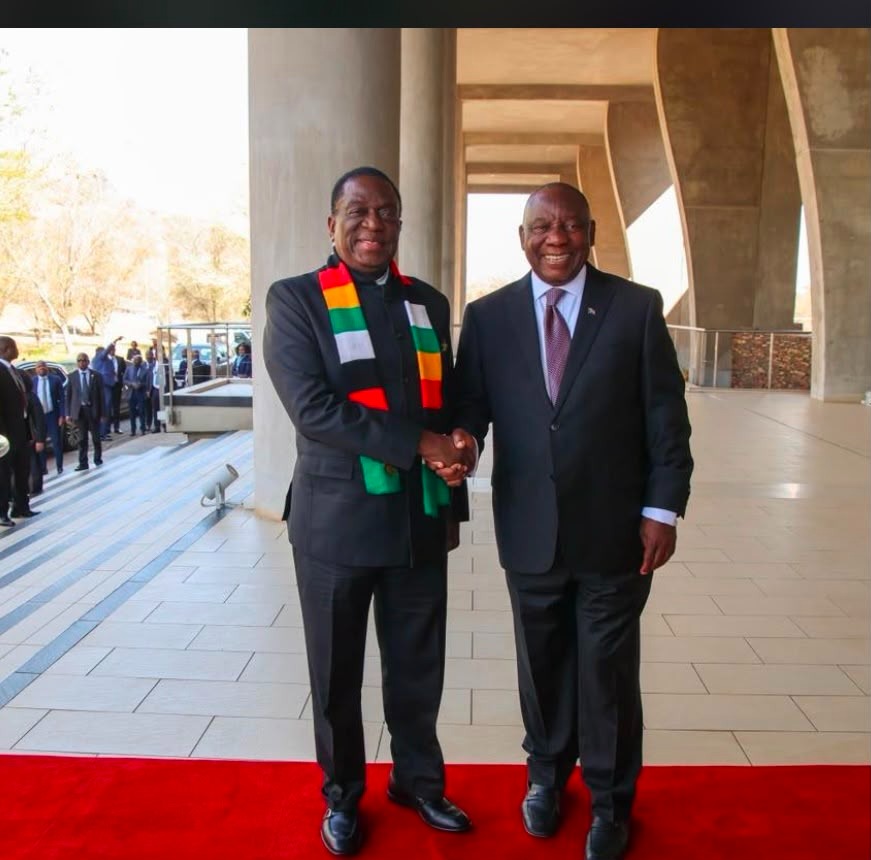
Presidents Mnangagwa and Cyril Ramaphosa

He said young people represented another important resource, with universities, tertiary institutions and innovation hubs already producing ideas and prototypes in agriculture, mining, manufacturing, engineering, energy and information technology.

President Mnangagwa called on financial institutions, development finance institutions and private investors to identify promising innovations and support their mass production, saying some of the industrial solutions required by the region could already be in the hands of its young people.

“Some of the industrial solutions we require may already be sitting in the hands of our young people. This is where the relationship between Zimbabwe and South Africa assumes even greater importance,” said the President.

“Our co-operation must not be limited to how much we sell to one another. We need to consider partnerships across the borders, that is, what we can do together.”

Zimbabwean and South African businesses, President Mnangagwa said, are already interconnected through trade in machinery, technology, inputs, services and markets, but the next step should be co-investment, joint research, technological innovation and mobilisation of financing for regional high-impact projects.

“Then, our businesses can use these partnerships to reach markets beyond Zimbabwe and South Africa. That is how a bilateral relationship begins to contribute to the transformation of an entire region,” he said.

President Mnangagwa said governments would continue providing political direction through the BNC and other frameworks while creating an environment where productive investment could thrive, technology could be exchanged and innovation commercialised.

President Ramaphosa said his country was Zimbabwe’s largest single source of imports from the rest of the world, but there remained considerable scope to grow bilateral trade.

He welcomed Zimbabwe’s decision to eliminate trade restrictions in line with SADC trade protocols, saying this would help unlock further opportunities between the two economies.

He said the African Continental Free Trade Area also presented an opportunity to expand intra-African trade but stressed that businesses had to turn government agreements into tangible economic activity.

“Governments can determine policy, sign agreements and ratify protocols, but it is business that turns a signed agreement into a shipment, a factory or a job,” he said.

President Ramaphosa said South Africa regarded Zimbabwe as a key regional market for its goods, products and services and remained optimistic about the prospects of the Zimbabwean economy.

Citing the African Development Bank, he said Zimbabwe’s real GDP growth rose to an estimated 7,5 percent in 2025, driven by growth in sectors including mining and agriculture, while inflation had declined following the introduction of the Zimbabwe Gold currency.

He said greater economic stability and predictability would give South African exporters and investors confidence to commit capital at scale.

“Zimbabwe is moving ahead in more ways than one, is modernising, it is punching ahead, growing at 7,25 percent and so the economy of Zimbabwe is in great recovery. The mining sector is growing and they are doing a number of very wonderful things,” said President Ramaphosa.

“The Zimbabwe that we are dealing with, that we are trading with is a Zimbabwe that is on the move. So, for us as South Africa, it is a real joy to have a neighbour on our northern side who is growing, becoming a market for us but also a neighbour who would want to start making South Africa a market, creating finished goods that they can bring to South Africa so that we are not the only ones that export finished goods.

“This is where the equalisation must come from; we don’t compete against each other, we compete with each other against the world and indeed the continent.”

President Ramaphosa said the modernisation of the Beitbridge Border Post had helped address long-standing challenges, including inadequate infrastructure, inefficient processes and limited staffing, which had previously resulted in trucks waiting several days to cross.

He said the developments formed part of a broader vision for a corridor linking the Port of Durban to the Democratic Republic of Congo, transforming transport routes into arteries of industry, commerce and employment.

The Musina-Makhado Special Economic Zone was cited as an example of the potential to develop industrial corridors supporting mining beneficiation, agriculture, agro-processing, milling and packaging.

President Ramaphosa said Zimbabwe’s exports of gold, chromium ore and semi-finished steel to South Africa presented opportunities for joint ventures that would ensure more refining and finishing took place within the region.

The two governments have established a Joint Technical Committee on Trade and Industry to facilitate cooperation in industrial value chains, infrastructure, special economic zones, trade, tourism, transport and logistics, while work is also progressing on a draft Memorandum of Understanding on Economic Cooperation.

President Ramaphosa said the Business Forum should translate these frameworks into partnerships that create decent jobs, particularly for women and young people, transform value chains and combine the strengths of both economies.

Meanwhile, President Mnangagwa arrived back home last night and was welcomed at the Robert Gabriel Mugabe International Airport by Vice President Constantino Chiwenga, Cabinet Ministers, Service Chiefs and other senior Government officials.

The post BEYOND TRADE! Zim, SA step up regional industrial integration appeared first on Zimbabwe Situation.

NEW: 10 000 Chiredzi and Beitbridge flood victims get food relief

Source: NEW: 10 000 Chiredzi and Beitbridge flood victims get food relief – herald Theseus Mauruki Shambare in CHIKOMBEDZI ABOUT 10 000 people who were affected by flooding in Chiredzi and Beitbridge districts during the 2025/26 rainy season are currently receiving food and other basic household commodities as humanitarian agencies scale up assistance to communities […]

The post NEW: 10 000 Chiredzi and Beitbridge flood victims get food relief appeared first on Zimbabwe Situation.

Source: NEW: 10 000 Chiredzi and Beitbridge flood victims get food relief – herald

Theseus Mauruki Shambare in CHIKOMBEDZI

ABOUT 10 000 people who were affected by flooding in Chiredzi and Beitbridge districts during the 2025/26 rainy season are currently receiving food and other basic household commodities as humanitarian agencies scale up assistance to communities still recovering from the disaster.

The Zimbabwe Red Cross Society, through the International Federation of Red Cross and Red Crescent Societies (IFRC) Disaster Response Emergency Fund (DREF), is targeting vulnerable households that lost homes, food stocks and essential belongings during the 2025–26 summer cropping season.

Beneficiaries are receiving essential food and grocery items including rice, sugar, salt, cooking oil and soap, alongside other household necessities to help families meet their immediate needs as they recover from the effects of the floods.

Intense downpours between December 2025 and February 2026 caused severe flooding in parts of the two districts, destroying homes, crops and household property while disrupting access to basic services.

Strong winds and flash floods caused houses to partially or totally collapse, damaged roofs and left walls deeply cracked, while families lost blankets, clothing, bedding and cooking utensils.

In farming communities, waterlogging and hailstorms destroyed maize, small grains and horticultural crops at critical growth stages, worsening food insecurity.

In Chiredzi, 170 people from 37 families in Mhlanguleni were among those receiving food assistance on Friday.

The distribution is being conducted concurrently in Boli and several areas of Beitbridge.

For Muhlava Chikendhlemusi of Chindlale village, the assistance came after floods destroyed her home.

“When the floods came, my house was destroyed and we lost some of the things we had worked for. It has not been easy living with the effects of the floods, especially because we still have to rebuild our home and find ways of getting food,” she said.

“This assistance has come as a big relief to my family. At least we have something to eat as we try to put our lives back together.”

For 62-year-old Senzeni Mahachi of Gundani village, under Chief Mupapa, the assistance will ease pressure on families struggling to put food on the table.

“The floods made life very difficult for us because we lost food and some of the things we depended on at home. Since then, we have been struggling to make ends meet,” she said.

“Receiving this food today has given us great relief because we can now take something home for our families to eat.”

The effects of the flooding went beyond damaged homes and lost crops, with swollen rivers and damaged bridges isolating communities in Chiredzi South and parts of Mwenezi, disrupting access to hospitals, markets and schools.

In Beitbridge, flooding also disrupted water supplies after electricity to water pumps was affected, increasing the risk of waterborne diseases.

IFRC planning, monitoring, evaluation and reporting officer Ms Tariro Kamangira said the organisation was working with the Zimbabwe Red Cross Society in support of Government’s disaster response.

“As IFRC, we work with the Zimbabwe Red Cross and we play an auxiliary role to the Government of Zimbabwe. We are there to save lives. Wherever disaster strikes, we are the first ones to respond, to make sure we save lives,” she said.

Zimbabwe Red Cross Society secretary-general Mr Elias Hwenga said the assistance was aimed at helping families meet immediate needs while supporting them to rebuild.

“For families who have lost their homes, food and household belongings to flooding, this assistance is about more than meeting immediate needs; it is about restoring dignity and giving communities the support they need to begin rebuilding their lives,” he said.

The DREF response also covers shelter, water, sanitation and hygiene, multipurpose cash assistance, health, protection, gender and inclusion, and community engagement.

The Zimbabwe Red Cross Society has already provided shelter and WASH non-food items, with food and other basic household assistance now being scaled up.

The post NEW: 10 000 Chiredzi and Beitbridge flood victims get food relief appeared first on Zimbabwe Situation.

Former Head Boy and church elder who scored 20 points at A-Level now wanted by police for stealing 16 cars!

20-point former head boy linked to 16-car thefts He was once the pride of his school: a Head Boy, church elder and brilliant student who scored an impressive 20 points at Advanced Level. Almost a decade later, Keith Nyasha Sibanda is the subject of a p…

20-point former head boy linked to 16-car thefts He was once the pride of his school: a Head Boy, church elder and brilliant student who scored an impressive 20 points at Advanced Level. Almost a decade later, Keith Nyasha Sibanda is the subject of a police manhunt in Bulawayo after investigators linked him to the […]

The post Former Head Boy and church elder who scored 20 points at A-Level now wanted by police for stealing 16 cars! first appeared on My Zimbabwe News.

Truck driver evades police arrest in movie-style: Jumps from moving vehicle full of drugs and resigns from work over the phone

MASVINGO – A haulage truck driver wanted in connection with a consignment of cough syrup and mbanje escaped into the darkness after jumping from his moving vehicle during a police operation in Masvingo, then apparently made one final call to his …

MASVINGO – A haulage truck driver wanted in connection with a consignment of cough syrup and mbanje escaped into the darkness after jumping from his moving vehicle during a police operation in Masvingo, then apparently made one final call to his employers: he was resigning and had abandoned the truck. 48-year-old Dzikamai Chimunda of Southlands […]

The post Truck driver evades police arrest in movie-style: Jumps from moving vehicle full of drugs and resigns from work over the phone first appeared on My Zimbabwe News.