Harare Mayor Says InDrive Operators Must Share Revenue With Council

Source: Harare Mayor Says InDrive Operators Must Share Revenue With Council ⋆ Pindula News Harare Mayor Jacob Mafume has said the City of Harare is drafting a policy that will allow the council to collect revenue from e-hailing drivers. This follows reports that the Council has intensified its crackdown on e-hailing services such as InDrive and […]

The post Harare Mayor Says InDrive Operators Must Share Revenue With Council appeared first on Zimbabwe Situation.

Source: Harare Mayor Says InDrive Operators Must Share Revenue With Council ⋆ Pindula News

Harare Mayor Says InDrive Operators Must Share Revenue With Council

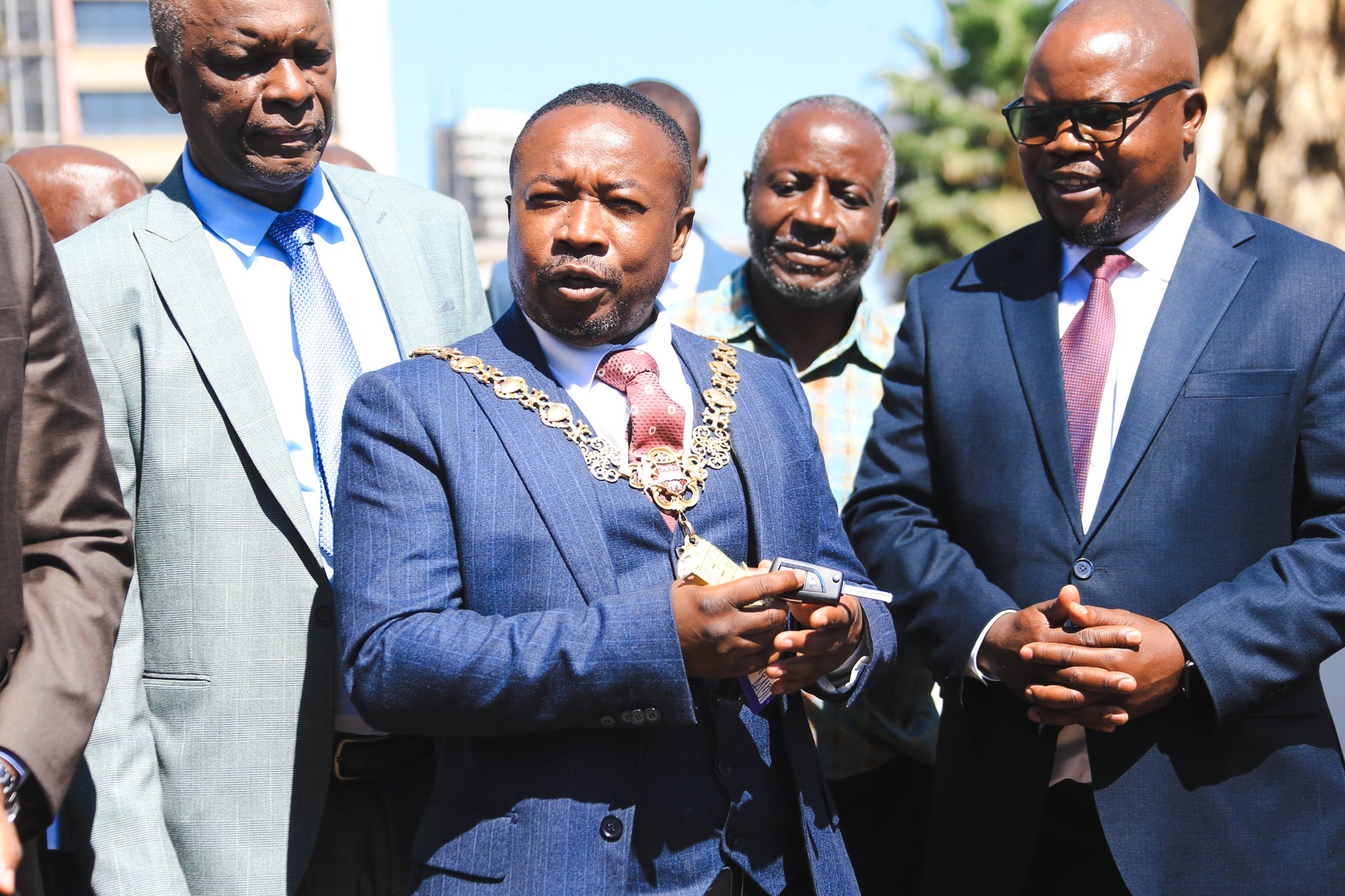
Harare Mayor Jacob Mafume has said the City of Harare is drafting a policy that will allow the council to collect revenue from e-hailing drivers.

This follows reports that the Council has intensified its crackdown on e-hailing services such as InDrive and Bolt.

Speaking to journalists, Mafume acknowledged that there has been a legal lacuna in how e-hailing services are handled in Harare and across Zimbabwe, with the law yet to catch up with the innovation.

“What is clear is that there has been a legal lacuna in terms of how e-hailing services are handled in Harare, and in Zimbabwe. Our law has not caught up with the innovation that comes with the e-hailing services,” said Mafume.

“And therefore, we have laws that are supposed to be a must for passenger-carrying vehicles. And basically, InDrive is a passenger-carrying vehicle and passenger operator. And other traditional taxis, traditional buses, and traditional kombis have been complying. And they have pointed out the inconsistency in terms of application of the law, as they relate to passengers and operating such businesses.”

Mafume said council recognises the role the sector is playing in the economy.

“We do understand that it is an innovation that is bringing relief to families, that is putting food on the table, that is increasing employment, in terms of those that are being employed in the city, and in the country,” he said.

He said the city will work with Government to regularise the sector, taking into account best international practices.

“It is up to us, together with consultations with Government, on how we regularise e-hailing services, taking into account best international practices, what our neighbours have done in South Africa, and other countries, who have recently come up with a policy framework and regulatory framework on how e-hailing services operate,” he said.

In the interim, Mafume said council is engaging its parent ministry on how to treat those currently operating, including whether to give them a window period while a regulatory framework is being developed.

“We have tasked our transport department to come up quickly with a policy that will consult with the relevant stakeholders, and make sure that there is compliance with the law, and that this service not only contributes to employment, but also contributes to the maintenance of the infrastructure that they have to use, and the maintenance of revenues to the city,” he said.

“I’m sure InDrive operators have no issues sharing their revenue with the city and the citizens of the city, so that the infrastructure can be put in place.”

Mafume said council will make an announcement shortly once consultations are concluded, including what will be done in the interim.

He defended the current enforcement, saying municipal police had been applying the law as it stands.

“What has been happening and what is being applied has been the law as it currently stands, vis-a-vis the innovation that has come with e-hailing services,” he said.

The post Harare Mayor Says InDrive Operators Must Share Revenue With Council appeared first on Zimbabwe Situation.

Zimbabwe: run by, owned by, the ZANU elite. And who still calls them a “liberation movement”?

The post Zimbabwe: run by, owned by, the ZANU elite. And who still calls them a “liberation movement”? appeared first on Zimbabwe Situation.

Source: Zimbabwe: run by, owned by, the ZANU elite. And who still calls them a “liberation movement”? – Martin Plaut

A $20 Million Wedding Shows Zimbabwe Who’s Really Running the Country

By Antony Sguazzin Bloomberg

Updated on 

  • Zimbabwe’s wealthy elite gathered at a polo club to celebrate a wedding, showcasing the country’s new parade of wealth and influence under President Emmerson Mnangagwa.
  • The government has abolished the presidential vote and amended the law to extend Mnangagwa’s term by two years, a move that has been criticized as the beginning of a one-party state and an authoritarian party state.
  • The changes have been driven by a handful of entrepreneurs who have become wealthy through government procurement programs and access to the country’s most profitable mines, and who have started to alter the ruling party by bankrolling politicians and securing powerful positions.

In late May, Zimbabwe’s one percent gathered at a polo club on the outskirts of Harare to celebrate the marriage of one of their own.

The country had never before seen a wedding like this. From the groom’s father, a presidential advisor and US-sanctioned tycoon, the couple received $17.5 million in cash and land. From government ministers, politically connected businessmen and the sons of President Emmerson Mnangagwa, Kudakwashe Tagwirei and Poneso Tinomuda Janda were showered with luxury cars, rare cattle and hundreds of thousands of dollars. The president delivered a speech, and the American R&B band Boyz II Men gave a surprise performance at the reception.

This parade of wealth and influence, documented on state and social media, was a clear illustration of who now holds power in the southern African country.

While Zimbabwe struggled with years of misrule and economic ruin under former leader Robert Mugabe, a Marxist who largely shunned business and abhorred ostentatious displays of wealth, that has changed dramatically under Mnangagwa. During his tenure, a handful of entrepreneurs have become enormously wealthy through government procurement programs, access to some of the country’s most profitable mines and generous state tenders. That’s happened as the prices of gold and platinum, two of Zimbabwe’s key resources, have surged, and the country has become a main lithium supplier to China.

After a months-long campaign, some of those entrepreneurs accomplished one of their main political objectives several weeks ago when the government abolished the presidential vote and amended the law to extend 83-year-old Mnangagwa’s term by two years, until 2030. That’s a major change to the system — even under Mugabe, elections were always held on the dates stipulated in the constitution.

“It’s the beginning of a one-party state,” warned Stephen Chan, a professor of world politics at the School of Oriental and African Studies in London, during a talk last month. “Not just a one-party state, but an authoritarian party state and an oligarchic party state.’’

By bankrolling politicians and securing powerful positions within the governing Zimbabwe African National Union-Patriotic Front (Zanu-PF), the businessmen have also started to alter the party, which has ruled the country since it achieved independence in 1980. Historically led by aging struggle veterans, some now rely on what Chan calls the “new class of oligarchs” for financial support. “The party needs money,” he said in an interview, “and they have bought their way in.’’

The major players were in attendance at the wedding. Kudakwashe Tagwirei, a tycoon under US and UK sanctions for alleged corruption, formally joined Zanu-PF’s leadership last year by being appointed to its top decision-making body. According to local media reports, he gifted 300 luxury vehicles to senior party leaders during this process. Wicknell Chivayo, a businessman whose ventures include solar power and logistics, also gave expensive vehicles to opposition lawmakers who agreed to get behind scrapping presidential elections. And Scott Sakupwanya, a metals trader who was featured in an Al Jazeera investigation into gold smuggling, is a member of parliament for Zanu-PF.

With these moves, “they are making sure they have access” to the president, said Trevor Ncube, a Zimbabwean owner of independent newspapers that are critical of the government. “Should anything happen, they will be part of the next administration or can influence it.”

Tagwirei, Sakupwanya and Chivayo did not answer multiple phone calls or reply to text messages seeking comment. The men have all publicly rejected allegations of corruption, describing them as politically motivated.

With the blessing of the senate and 280-member parliament, Mnangagwa signed the amendment to extend his term and empower parliament to select the next president on July 7, telling the state-run press it had been a “collective” decision. Just two years ago, the president forced one of Ncube’s newspapers to publicly apologize for suggesting he might try to remain in power.

Wilf Mbanga, the founder of the Zimbabwean, a newspaper distributed in the UK and South Africa, describes the changes as a way for the new business elite to entrench control and circumvent a vote. “They know they can’t appeal to all Zimbabweans to be elected,” he said. “That’s why they have been pushing for the amendments.”

In response to queries, Zanu-PF’s information secretary Chris Mutsvangwa said that the term extension will stabilize the business environment and usher in “a period of political and governance certainty.” He also dismissed suggestions that it was motivated by external factors. “The finger pointing at a few business figures is neither here nor there,” he said.

Before the amendments were passed, they were met with deep public resistance. Court cases and requests for a referendum were brushed aside, and human rights groups say that protestors were assaulted and prevented from speaking at public hearings.

The campaign has also fractured the ruling party. A prominent retired air marshal wrote to parliament in March demanding a referendum on the measures, saying the failure to hold one would be “a betrayal not of us but of every Zimbabwean who hoped for a better country.” Constantino Chiwenga, Mnangagwa’s vice president, criticized Tagwirei for “buying” his way into the party and warned of “bloodshed” if the term extension went through. In an address last year at a graveyard where many of Zimbabwe’s liberation heroes are buried, he referred to the clique of businessmen as “Zvigananda” a word whose origins come from a Shona term for blood-engorged ticks. The vice president accused the men of betraying the country’s revolutionary values.

“There is tension in the country,” said Ncube, the newspaper owner. Referring to Chiwenga, he added, he “has got a loyal group of military people, retired commanders, who are saying this is not what we fought for.”

In a June report, the International Crisis Group warned that a coup could be one possible outcome: “The risk is that Chiwenga will come to see such a gambit as the only route to reach a position he feels he is owed.” Chiwenga led the 2017 coup.

Still, he will struggle to secure power without the party’s financial backers, said Chipo Dendere, assistant professor of Africana at Wellesley College in Massachusetts. “The vice president has openly spoken against corruption” and oligarchs, she said, “but since these types hold the party purse I don’t see how he can have a political career without their support.”

The situation echoes the waning years of Mugabe’s rule, when old allies were jettisoned after a group of businessmen won favor with the aging leader and his increasingly influential wife Grace. Mugabe removed Mnangagwa from his post as vice president in November 2017, and a coup followed a week later.
The post Zimbabwe: run by, owned by, the ZANU elite. And who still calls them a “liberation movement”? appeared first on Zimbabwe Situation.

Stallion Cruise Demands Ban On Touts

Source: Stallion Cruise Demands Ban On Touts ⋆ Pindula News Passengers and bus operators say harassment, intimidation and coercion by touts at Bulawayo’s Fourth Avenue Bus Terminus have turned the city’s main long-distance rank into a no-go zone, prompting Government to call for a coordinated crackdown. The Ministry of Transport and Infrastructural Development has said […]

The post Stallion Cruise Demands Ban On Touts appeared first on Zimbabwe Situation.

Source: Stallion Cruise Demands Ban On Touts ⋆ Pindula News

Passengers and bus operators say harassment, intimidation and coercion by touts at Bulawayo’s Fourth Avenue Bus Terminus have turned the city’s main long-distance rank into a no-go zone, prompting Government to call for a coordinated crackdown.

The Ministry of Transport and Infrastructural Development has said it is treating the complaints with “serious concern”, warning that passenger safety and security now require a Whole-of-Government response.

In a letter to Commissioner-General of Police Stephen Mutamba, the Ministry called for the “immediate removal” of rank touts from Fourth Avenue following a complaint by Stallion Cruise bus company. The correspondence was copied to senior provincial and city officials.

“The Ministry notes with serious concern the passenger safety and security issues raised in your correspondence,” the ministry said.

It added that the matter would be escalated to the Ministers of Home Affairs and Cultural Heritage and Local Government and Public Works.

“It is the Ministry’s considered view that an integrated Whole-of-Government approach is required to decisively address the challenges posed by rank touts,” it said.

At the centre of the complaints are allegations that touts are assaulting passengers, extorting money and dictating which buses travellers must board.

Stallion Cruise, which raised the complaint, said the situation can no longer be tolerated.

“We can no longer fold our arms while our passengers are abused daily,” the company said in a letter to the Resident Minister of State and Devolution Affairs for Bulawayo Province.

“Touts assault passengers, extort money, and block entry points. They have turned the rank into their personal territory.”

The operator is demanding a ban on touting, the deployment of police and the introduction of licensed marshals at the terminus within 14 days.

The alleged conduct could also breach consumer protection laws. Section 35(2) of the Consumer Protection Act [Chapter 14:44] prohibits the use of physical force, threats or other unfair practices against consumers.

Tensions between rival operators have worsened the disorder. Inter Africa bus management had to issue an apology after its touts damaged a Stallion Cruise bus in Bulawayo, an incident that has deepened bad blood between the two companies.

The problem extends beyond Bulawayo. Touts have been blamed for repeated confrontations at ranks across the country, with stakeholders calling for a permanent solution.

Earlier this year, a tout died in Chiredzi during skirmishes involving rival touts from Inter Africa and Stallion Cruise, forcing authorities to allocate the two companies different loading ranks to stop the clashes.

In Harare, passengers have also complained of harassment around Fourth Street Roadport, where a tout identified as Tafadzwa was reportedly arrested before being released.

The post Stallion Cruise Demands Ban On Touts appeared first on Zimbabwe Situation.

Dry Weekend For Harare Residents As Council Shuts Down Morton Jaffray, Warren Control

Source: Dry Weekend For Harare Residents As Council Shuts Down Morton Jaffray, Warren Control ⋆ Pindula News The City of Harare will effect a citywide water supply disruption from Friday morning to Sunday evening to allow for urgent repairs and cleaning at its two major water facilities. In a public notice issued on 12 August […]

The post Dry Weekend For Harare Residents As Council Shuts Down Morton Jaffray, Warren Control appeared first on Zimbabwe Situation.

Source: Dry Weekend For Harare Residents As Council Shuts Down Morton Jaffray, Warren Control ⋆ Pindula News

The City of Harare will effect a citywide water supply disruption from Friday morning to Sunday evening to allow for urgent repairs and cleaning at its two major water facilities.

In a public notice issued on 12 August 2026, Acting Town Clerk Warren Chiwawa said water supplies will be disrupted from Friday, 14 August at 6 AM to Sunday, 16 August at 6 PM.

Chiwawa said the disruption is due to a partial shutdown at Morton Jaffray Water Works and a total shutdown of the Warren Control Pump Station to allow for urgent repair of leaks and reservoir cleaning at both facilities.

“Consequently, water supply to the entire City of Harare will be affected during this period,” the notice reads.

The city has urged residents and stakeholders to prepare in advance.

“Residents are urged to store enough water in clean, covered containers before Friday morning and to use water sparingly during the shutdown period,” said Chiwawa.

He said normal water supply is expected to resume on Sunday, 16 August at 6 PM upon completion of the works.

The post Dry Weekend For Harare Residents As Council Shuts Down Morton Jaffray, Warren Control appeared first on Zimbabwe Situation.

Zimbabwe – United States Department of State

Source: Zimbabwe – United States Department of State During the review period, the government published a timely audit that covered the entire annual executed budget.The government also made its executive budget proposal, enacted budget, and end-of-year report publicly available online within a reasonable period.  The government made information on some debt obligations publicly available, including […]

The post Zimbabwe – United States Department of State appeared first on Zimbabwe Situation.

Source: Zimbabwe – United States Department of State

During the review period, the government published a timely audit that covered the entire annual executed budget.
The government also made its executive budget proposal, enacted budget, and end-of-year report publicly available online within a reasonable period.  The government made information on some debt obligations publicly available, including government guarantees of major state-owned enterprise debt, but did not publish total debt holdings by major state-owned enterprises. 

Publicly available budget documents did not include a substantially complete picture of revenue and expenditures.  Although actual revenues and expenditures did not reasonably correspond to those in the enacted budget, the government publicly issued revised budget estimates.  The budget included aggregate allocations to, but not earnings from, state-owned enterprises.  The government maintained significant off-budget accounts not subject to audit or oversight. 

The military budget, but not the intelligence budget, was subject to parliamentary oversight.  The supreme audit institution met international standards of independence, and its reports contained substantive findings. 

The government specified in law or regulation, but did not appear to follow in practice, the criteria and procedures for awarding natural resource extraction contracts or licenses.  The government did not make basic information on mining concessions publicly available but did publish information on public procurement contracts.

Steps Zimbabwe could take to improve fiscal transparency include:

  • Publishing debt information of major state-owned enterprises;
  • Providing a complete picture of revenues and expenditures;
  • Detailing allocations to and revenues from state-owned enterprises in budget documents;
  • Eliminating off-budget accounts or subjecting them to adequate oversight and audit, including the intelligence budget;
  • Following laws and regulations governing natural resource extraction contracting and licensing in practice; and
  • Publishing basic information on natural resource awards.

The post Zimbabwe – United States Department of State appeared first on Zimbabwe Situation.