IMF Urges Zimbabwe to Build US$275 Million Fiscal Buffer Ahead of Drought Risk

HARARE — The International Monetary Fund has urged Zimbabwe to set aside at least US$275 million from stronger-than-expected government revenues as a fiscal safeguard against a potential El Niño-induced drought and worsening food-security pressures in 2027. The recommendation comes as the IMF welcomed a stronger fiscal performance by Zimbabwe during the first quarter of 2026 […]

The post IMF Urges Zimbabwe to Build US$275 Million Fiscal Buffer Ahead of Drought Risk appeared first on The Zimbabwe Mail.

HARARE — The International Monetary Fund has urged Zimbabwe to set aside at least US$275 million from stronger-than-expected government revenues as a fiscal safeguard against a potential El Niño-induced drought and worsening food-security pressures in 2027.

The recommendation comes as the IMF welcomed a stronger fiscal performance by Zimbabwe during the first quarter of 2026 but cautioned authorities against using the additional revenue to finance higher expenditure.

Under its latest review of Zimbabwe’s Staff Monitored Programme, the Fund said the Government should maintain spending within the parameters of the approved 2026 Budget and save the revenue windfall to create room for an emergency response should climatic conditions deteriorate.

Revenue performance provides room for savings

Zimbabwe recorded a US$371 million primary cash surplus during the first quarter, significantly outperforming the IMF programme target by approximately US$320 million.

Government revenue was also about US$560 million above target, supported by stronger economic activity, improved VAT and customs collections, higher personal income tax receipts and gains in tax administration.

The IMF expects Zimbabwe’s total revenue for 2026 to reach approximately US$10.3 billion, equivalent to about 16% of GDP, while projecting a cash primary surplus of roughly 1.7% of GDP.

Rather than translating the stronger revenue performance into additional spending, the Fund is urging authorities to preserve part of the windfall.

The proposed US$275 million buffer would give Treasury the capacity to respond to an agricultural and food-security shock without accumulating new domestic arrears or diverting funding from essential social programmes.

El Niño raises food-security concerns

The IMF’s warning comes amid heightened concerns over the possibility of a significant El Niño weather event towards the end of 2026 and into early 2027.

A severe drought could weaken agricultural output, reduce household incomes and place additional pressure on food prices and imports.

The Fund warned that a major climate shock could simultaneously reduce government revenues and increase public expenditure, particularly if authorities are forced to purchase grain and provide assistance to vulnerable households.

For Zimbabwe, where agriculture remains highly exposed to rainfall variability, such a shock could place considerable pressure on both the fiscal position and foreign-currency resources.

Government pushes economic resilience

Finance Minister Mthuli Ncube has similarly identified climate and commodity shocks as key risks to Zimbabwe’s economic outlook, arguing that resilience must be built into the country’s broader economic strategy.

In the 2026 Budget Strategy Paper, Ncube said Zimbabwe needed to accelerate economic diversification, increase value addition and beneficiation and expand targeted irrigation development.

The strategy reflects a growing recognition within Government that fiscal reserves alone cannot provide a long-term solution to recurring agricultural shocks.

Greater irrigation capacity, agricultural productivity and economic diversification would reduce the economy’s dependence on rainfall while also strengthening domestic food production and export capacity.

IMF flags social spending shortfall

While praising Zimbabwe’s overall fiscal performance, the IMF raised concerns about the execution of protected social and priority spending.

Government fell US$84 million short of its first-quarter target for protected social and priority expenditure, with under-spending affecting programmes including the Basic Education Assistance Module (BEAM), Pfumvudza and the Social Protection Management Information System.

The IMF is therefore calling for improved execution of social-protection programmes at a time when the potential drought could increase pressure on vulnerable households.

The challenge for Treasury will be to preserve fiscal discipline while ensuring that budgeted social programmes are actually implemented.

Wider policy reforms remain on the agenda

Beyond the proposed drought buffer, the IMF is pressing Zimbabwe to maintain a broader package of fiscal, monetary and structural reforms.

These include limiting gold incentives to US$300 million in 2026, accelerating the clearance of domestic arrears and maintaining tight monetary policy.

The Fund is also urging authorities to move towards a more liberalised foreign-exchange market while continuing efforts to restructure external debt and clear longstanding arrears.

The recommendations highlight a central policy dilemma facing Zimbabwe: the Government has improved its fiscal position, but the stronger revenue performance needs to be converted into greater resilience rather than higher recurrent expenditure.

For Treasury, the proposed US$275 million reserve could therefore become an important test of fiscal discipline. If accumulated, it would provide Zimbabwe with a financial cushion before a potential drought hits agricultural output, food supplies and public finances.

The IMF’s message is consequently straightforward: use today’s revenue strength to prepare for tomorrow’s shock rather than spend the windfall before the risks materialise.

The post IMF Urges Zimbabwe to Build US$275 Million Fiscal Buffer Ahead of Drought Risk appeared first on The Zimbabwe Mail.

IMF Urges Zimbabwe to Build US$275 Million Fiscal Buffer Ahead of Drought Risk

HARARE — The International Monetary Fund has urged Zimbabwe to set aside at least US$275 million from stronger-than-expected government revenues as a fiscal safeguard against a potential El Niño-induced drought and worsening food-security pressures in 2027. The recommendation comes as the IMF welcomed a stronger fiscal performance by Zimbabwe during the first quarter of 2026 […]

The post IMF Urges Zimbabwe to Build US$275 Million Fiscal Buffer Ahead of Drought Risk appeared first on The Zimbabwe Mail.

HARARE — The International Monetary Fund has urged Zimbabwe to set aside at least US$275 million from stronger-than-expected government revenues as a fiscal safeguard against a potential El Niño-induced drought and worsening food-security pressures in 2027.

The recommendation comes as the IMF welcomed a stronger fiscal performance by Zimbabwe during the first quarter of 2026 but cautioned authorities against using the additional revenue to finance higher expenditure.

Under its latest review of Zimbabwe’s Staff Monitored Programme, the Fund said the Government should maintain spending within the parameters of the approved 2026 Budget and save the revenue windfall to create room for an emergency response should climatic conditions deteriorate.

Revenue performance provides room for savings

Zimbabwe recorded a US$371 million primary cash surplus during the first quarter, significantly outperforming the IMF programme target by approximately US$320 million.

Government revenue was also about US$560 million above target, supported by stronger economic activity, improved VAT and customs collections, higher personal income tax receipts and gains in tax administration.

The IMF expects Zimbabwe’s total revenue for 2026 to reach approximately US$10.3 billion, equivalent to about 16% of GDP, while projecting a cash primary surplus of roughly 1.7% of GDP.

Rather than translating the stronger revenue performance into additional spending, the Fund is urging authorities to preserve part of the windfall.

The proposed US$275 million buffer would give Treasury the capacity to respond to an agricultural and food-security shock without accumulating new domestic arrears or diverting funding from essential social programmes.

El Niño raises food-security concerns

The IMF’s warning comes amid heightened concerns over the possibility of a significant El Niño weather event towards the end of 2026 and into early 2027.

A severe drought could weaken agricultural output, reduce household incomes and place additional pressure on food prices and imports.

The Fund warned that a major climate shock could simultaneously reduce government revenues and increase public expenditure, particularly if authorities are forced to purchase grain and provide assistance to vulnerable households.

For Zimbabwe, where agriculture remains highly exposed to rainfall variability, such a shock could place considerable pressure on both the fiscal position and foreign-currency resources.

Government pushes economic resilience

Finance Minister Mthuli Ncube has similarly identified climate and commodity shocks as key risks to Zimbabwe’s economic outlook, arguing that resilience must be built into the country’s broader economic strategy.

In the 2026 Budget Strategy Paper, Ncube said Zimbabwe needed to accelerate economic diversification, increase value addition and beneficiation and expand targeted irrigation development.

The strategy reflects a growing recognition within Government that fiscal reserves alone cannot provide a long-term solution to recurring agricultural shocks.

Greater irrigation capacity, agricultural productivity and economic diversification would reduce the economy’s dependence on rainfall while also strengthening domestic food production and export capacity.

IMF flags social spending shortfall

While praising Zimbabwe’s overall fiscal performance, the IMF raised concerns about the execution of protected social and priority spending.

Government fell US$84 million short of its first-quarter target for protected social and priority expenditure, with under-spending affecting programmes including the Basic Education Assistance Module (BEAM), Pfumvudza and the Social Protection Management Information System.

The IMF is therefore calling for improved execution of social-protection programmes at a time when the potential drought could increase pressure on vulnerable households.

The challenge for Treasury will be to preserve fiscal discipline while ensuring that budgeted social programmes are actually implemented.

Wider policy reforms remain on the agenda

Beyond the proposed drought buffer, the IMF is pressing Zimbabwe to maintain a broader package of fiscal, monetary and structural reforms.

These include limiting gold incentives to US$300 million in 2026, accelerating the clearance of domestic arrears and maintaining tight monetary policy.

The Fund is also urging authorities to move towards a more liberalised foreign-exchange market while continuing efforts to restructure external debt and clear longstanding arrears.

The recommendations highlight a central policy dilemma facing Zimbabwe: the Government has improved its fiscal position, but the stronger revenue performance needs to be converted into greater resilience rather than higher recurrent expenditure.

For Treasury, the proposed US$275 million reserve could therefore become an important test of fiscal discipline. If accumulated, it would provide Zimbabwe with a financial cushion before a potential drought hits agricultural output, food supplies and public finances.

The IMF’s message is consequently straightforward: use today’s revenue strength to prepare for tomorrow’s shock rather than spend the windfall before the risks materialise.

The post IMF Urges Zimbabwe to Build US$275 Million Fiscal Buffer Ahead of Drought Risk appeared first on The Zimbabwe Mail.

Kuwadzana Faces Fresh Demolitions: Who Approved the Stands, and Who Will Pay When They Go?

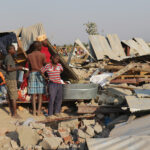
HARARE – In the bustling high-density suburb of Kuwadzana in Harare, thousands of livelihoods hang in a precarious balance. For over three decades, the open spaces and service industry stands designated as stands 1 to 101 have served as the econo…

HARARE – In the bustling high-density suburb of Kuwadzana in Harare, thousands of livelihoods hang in a precarious balance. For over three decades, the open spaces and service industry stands designated as stands 1 to 101 have served as the economic heartbeat for hundreds of artisans, carpenters, metal fabricators, mechanics, and small-scale traders. Yet, an […]

The post Kuwadzana Faces Fresh Demolitions: Who Approved the Stands, and Who Will Pay When They Go? first appeared on My Zimbabwe News.

Is Zimbabwe’s economic boom reserved only for the politically connected while ordinary citizens suffer?

Source: Is Zimbabwe’s economic boom reserved only for the politically connected while ordinary citizens suffer? “A tale of two cities”, as Charles Dickens wrote. No one in their right mind can deny the impressive economic figures and macroeconomic strides witnessed in Zimbabwe over the past few years under the so-called Second Republic.  To directly receive […]

The post Is Zimbabwe’s economic boom reserved only for the politically connected while ordinary citizens suffer? appeared first on Zimbabwe Situation.

Source: Is Zimbabwe’s economic boom reserved only for the politically connected while ordinary citizens suffer?

“A tale of two cities”, as Charles Dickens wrote.

No one in their right mind can deny the impressive economic figures and macroeconomic strides witnessed in Zimbabwe over the past few years under the so-called Second Republic.

 
To directly receive my articles please join my WhatsApp Channel on: https://whatsapp.com/channel/0029VaqprWCIyPtRnKpkHe08


State media and official releases paint a picture of an economy firing on all cylinders. 

For the first time this year, monthly export earnings exceeded the $1 billion mark in June, jumping by 63 percent from $884 million in May, driven by semi-manufactured gold, nickel mattes, and other valuable minerals. 
Across the first half of 2026, total export receipts reached an unprecedented $5.89 billion, up from $3.87 billion during the same period last year. 
Backed by booming mineral exports, resilient diaspora remittances, and a move toward domestic lithium beneficiation, the International Monetary Fund confirmed a $2.1 billion current-account surplus in 2025 alongside a 58 percent year-on-year surge in exports.
These figures are accompanied by headline milestones that any treasury would boast about. 
For the first time in decades, annual inflation has stabilized into single-digit territory, while the country recorded one of the fastest-growing Gross Domestic Products in the region. 
Real GDP growth reached 8.3 percent in 2025 and is projected to expand between 4.6 and 5 percent this year. 
The economy has consistently maintained this upward trajectory over the past few years.
Given these stellar statistics, one would naturally expect the daily livelihoods of ordinary Zimbabweans to simultaneously improve. 
In any normal functioning economy, sustained GDP expansion, soaring export earnings, and balance-of-payment surpluses trickle down to improve basic living conditions, raise wages, and upgrade public infrastructure. 
However, the reality on the ground in Zimbabwe is completely divorced from these celebrated macroeconomic achievements. 
What citizens are witnessing daily are shocking, escalating levels of poverty. 
The bitter truth is that ordinary Zimbabweans are significantly poorer today than they were nine years ago when the Second Republic assumed power in 2017.
Just as the government’s statistics on export growth do not lie, the figures tracking human suffering and poverty in Zimbabwe do not lie either. 
According to IMF international poverty metrics, extreme poverty—defined as those surviving on less than $2.15 a day or earning under $65 a month—rose from 30.4 percent of the population in 2017 to an appalling 42 percent in 2025. 
Similarly, general poverty, encompassing those living on less than $3.65 a day or earning under $110 a month, climbed from 61.6 percent in 2017 to 64.5 percent today. 
When examining upper poverty—those living on less than $6.85 a day or under $200 a month—the figure rose from 83 percent in 2017 to 85 percent in 2025.
These numbers represent a profound social tragedy. 
How can a nation where over two-thirds of the population takes home less than $200 per month boast of phenomenal economic growth and billion-dollar export earnings? 
The endless government-sponsored “empowerment projects” touted in state media are clearly not empowering anyone in a meaningful way. 
They are designed merely to keep citizens barely afloat and prevent outright starvation. 
Even among formal workers, the distress is severe. 
While the lowest-paid civil servant earns around $375 on paper, their actual take-home pay after taxes and mandatory deductions often drops as low as $150, placing state employees firmly within the poverty bracket.
This systemic decay is not felt only in empty pockets; it is measured in lost human lives across underfunded public hospitals where thousands die each year simply because there are no basic medications, functional machines, or working theater equipment. 
Children’s futures are repeatedly stolen in schools—particularly in rural areas—that lack proper building infrastructure, textbooks, and science laboratories. 
Roads across the country are in shambles and barely navigable, while major urban centers have gone years without reliable running tap water.
The natural question to ask is simple: who then is reaping the fruits of this lauded economic development?
It is certainly not ordinary Zimbabweans. 
Instead, this is a country where an individual with close ties to the corridors of power can casually splash over $70 million in just a few years on lavish gifts for religious groups and celebrities. 
It is a country where, within a mere 18 months, a romantic partner of a political elite can purchase at least ten luxury properties valued at an estimated $7 million. 
One can only imagine the sheer volume of wealth possessed or spent by the political elite themselves.
Meanwhile, the overwhelming majority of hard-working Zimbabweans cannot afford to give even $10 to a family member in desperate need. 
Where is all this private wealth coming from? 
Even the world’s wealthiest individual, Elon Musk, does not hand out millions of dollars in liquid cash to private individuals on a personal whim.
It is undeniably clear that two separate economies operate in Zimbabwe today: one exclusive economy for the ruling elite and their cronies, and a subsistence economy for everyone else. 
Transparency International’s Corruption Perceptions Index ranks Zimbabwe among the most corrupt nations globally, placing it at a dismal 157 out of 182 countries. 
That ranking explains the structural disconnect. 
In a country blessed with vast natural wealth and surging mineral revenues, millions remain among the poorest people on earth because the gains are systematically siphoned off at the top. 
The economic development under the Second Republic is not designed for the general public—it is built by and for those in power. 
If current trajectory holds, by 2030, ordinary Zimbabweans will remain just as poor, if not worse off.
Tendai Ruben Mbofana is a social justice advocate and writer. Please feel free to contact him on +263715667700 or mbofana.tendairuben73@gmail.com

The post Is Zimbabwe’s economic boom reserved only for the politically connected while ordinary citizens suffer? appeared first on Zimbabwe Situation.

1.1 million traffic fines as AI cameras now detect speeding, red-robot violations, illegal turns, mobile-phone use & missing seatbelts

HARARE – For thousands of motorists navigating the bustling streets of Harare, a quiet technological revolution is unfolding above intersections and highway junctions. Since going live earlier this year, the Government’s newly installed net…

HARARE – For thousands of motorists navigating the bustling streets of Harare, a quiet technological revolution is unfolding above intersections and highway junctions. Since going live earlier this year, the Government’s newly installed network of artificial intelligence-driven surveillance cameras has flagged more than 1.1 million suspected traffic violations. For ordinary drivers, however, the headline figure […]

The post 1.1 million traffic fines as AI cameras now detect speeding, red-robot violations, illegal turns, mobile-phone use & missing seatbelts first appeared on My Zimbabwe News.