John Travolta Arrested for Robbery

HARARE – Police have confirmed the arrest of a man named John Travolta, 34, – though this one won’t be doing any dancing as a free man anytime soon. Police said Travolta, together with an accomplice who remains at large, allegedly stormed a shop at Warren Park D shopping centre at around 7PM on August […]

The post John Travolta Arrested for Robbery appeared first on The Zimbabwe Mail.

HARARE – Police have confirmed the arrest of a man named John Travolta, 34, – though this one won’t be doing any dancing as a free man anytime soon.

Police said Travolta, together with an accomplice who remains at large, allegedly stormed a shop at Warren Park D shopping centre at around 7PM on August 8 armed with a pistol and disguised in balaclavas.

The pair allegedly threatened the shopkeeper and made off with US$3,813 and ZiG1,200 in cash.

But their getaway proved less than cinematic – members of the public gave chase and caught up with Travolta before police arrived.

Officers recovered part of the loot, comprising US$1,071 and ZiG775, from Travolta who is now helping police with their investigations.

The Pulp Fiction and Saturday Night Fever actor, 71, remains unconnected to the case.

The Pulp Fiction and Saturday Night Fever actor, 71, remains unconnected to the case.


The post John Travolta Arrested for Robbery appeared first on The Zimbabwe Mail.

More than 90 people are feared dead after a boat capsized on Lake Kariba

HARARE – Dozens of people are feared dead after the Mbuya Nehanda ferry, used to connect Kariba town with rural communities in Mashonaland West province, capsized on Lake Kariba on Tuesday afternoon. Police said the ferry, which they described as owned by “DDF” — a reference to the organisation now known as the Rural Infrastructure […]

The post More than 90 people are feared dead after a boat capsized on Lake Kariba appeared first on The Zimbabwe Mail.

HARARE – Dozens of people are feared dead after the Mbuya Nehanda ferry, used to connect Kariba town with rural communities in Mashonaland West province, capsized on Lake Kariba on Tuesday afternoon.

Police said the ferry, which they described as owned by “DDF” — a reference to the organisation now known as the Rural Infrastructure Development Agency (RIDA) — was carrying 90 passengers and five crew members.

But people involved in the rescue operation said the number of passengers could have been significantly higher.

An incident report circulated on RIDA’s WhatsApp group said there were “114 adult passengers on board confirmed through tickets, five crew members and an undisclosed number of children below ticketing age”.

The ferry has a carrying capacity of 90 people.

The report said 77 passengers had been rescued alive and 15 bodies retrieved from the lake, leaving at least 27 people unaccounted for.

Video footage showed the ferry overturned in the lake as a helicopter hovered above, apparently searching for survivors.

Image

Life jackets could be seen strewn across the water, while one disturbing video showed the body of a child who appeared to have drowned.

In a brief statement, national police spokesman Commissioner Paul Nyathi said: “The ZRP reports that a DDF boat with 90 people and five crew members has capsized in Lake Kariba. Rescue efforts are currently underway. More details on the situation will be released in due course.”

Police later issued a second statement warning the public to be “cautious of releasing the total figures of the victims either injured or dead to allow the ZRP and the government authorities to manage the situation professionally without interference or distortion of figures”.

The Mbuya Nehanda ferry seen on the waters of Lake Kariba

A video reposted by Mashonaland West MP Mutsa Murombedzi, which allegedly shows the ferry setting sail before the disaster, features voices expressing concern about what they call the “Binga Wave” — described by one speaker as a powerful wave capable of beaching fish — which appears to have been active at the time.

Binga, in the Zambezi Valley near the Zambian border, is also connected to Lake Kariba.

Brenda Gray Javis, who works in the area, said on Facebook that a safety warning had been issued earlier on Tuesday advising boats not to sail because of dangerous waves.

“This incident has nothing to do with the age of the boat. A safety warning was issued today by the Lake Captain advising all boats not to sail on Lake Kariba due to dangerous waves. Sadly, this ferry appears to have ignored the warning and capsized after being hit by a huge wave. This is a reminder that safety warnings are meant to save lives,” she wrote.

The cause of the disaster had not been officially established by Tuesday night, but investigators are expected to examine the Mbuya Nehanda’s maintenance history amid claims that the vessel has been in service since the 1980s.

They are also likely to investigate whether the ferry was overloaded, whether passengers had adequate life jackets and whether required safety procedures were followed given the hazardous water conditions reported at the time.

Former MP Fadzayi Mahere blamed the government for what she described as a failure to prioritise public safety and disaster preparedness.

Mahere wrote on X: “Every day, we are reminded about how woefully inadequate, if not non-existent, Zimbabwe’s disaster management capacity is. The Kariba ferry disaster is further testament to a broken down state which cannot save lives in critical moments.

“Instead of investing in functional civil protection systems, money is spent on small houses (girlfriends), cars and trinkets. It’s a mess.”

Source: ZimLive

The post More than 90 people are feared dead after a boat capsized on Lake Kariba appeared first on The Zimbabwe Mail.

Who really runs Zimbabwe? This $20m wedding holds the answer

Brazen intermingling of money and politics likely to add to ordinary citizens’ disillusionment and raise risk of coup by the VP who led the coup that put the current president in power. Source: Who really runs Zimbabwe? This $20m wedding holds the answer – Moneyweb Brazen intermingling of money and politics likely to add to […]

The post Who really runs Zimbabwe? This $20m wedding holds the answer appeared first on Zimbabwe Situation.
Brazen intermingling of money and politics likely to add to ordinary citizens’ disillusionment and raise risk of coup by the VP who led the coup that put the current president in power.

Source: Who really runs Zimbabwe? This $20m wedding holds the answer – Moneyweb

Brazen intermingling of money and politics likely to add to ordinary citizens’ disillusionment and raise risk of coup by the VP who led the coup that put the current president in power.

In late May, Zimbabwe’s one percent gathered at a polo club on the outskirts of Harare to celebrate the marriage of one of their own.

The country had never before seen a wedding like this. From the groom’s father, a presidential advisor and US-sanctioned tycoon, the couple received $17.5 million in cash and land.

From government ministers, politically connected businessmen and the sons of President Emmerson Mnangagwa, the couple – Kudakwashe Tagwirei and Poneso Tinomuda Janda – were showered with luxury cars, rare cattle and hundreds of thousands of dollars.

The president delivered a speech, and the American R&B band Boyz II Men gave a surprise performance at the reception.

This parade of wealth and influence, documented on state and social media, was a clear illustration of who now holds power in the southern African country.

While Zimbabwe struggled with years of misrule and economic ruin under former leader Robert Mugabe, a Marxist who largely shunned business and abhorred ostentatious displays of wealth, that has changed dramatically under Mnangagwa.

During his tenure, a handful of entrepreneurs have become enormously wealthy through government procurement programmes, access to some of the country’s most profitable mines, and generous state tenders.

That’s happened as the prices of gold and platinum, two of Zimbabwe’s key resources, have surged, and the country has become a main lithium supplier to China.

The ‘new’ Zanu-PF … and new laws

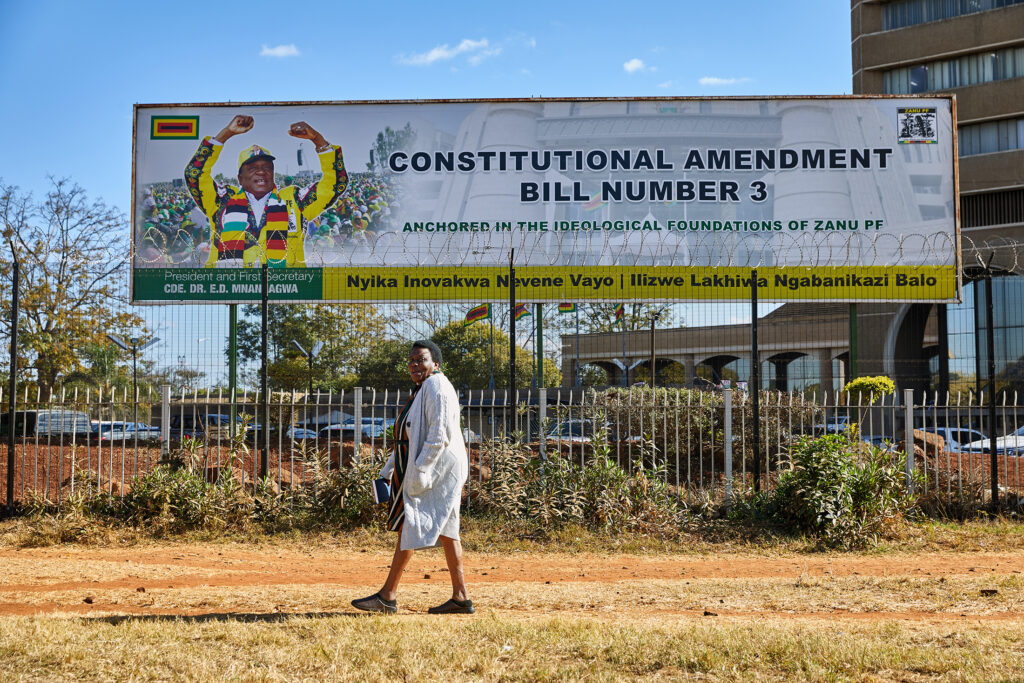
After a months-long campaign, some of those entrepreneurs accomplished one of their main political objectives several weeks ago when the government abolished the presidential vote and amended the law to extend 83-year-old Mnangagwa’s term by two years, until 2030.

That’s a major change to the system – even under Mugabe, elections were always held on the dates stipulated in the constitution.

“It’s the beginning of a one-party state,” warned Stephen Chan during a talk last month.

Chan, a professor of world politics at the School of Oriental and African Studies in London, added: “Not just a one-party state, but an authoritarian party state and an oligarchic party state.’’

By bankrolling politicians and securing powerful positions within the governing Zimbabwe African National Union-Patriotic Front (Zanu-PF), the businessmen have also started to alter the party, which has ruled the country since it achieved independence in 1980.

Historically led by ageing struggle veterans, some now rely on what Chan calls the “new class of oligarchs” for financial support.

“The party needs money,” he said in an interview, “and they have bought their way in.’’

The major players were in attendance at the wedding.

Kudakwashe Tagwirei, a tycoon under US and UK sanctions for alleged corruption, formally joined Zanu-PF’s leadership last year by being appointed to its top decision-making body.

According to local media reports, Tagwirei gifted 300 luxury vehicles to senior party leaders during this process.

Meanwhile Wicknell Chivayo, a businessman whose ventures include solar power and logistics, gave expensive vehicles to opposition lawmakers who agreed to get behind scrapping presidential elections.

And Scott Sakupwanya, a metals trader who was featured in an Al Jazeera investigation into gold smuggling, is a member of parliament for Zanu-PF.

‘Access’ to the president

With these moves, “they are making sure they have access” to the president, said Trevor Ncube, a Zimbabwean owner of independent newspapers that are critical of the government.

“Should anything happen, they will be part of the next administration or can influence it.”

Tagwirei, Sakupwanya and Chivayo did not answer multiple phone calls or reply to text messages seeking comment. The men have all publicly rejected allegations of corruption, describing them as politically motivated.

With the blessing of the senate and 280-member parliament, Mnangagwa signed the amendment to extend his term and empower parliament to select the next president on 7 July, telling the state-run press it had been a “collective” decision.

Just two years ago, the president forced one of Ncube’s newspapers to publicly apologise for suggesting he might try to remain in power.

Wilf Mbanga, the founder of the Zimbabwean, a newspaper distributed in the UK and South Africa, describes the changes as a way for the new business elite to entrench control and circumvent a vote.

“They know they can’t appeal to all Zimbabweans to be elected,” he said. “That’s why they have been pushing for the amendments.”

In response to queries, Zanu-PF’s information secretary Chris Mutsvangwa said the term extension will stabilise the business environment and usher in “a period of political and governance certainty”.

He dismissed suggestions that it was motivated by external factors. “The finger pointing at a few business figures is neither here nor there.”

‘Betrayal’

Before the amendments were passed, they were met with deep public resistance.

Court cases and requests for a referendum were brushed aside, and human rights groups say protestors were assaulted and prevented from speaking at public hearings.

The campaign has also fractured the ruling party.

A prominent retired air marshall wrote to parliament in March demanding a referendum on the measures, saying the failure to hold one would be “a betrayal not of us but of every Zimbabwean who hoped for a better country”.

Mnangagwa’s vice president, Constantino Chiwenga, criticised Tagwirei for “buying” his way into the party and warned of “bloodshed” if the term extension went through.

In an address last year at a graveyard where many of Zimbabwe’s liberation heroes are buried, he referred to the clique of businessmen as “Zvigananda” – a word whose origins come from a Shona term for blood-engorged ticks.

The vice president accused the men of betraying the country’s revolutionary values.

“There is tension in the country,” said Ncube, the newspaper owner. Referring to Chiwenga, he added, he “has got a loyal group of military people, retired commanders, who are saying this is not what we fought for”.

In a June report, the International Crisis Group warned that a coup could be one possible outcome.

“The risk is that Chiwenga will come to see such a gambit as the only route to reach a position he feels he is owed.”

Chiwenga led the 2017 coup.

Still, he will struggle to secure power without the party’s financial backers, said Chipo Dendere, assistant professor of Africana at Wellesley College in Massachusetts.

“The vice president has openly spoken against corruption” and oligarchs, she said, “but since these types hold the party purse I don’t see how he can have a political career without their support.”

The situation echoes the waning years of Mugabe’s rule, when old allies were jettisoned after a group of businessmen won favour with the ageing leader and his increasingly influential wife Grace.

Mugabe removed Mnangagwa from his post as vice president in November 2017, and a coup followed a week later.

Debt

At the time, Zimbabwe was deeply in debt to multilateral lenders. Its economy provided little formal employment, and waves of Zimbabweans were emigrating to South Africa and the UK.

On taking power, the new president promised a revival and return to the global economy.

“Mnangagwa spent years presenting himself as a reformer who had broken with the Mugabe era, and was committed to international re-engagement,” said Zaynab Hoosen, a senior Africa analyst at intelligence advisory agency Pangea Risk.

But nine years on, that still hasn’t happened.

Despite a booming lithium industry, record tobacco production and the surge in gold and platinum prices, Zimbabwe remains in default to international lenders.

It’s been in arrears for 26 years, and a quarter of its population has left.

For now, the country’s relationships with external creditors remain frozen.

The World Bank, African Development Bank, European Investment Bank and Paris Club, which have loaned to Zimbabwe in the past, are precluded from extending more credit until previous debts have been paid. Unlocking access to credit is also contingent on enacting democratic reforms.

The recent amendments could make the country even more of an international pariah and deepen its economic crisis, said Hoosen.

“Political and governance reforms are an explicit part of Zimbabwe’s dialogue with creditors.”

At home, the brazen intermingling of money and politics is likely to add to ordinary Zimbabweans’ disillusionment with democracy.

Since 2000, every election has been marred by allegations of voter intimidation and fraud.

“It was never like this in the past,” said Tinei, a construction worker in Harare who asked that his surname not be used. “But maybe times are changing very fast. I guess it pays to be in politics.”

The post Who really runs Zimbabwe? This $20m wedding holds the answer appeared first on Zimbabwe Situation.
Zimbabwe’s monthly exports reach record US$1.44 billion

Zimbabwe’s export earnings reached a record US$1.44 billion in June 2026, driven by mineral products and strong demand from the UAE, South Africa and China. Source: Zimbabwe’s monthly exports reach record US$1.44 billion | TV BRICS, 10.08.26 The country’s export receipts reached US$1.44 billion in June, driven mainly by mineral products and strong demand from […]

The post Zimbabwe’s monthly exports reach record US$1.44 billion appeared first on Zimbabwe Situation.

Zimbabwe’s export earnings reached a record US$1.44 billion in June 2026, driven by mineral products and strong demand from the UAE, South Africa and China.

Source: Zimbabwe’s monthly exports reach record US$1.44 billion | TV BRICS, 10.08.26

The country’s export receipts reached US$1.44 billion in June, driven mainly by mineral products and strong demand from key trading partners

Zimbabwe’s monthly export earnings exceeded the US$1 billion mark for the first time this year in June, increasing by 63 per cent from US$884 million in May, according to The Herald, a partner of TV BRICS.

Mineral products accounted for the largest share of exports during the month. Semi-manufactured gold made up 40.5 per cent of total exports, followed by nickel mattes at 22.2 per cent and other mineral substances at 14.4 per cent. Together, the three categories represented 77 per cent of the country’s exports.

The United Arab Emirates was Zimbabwe’s largest export destination in June, receiving goods worth US$583.8 million. South Africa ranked second with US$443.2 million, while China accounted for US$304.4 million. The three markets jointly represented about 92 per cent of Zimbabwe’s total exports for the month.

Moreover, export performance also strengthened during the first half of 2026. Receipts reached US$5.89 billion, up from US$3.87 billion during the same period last year. The UAE accounted for 48 per cent of exports, followed by South Africa with 25 per cent and China with 17 per cent, giving the three destinations a combined share of 90 per cent.

Zimbabwe is also advancing measures to increase the value generated from its mineral resources. President Emmerson Mnangagwa said the country would move towards greater value addition, beneficiation and industrialisation rather than exporting raw minerals.

The government plans to introduce further changes to mineral exports, with Zimbabwe set to export only lithium sulphate from January 2027. An orderly quota arrangement has been established to support operators during the transition. Mines and Mining Development Minister Polite Kambamura said the reforms would continue to strengthen local value addition and support industrial development.

The post Zimbabwe’s monthly exports reach record US$1.44 billion appeared first on Zimbabwe Situation.

Doctor Shortage Hits Police Force

Source: Doctor Shortage Hits Police Force ⋆ Pindula News ZRP Masvingo Province has been operating without a resident doctor for three years following the retirement of veteran medical practitioner Dr Godfrey Zimbwa. The gap has forced the province to rely on doctors seconded from Manicaland or Midlands periodically, a situation that is affecting the smooth […]

The post Doctor Shortage Hits Police Force appeared first on Zimbabwe Situation.

Source: Doctor Shortage Hits Police Force ⋆ Pindula News

ZRP Masvingo Province has been operating without a resident doctor for three years following the retirement of veteran medical practitioner Dr Godfrey Zimbwa.

The gap has forced the province to rely on doctors seconded from Manicaland or Midlands periodically, a situation that is affecting the smooth flow of operations, especially health records management.

Speaking to Midweek Watch, National police spokesperson Commissioner Paul Nyathi confirmed that there has been no resident doctor in Masvingo for the past three years, but said the situation was under control.

“Yes, there is no resident doctor in Masvingo, but the situation is under control as we send a doctor either from Manicaland or Midlands provinces from time to time to manage the situation,” said Commissioner Nyathi.

He said the challenge is not peculiar to Masvingo, as other provinces are also without resident doctors.

“This is not peculiar to Masvingo only, as there are other provinces without resident doctors, and we are waiting for deployment after the necessary government procedures, which sometimes take longer than anticipated, but one is coming soon after the necessary formalities like vetting and interviews,” he said.

Commissioner Nyathi explained that the resident doctor does not attend to patients on a daily basis, as most staff and their families are on medical aid.

He said their main role is to check on the medical status of staff and maintain health records for the smooth operations of the police force.

However, a source who spoke on condition of anonymity said the situation is more critical than portrayed, particularly in Bulawayo and Harare.

“Countrywide, there should be 30 doctors in the police force, including specialists, but there are not more than 10 countrywide, leaving a deficit of 20,” said the source.

“There is no doctor in Masvingo, Mashonaland West, Mashonaland East, with Bulawayo and Harare being the most affected because of their size.”

The source added that a minimum of 14 doctors, including specialists, are required in Bulawayo and Harare alone, but there are only four at the moment.

Some officers and members of the community have raised concerns, saying a permanently stationed doctor would ensure quicker medical assessments and better healthcare support.

The post Doctor Shortage Hits Police Force appeared first on Zimbabwe Situation.