Zimbabwe Vigil Diary 1st August 2026

Source: Zimbabwe Vigil Diary 1st August 2026 Once again Vigil activists met outside the Zimbabwe Embassy in London to continue our protest against the human rights abuse and lack of democracy in Zimbabwe perpetrated by ZANU PF Once again Vigil activists met outside the Zimbabwe Embassy in London to continue our protest against the human […]

The post Zimbabwe Vigil Diary 1st August 2026 appeared first on Zimbabwe Situation.

Source: Zimbabwe Vigil Diary 1st August 2026

Once again Vigil activists met outside the Zimbabwe Embassy in London to continue our protest against the human rights abuse and lack of democracy in Zimbabwe perpetrated by ZANU PF
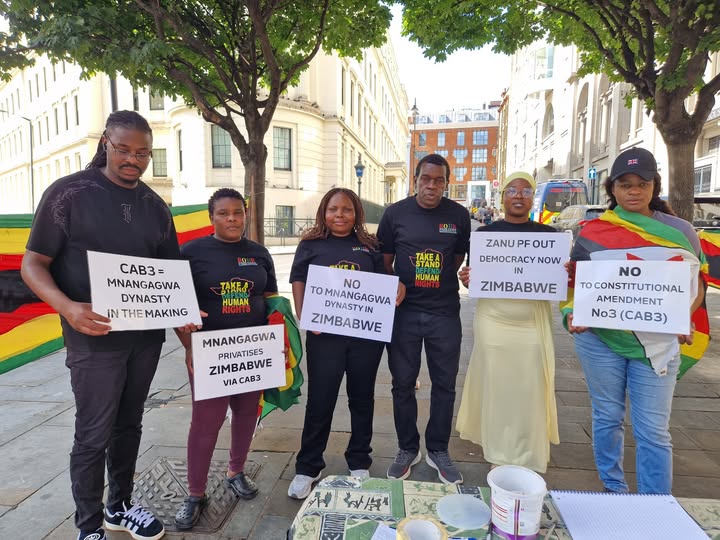
Once again Vigil activists met outside the Zimbabwe Embassy in London to continue our protest against the human rights abuse and lack of democracy in Zimbabwe perpetrated by ZANU PF, the ruling regime. Thanks to those who came today: Barbara Chibvamushure, Jonathan Kariwo, Munashe Madziyauswa, Charity Mahuni, Nyarai Manyere, Philip Maponga, Tatenda Nyakudziwanza, Samantha Pfupajena and Tatenda Tsumba. Special thanks to Barbara for bringing the Vigil posters and banners. Photos: https://www.flickr.com/…/zimb…/albums/72177720334968608/ 

.
Bob Marley once sang, ‘you will never find justice in a world where laws are made by criminals’. How profoundly true. When power and lawmakers are controlled by self-serving, corrupt and ruthless individuals, it is impossible to get justice and fairness from the system.
A good example is when civil society called for the nation to protest against CAB3 on 31/07/2026, they were told NO. This, coming after citizens were brazenly denied their right to be heard during the so called CAB3 consultations. Many were tortured, some killed, some were denied access to venues, meetings were disrupted – Zimbabwe was under siege!
Now citizens have to request permission to protest from and against the oppressors. It would be foolhardy for anyone to expect the powerful corrupt ZANUPF regime, to grant anyone permission to expose them. Excuses usually include: not enough police presence, protesters will be violent, or they want to saw seeds of disunity and disturb the peace, or are enemies of development, or are Western puppets. The list goes on.
Come the appointed day of demonstrations, every street corner and stretch will be awash with police, CIOs and even the army – armed to the teeth, clearly with orders to kill.
The powerful win, they make the laws that further their interests at the expense of the ordinary people. And they will not countenance any challenge.
Wither Zimbabwe!
For Vigil pictures check: http://www.flickr.com/photos/zimbabwevigil/ 

. Please note: Vigil photos can only be downloaded from our Flickr website.

Events and Notices:
Next Vigil meeting outside the Zimbabwe Embassy. Saturday 15th August from 2 – 5 pm. We meet on the first and third Saturdays of every month. On other Saturdays the virtual Vigil will run.
The Restoration of Human Rights in Zimbabwe (ROHR) is the Vigil’s partner organisation based in Zimbabwe. ROHR grew out of the need for the Vigil to have an organisation on the ground in Zimbabwe which reflected the Vigil’s mission statement in a practical way. ROHR in the UK actively fundraises through membership subscriptions, events, sales etc to support the activities of ROHR in Zimbabwe.
The Vigil’s book ‘Zimbabwe Emergency’ is based on our weekly diaries. It records how events in Zimbabwe have unfolded as seen by the diaspora in the UK. It chronicles the economic disintegration, violence, growing oppression and political manoeuvring – and the tragic human cost involved. It is available at the Vigil. All proceeds go to the Vigil and our sister organisation the Restoration of Human Rights in Zimbabwe’s work in Zimbabwe. The book is also available from Amazon.
Facebook pages:
Vigil : https ://www.facebook.com/zimbabwevigil
The Vigil, outside the Zimbabwe Embassy, 429 Strand, London meets regularly on Saturdays from 14.00 to 17.00 to protest against gross violations of human rights in Zimbabwe. The Vigil which started in October 2002 will continue until internationally-monitored, free and fair elections are held in Zimbabwe.

The post Zimbabwe Vigil Diary 1st August 2026 appeared first on Zimbabwe Situation.
Still No Accountability for Zimbabwe’s 2018 Abuses

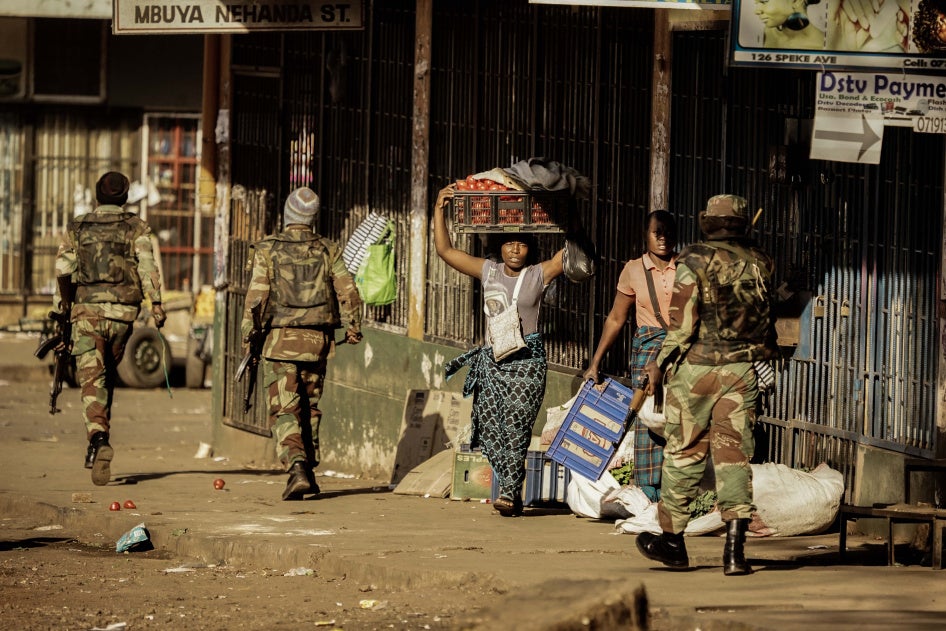
Source: Still No Accountability for Zimbabwe’s 2018 Abuses End Culture of Impunity; Implement Commission’s Recommendations Click to expand Image A vendor seeks cover as soldiers disperse demonstrators in Harare, Zimbabwe, after protests erupted over alleged fraud in the country’s election on August 1, 2018. © 2018 Zinyange Auntony/AFP via Getty Images Eight years on, justice is […]

The post Still No Accountability for Zimbabwe’s 2018 Abuses appeared first on Zimbabwe Situation.
Source: Still No Accountability for Zimbabwe’s 2018 Abuses

End Culture of Impunity; Implement Commission’s Recommendations

d13bef93-07c8-4d2a-a47b-d615f9fb8041

Click to expand Image

A vendor seeks cover as soldiers disperse demonstrators in Harare, Zimbabwe, after protests erupted over alleged fraud in the country’s election on August 1, 2018. © 2018 Zinyange Auntony/AFP via Getty Images

Eight years on, justice is still elusive for the families of 6 people killed and the 35 injured by Zimbabwe state security forces during the August 1, 2018, protests.

Witnesses at the time told Human Rights Watch that military officers and anti-riot police used excessive and lethal force against people who were protesting delayed election results on the streets of Harare, the capital. Security forces indiscriminately fired live ammunition at protesters and bystanders. Among the dead was Sylvia Maposa, a 53-year-old mother of two whom soldiers fatally shot in the back when she was heading home from work that afternoon.

The following day, President Emmerson Mnangagwa called for an independent investigation into the killings and said: “those responsible should be identified and brought to justice.”

Mnangagwa later appointed a commission, known as the Motlanthe Commission of Inquiry, to investigate the violence and make recommendations. Eight years later, Mnangagwa has not implemented the commission’s recommendations, including completing investigations to hold responsible members of the military and police to account.

No security personnel have been arrested or prosecuted, nor has any compensation been provided. Since the August 2018 protest, the government has taken few concrete steps to demonstrate commitment to accountability, justice, and respect for the rule of law. This culture of impunity has bred an atmosphere of governmental abuse and violence. During three days of demonstrations throughout Zimbabwe in January 2019 to protest a fuel price increase, security forces fired live ammunition, killing 17 people, and raped at least 17 women.

Since assuming power in a military coup in 2017, the Mnangagwa administration has committed serious human rights violations and shown a failure or unwillingness to institute lasting human rights reforms. Violence, intimidation, harassment, and repression aimed principally at opposition party members, journalistsstudents, and civil society activists have severely restricted civic and political space.

Zimbabwe authorities should demonstrate respect for human rights and the rule of law by acting on the recommendations of Motlanthe commission without any further delay and start breaking the country’s cycle of impunity.

The post Still No Accountability for Zimbabwe’s 2018 Abuses appeared first on Zimbabwe Situation.

Zimbabwe Probes Russian War Recruiting Schemes

Source: Zimbabwe Probes Russian War Recruiting Schemes At least 18 Zimbabweans have been killed in Russia’s war on Ukraine Zimbabwean Tatenda Tarwire, 37, was captured and is being held as a prisoner of war in Ukraine. UNITED24 MEDIA Amid a spate of recent arrests on charges of human trafficking, police and government officials in Zimbabwe […]

The post Zimbabwe Probes Russian War Recruiting Schemes appeared first on Zimbabwe Situation.

Source: Zimbabwe Probes Russian War Recruiting Schemes

At least 18 Zimbabweans have been killed in Russia’s war on Ukraine

Edward Kachingwe, a 36-year-old Zimbabwean, faced charges in a Harare court on June 29 of trafficking in persons and operating an unregistered employment agency. Prosecutors said he worked with a Russian accomplice identified as “Roman,” who remains at large, to “unlawfully recruit victims to join the Russian army where they will be forced to fight in the armed conflict between the Russian Federation and Ukrainian Forces.”

Investigators reportedly are examining financial transactions, communication records and travel arrangements. They believe Kachingwe had recruited five men before he was arrested at Harare’s Roadport Bus Terminus on June 27 while escorting one of them to a bus bound for South Africa. Prosecutors allege that it was the first stage of the journey to Russia. They also are looking for links to a similar case in June, when Russian national Leonid Koftev appeared in court on trafficking charges after allegedly arranging a Zimbabwean man’s travel to Russia.

“What we are seeing are not isolated incidents but indications of organised networks exploiting socio-economic vulnerabilities,” security analyst Effie Dlela Ncube told Zimbabwean newspaper NewsDay for a July 25 article. NewsDay reported that recruiting syndicates have shifted their methods in response to increased scrutiny. Initially, many recruits traveled directly from Harare. However, as arrests increased, the networks allegedly shifted toward overland routes through South Africa.

At least 18 Zimbabweans have been killed while fighting alongside Russian forces and at least 63 more remain unaccounted, Information Minister Zhemu Soda said, accusing fraudulent employment agencies of promising lucrative jobs in Russia to trick Zimbabweans into joining the war.

“Our citizens are being preyed upon by unscrupulous individuals and networks who operate with complete disregard of human life,” he said at a news conference on March 25.

Police recovered electronic tickets, hotel bookings and Russian visa documents during the operation.

Kachingwe’s arrest highlighted the evolving strategy. Recruits travel to Russia, where the promised jobs disappear. Their passports are confiscated shortly after arrival, and they find themselves tricked or coerced into joining the army, sometimes at gunpoint.

Zimbabwean human rights activist Mbuso Fuzwayo said the allegations exhibit all the characteristics of human trafficking.

“These networks operate in layers. The people making contact with recruits are often only one part of a much larger chain involving financiers, transport facilitators and foreign coordinators,” he told NewsDay. “Arresting local recruiters is important, but dismantling these operations requires following financial trails and establishing who is coordinating these activities internationally.”

Mounting casualties have forced Russia to intensify its recruitment efforts in Africa. But the Russian Army treats foreign fighters as a disposable resource, Ukrainian Foreign Minister Andrii Sybiha said.

“They use them in their so-called meat assaults, unfortunately,” he told Public Broadcasting Service’s “News Hour” program for a July 3 broadcast. “They use them on the most difficult directions on the battlefield. So, it means that their period of their life is very short.”

Russia in expects to recruit 18,500 foreign fighters in 2026, a nearly sixfold increase since the beginning of the war, according to the Kyiv-based war crimes watchdog Truth Hounds. Researcher Kenza Rharmaoui, one of the authors of the April 29 report on Russia’s exploitation of foreign fighters, said that Africans sent to the battlefield have few options and a low survival rate.

“All the persons that we spoke to were fighting for less than two months, a month” before they were killed or captured, she told PBS before adding a warning to would-be recruits: “There is no possibility to just stop, end your contract and go back home. Once you’re in this, you’re in this.”

The post Zimbabwe Probes Russian War Recruiting Schemes appeared first on Zimbabwe Situation.

So, Mukanya, when did Chivayo’s money suddenly become clean?

Source: So, Mukanya, when did Chivayo’s money suddenly become clean? Money is indeed a powerful force. Tendai Ruben Mbofani There was a time when the name Thomas Mapfumo stood as an unshakeable monument to unyielding integrity. To directly receive my articles please join my WhatsApp Channel on: https://whatsapp.com/channel/0029VaqprWCIyPtRnKpkHe08 For over five decades, the Lion of Zimbabwe […]

The post So, Mukanya, when did Chivayo’s money suddenly become clean? appeared first on Zimbabwe Situation.

Source: So, Mukanya, when did Chivayo’s money suddenly become clean?

Money is indeed a powerful force.

Tendai Ruben Mbofani

There was a time when the name Thomas Mapfumo stood as an unshakeable monument to unyielding integrity.

To directly receive my articles please join my WhatsApp Channel on: https://whatsapp.com/channel/0029VaqprWCIyPtRnKpkHe08

For over five decades, the Lion of Zimbabwe built a legacy on the foundation of uncompromising principles.

Through the dark days of colonial Rhodesia to the post-independence years of state corruption and economic decay, Mukanya was the acoustic conscience of a suffering nation.

His music was not merely entertainment; it was a sanctuary for the oppressed, an uncompromising voice against state plunder, and a relentless critique of the political patronage that has ruined our country.

When he spoke, we listened, because his words carried the heavy weight of a man who could not be bought.

That is why his initial refusal of controversial tenderpreneur Wicknell Chivayo’s lavish offer was met with such widespread admiration.

When Chivayo dangled a $300,000 house and a $200,000 luxury vehicle in front of the legendary artist, Mapfumo did what true icons do: he rejected it.

He publicly called out the offer for what it was—dirty money, a political bribe aimed at buying his silence and neutralizing his moral authority.

He reminded us that his dignity was not for sale and that he would never feast on the crumbs of a system that starves ordinary citizens.

Mapfumo even openly mocked fellow artists like Ba Troy, Seh Calaz, and Mathias Mhere for accepting Chivayo’s gifts, dismissing them as desperate beggars who were easily enticed like naive children by “dangled toys.”

In that moment, Mukanya validated the faith millions had placed in him for generations.

Yet today, that towering legacy lies severely tarnished under the weight of a staggering paradox.

Mapfumo has now accepted an eye-watering $1 million from the very same Chivayo to perform at his private birthday celebration and Jah Prayzah’s wedding.

The sudden somersault is as breathtaking as it is disappointing.

How does money that was declared toxic, corrupt, and compromised when attached to a house and a car suddenly become immaculate when packaged as a performance fee?

Mapfumo’s current defense is that this is simply “zvebasa izvi”—just work, a purely commercial arrangement between an artist and a client.

He insists that performing for a client does not equate to political endorsement or moral compromise.

But this line of reasoning is a hollow shield that collapses under the lightest scrutiny.

Laundered through a contract or handed over in an envelope, the source of that money has not changed by a single cent.

If the funds were born of opaque state tenders and political patronage yesterday, they carry the exact same lineage today.

Wrapping a million dollars in the vocabulary of a business transaction does not cleanse it of its origin, nor does it sanitize the ethical failure of accepting it.

If Mapfumo labeled Chivayo’s money “dirty” yesterday, what has suddenly made it “clean” today?

What makes this betrayal even more bitter is Mapfumo’s astonishing turn as Chivayo’s public defender.

In his recent media interviews, Mukanya went so far as to challenge the public, accusing people of hypocrisy for targeting Chivayo while remaining silent on other wealthy figures.

​He even praised Chivayo for “giving back” to artists and the community—conveniently forgetting that he was mocking those very same recipients not so long ago.

To hear the Lion of Zimbabwe adopt the standard rhetoric of patronage beneficiaries—using selective philanthropy to justify questionable wealth—is nothing short of tragic.

​To demand that ordinary Zimbabweans report Chivayo to law enforcement if they suspect corruption is the height of disingenuousness.

Mapfumo knows better than anyone that in a nation governed by a deeply entrenched patronage system, state institutions are structured to protect political elites, not investigate them.

For a man who himself declared Chivayo’s wealth “dirty” without needing a court verdict, hiding behind the shield of due process now is nothing short of intellectual dishonesty.

Mapfumo scolds the public for applying the exact moral standard that he spent fifty years teaching them to hold.

For decades, his music urged Zimbabweans to reject the flashiness of corrupt elites and to demand accountability.

Now, when his audience holds him to the very standard he established, he deflects by asking why others are not being criticized.

Mukanya cannot have it both ways.

He cannot claim the mantle of the nation’s moral conscience while collecting million-dollar checks from the champions of the status quo.

By putting a price tag on his engagement, he has demonstrated that his initial rejection was not a matter of absolute principle, but merely a question of the figure on the check.

The Lion has not lost his voice, but he has certainly changed his tune.

In accepting Chivayo’s million dollars, Mapfumo may have secured a massive payday, but he has surrendered something far more valuable: the absolute trust of the people who once saw him as incorruptible.

So, Mukanya, tell the nation: at what exact figure did the money become clean?

The post So, Mukanya, when did Chivayo’s money suddenly become clean? appeared first on Zimbabwe Situation.

Jailed 9 years for false rape, lying girl’s mother died mysteriously… Simba’s wedding after ngozi revealed shocking truth!

From a Prison Cell to the Altar: The Remarkable Redemption of Simbarashe Chadiwa In the coming weeks, the bustling heart of Harare is set to witness a spectacle rarely seen in the capital’s history. Whether it be the manicured lawns of the Harare…

From a Prison Cell to the Altar: The Remarkable Redemption of Simbarashe Chadiwa In the coming weeks, the bustling heart of Harare is set to witness a spectacle rarely seen in the capital’s history. Whether it be the manicured lawns of the Harare Gardens or the historic grounds of Africa Unity Square, a grand public […]

The post Jailed 9 years for false rape, lying girl’s mother died mysteriously… Simba’s wedding after ngozi revealed shocking truth! first appeared on My Zimbabwe News.