How telehealth is helping close the healthcare gap in rural Zimbabwe

Virtual consultations are replacing hours of travel, bringing affordable healthcare closer to rural Zimbabweans. Source: How telehealth is helping close the healthcare gap in rural Zimbabwe | News | Al Jazeera By Farai Shawn Matiashe Nyazura, Zimbabwe – Bright fluorescent lights reflect off polished floors as Anymore Kadzunge returns for a routine check-up at a telehealth centre […]

The post How telehealth is helping close the healthcare gap in rural Zimbabwe appeared first on Zimbabwe Situation.
Virtual consultations are replacing hours of travel, bringing affordable healthcare closer to rural Zimbabweans.

Source: How telehealth is helping close the healthcare gap in rural Zimbabwe | News | Al Jazeera

Nyazura, Zimbabwe – Bright fluorescent lights reflect off polished floors as Anymore Kadzunge returns for a routine check-up at a telehealth centre that helped diagnose the illness she had struggled with for months.

The 38-year-old farmer sits quietly as a nurse wraps a blood pressure cuff around her arm. Moments later, the machine beeps with the reading.

Only months earlier, Kadzunge had been struggling to work her fields or prepare meals for her family. She had spent three months experiencing chest pains and dizziness before walking 14km (8.7 miles) from her village of Chimbondi after a friend told her about the facility.

A nurse found her blood pressure was elevated and connected her with a doctor through a video consultation.

“The nurse tested my blood pressure, but it was extremely high,” Kadzunge told Al Jazeera. “I then spoke to a doctor through a video call.”

She was diagnosed with hypertension and prescribed medication, which she continues to take daily. Within days, her condition improved.

Bringing doctors closer

Kadzunge’s experience comes as efforts grow to bring doctors closer to rural communities in Zimbabwe, where years of economic hardship have left the public health system facing shortages of medicines, equipment and medical workers.

The programme was launched in 2024 by ZimSmart Villages, a Zimbabwean technology and innovation organisation, in partnership with NetOne, the country’s state-owned telecommunications company, and Zimbabwe Posts (Zimpost), the state-owned postal and courier service.

The programme connects patients in remote communities with healthcare professionals providing digital consultations, reducing the need for long journeys to see a doctor.

Advertisement

According to the World Health Organization (WHO), Zimbabwe had 1.7 doctors for every 10,000 people in 2022, compared with Africa’s average of 2.6.

For many rural residents, seeing a doctor in person requires expensive travel. Without the Nyazura centre, Kadzunge would have needed to travel 22km (13.7 miles) to Rusape, a town in eastern Zimbabwe, or 70km (43 miles) to Mutare, the capital of Manicaland province.

Ambulances are limited in many rural areas, forcing some families to transport sick relatives to health facilities using ox-drawn scotch carts, a common form of rural transport.

At the Nyazura centre, registered nurse Noreen Chimanya checks patients’ vital signs, including blood pressure, blood sugar levels and temperature, before arranging video consultations with doctors. She also provides prescribed treatment and refers serious cases to hospitals.

“When we opened in May 2024, telemedicine was something completely new in this community,” Chimanya told Al Jazeera. “People were used to speaking to doctors in person and being physically examined.”

Building trust required months of community outreach. Chimanya travelled to surrounding villages explaining how virtual consultations worked.

“They like it here because there are no queues,” she said. “At public health facilities, people spend hours waiting to be seen.”

The centre uses Starlink, the satellite internet service operated by United States aerospace company SpaceX, and a backup lithium battery to keep consultations running during frequent power cuts.

A lifeline for rural patients

According to ZimSmart Villages, by 2026 the organisation had established 28 telehealth centres across seven of Zimbabwe’s 10 provinces and conducted more than 28,000 virtual consultations, including about 25,000 diagnostic tests.

Tawanda Njerere, the organisation’s cofounder and chief operations officer, told Al Jazeera the programme was designed to create digital health access points within existing post office infrastructure.

“Rather than requiring rural patients to travel 50km or more to urban health facilities, the programme establishes digital health access points embedded within existing post office infrastructure,” he said.

The centres charge between $2 and $10 for consultations, compared with $15 to $20 at many private clinics.

For some rural households, that difference can determine whether they seek treatment or wait.

For Proud Chimene, a vendor from nearby Chimene village, it made seeking treatment possible.

In July 2024, after experiencing unexplained weight loss, extreme thirst and persistent fatigue, she visited the Nyazura centre.

“The situation had deteriorated,” Chimene told Al Jazeera. “The nurse tested my blood glucose level and it was high. After speaking to the doctor through a video call, they put me on an intravenous drip for several hours. He also prescribed medicine that I take twice a day.”

Advertisement

She was diagnosed with diabetes.

“If it was not for this nearby telehealth centre providing access to a doctor at affordable fees, I would probably not have sought treatment at all,” she said.

Njerere said the programme focuses on detecting illnesses earlier by bringing screening services closer to communities. Digital health records and follow-up consultations also help patients manage chronic conditions such as hypertension and diabetes.

The centres have also diagnosed sexually transmitted infections and referred patients needing specialised care.

Challenges remain

Despite its growth, telehealth cannot replace all the services provided by traditional healthcare facilities.

Specialist services, particularly for eye health, mental health and complex chronic disease management, remain limited across Zimbabwe.

“The programme addresses this through partnerships with established eye-care providers and specialist networks, but specialist capacity remains a systemic constraint,” Njerere said.

In some rural communities, unfamiliarity with virtual consultations means building trust remains an ongoing challenge.

For Kadzunge, the measure of success is simple: she can return to the fields and daily routines that illness had taken away.

“I am healthy again,” she said. “Now I can go to the farm without scaring my family.”

The post How telehealth is helping close the healthcare gap in rural Zimbabwe appeared first on Zimbabwe Situation.

Cabinet Approves Bill Giving Municipal Police Powers To Arrest

Source: Cabinet Approves Bill Giving Municipal Police Powers To Arrest ⋆ Pindula News Cabinet has approved the Municipal Police and Courts Bill, which gives municipal police officers powers to arrest people when enforcing by-laws. The Bill was presented by the chairman of the Cabinet Committee on Legislation, Justice, Legal and Parliamentary Affairs Minister Ziyambi Ziyambi. […]

The post Cabinet Approves Bill Giving Municipal Police Powers To Arrest appeared first on Zimbabwe Situation.

Source: Cabinet Approves Bill Giving Municipal Police Powers To Arrest ⋆ Pindula News

Cabinet has approved the Municipal Police and Courts Bill, which gives municipal police officers powers to arrest people when enforcing by-laws.

The Bill was presented by the chairman of the Cabinet Committee on Legislation, Justice, Legal and Parliamentary Affairs Minister Ziyambi Ziyambi.

A post-cabinet notice which confirmed the development reads: “The public is informed that in line with the Urban Councils Act [Chapter 29:15] and the Rural District Councils Act [Chapter 29:13], Local Authorities are empowered to formulate and enforce regulations of matters falling within their jurisdiction.

“In order to promote good governance, efficient service delivery and access to justice, local authorities require coordinated structures and strengthened municipal enforcement of by-laws to address issues of non-compliance, including apprehension of offenders of by-laws, investigation and prosecution of such offences.

“The Bill strengthens the legal framework for municipalities to establish and maintain, dedicated and professional police services focused on community safety, by-law enforcement, traffic management, and local crime prevention.

“Additionally, the Bill provides for the creation of municipal courts; definition of the courts’ jurisdiction; including over municipal by-laws, minor offences, traffic violations; and the appointment of municipal magistrates, among other matters prescribed by the law.

“Accordingly, local governance structures will be enhanced in line with the constitutional Devolution principles and improved public safety and environmental outcomes.”

Early this month, Bulawayo Mayor David Coltart said municipal police should be given powers to make arrests to help restore order in the city’s streets.

Coltart said municipal police have been stripped of the powers needed to carry out their duties, resulting in what he described as a breakdown in the enforcement of law and order on the city’s streets.

The post Cabinet Approves Bill Giving Municipal Police Powers To Arrest appeared first on Zimbabwe Situation.

As Zimbabwe’s raw lithium ban pays off, ambitions grow

Source: As Zimbabwe’s raw lithium ban pays off, ambitions grow Buoyed by the development, the small southern African country is determined to go much further in its drive for local processing of its resources, even eyeing its own production of rechargeable lithium batteries. It is part of a push by the country — and others […]

The post As Zimbabwe’s raw lithium ban pays off, ambitions grow appeared first on Zimbabwe Situation.

Source: As Zimbabwe’s raw lithium ban pays off, ambitions grow

Buoyed by the development, the small southern African country is determined to go much further in its drive for local processing of its resources, even eyeing its own production of rechargeable lithium batteries.

It is part of a push by the country — and others on the continent — to add value domestically to raw materials to create jobs and lift export earnings.

“We will no longer tolerate the raw exportation of our wealth,” President Emmerson Mnangagwa said this week as he opened an industrialisation conference.

“We would rather leave our valuable minerals underground than export them without processing them locally. The era of ‘horse and rider’ investment relationships is over.”

In February, Zimbabwe froze exports of raw minerals ahead of a full ban in 2027, announcing it would require “in-country value addition and beneficiation”.

The focus was on raw concentrates of the rechargeable battery ingredient lithium, with most of its hundreds of thousands of tons of annual production shipped out to China, the world’s largest maker of electric vehicles.

The ban sent mining firms scrambling to build plants to process lithium sulfate, a step along the value chain towards battery‑grade materials.

The first, and only one so far, was set up at Goromonzi, around 30 kilometres (20 miles) east of Harare, a $400-million facility built by Chinese-owned Prospect Lithium Zimbabwe (PLZ) that became fully operational in May.

It was also a first for the continent, mines minister Polite Kambamura said on a tour last week.

“The construction of the first lithium sulphate plant in Africa is behind me, and this was done in Zimbabwe,” he told journalists.

“We are very happy, as a government, to witness this milestone, especially as we continue pushing for local value addition and beneficiation,” he said.

Batteries and beyond

Kambamura said PLZ had also nearly completed a plant to refine lithium carbonate, the next point along the processing sequence.

More sulphate processing plants were expected to come on line by the time the ban on lithium concentrate exports comes into force in January 2027, he said.

“The next step will be getting lithium batteries in Zimbabwe,” he said. “We will rest only after we can produce… lithium batteries and solar panels.”

Battery manufacturing requires extensive industrial supply chains that remain concentrated in Asia, with South Africa dominating the emerging sector on the continent.

Besides the focus on lithium, Zimbabwe’s government has another 13 minerals — from cobalt to platinum metals and rare earth elements — on its list of “critical” minerals that cannot be exported in raw form from the start of next year.

Gold

The new policy is intended to secure long-term benefits from Zimbabwe’s natural wealth, government spokesman Nick Mangwana said.

“Some of these minerals are finite and future generations may never see them. We do not want them to inherit white elephants,” he told AFP.

The overhaul has extended to the significant gold sector, with the government announcing in May that only indigenous citizens and locally owned companies will be permitted to operate small- and medium-scale mines, which provide livelihoods for thousands.

“This policy is not exclusion, it is structured inclusion,” said Payne Farai Kupfuwa, founder of the Young Miners Foundation, welcoming the move.

The growth of the lithium sector since the February export freeze — with over $1 billion in investments since then — shows that the limits on raw mineral exports “attracts value-adding industries, creates jobs, boosts the economy, and ensures more profits stay within the country,” public policy expert Tedious Ncube told AFP.

The post As Zimbabwe’s raw lithium ban pays off, ambitions grow appeared first on Zimbabwe Situation.

Why Zimbabwe’s new municipal police bill could backfire on citizens

Source: Why Zimbabwe’s new municipal police bill could backfire on citizens Zimbabwe has become a haven for ill-conceived ideas. The approval of the Municipal Police and Courts Bill—announced following a Cabinet briefing by Information Minister Dr. Zhemu Soda—marks a defining crossroads for local governance. If you value my social justice advocacy and writing, please consider […]

The post Why Zimbabwe’s new municipal police bill could backfire on citizens appeared first on Zimbabwe Situation.

Source: Why Zimbabwe’s new municipal police bill could backfire on citizens

Zimbabwe has become a haven for ill-conceived ideas.

The approval of the Municipal Police and Courts Bill—announced following a Cabinet briefing by Information Minister Dr. Zhemu Soda—marks a defining crossroads for local governance.

If you value my social justice advocacy and writing, please consider a financial contribution to keep it going. Contact me on WhatsApp: +263 715 667 700 or Email: mbofana.tendairuben73@gmail.com

Framed as a stride toward constitutional devolution and community safety, the proposed law seeks to empower local authorities by establishing dedicated municipal police services and specialized municipal courts.

While the legislative intent purports to professionalize enforcement and decentralize access to justice, a rigorous analysis reveals that without radical structural safeguards, this legislation risks institutionalizing state-sponsored harassment, worsening human rights abuses, and turning municipal enforcement into an engine of extortion.

At first glance, codifying municipal enforcement appears necessary. Under the Urban Councils Act and Rural District Councils Act, local authorities possess the power to formulate by-laws but have long lacked a coherent statutory framework for enforcement.

In theory, establishing dedicated municipal courts presided over by municipal magistrates could shift dispute resolution off the streets into a formal judicial setting.

This could guarantee citizens due process, proper evidentiary standards, and legal representation, replacing summary street justice, arbitrary property confiscation, and instant fines with formal adjudication.

However, theory rarely survives contact with street-level reality. In cities like Harare, municipal enforcement has earned a reputation for violent heavy-handedness, particularly against informal vendors, public transport operators, and daily wage earners.

Granting expanded powers of arrest, criminal investigation, and prosecution to the very forces responsible for these abuses, without first reforming their operational culture, is a dangerous miscalculation.

A primary flaw in this proposal is the severe gap in institutional readiness and capacity.

Municipal enforcement personnel are currently trained for basic administrative compliance, not the rigorous demands of criminal procedure, legal chain of custody, and constitutional rights during arrest.

Expecting officers to transition from an aggressive “confront-and-confiscate” mentality to professional criminal investigation requires far more than passing a piece of legislation.

Without accredited retraining, extensive human rights education, and strict behavioral vetting, expanding officer authority will simply give rogue elements legal cover to abuse vulnerable citizens.

Equally troubling is the fiscal reality facing local authorities. Constructing specialized courts, employing magistrates and prosecutors, and equipping a professionalized police unit with proper transport, gear, and competitive salaries requires substantial capital.

For financially constrained councils, the temptation to use municipal courts and police forces as revenue-generating tools will be irresistible.

International precedent provides a stark warning. In the United States, independent investigations into municipal courts—such as those in Ferguson, Missouri—demonstrated how local policing transforms into systematic extortion when city budgets depend on court fines and penalizing low-income residents.

If local councils rely on fines to fund these new institutions, officers will face implicit quotas, weaponizing the law against economically vulnerable populations under the guise of by-law compliance.

Global models underscore that local policing only succeeds when bound by strict jurisdictional limits and robust accountability.

In South Africa, Metropolitan Police Departments operate alongside dedicated municipal courts, but their mandate is strictly restricted to minor traffic infractions and visible by-law enforcement, leaving serious criminal investigations to national police.

Crucially, South African law mandates independent civilian oversight committees for every metro department to investigate public complaints against officers.

If the Municipal Police and Courts Bill is to bring genuine sanity rather than heightened chaos, it cannot merely expand statutory authority.

The legislation must explicitly restrict municipal jurisdiction to minor administrative infractions, decouple court revenues from police operational budgets, and mandate an independent civilian oversight body empowered to investigate municipal misconduct.

Furthermore, local authorities must recognize that urban order cannot be achieved through policing alone; it requires sustainable socio-economic solutions, including designated vending infrastructure and inclusive urban planning.

Without these checks, this bill will not deliver public safety—it will merely grant legal impunity to municipal abuse.

  • Advertise your business, products, or services on my WhatsApp Channel with over 10k followers. For bookings, contact me on WhatsApp: +263 715 667 700 or Email: mbofana.tendairuben73@gmail.com

The post Why Zimbabwe’s new municipal police bill could backfire on citizens appeared first on Zimbabwe Situation.

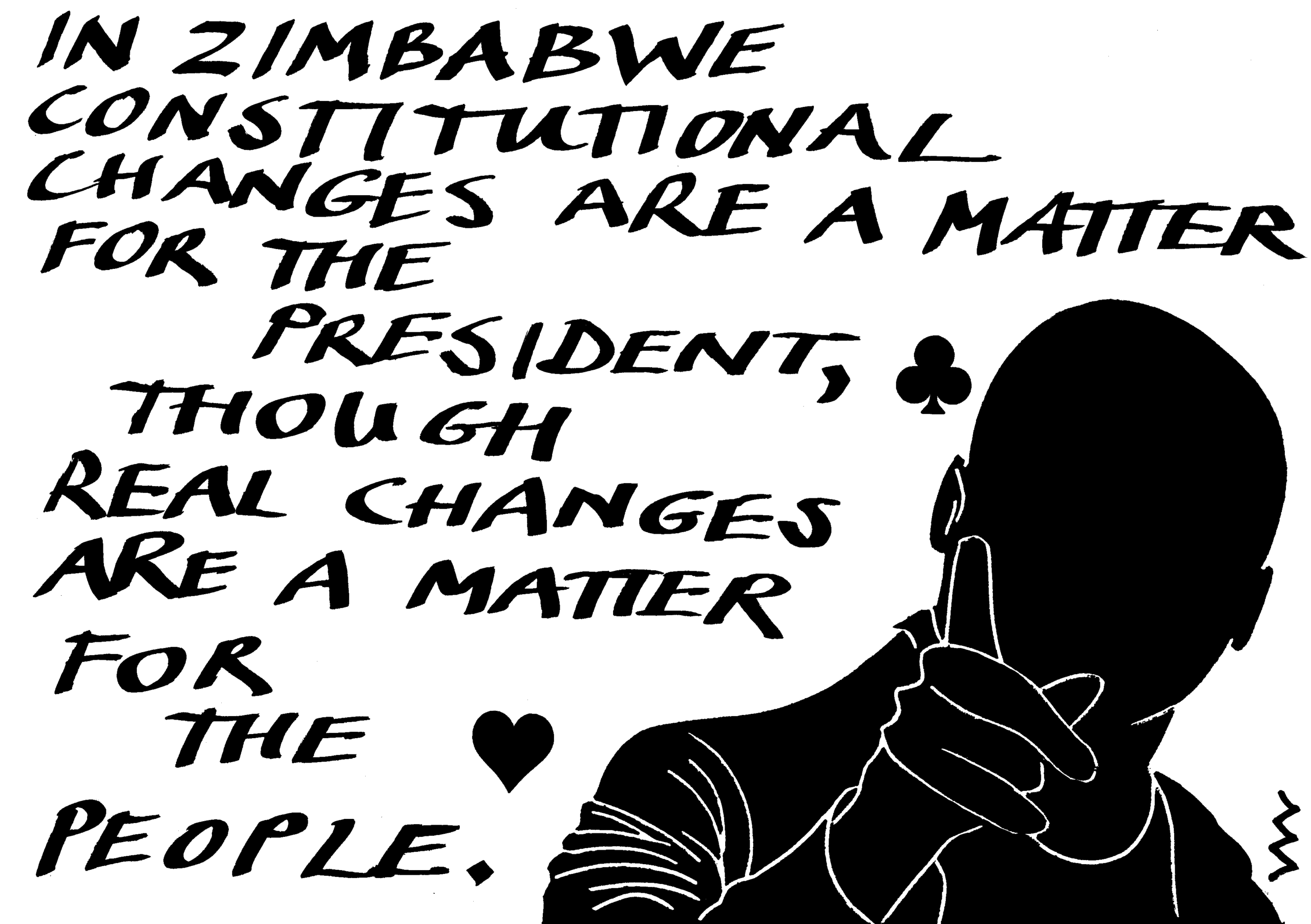
In Zimbabwe constitutional changes are a matter for the President

Source: In Zimbabwe constitutional changes are a matter for the President

In Zimbabwe constitutional changes are a matter for the President

Paul Bogaert

The post In Zimbabwe constitutional changes are a matter for the President appeared first …

Source: In Zimbabwe constitutional changes are a matter for the President

In Zimbabwe constitutional changes are a matter for the President

Paul Bogaert

The post In Zimbabwe constitutional changes are a matter for the President appeared first on Zimbabwe Situation.