AS a newly appointed adviser to the President on environmental policies, Dilesh Nguwaya has an opportunity to move Zimbabwe’s environmental conversation beyond waste disposal and towards a national economic strategy centred on resource efficiency, innovation and sustainable industrial growth.
By Brighton Musonza
Global investment decisions are increasingly being shaped by environmental performance, with investors paying closer attention to how countries manage natural resources, waste and climate-related risks. Beyond traditional economic indicators, capital providers are now evaluating the strength of national environmental policies, particularly efforts to transition towards circular economy models that improve resource efficiency, reduce waste and create more resilient production systems.
For emerging economies such as Zimbabwe, a credible circular economy strategy can enhance investment attractiveness by signalling policy maturity, long-term sustainability and alignment with the evolving expectations of global capital markets.
Beyond Politics: The Economic Opportunity Behind Environmental Reform
Public figures often attract diverse opinions, and Dilesh Nguwaya is no exception. However, beyond political debates and personal perceptions, there is a broader economic conversation that deserves attention: the need for Zimbabwe to rethink how it manages resources, waste and industrial development.
Unlike many individuals associated with public institutions, Nguwaya has established a visible private-sector entity operating in an area that addresses one of Zimbabwe’s most urgent urban challenges: waste management. Through the Geo Pomona project, the conversation around landfills, municipal waste and environmental sustainability has moved closer to the centre of national economic planning.
His recent appointment as an adviser to the President presents an opportunity to elevate environmental management from a municipal responsibility into a national economic strategy. Zimbabwe’s challenge is no longer simply about collecting waste; it is about redesigning an economic system that has historically followed a linear model of extraction, production, consumption and disposal.
The next phase for Nguwaya should involve bringing together Zimbabwe’s leading environmental economists, engineers, sustainability researchers and circular economy specialists from both local universities and the global diaspora to develop a comprehensive national framework for transitioning from a linear economy to a circular economy.
The ultimate objective should be the convening of a National Circular Economy Conference, bringing together policymakers, industry leaders, academics, environmental experts, investors and civil society to develop a shared vision for Zimbabwe’s economic transition. The conference should produce a comprehensive Circular Economy Policy White Paper that provides evidence-based recommendations and a strategic roadmap for moving the country away from the traditional linear model of extraction, production, consumption and disposal towards a regenerative economic system built on resource efficiency, innovation, waste reduction and value preservation.
The document should then undergo broad stakeholder consultation and debate to ensure that Zimbabwe’s circular economy transition is anchored in national priorities, economic realities and long-term sustainable development goals.
Circular Economy: Moving Beyond the Waste Management Debate
The circular economy is often misunderstood as merely a recycling initiative. In reality, it represents a fundamental redesign of how economies create and preserve value.
The traditional industrial model has operated on a simple principle: extract resources, manufacture products, consume them and dispose of the resulting waste. This linear approach was effective during periods of abundant resources and lower environmental pressures. However, in the modern economy, it is increasingly creating high financial, environmental and social costs.
A circular economy seeks to keep materials in productive use for as long as possible through repair, reuse, refurbishment, remanufacturing and recycling. Waste is no longer viewed as an unavoidable by-product but as a potential input into new production systems.
For Zimbabwe, this shift has major economic implications. A discarded plastic bottle, agricultural residue, industrial by-product or mining waste stream should not necessarily represent an economic loss. With the right technology, investment and policy environment, these materials can become sources of new industries, employment and value creation.
The question is no longer simply how Zimbabwe can dispose of waste more efficiently. The more important question is how the country can redesign its economic systems so that waste generation is reduced and resources continuously circulate within productive value chains.
The Ellen MacArthur Framework and Zimbabwe’s Economic Future
Around the world, governments and businesses are increasingly adopting circular economy principles pioneered through frameworks such as those developed by the Ellen MacArthur Foundation. These approaches have influenced national strategies across Europe, Asia and parts of Africa by demonstrating that environmental responsibility and economic competitiveness are not contradictory objectives.
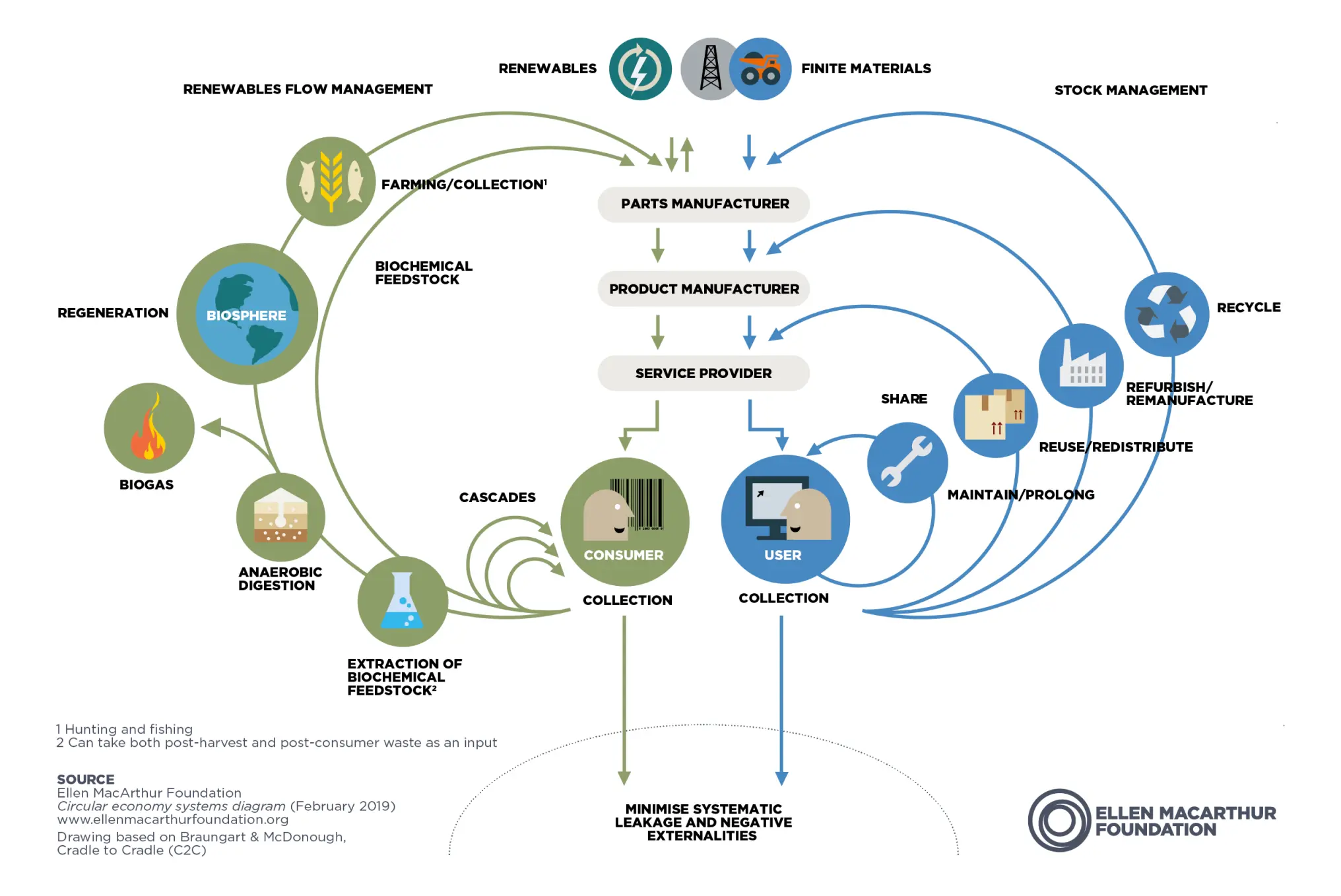
For Zimbabwe, adopting a circular economy framework would align environmental policy with industrial development.
The country has historically depended heavily on resource extraction, agriculture and manufacturing. Yet the challenge has not always been the availability of resources, but rather the efficiency with which those resources are utilised.
Circular thinking changes the economic equation by focusing on resource productivity, creating greater economic value from every unit of material, energy and natural resource consumed.
In mining, Zimbabwe has significant opportunities. The country’s long mining history has generated substantial volumes of waste material, including tailings and old mine dumps. Advances in processing technologies globally have demonstrated that materials once classified as waste can become commercially valuable resources.
Countries such as Australia and Finland have increasingly explored secondary mineral recovery, where previously discarded mining residues are reprocessed to extract additional value. Zimbabwe could apply similar approaches by turning historical waste streams into future economic assets.
Agriculture presents an equally significant opportunity. Crop residues, livestock waste and organic materials can be transformed into bioenergy, fertiliser, animal feed and industrial inputs. Instead of treating agricultural by-products as waste, circular systems view them as resources capable of supporting new rural industries.
Education Reform: Building a Circular Economy Generation
A successful transition cannot happen through policy alone. It requires a fundamental shift in knowledge, skills and education.
Environmental sustainability should no longer be treated as a specialised subject reserved for environmental scientists. It should become a core component of national education planning.
At primary and secondary levels, learners should understand concepts such as resource conservation, responsible consumption and environmental stewardship. At the university level, circular economy principles should become embedded across disciplines.
Future accountants should understand sustainability reporting and environmental accounting. Engineers should design products with lifecycle efficiency in mind. Architects should incorporate sustainable materials and energy efficiency. Lawyers should understand environmental regulation. Business students should learn how circular models influence competitiveness, supply chains and investment decisions.
Every undergraduate and postgraduate programme should incorporate circular economy principles because the future economy will increasingly reward organisations that can manage resources efficiently.
Waste Management Is Becoming an Economic Issue
For developing economies, waste is increasingly becoming a major financial burden.
As populations grow and consumption patterns change, municipalities face rising costs associated with landfill management, collection systems and environmental rehabilitation. These costs divert public resources away from productive investments such as infrastructure, healthcare and education.
Zimbabwe is experiencing many of these pressures. Rapid urbanisation, informal settlements and increased consumption have intensified waste management challenges, placing additional strain on local authorities.
The circular economy provides an alternative approach by converting waste management from a cost centre into an economic opportunity.
Recycling industries, waste-to-energy projects, repair businesses, materials recovery facilities and sustainable packaging companies can become contributors to economic growth rather than simply environmental interventions.
Designing Policies That Match Zimbabwe’s Reality
Environmental policy must reflect economic realities.
In many developed economies, consumers respond strongly to environmental incentives because purchasing decisions are influenced by sustainability considerations and price signals. Measures such as plastic bag charges at retail outlets have successfully reduced consumption because consumers directly experience the financial cost.
However, developing economies often require a different approach. Where consumer behaviour is less responsive to environmental pricing, policy intervention must increasingly target producers.
Zimbabwe could introduce stronger producer responsibility regulations requiring manufacturers and importers to design packaging that is reusable, recyclable or biodegradable. Companies should have greater responsibility for the lifecycle impact of the products they introduce into the market.
Similar environmental standards should also apply at border posts. Imported goods should meet sustainability requirements, ensuring that Zimbabwe does not become a destination for environmentally damaging products that other markets are increasingly restricting.
Circular Economy as an Industrial Growth Strategy
The greatest opportunity presented by circular economy thinking is that it connects environmental protection with industrial development.
Zimbabwe’s businesses operate in an environment characterised by high input costs, foreign currency constraints, energy challenges and supply chain vulnerabilities. Under such conditions, improving resource efficiency is not simply an environmental objective — it is a competitiveness strategy.
Companies that reduce raw material waste, recover valuable by-products and improve production efficiency can strengthen profitability and resilience.
Circular models also create opportunities for small and medium enterprises through repair services, recycling businesses, logistics networks and sustainable manufacturing.
For a country seeking industrial recovery and employment creation, the circular economy offers a pathway towards new sectors while improving efficiency within existing industries.
A Strategic Opportunity for Zimbabwe
Zimbabwe’s environmental conversation must now evolve beyond landfill management and waste collection. The country needs a comprehensive Circular Economy Policy that integrates environmental protection, industrial development, education reform and investment attraction.
The appointment of advisers with an environmental focus provides an opportunity to build such a vision. The immediate priority should be developing a national strategy supported by research, evidence and international best practice.
The global economy is moving towards greater resource efficiency. Investors are increasingly considering environmental performance, sustainability risks and long-term resilience when allocating capital.
For Zimbabwe, circular economy thinking is not a luxury reserved for wealthy nations. It is an economic necessity.
The country’s next growth story may not come only from discovering new resources, but from learning how to extract greater value from the resources it already has.
The future economy will not simply be defined by how much Zimbabwe produces. It will be defined by how intelligently Zimbabwe uses what it produces.
Recommendations: Building a National Circular Economy Framework for Zimbabwe
A successful transition from a linear economy to a circular economy requires coordinated action across national government, local authorities, communities and the private sector. Circularity cannot be achieved through isolated waste management projects alone; it requires a fundamental redesign of production systems, consumption patterns, education, regulation and investment priorities.
Recommendations for Central Government: Establishing the Policy and Regulatory Foundation
The Government of Zimbabwe should develop and adopt a comprehensive National Circular Economy Policy that provides a long-term framework for resource efficiency, sustainable production, waste reduction and green industrial development.
The policy should move environmental management from being viewed primarily as a cost to being recognised as an economic development opportunity. Circular economy principles should become integrated into national industrial policy, mining strategy, agricultural transformation programmes, trade policy and investment promotion frameworks.
A central priority should be the creation of an Extended Producer Responsibility (EPR) framework, requiring manufacturers, importers and distributors to take greater responsibility for the entire lifecycle of their products. Companies producing plastics, packaging materials, electronics and other high-waste products should be incentivised to design goods that can be reused, repaired or recycled.
The government should introduce regulatory standards requiring imported products entering Zimbabwe to meet minimum environmental requirements. Border management systems should incorporate sustainability considerations to prevent the country from becoming a dumping ground for environmentally damaging products and packaging.
Fiscal policy can also play a critical role. Instead of relying only on consumer-level environmental taxes, Zimbabwe should consider targeted incentives and penalties at the production level. Companies investing in recyclable packaging, renewable energy, waste recovery technologies and resource-efficient production systems should receive incentives, while environmentally harmful practices should attract corrective measures.
The Government should also establish a Circular Economy Research and Innovation Fund to support universities, entrepreneurs and industries developing solutions in waste recovery, sustainable materials, renewable energy, recycling technologies and resource efficiency.
Public procurement should become a powerful driver of circularity. Government departments, state-owned enterprises and local authorities should prioritise suppliers that demonstrate sustainable production practices, recycled content usage and responsible waste management.
Recommendations for Education and Skills Development
Zimbabwe’s transition towards a circular economy requires a new generation of professionals equipped with sustainability knowledge.
The Ministry of Education should work with universities, technical colleges and industry bodies to integrate circular economy principles into national curricula. Environmental sustainability should not remain limited to environmental science programmes but should become part of mainstream education across disciplines.
Business schools should incorporate circular business models, sustainable supply chains, Environmental, Social and Governance (ESG) principles and resource efficiency into management programmes. Engineering faculties should emphasise sustainable design, renewable energy systems and lifecycle analysis. Accounting and finance programmes should introduce sustainability reporting and environmental accounting.
Universities should establish multidisciplinary research centres bringing together economists, engineers, scientists, business specialists and policymakers to develop locally relevant circular economy solutions.
Technical and vocational education should also play a major role by developing skills in recycling, repair, renewable energy maintenance, waste processing and sustainable manufacturing.
Recommendations for Urban Municipalities and Local Authorities
Urban municipalities should transform waste management from a traditional collection-and-disposal model into a resource recovery system.
Cities such as Harare, Bulawayo, Mutare and Gweru should develop integrated waste management strategies that prioritise waste separation, recycling, composting and materials recovery rather than reliance on landfill sites.
Municipalities should establish partnerships with private-sector recycling companies, community organisations and informal waste collectors to create structured recycling ecosystems. Informal waste workers, who already play a significant role in material recovery, should be incorporated into formal value chains through training, licensing and access to safer working conditions.
Local authorities should introduce source separation programmes where households and businesses separate recyclable materials from general waste. Successful circular economies depend heavily on efficient collection systems that preserve the quality and value of recyclable materials.
Urban councils should also explore waste-to-energy opportunities, particularly for non-recyclable waste streams. Modern waste processing technologies can reduce landfill dependency while contributing to energy security.
Municipal planning should incorporate circular economy principles into housing developments, commercial projects and infrastructure investments. New developments should consider water efficiency, sustainable materials, renewable energy integration and waste reduction from the design stage.
Digital technology should also be adopted to improve municipal waste management. Smart systems can track waste collection routes, monitor landfill capacity, measure recycling rates and improve accountability.
Recommendations for Rural District Councils and Communities
Rural areas present significant opportunities for circular economy development, particularly through agriculture and natural resource management.
Rural district councils should promote the conversion of agricultural waste into productive resources. Crop residues, livestock manure and organic waste can support compost production, biogas generation, renewable energy and soil restoration programmes.
Smallholder farmers should be supported through training and financing mechanisms that encourage regenerative agricultural practices, including organic fertiliser production, water conservation and efficient resource use.
Rural communities can benefit from decentralised circular economy enterprises such as community recycling centres, composting initiatives, repair businesses and renewable energy projects.
Traditional leadership structures and community organisations should be incorporated into environmental awareness programmes. Local knowledge systems can complement modern sustainability approaches by promoting responsible resource management.
Government and development partners should support rural entrepreneurs who transform waste materials into commercially valuable products. This can create employment opportunities while reducing environmental degradation.
Recommendations for Business and Industry
The private sector should recognise circular economy adoption as a competitiveness strategy rather than merely a compliance requirement.
Manufacturers should redesign production processes to reduce material waste, improve energy efficiency and incorporate recycled inputs into supply chains.
Retailers should work with suppliers to reduce unnecessary packaging and promote reusable alternatives. Banks and financial institutions should also develop financing products that support sustainable businesses, recycling enterprises and green technologies.
Mining companies should explore opportunities in waste recovery, mine rehabilitation and secondary resource extraction. Agricultural companies should invest in value chains that convert biological waste into commercial products.
Companies that embrace circular models early will increasingly gain advantages in export markets, where environmental standards are becoming more important in international trade.
Conclusion: Turning Environmental Challenges into Economic Opportunities
Zimbabwe stands at an important economic crossroads. The challenges associated with waste, resource inefficiency and environmental degradation are significant, but they also represent opportunities for innovation, investment and industrial transformation.
The transition towards a circular economy requires a shift in mindset — from viewing waste as a problem to recognising it as an untapped economic resource.
For decades, economic systems have operated on a linear model of extraction, production, consumption and disposal. That model is becoming increasingly expensive and unsustainable. The future belongs to economies that preserve resources, reduce waste and maximise value creation.
Zimbabwe has the opportunity to position itself as a regional leader in circular economy development by combining policy reform, education, private-sector innovation and community participation.
The role of government will be critical, but the transition cannot be achieved by government alone. It requires collaboration between policymakers, businesses, universities, municipalities, communities and citizens.
A circular economy is ultimately not only an environmental strategy. It is an industrial strategy, an employment strategy, an investment strategy and a pathway towards a more resilient Zimbabwean economy.
The country’s future competitiveness will depend not only on what it extracts from the earth, but on how effectively it preserves, reuses and transforms the resources already within its economy.
The post Dilesh Nguwaya’s Circular Economy Mission: Why Zimbabwe’s Next Growth Story Could Be Built from Waste appeared first on The Zimbabwe Mail.