DPC Bill to bolster depositor protection 

Source: DPC Bill to bolster depositor protection – herald Ivan Zhakata Herald Correspondent PARLIAMENT has begun considering the Deposit Protection Corporation (DPC) Amendment Bill, which seeks to strengthen depositor protection, establish a dedicated insolvency framework for banking institutions and enhance financial stability. Addressing a DPC Amendment Bill workshop in Harare on Tuesday, Parliamentary Portfolio Committee […]

The post DPC Bill to bolster depositor protection  appeared first on Zimbabwe Situation.

Source: DPC Bill to bolster depositor protection – herald

Ivan Zhakata

Herald Correspondent

PARLIAMENT has begun considering the Deposit Protection Corporation (DPC) Amendment Bill, which seeks to strengthen depositor protection, establish a dedicated insolvency framework for banking institutions and enhance financial stability.

Addressing a DPC Amendment Bill workshop in Harare on Tuesday, Parliamentary Portfolio Committee on Budget, Finance and Investment Promotion chairperson Cde Lincoln Dhliwayo said the proposed legislation will close long-standing legal gaps in Zimbabwe’s financial sector.

“The Bill’s primary objective is to strengthen the Deposit Protection Corporation and, by extension, protect depositors,” he said.

“It introduces fundamental reforms that will transform the manner in which we deal with the insolvency of banking institutions in Zimbabwe.”

Cde Dhliwayo said the Bill establishes, for the first time, a specialised insolvency regime for banking institutions, recognising that the collapse of a bank carries systemic risks that cannot be adequately addressed through ordinary insolvency laws.

He said Parliament will conduct nationwide public hearings on the Bill from July 20 to 24 and urged legislators to familiarise themselves with its provisions ahead of the consultations.

“We cannot explain to the public what we do not understand. This workshop is therefore essential to ensure that when we go out to the people, we do so with confidence,” he said.

DPC board member and shareholders’ representative Ms Meluleki Sibanda said the Corporation has, with effect from July 1, increased the deposit protection cover for commercial bank depositors from US$1 000 to US$3 000, while the cover for deposit-taking microfinance institutions had been raised to US$2 000.

“All those with deposits of up to US$3 000 in commercial banks can be assured that their money is protected and insured,” she said.

Ms Sibanda said the amendment process followed years of technical reviews, international benchmarking and stakeholder consultations aimed at strengthening Zimbabwe’s financial safety net.

She said the proposed law will create a distinct insolvency regime for banking institutions while improving financial stability and protecting depositors.

DPC chief executive Mr Hopewell Zinyau said the corporation protects depositors through a fund financed by premiums collected from participating banking institutions and deposit-taking microfinance institutions.

He said eligible depositors are compensated within 14 days after the closure of a financial institution, up to the insured limits.

“Our role is to collect premiums, grow the fund and compensate depositors when a bank fails,” said Mr Zinyau.

He said the DPC Fund had grown from US$15,2 million in December 2024 to US$29 million in December 2025 and currently stands at US$42 million, with a target of about US$48 million by the end of the year.

Mr Zinyau said Zimbabwe currently lacks a dedicated bank insolvency framework, making the proposed amendments critical to improving crisis management in the financial sector.

He said the amendments seek to strengthen depositor protection, enhance financial stability, improve crisis preparedness and align Zimbabwe’s deposit protection framework with international best practice.

The post DPC Bill to bolster depositor protection  appeared first on Zimbabwe Situation.
Mnangagwa defends Zimbabwe’s term extension after once pledging to leave office in 2028 

Zimbabwes President Emmerson Mnangagwa has defended constitutional amendments extending his presidency to 2030, saying the reforms were a collective decision despite criticism from opposition groups and legal experts Source: Mnangagwa defends Zimbabwe’s term extension after once pledging to leave office in 2028 | Business Insider Africa Zimbabwean President Emmerson Mnangagwa has defended the constitutional amendments […]

The post Mnangagwa defends Zimbabwe’s term extension after once pledging to leave office in 2028  appeared first on Zimbabwe Situation.

Zimbabwes President Emmerson Mnangagwa has defended constitutional amendments extending his presidency to 2030, saying the reforms were a collective decision despite criticism from opposition groups and legal experts

Source: Mnangagwa defends Zimbabwe’s term extension after once pledging to leave office in 2028 | Business Insider Africa

Zimbabwean President Emmerson Mnangagwa has defended the constitutional amendments that extend his presidency until 2030, insisting the changes were the result of a “collective decision” rather than his personal ambition, even though he had previously pledged to leave office in 2028.

  • President Emmerson Mnangagwa has defended Zimbabwe’s constitutional amendments extending his presidency to 2030, saying the reforms reflected a “collective decision.”
  • The remarks contrast with his previous public pledge to leave office when his second term ended in 2028.
  • The amendments delay the next general election, extend presidential and parliamentary terms from five to seven years and replace direct presidential elections with parliamentary selection.
  • The reforms have sparked legal challenges and criticism from opposition parties, civil society groups and some liberation war veterans.

Speaking during an interview with senior state media journalists at State House in Harare, Mnangagwa said Parliament had “done the correct thing” by approving Constitutional Amendment Act No. 3, which was signed into law last week.

The legislation extends Zimbabwe’s presidential, parliamentary and local government terms from five years to seven years, postpones the next general election from 2028 to 2030, replaces direct presidential elections with selection by Parliament and expands the Senate from 80 to 90 members, with the president appointing the additional 10 senators.

It wasn’t an idea of an individual. You cannot attribute this to a particular individual or group of persons, but a collective evolution of the political process,” Mnangagwa said.

The president rejected suggestions that the reforms were designed to serve one person, saying government decisions were reached collectively.

“I don’t believe in individual persuasion or individual systems where the wishes of an individual take the day. I carry my Cabinet and the country on whatever decision we make,” he said.

A reversal from earlier assurances

Mnangagwa’s defence marks a sharp contrast with remarks he made in September 2024 during a visit to China, when he publicly stated that he would step down at the end of his constitutionally mandated second term in 2028.

At the time, he said he already knew the date he would leave office and urged supporters campaigning for him to remain in power to abandon the effort.

The new constitutional amendments, however, extend his current term by two years to 2030 while keeping the two-term limit in place by lengthening each presidential term from five years to seven.

Critics challenge the reforms

The amendments have drawn criticism from opposition parties, constitutional lawyers, civil society organisations and some veterans of Zimbabwe’s liberation war, who argue that such far-reaching constitutional changes should have been subjected to a national referendum.

Several legal challenges have already been filed, questioning both the process used to pass the amendments and their compatibility with constitutional provisions designed to prevent incumbents from extending their tenure.

The government has defended the reforms as necessary to improve governance, align election cycles and provide greater political stability. Supporters also argue that the two-term presidential limit remains intact despite the longer tenure.

Why it matters

The constitutional changes come as Zimbabwe seeks to rebuild investor confidence, restructure billions of dollars in external debt and attract fresh foreign investment after years of economic instability.

Political stability is often cited by the government as essential for economic recovery. However, governance reforms that alter presidential succession and electoral rules are also closely watched by investors, creditors and international partners as indicators of institutional predictability.

Whether the amendments strengthen long-term stability or deepen political divisions is now likely to be tested both in Zimbabwe’s courts and in the country’s political arena ahead of the rescheduled 2030 elections.

The post Mnangagwa defends Zimbabwe’s term extension after once pledging to leave office in 2028  appeared first on Zimbabwe Situation.

Water shedding driving sewage overflows and pipe bursts in Bulawayo

Source: Water shedding driving sewage overflows and pipe bursts in Bulawayo — CITEZW Bulawayo City Council says the city’s water-shedding programme is a major cause of recurring sewage overflows and water pipe bursts, with the ageing network unable to withstand repeated interruptions to water supply. Ward 23 councillor Ntombizodwa Khumalo, who chairs the council’s Health, […]

The post Water shedding driving sewage overflows and pipe bursts in Bulawayo appeared first on Zimbabwe Situation.

Source: Water shedding driving sewage overflows and pipe bursts in Bulawayo — CITEZW

Bulawayo City Council says the city’s water-shedding programme is a major cause of recurring sewage overflows and water pipe bursts, with the ageing network unable to withstand repeated interruptions to water supply.

Ward 23 councillor Ntombizodwa Khumalo, who chairs the council’s Health, Housing and Education Committee, said the city’s ageing infrastructure was designed for a continuous flow of water rather than the frequent opening and closing of valves required under the current rationing system.

Speaking to CITE, Khumalo said the intermittent supply places significant pressure on the network, leading to frequent failures.

“The main problem that we have is water shedding, which is contributing to sewage bursts because these pipes are not meant to be opened and closed. When the pipes are closed and later reopened, that is when we experience pipe bursts,” she said.

“If residents report these bursts to the city council as soon as they occur, they can be resolved. However, the next time water is restored, the pipes may burst in a different location, not necessarily where repairs were carried out.”

Bulawayo has relied on water shedding for years because of limited supplies in its dams, forcing the local authority to ration water to residents.

Khumalo said the long-term solution was to restore a continuous daily water supply, which would reduce stress on the ageing infrastructure.

“Our expectation is that the whole of Bulawayo gets water every day. The problem is the opening and closing of the valves, which gives us these challenges. The pipes were designed to remain open and have a continuous flow of water, not to be closed. As a result, we end up with sewage bursts and pipe bursts, and clean water is also lost,” she said.

She said the council had begun replacing old water pipes as part of efforts to modernise the network, although the benefits had yet to be fully realised because water shedding remained in place.

“Currently, we have contracted companies to replace these old pipes. This initiative started last year. The contractors are on the ground right now, but the results are not really visible because of the water shedding,” Khumalo said.

She also urged residents to stop dumping waste into drains and sewer systems, saying blockages were worsening sewage problems.

“Another solution is raising awareness among residents to stop dumping waste into drainages because when we open the pipes, we find sand, teaspoons and other waste,” she said.

Khumalo said the council had already increased the number of hours that residents receive water and expressed hope that improved supplies from Mzingwane and Insiza dams would further ease pressure on the city’s water system.

“We have also increased the hours of water supply across the City of Bulawayo. If the pipes connected to Mzingwane and Insiza Dam are fixed and the dams are able to provide more water, we will have enough water and reduce water shedding in the city,” she said.

The post Water shedding driving sewage overflows and pipe bursts in Bulawayo appeared first on Zimbabwe Situation.

Byo MPs seeks fee cuts, deadline extension for title deeds validation programme

Source: Byo MPs seeks fee cuts, deadline extension for title deeds validation programme — CITEZW A Bulawayo legislator has tabled a motion in Parliament urging the government to significantly reduce the cost of validating old title deeds and extend the programme’s deadline by at least two years, warning that thousands of Zimbabweans risk exclusion because […]

The post Byo MPs seeks fee cuts, deadline extension for title deeds validation programme appeared first on Zimbabwe Situation.

Source: Byo MPs seeks fee cuts, deadline extension for title deeds validation programme — CITEZW

A Bulawayo legislator has tabled a motion in Parliament urging the government to significantly reduce the cost of validating old title deeds and extend the programme’s deadline by at least two years, warning that thousands of Zimbabweans risk exclusion because they cannot afford the process.

For homeowners processing and validating digitised title deeds under the national programme, official costs include an initial US$10 application processing fee, followed by a mandatory US$200 validation and securitisation fee.

The exact out-of-pocket costs can vary based on one’s specific property status and location.

Emakhandeni-Luveve Member of Parliament Discent Collins Bajila has filed a Notice of Motion on the Validation and Securitisation of Old Title Deeds Programme, calling on the Minister of Justice, Legal and Parliamentary Affairs to review the implementation of Statutory Instrument (SI) 76 of 2025, which introduced the nationwide exercise.

The motion, seconded by Bulawayo North MP, Minenhle Gumede, acknowledges that modernising Zimbabwe’s Deeds Registry is an important step but argues the programme’s costs and timelines place an unfair burden on ordinary property owners.

The motion notes that while the objective of improving “the security, integrity and reliability of Zimbabwe’s land administration system is commendable,” the regulations require holders of old title deeds to submit them for validation within 24 months.

It further notes that under Section 44 of the regulations, old title deeds “will cease to be recognised after that period unless the Minister extends the deadline by notice in the Gazette.”

The motion argues the fees prescribed under the Second Schedule of the regulations have become a major obstacle for many homeowners.

It states the charges “collectively, place a significant financial burden on ordinary homeowners, pensioners, low-income earners and families across Zimbabwe.”

Bajila also warned many Zimbabweans, particularly those living in rural and remote communities, face additional barriers beyond affordability.

The motion notes that many citizens have limited access to information, legal assistance and financial resources, making compliance within the prescribed timeframe difficult.

It further cautions that failure to participate in the programme could have serious consequences for property owners.

“Failure by property owners to participate in the programme within the stipulated period could expose them to uncertainty regarding proof of ownership, impede access to credit and undermine confidence in Zimbabwe’s property rights system,” the motion states.

To address these concerns, Bajila is urging Parliament to resolve that the Justice Minister implements several key reforms before the programme progresses further.

The motion’s first recommendation calls on the government to “review and substantially reduce the fees and administrative charges associated with the Title Deeds Validation and Securitisation Programme to make the exercise affordable to ordinary Zimbabweans.”

Secondly, Bajila proposes that vulnerable groups should receive financial relief through a targeted subsidy programme.

He recommends that the government “introduces a fee waiver or subsidised fee structure for pensioners, persons with disabilities, beneficiaries of social protection programmes, low-income households and other vulnerable groups.”

The motion also seeks a significant extension of the programme’s implementation period.

Bajila wants the Minister to “extend the current validation deadline by not less than 24 additional months through the mechanism provided for under section 44(1) of Statutory Instrument 76 of 2025 to allow all eligible property owners adequate time to comply.”

In addition, the motion recommends establishing mobile registration and validation centres in every province and district to improve access, particularly for rural communities, while also calling for a nationwide public awareness campaign to make sure citizens fully understand the programme’s requirements and benefits.

This parliamentary intervention comes amid growing public debate over the title deeds validation and securitisation programme, implemented through Zimbabwe’s Digital Land Administration platform.

The government said the initiative is intended to modernise the country’s land administration system by replacing the decades-old paper-based property registration process with a secure digital registry.

Officials argue digitisation will strengthen property rights, improve confidence in the real estate sector and reduce the growing risk of title deed fraud.

Deputy Chief Registrar in the Department of Deeds, Companies and Intellectual Property Elizabeth Nyagura recently defended the programme, saying Zimbabwe’s existing deeds registry remains vulnerable because it relies on a system inherited from the colonial era.

“The current system that we have is one that we inherited,” Nyagura said during a recent interview.

“Therefore the objective of SI 76 of 2025 is to strengthen property rights and also to make sure that confidence in the local real estate sector is actually improved.”

Legal and property experts have similarly defended the validation exercise, saying it is intended to secure ownership records rather than deprive citizens of their property.

While some support the principle behind the programme, concerns continue to centre on its implementation, as property owners have questioned why they are required to validate title deeds already legally recognised.

This has seen citizens raising concerns over affordability, transparency and whether the process could expose them to fraud or unnecessary bureaucratic hurdles.

The post Byo MPs seeks fee cuts, deadline extension for title deeds validation programme appeared first on Zimbabwe Situation.

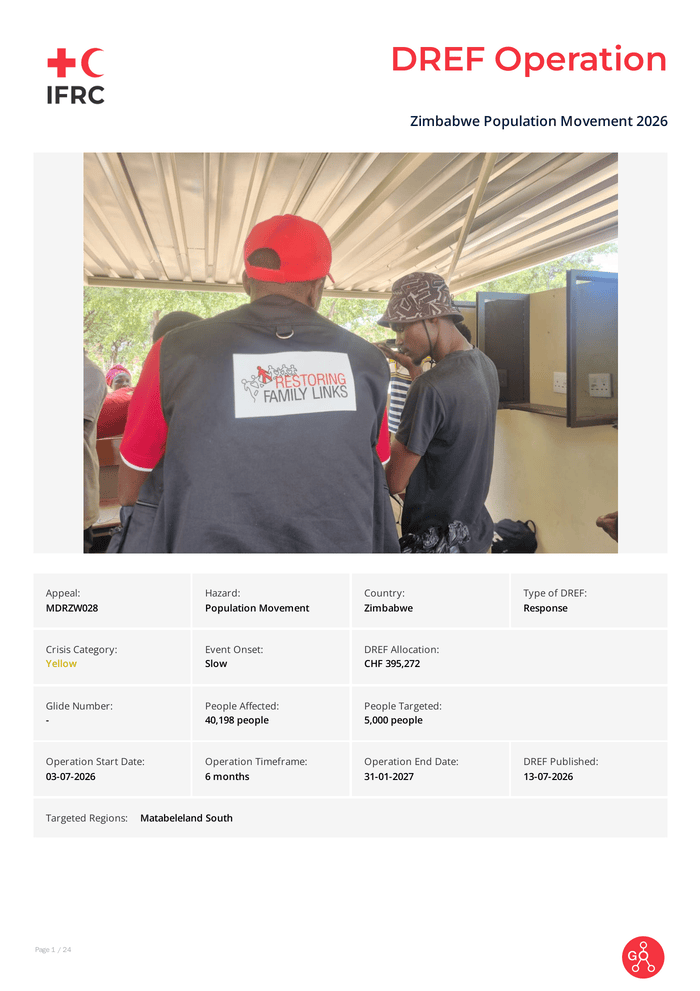
Zimbabwe Population Movement 2026 – DREF Operation (MDRZW028), 13 July 2026

Situation Report in English on Zimbabwe and 1 other country about Food and Nutrition, Health and more; published on 13 Jul 2026 by IFRC Source: Zimbabwe Population Movement 2026 – DREF Operation (MDRZW028), 13 July 2026 – Zimbabwe | ReliefWeb Description of the Event Date when the trigger was met 25-06-2026 What happened, where and […]

The post Zimbabwe Population Movement 2026 – DREF Operation (MDRZW028), 13 July 2026 appeared first on Zimbabwe Situation.

Situation Report in English on Zimbabwe and 1 other country about Food and Nutrition, Health and more; published on 13 Jul 2026 by IFRC

Source: Zimbabwe Population Movement 2026 – DREF Operation (MDRZW028), 13 July 2026 – Zimbabwe | ReliefWeb

Description of the Event
Date when the trigger was met
25-06-2026

What happened, where and when?

The ongoing situation involves the large-scale return of Zimbabwean nationals from South Africa following a sharp escalation of localised violence targeting foreign nationals between March and June 2026. The violence, concentrated in major urban centres including Johannesburg, Durban, Cape Town, and parts of KwaZulu-Natal and the Eastern Cape (including Port Elizabeth), resulted in intimidation, displacement, loss of access to basic services, and heightened insecurity among migrant communities, prompting large-scale voluntary and assisted return movements to Zimbabwe. According to the Department of Immigration, a total of over 40,198 Zimbabwean returnees has self-repatriated since 28 May 2026, including 4,795 migrants who have been assisted through the State-assisted repatriation program (as of 27 June 2026).

The primary entry point and reception area is Beitbridge Border Post in Matabeleland South Province, Zimbabwe, where returnees are processed at the Beitbridge Reception Centre before onward movement to their areas of origin across the country, including Harare, Bulawayo, Manicaland, Masvingo, Midlands, Mashonaland East, Mashonaland West and Mashonaland Central Provinces.

The violence escalated between March and June 2026, with return movements beginning in late May 2026 and continuing to date. The Government of Zimbabwe has convened a series of coordination meetings at national and district levels to manage and coordinate assistance for returning migrants, including an interministerial meeting held on 27 May 2026, during which the Department of Immigration reported the consolidated statistics on return movements. Although returns have been ongoing over several months, the current phase of sustained high-volume arrivals, combined with winter conditions, makes this the appropriate time for DREF activation, as humanitarian needs have intensified due to prolonged waiting times, overnight stays at the reception centre, and exposure to low temperatures.

The post Zimbabwe Population Movement 2026 – DREF Operation (MDRZW028), 13 July 2026 appeared first on Zimbabwe Situation.