Byo MPs seeks fee cuts, deadline extension for title deeds validation programme

Source: Byo MPs seeks fee cuts, deadline extension for title deeds validation programme — CITEZW A Bulawayo legislator has tabled a motion in Parliament urging the government to significantly reduce the cost of validating old title deeds and extend the programme’s deadline by at least two years, warning that thousands of Zimbabweans risk exclusion because […]

The post Byo MPs seeks fee cuts, deadline extension for title deeds validation programme appeared first on Zimbabwe Situation.
Source: Byo MPs seeks fee cuts, deadline extension for title deeds validation programme — CITEZW

A Bulawayo legislator has tabled a motion in Parliament urging the government to significantly reduce the cost of validating old title deeds and extend the programme’s deadline by at least two years, warning that thousands of Zimbabweans risk exclusion because they cannot afford the process.

For homeowners processing and validating digitised title deeds under the national programme, official costs include an initial US$10 application processing fee, followed by a mandatory US$200 validation and securitisation fee.

The exact out-of-pocket costs can vary based on one’s specific property status and location.

Emakhandeni-Luveve Member of Parliament Discent Collins Bajila has filed a Notice of Motion on the Validation and Securitisation of Old Title Deeds Programme, calling on the Minister of Justice, Legal and Parliamentary Affairs to review the implementation of Statutory Instrument (SI) 76 of 2025, which introduced the nationwide exercise.

The motion, seconded by Bulawayo North MP, Minenhle Gumede, acknowledges that modernising Zimbabwe’s Deeds Registry is an important step but argues the programme’s costs and timelines place an unfair burden on ordinary property owners.

The motion notes that while the objective of improving “the security, integrity and reliability of Zimbabwe’s land administration system is commendable,” the regulations require holders of old title deeds to submit them for validation within 24 months.

It further notes that under Section 44 of the regulations, old title deeds “will cease to be recognised after that period unless the Minister extends the deadline by notice in the Gazette.”

The motion argues the fees prescribed under the Second Schedule of the regulations have become a major obstacle for many homeowners.

It states the charges “collectively, place a significant financial burden on ordinary homeowners, pensioners, low-income earners and families across Zimbabwe.”

Bajila also warned many Zimbabweans, particularly those living in rural and remote communities, face additional barriers beyond affordability.

The motion notes that many citizens have limited access to information, legal assistance and financial resources, making compliance within the prescribed timeframe difficult.

It further cautions that failure to participate in the programme could have serious consequences for property owners.

“Failure by property owners to participate in the programme within the stipulated period could expose them to uncertainty regarding proof of ownership, impede access to credit and undermine confidence in Zimbabwe’s property rights system,” the motion states.

To address these concerns, Bajila is urging Parliament to resolve that the Justice Minister implements several key reforms before the programme progresses further.

The motion’s first recommendation calls on the government to “review and substantially reduce the fees and administrative charges associated with the Title Deeds Validation and Securitisation Programme to make the exercise affordable to ordinary Zimbabweans.”

Secondly, Bajila proposes that vulnerable groups should receive financial relief through a targeted subsidy programme.

He recommends that the government “introduces a fee waiver or subsidised fee structure for pensioners, persons with disabilities, beneficiaries of social protection programmes, low-income households and other vulnerable groups.”

The motion also seeks a significant extension of the programme’s implementation period.

Bajila wants the Minister to “extend the current validation deadline by not less than 24 additional months through the mechanism provided for under section 44(1) of Statutory Instrument 76 of 2025 to allow all eligible property owners adequate time to comply.”

In addition, the motion recommends establishing mobile registration and validation centres in every province and district to improve access, particularly for rural communities, while also calling for a nationwide public awareness campaign to make sure citizens fully understand the programme’s requirements and benefits.

This parliamentary intervention comes amid growing public debate over the title deeds validation and securitisation programme, implemented through Zimbabwe’s Digital Land Administration platform.

The government said the initiative is intended to modernise the country’s land administration system by replacing the decades-old paper-based property registration process with a secure digital registry.

Officials argue digitisation will strengthen property rights, improve confidence in the real estate sector and reduce the growing risk of title deed fraud.

Deputy Chief Registrar in the Department of Deeds, Companies and Intellectual Property Elizabeth Nyagura recently defended the programme, saying Zimbabwe’s existing deeds registry remains vulnerable because it relies on a system inherited from the colonial era.

“The current system that we have is one that we inherited,” Nyagura said during a recent interview.

“Therefore the objective of SI 76 of 2025 is to strengthen property rights and also to make sure that confidence in the local real estate sector is actually improved.”

Legal and property experts have similarly defended the validation exercise, saying it is intended to secure ownership records rather than deprive citizens of their property.

While some support the principle behind the programme, concerns continue to centre on its implementation, as property owners have questioned why they are required to validate title deeds already legally recognised.

This has seen citizens raising concerns over affordability, transparency and whether the process could expose them to fraud or unnecessary bureaucratic hurdles.

The post Byo MPs seeks fee cuts, deadline extension for title deeds validation programme appeared first on Zimbabwe Situation.

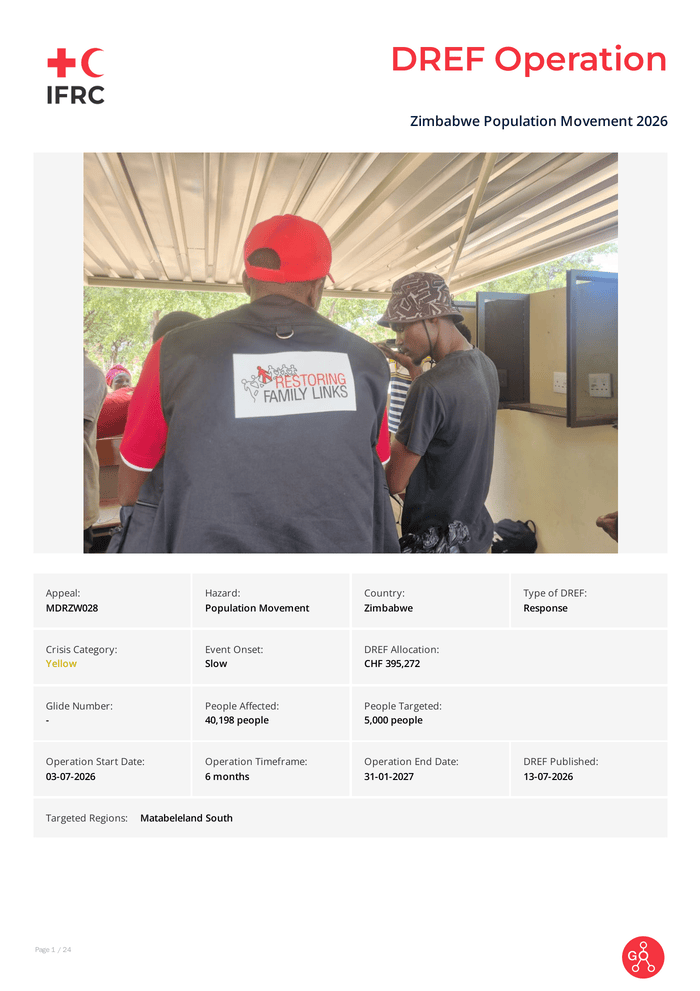
Zimbabwe Population Movement 2026 – DREF Operation (MDRZW028), 13 July 2026

Situation Report in English on Zimbabwe and 1 other country about Food and Nutrition, Health and more; published on 13 Jul 2026 by IFRC Source: Zimbabwe Population Movement 2026 – DREF Operation (MDRZW028), 13 July 2026 – Zimbabwe | ReliefWeb Description of the Event Date when the trigger was met 25-06-2026 What happened, where and […]

The post Zimbabwe Population Movement 2026 – DREF Operation (MDRZW028), 13 July 2026 appeared first on Zimbabwe Situation.

Situation Report in English on Zimbabwe and 1 other country about Food and Nutrition, Health and more; published on 13 Jul 2026 by IFRC

Source: Zimbabwe Population Movement 2026 – DREF Operation (MDRZW028), 13 July 2026 – Zimbabwe | ReliefWeb

Description of the Event
Date when the trigger was met
25-06-2026

What happened, where and when?

The ongoing situation involves the large-scale return of Zimbabwean nationals from South Africa following a sharp escalation of localised violence targeting foreign nationals between March and June 2026. The violence, concentrated in major urban centres including Johannesburg, Durban, Cape Town, and parts of KwaZulu-Natal and the Eastern Cape (including Port Elizabeth), resulted in intimidation, displacement, loss of access to basic services, and heightened insecurity among migrant communities, prompting large-scale voluntary and assisted return movements to Zimbabwe. According to the Department of Immigration, a total of over 40,198 Zimbabwean returnees has self-repatriated since 28 May 2026, including 4,795 migrants who have been assisted through the State-assisted repatriation program (as of 27 June 2026).

The primary entry point and reception area is Beitbridge Border Post in Matabeleland South Province, Zimbabwe, where returnees are processed at the Beitbridge Reception Centre before onward movement to their areas of origin across the country, including Harare, Bulawayo, Manicaland, Masvingo, Midlands, Mashonaland East, Mashonaland West and Mashonaland Central Provinces.

The violence escalated between March and June 2026, with return movements beginning in late May 2026 and continuing to date. The Government of Zimbabwe has convened a series of coordination meetings at national and district levels to manage and coordinate assistance for returning migrants, including an interministerial meeting held on 27 May 2026, during which the Department of Immigration reported the consolidated statistics on return movements. Although returns have been ongoing over several months, the current phase of sustained high-volume arrivals, combined with winter conditions, makes this the appropriate time for DREF activation, as humanitarian needs have intensified due to prolonged waiting times, overnight stays at the reception centre, and exposure to low temperatures.

The post Zimbabwe Population Movement 2026 – DREF Operation (MDRZW028), 13 July 2026 appeared first on Zimbabwe Situation.

Let’s get this straight: the Mutapa Empire was not in Masvingo and ED has no claim to the throne

Source: Let’s get this straight: the Mutapa Empire was not in Masvingo and ED has no claim to the throne When history is distorted, the future can be manipulated. As Zimbabwe charts its path forward, we are treated to a bizarre display of historical revisionism. If you value my social justice advocacy and writing, please […]

The post Let’s get this straight: the Mutapa Empire was not in Masvingo and ED has no claim to the throne appeared first on Zimbabwe Situation.

Source: Let’s get this straight: the Mutapa Empire was not in Masvingo and ED has no claim to the throne

When history is distorted, the future can be manipulated.

As Zimbabwe charts its path forward, we are treated to a bizarre display of historical revisionism.

If you value my social justice advocacy and writing, please consider a financial contribution to keep it going. Contact me on WhatsApp: +263 715 667 700 or Email: mbofana.tendairuben73@gmail.com

A viral thread on X, allegedly written by an individual calling himself a “Prince of the Mutapa Kingdom,” makes an audacious proposal.

It suggests that as President Emmerson Mnangagwa approaches retirement, he should be crowned the supreme Emperor of a restored Mutapa Empire.

The author frames this pitch as a return to our spiritual roots.

However, when we strip away the grandiose rhetoric, we are left with a bankrupt argument that weaponizes traditional history to massage the president’s ego.

Almost everything about this proposal is historically inaccurate and entirely irrelevant to the reality of pre-colonial statehood.

The core of this viral proposal relies on a fundamental ignorance of Zimbabwe’s pre-colonial past.

The author eagerly conflates the Mutapa Empire with the Kingdom of Great Zimbabwe to claim that the President, as a son of Masvingo Province, carries a hereditary royal bloodline to the Mutapa throne because Masvingo is the ancestral cradle.

This is historical nonsense of the highest order.

The Mutapa Empire and Great Zimbabwe were distinct geopolitical entities existing in entirely different eras and geographic regions.

Mutapa was established in the northern plateau and the Zambezi Valley by Nyatsimba Mutota, a prince who migrated away from Great Zimbabwe in search of salt.

The heart of the Mutapa state was never in Masvingo.

It was located hundreds of kilometers to the north, in areas like modern-day Mount Darwin and the Zambezi escarpment – stretching into Mozambique.

Claiming a hereditary right to the Mutapa crown by pointing to a Masvingo birthright is completely inaccurate.

Furthermore, President Mnangagwa has absolutely no genealogical claim to the Mutapa lineage.

Authentic traditional leadership in Shona culture, known as ushe, is governed by strict, locally recognized kinship lineages and collateral succession.

It is not based on retroactive military promises discovered on social media centuries after the fact.

The claim that an ancestral military promise to a “Shumba” general makes the President a rightful heir to the Mutapa throne is a total fabrication.

A military title in a state’s standing army does not translate into a hereditary claim to a sacred dynastic throne.

President Mnangagwa does not belong to the royal Mutapa dynasty, and no amount of creative genealogy can place him in that lineage.

​The writer acknowledges that the president hails from Masvingo, yet history clearly places the Mutapa Empire hundreds of kilometers away to the north.

This geographic contradiction alone completely dismantles any claim he could possibly have to that throne.

President Mnangagwa is a politician in a modern republic, not an imperial heir waiting in the wings.

We must also dismantle the absurd notion of declaring the entire modern territory of Zimbabwe as a new Mutapa Empire.

If the writer of this post genuinely wants to revert to the pre-colonial order, he cannot cherry-pick history.

He cannot ignore the historical fact that by the time European colonialism arrived, the Mutapa Empire was long dead.

It had already been decisively defeated and supplanted by the Rozvi State under the leadership of Changamire Dombo.

Following the Rozvi era, the Ndebele state led by King Mzilikazi arrived and ultimately defeated the Rozvi.

Therefore, portraying Mutapa as the sole, natural pre-colonial authority over the entire country is a lie.

If the proponents of this imperial retirement plan want to resurrect pre-colonial states, they cannot simply pretend the Mutapa Empire ruled unchallenged over the entire plateau until the late nineteenth century.

To truly bring back the pre-colonial order, one would logically have to resuscitate both the Rozvi and Ndebele empires as well.

The Mutapa state did not rule over the entire modern territory of Zimbabwe.

It was the Rozvi state that unified much of the plateau, only to be succeeded by the Ndebele state in the west and southwest.

Forcing a singular, resurrected Mutapa identity onto a modern nation-state completely erases the historical realities of the Rozvi and Ndebele states.

It is a highly selective reading of history designed purely to fit a modern political agenda.

Ultimately, this social media campaign is not a serious cultural movement but a highly creative public relations trial balloon.

It tries to solve a modern, secular political problem regarding succession, immunity, and the transition of power by dressing it up in the sacred robes of tradition.

By attempting to bypass the constitutional limits of our modern republic under the guise of “returning to our sacred roots,” the proponents of this imperial plan show a profound disrespect for our actual history.

Our pre-colonial history is rich, complex, and dynamic, and it should not be treated as a political playground where dynasties are invented to flatter a sitting president.

Let us keep our history accurate and our politics grounded in the real world.

The Mutapa Empire was not in Masvingo, and President Mnangagwa has no claim to its throne.

  • Advertise your business, products, or services on my WhatsApp Channel with over 10k followers. For bookings, contact me on WhatsApp: +263 715 667 700 or Email: mbofana.tendairuben73@gmail.com

The post Let’s get this straight: the Mutapa Empire was not in Masvingo and ED has no claim to the throne appeared first on Zimbabwe Situation.

Thomas Mapfumo’s US$1 million U-Turn: The Real Reason why Mukanya Finally Accepted Wicknell Chivayo’s Cash

For decades, the name Thomas Mapfumo has been synonymous with the “Chimurenga” spirit — a musical and political resistance that once provided the soundtrack to Zimbabwe’s liberation struggle and, later, its most searing critiques of p…

For decades, the name Thomas Mapfumo has been synonymous with the “Chimurenga” spirit — a musical and political resistance that once provided the soundtrack to Zimbabwe’s liberation struggle and, later, its most searing critiques of post-colonial corruption. Known as “Mukanya,” the dreadlocked lion of Zimbabwean music has lived in self-imposed exile in the United States […]

The post Thomas Mapfumo’s US$1 million U-Turn: The Real Reason why Mukanya Finally Accepted Wicknell Chivayo’s Cash first appeared on My Zimbabwe News.