Unpacking the monetary policy

Source: Unpacking the monetary policy | Sunday News (Business) Agatha Rufaro Changau THE long-awaited monetary policy that was presented by Reserve Bank of Zimbabwe Governor Dr John Mangudya last week was received with mixed emotions. Obviously, many people were left with unanswered questions concerning some of the pronouncements that were made. A monetary policy is […]

The post Unpacking the monetary policy appeared first on Zimbabwe Situation.

Source: Unpacking the monetary policy | Sunday News (Business)

Agatha Rufaro Changau

THE long-awaited monetary policy that was presented by Reserve Bank of Zimbabwe Governor Dr John Mangudya last week was received with mixed emotions.

Obviously, many people were left with unanswered questions concerning some of the pronouncements that were made. A monetary policy is a process by which the monetary authority of a country, typically the central bank controls either the cost of very short-term borrowing, often targeting an inflation rate to ensure price stability and general trust in the currency. I will try to unpack some of the pronouncements so that people can understand the implications or rather what they mean.

The policy highlighted inter-banking of foreign exchange RTGS balances and bond notes with the USD and other currencies on a willing buyer-willing seller basis through the banks and bureaux de change — offices that facilitate foreign currency exchange legally with immediate effect.

Willing buyer and willing seller means the market forces of demand and supply will take precedence and determine the rate of exchange on a daily basis. This suggests that the exchange rate is no longer pegged at 1:1 as before but is now operating at a managed floating exchange rate.

A managed float regime is the current international financial environment in which exchange rates fluctuate from day to day, but central banks attempt to influence their countries’ exchange rates by buying and selling currencies to maintain a certain range. The other aspect is around denominating existing RTGS balances, bond notes and coins in circulation as RTGS dollars in order to establish an exchange rate between the current monetary balances and foreign currency. In short the RTGS dollars thus become part of the multi-currency system in Zimbabwe.

The legal instrument to give effect to this has been prepared. This means all the bond notes and coins in circulation are now part and parcel of what is known as RTGS dollars. This also includes the existing RTGS balances that most Zimbabweans have been relying on for transactional purposes.

In his own words Dr Mangudya said “the bond note fits well and is part of the RTGS dollars. The RTGS dollars shall be used by all entities (including Government) and individuals in Zimbabwe for the purposes of pricing of goods and services, record debts, accounting and settlement of domestic transactions.”

This means that all salaries and incentives will be denoted in RTGS dollars. Then one would ask, “what about those who had or intend to take loans?” All loans that are record debts shall too be denoted in RTGS dollars.

The RTGS dollars comes about to try and solve the three-tier pricing system that had now become evident in Zimbabwe, where goods or services had prices in bond, prices in RTGS (EcoCash and swipe) and the USD price with some even having a rand price. In this regard, prices should remain at their current levels and or start to decline in sympathy with the stability in the exchange rate given that the current monetary balances have not been changed.

Dr Mangudya said the bank has arranged sufficient lines of credit to enable it to maintain adequate foreign currency to underpin the foreign exchange market. This is essential to restore the purchasing power of RTGS balances through safeguarding price stability emanating from the pass-through effects of exchange rate movements. Restoring the purchasing power of the RTGS balances is of importance since most of the transactions are done using RTGS and most salaries are delivered in the same form.

Dr Mangudya also announced that the foreign currency from the inter-bank market shall be utilised for current bonafide foreign payment invoices except for education fees. In simple terms the foreign currency from inter-banking that is banking of banks among each other will be used to pay foreign debts excluding education fees.

However, banks shall report activities of the inter-bank foreign currency market to the bank that shall closely monitor the foreign currency trades on a daily basis using the form and format stipulated by the Bank.

This is done to monitor especially those depositing or withdrawing large funds and addressing the question of source funds comes into play. According to the policy, in order to allow exporters to benefit from the inter-bank foreign currency market and to promote uninterrupted supply of forex in the economy, the export retention thresholds were introduced for different sectors.

This is a good thing because exporters were suffering from the previous rate 1:1.There is a casual effect that will occur as exporters can export more now with the introduction of the thresholds, this means that there will be inflow of foreign currency that can help stabilise the demand of it in the domestic market.

Similarly, in order to enhance liquidity within the foreign currency market, exporters shall be entitled to utilise their retained export receipts within 30 days, after which the unutilised export receipts will be offloaded into the market at the prevailing market exchange rate at that given date.

The policy also touched on that given the successful completion of the separation of RTGS, FCAs and Nostro FCAs, the RBZ has put in place a local Nostro FCAs settlement platform to allow for domestic inter-bank settlement of Nostro FCA transfers. This means that one can now withdraw from their local Nostro FCA to get foreign currency at the given rate on that particular day.

The implementation of International Financial Reporting Standard (IFRS) 9 represents a significant milestone in financial stability enhancement due to the forward-looking nature of provisions set under the new standard. IFRS 9 specifies how an entity should classify and measure financial assets, financial liabilities, and some contracts to buy or sell non-financial items.

In order to strengthen the stability and resilience of the financial system, the Bank is putting in place a macro-prudential policy framework which will be operational by 30 June 2019. Overall the measures highlighted in the statement are expected to improve the competitiveness of the economy by appropriately rewarding exporters while at the same time reducing price distortions and arbitrage within the domestic market.

RBZ also committed itself to reduce inflation within growth enhancing levels, while minimising the adverse effects of a tight monetary framework in order to enhance production and productivity in the country.

One of the contentious issues among people was dollarisation. Some thought the country needed to dollarise.

Looking at countries that have fully dollarised before such as Ecuador and El Salvador in Latin America, the move comes with its own advantages and disadvantages. Dollarisation that is, the use of foreign currencies as a medium of exchange, store of value, or unit of account is a notable feature of financial development under macro-economically fragile conditions.

One of the many disadvantages of taking the dollarisation route is that it reduces the cental bank authorities’ capacity to use monetary policy and makes it harder to use the central bank’s lender-of-last resort function to stabilise the domestic banking system. In simple terms it cripples the central bank as it cannot play its crucial part of being the “bank to other banks”.

On the other hand, dollarisation may also have some merit in very specific circumstances. In economies with high and volatile inflation, allowing foreign currency deposits may encourage residents to transact through the banking system rather than deposit money abroad or hold their savings in non-monetary assets. The use of a foreign currency can also bring credibility to a country’s disinflation efforts, notably in situations of very high inflation.

Countries that have experienced episodes of high inflation or hyperinflation have often used the exchange rate as a nominal anchor and have managed to bring inflation down through exchange rate-based stabilisation programmes. For these countries, dollarisation is a way of benefiting from the long track record of the monetary and fiscal authorities of advanced economies and the credibility that is associated with their currencies.

In highly dollarised economies, therefore, the debate about reforms frequently centres on whether these economies should fully dollarise, fully dedollarise, or maintain the status quo.

-Agatha Rufaro Changau is an economist with a local university. She can be contacted by email on agatharufaro@gmail.com

The post Unpacking the monetary policy appeared first on Zimbabwe Situation.
Zimbabwe Finance Minister slams US Geography academic Prof Steve Hanke

Minister for Finance and Economic Development, Mthuli Ncube says that he will not quarrel with global economist Steve Hanke over the latter’s assertion that Zimbabwe’s inflation was much higher than the official figures presented by […]

Minister for Finance and Economic Development, Mthuli Ncube says that he will not quarrel with global economist Steve Hanke over the latter’s assertion that Zimbabwe’s inflation was much higher than the official figures presented by [...]

ED challenges youths. . . Use intellect, skills to spearhead development

Source: ED challenges youths. . . Use intellect, skills to spearhead development | Sunday News (local news) Levi Mukarati, Harare Bureau THE country’s youth should emulate the life of ingenious and innovative luminaries such as the late national hero, Professor Callistus Ndlovu to channel their creative prowess and innovation “to leapfrog the country’s industrialisation and […]

The post ED challenges youths. . . Use intellect, skills to spearhead development appeared first on Zimbabwe Situation.
Source: ED challenges youths. . . Use intellect, skills to spearhead development | Sunday News (local news)

Levi Mukarati, Harare Bureau
THE country’s youth should emulate the life of ingenious and innovative luminaries such as the late national hero, Professor Callistus Ndlovu to channel their creative prowess and innovation “to leapfrog the country’s industrialisation and modernisation agenda,” President Mnangagwa has said.

In his eulogy at the burial of Prof Ndlovu at the National Heroes Acre yesterday, President Mnangagwa also rallied the country’s tertiary institutions to produce “technopreneurs” to drive the Fourth Industrial Revolution, which leverages on emerging technological innovations to spur economic development.

The late liberation icon succumbed to pancreatic cancer at a South African health facility a fortnight ago.
He was 83.

“I challenge students and student leaders across the country to emulate the life-history of heroes such as the late Professor Ndlovu. Youthful ingenuity, creativity and innovation must be harnessed to drive our desire to leapfrog the country’s industrialisation and modernisation agenda. We are in a defining phase in our country’s economic history; hence, I call upon students throughout our institutions of higher learning not to be spectators in our country’s development epoch,” said President Mnangagwa.

“Academic intellect, scholarship and proximity to age-mates — which learning institutions provide — must be used to develop start-ups, innovation and products that give solutions to our development,” he said.

The new political administration, President Mnangagwa said, we will not brook “politics that engender violence”.

“Let us desist from engaging in divisive politics that work against the national interest and worsen the plight of our people.

“Politics that engender violence have no place in the new Zimbabwe. We condemn in strongest terms the actions by some hooligans with a wicked agenda, who went about attacking people in Harare South wearing Zanu-PF regalia and destroying their trading stalls and merchandise.

Destabilisation of the country through such political hooliganism is criminal, evil and barbaric. This will not be tolerated by my administration. Perpetrators of such criminal activities will be brought to book.”

He said Prof Ndlovu — who he described as an intellectual giant — was a consistent and persistent cadre who had high regard for the Zanu-PF Constitution.

“The principles of the party were always his beacon and he never decided matters to please personalities or one group against the other. He was a unifier and peace-maker. The hero we are bidding farewell today (yesterday) was an intellectual giant par excellence, an accomplished scholar, a progressive-minded person, an astute political cadre, a peace-maker and a man of substance,” said the President.

Prof Ndlovu, he added, was a “genuine nationalist”.

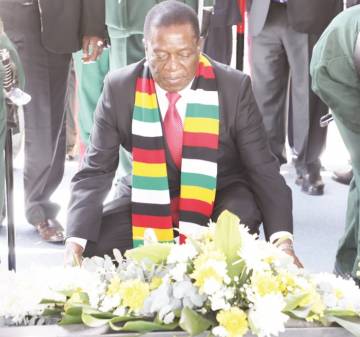
President Mnangagwa lays a wreath at the grave of late national hero Cde Callistus Ndlovu at the National Heroes Acre in Harare yesterday

“He has a rich history of service to the party and Government, which made him a fountain of knowledge and wisdom. His vast contribution benefited many generations and helped contribute to the transformation of our great nation. He was a genuine nationalist with unwavering dedication to national development . . . On behalf of the Government and people of Zimbabwe, the ruling party Zanu-PF and indeed on my own behalf, I want to convey my heartfelt condolences to Mrs Ndlovu, the children and entire Ndlovu family for their sad loss.”

President Mnangagwa said Prof Ndlovu grew up in a hostile and oppressive political environment that discriminated against blacks in favour of white settlers.

He said the late academic became a victim of discriminatory pieces of legislation such as the 1930 Land Apportionment Act, Land Husbandry Act of 1951 and later the Preventative Detention Act, which essentially banned political activities by Africans.

However, punitive legislation did not stop Prof Ndlovu from political activities as he joined the National Democratic Party in 1960. “He was subjected to periods of detention and was perceived, by the regime, as a bad influence. He became chairman of Zapu branch of students and residents in the early 60’s while he was a student at Pius XII University College in Lesotho. From 1963 to 1964, he was president of the Student Representative Council.

Between 1956 and 1964, he was secretary for publicity for the National Union for the Basutoland Students.”

President Mnangagwa challenged the nation to remain loyal and true to the country in the face of current challenges.

Prof Ndlovu was born on February 9 1936 in Plumtree, where he did his primary and secondary education before joining the National Democratic Party in 1960. He trained as a teacher before enrolling for a Bachelor of Arts degree at Pius XII University College in Lesotho. He became involved with Zapu in 1963 when he was a student in Lesotho.

On completing his degree, Cde Ndlovu came to Bulawayo and taught at Empandeni High School, before moving to Mafakela Government School. From 1966 to 1967, he taught at Mpopoma High School. As a teacher, he was detained in 1966 by the Rhodesian regime, which felt that his influence among African teachers was not good for the regime.

He was detained at Khami Prison in 1966 for promoting the objectives of the Zapu guerrillas and was released after 90 days.

He left the country in 1967 for New York University, where he did his Masters and PhD studies. During the course of his studies at New York University, Prof Ndlovu became very much involved with Zapu, and became the party’s chairperson in North America from 1967 to 1971. He set up an office near the United Nations.

This was quite an important office for Zapu because the party coordinated most of its external relations outside Africa, and the office in London, United Kingdom, depended on information from his office.

From 1971 to 1980, he was a member of the Revolutionary Council and represented the party at the United Nations and North America. Prof Ndlovu also attended the Geneva talks as a political advisor in the Zapu delegation in 1976, as well as the Lancaster House talks on Zimbabwe for the Zapu delegation.

In 2000, Prof Ndlovu was a member of the Constitutional Commission of Zimbabwe.

After independence, Prof Ndlovu was a Central Committee member from 1980 to 1983 and the Bulawayo provincial chairperson of the Zimbabwe African National Union (Zanu) from 1984 to 1987. He was a Member of Parliament from 1980 to 1985 and a Member of the Senate from 1985 to 1990. He worked as a director at Carbin Finance and the Group industrial relations manager at Union Carbide Corporation in the early 80s. In 1990, he was an executive consultant with the Treger Group of Companies and a member of the Joint Private Sector Standing Committee to promote trade between Zimbabwe and Botswana.

He also worked as the chief executive officer at Calding Consultants (Pvt) Limited in 1991. Prof Ndlovu was appointed the Minister of Construction between 1982 and 1983 before he was appointed the Minister of Mines from 1983 to 1984.

Between 1984 and 1989 he was the Minister of Industry and Commerce. He also worked for the Zimbabwe Institute of Public Administration and Management (Zipam) for several years. The late academic was once chairman of the Board of Directors at NetOne and chairman of the Foundation Task Force of the Gwanda State University. At the time of his death, Prof Ndlovu was a member of the Zanu-PF Central Committee and Bulawayo provincial chairman. He is survived by wife Angeline, several children and seven grandchildren.

The post ED challenges youths. . . Use intellect, skills to spearhead development appeared first on Zimbabwe Situation.
Millions spent on ED’s trips

Source: Millions spent on ED’s trips – DailyNews Live Tendai Kamhungira & Benjamin Manzini      24 February 2019 HARARE – President Emmerson Mnangagwa’s penchant for travelling in state-of-the-art airplanes has come at a huge cost to the taxpayer, thus undermining his government’s `austerity for prosperity’ mantra. Since coming to power in November 2017, Mnangagwa […]

The post Millions spent on ED’s trips appeared first on Zimbabwe Situation.

Source: Millions spent on ED’s trips – DailyNews Live

Tendai Kamhungira & Benjamin Manzini      24 February 2019

HARARE – President Emmerson Mnangagwa’s penchant for travelling in
state-of-the-art airplanes has come at a huge cost to the taxpayer, thus
undermining his government’s `austerity for prosperity’ mantra.

Since coming to power in November 2017, Mnangagwa has travelled over 25
trips.

In nearly 16 months, he has been to countries such as Russia, Rwanda,
Belarus, Guinea, Azerbaijan, Kazakhstan, South Africa, Switzerland,
Angola, Zambia, Namibia, Ethiopia, Botswana, Mozambique, Mauritania,
Tanzania, Botswana, the United States, the Democratic Republic of Congo
and China, among others.

A look into Mnangagwa’s travel since he became president gives a picture
of his extravagant expenditure.

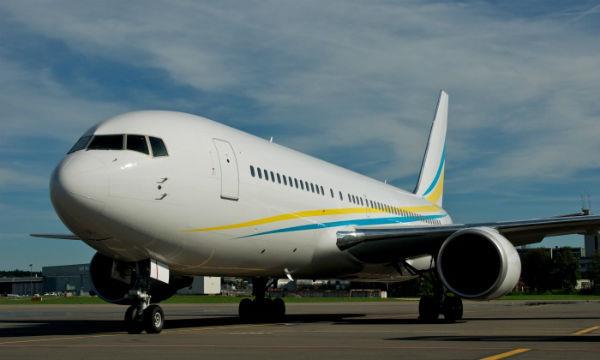
His office has been chartering the Comlux Boeing 767-200ER (Boeing
Business Jet or BBJ), which charges in the region of US$50 000 per hour in
flight time.

On average, the trips are about five hours per leg for his foreign trips
on these large VIP jets.

When he travelled to Eurasia recently, Mnangagwa chartered the Boeing 787
Dreamliner VIP jet from Deer Jet and Asian VIP Charter Company.

Charter companies charge for flights on an hourly basis, based on what
they call Total Time, which is basically the period during which an
aero-plane flies with actual passengers other than just the crew.

There are also Repositioning legs, which is the flight time to and from
pick up and or drop off airports without passengers.

There are also Short legs, which refer to time allotted by the individual
operator for any given leg, as well as Taxi Time, which is the amount of
time on the ground before each take off and after landing.

In just basic flight time, Mnangagwa’s trips have cost the taxpayer a
whopping $6,68 million, without factoring in the operator’s charges to
ferry the president in Zimbabwe.

This figure is for only 22 hours flight time to Europe round-trip at a
rate of $74 000 per hour.

Include his travel in Africa, and East Asia, his bill can easily hit
jaw-dropping figures considering that Mnangagwa’s other trips across the
world constitute about 90 hours at $50 000 per hour.

His travel is, however, said to be sponsored by some wealthy
businesspeople in Zimbabwe, and handled by Mary Chiwenga, the wife of Vice
President Constantino Chiwenga.

Nonetheless, his immoderate expenditure is ironic.

Last year, Finance minister Mthuli Ncube announced some stringent measures
aimed at reducing government expenditure.

Among some of the measures introduced to curtail spending being a five
percent salary cut for the president, his deputies, top government
officials and parastatal bosses.

The measures also included retiring all civil servants above 65 years of
age and retrenching over 3 000 youth officers.

Earlier in October last year, Ncube introduced a two percent tax on every
electronic transaction between $10 and $10 000 to fund government costs.

Observers argue that while these measures are noble, they are going to
waste owing to Mnangagwa’s insatiable desire to travel large.

Analysts canvassed by the Daily News on Sunday said government’s runaway
spending could at least be reduced if the president uses local airlines
and channels the money to depleted hospitals and schools.

The health sector in the country has virtually been destroyed by years of
plunder and corruption with the government failing to revitalise the
sector.

It is therefore being argued that the President’s Office could save a lot
of money by making use of commercial flights and redirecting the savings
towards critical areas of education, health and providing safety nets to
the poor.

Rashweat Mukundu, an analyst, said the sad part about Mnangagwa’s
continued hiring of expensive jets on his many trips outside the country
is a clear indication of his lack of faith and belief in the austerity
measures that government is pushing on citizens.

Mukundu sees a consistent message from him that economic recovery is going
to be hard and that the public must tighten its belts, but does not see
the tightening of belts from him and his government.

“…this is a clear indication that there is a lack of prioritisation of
key issues that he needs to address. We even noticed that this hiring of
expensive jets is coming at a time when the health sector is struggling,
we have had strikes from doctors, nurses, there is a threat of strike from
civil servants, the government cannot afford to meet some of the basic
needs of the people, yet we are wasting so much money on these foreign
trips on very expensive and luxurious jets,” said Mukundu.

“We have seen the president of Tanzania John Magufuli travelling on Air
Tanzania, last year we saw South Africa president Cyril Ramaphosa
travelling on South African Airways, the president of Malawi travels on
Malawi Airlines and we wonder why our own president cannot cut this huge
burdensome cost of hiring all these expensive jets by travelling with
commercial airlines”. Pessimists believe the measures were actually meant
to hoodwink the general suffering public, while those in high offices
continue to live opulent lives, albeit in a sea of poverty.

Mnangagwa has failed to take a leaf from his African counterparts such as
Magufuli.

Three years ago, Magufuli decided to embark on not so popular austerity
measures in an effort to curb government expenditure by flying on
commercial flights when traveling to other nations on State visits.

He would only book in business class on long haul flights with an aid or
two, whereas the rest of his team would fly in economy class or the main
cabin.

The austerity measures that were implemented by Magafuli have created
funding that helped in the re-establishment of Air Tanzania which recently
acquired the modern wide body Boeing 787 aircraft for its long haul
flights and as well as the ultra-new Airbus 220 for its short to medium
range routes.

This same formula can be used to resuscitate the moribund Air Zimbabwe, if
the money is not decided to be used in more important issues of education
and health.

MDC spokesperson Jacob Mafume said the powers-that-be have a parasitic
relationship with the Zimbabwean taxpayer whereby in typical vampire
State-style they suck the life out of Zimbabweans.

He said the problem is that Mnangagwa is seeing the presidency as a reward
for his personal struggles to get there.

“He is seeing it as a culmination of his personal goals. He is there to
fulfil all the desires that he wanted to achieve when he was not yet
president and those desires were to visit as many countries as possible,
probably eat as much food as possible, wear as many suits as possible,
drive as many cars as possible, make his family rich and probably his
friends,” he said.

“It is never about serving the people, it is never about doing work, it is
never about uplifting the lives of Zimbabweans. If anything, anything that
uplifts the life of Zimbabweans and does not make him richer, it is
quickly abandoned. They are no longer looking at what Zimbabweans need,
but they are looking for what they need, so they are now driving in better
cars, getting into better aeroplanes, getting into better houses.”

The post Millions spent on ED’s trips appeared first on Zimbabwe Situation.

MDC Alliance leaders tortured with electric shocks, bashed with tree logs at army barracks

TWO top MDC Alliance officials in Mutare were allegedly beaten with tree logs and subjected to electric shocks after they were detained overnight by soldiers at Herbert Chitepo Barracks, it has been revealed. Jack and Dunmore Saunyama who are MDC Allia…

TWO top MDC Alliance officials in Mutare were allegedly beaten with tree logs and subjected to electric shocks after they were detained overnight by soldiers at Herbert Chitepo Barracks, it has been revealed. Jack and Dunmore Saunyama who are MDC Alliance’s Mutare South district chairman and Dangamvura/Chikanga constituency ward 6 councillor respectively, were allegedly abducted […]