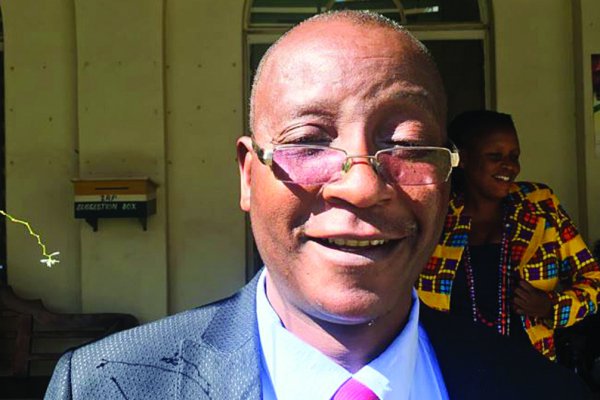
HARARE – Zimbabwe’s main opposition party has begun negotiations with the ruling party about how to resolve the nation’s political crisis, despite its leader refusing to take part in talks convened by President Emmerson Mnangagwa, […]
HARARE – Zimbabwe’s main opposition party has begun negotiations with the ruling party about how to resolve the nation’s political crisis, despite its leader refusing to take part in talks convened by President Emmerson Mnangagwa, [...]
The Nelson Chamisa-led MDC has reportedly called for a national council meeting tomorrow to start work on a roadmap to its elective congress at a time some of its top officials are said to be […]
The Nelson Chamisa-led MDC has reportedly called for a national council meeting tomorrow to start work on a roadmap to its elective congress at a time some of its top officials are said to be [...]
Source: ‘New Mines Bill to regulate artisanal miners’ – NewsDay Zimbabwe February 21, 2019 BY VENERANDA LANGA JUSTICE minister Ziyambi Ziyambi has told Parliament that the forthcoming Mines and Minerals Bill will include provisions that will regulate the conduct of artisanal miners, and ensure their safety when carrying out underground mining activities. The minister was […]
JUSTICE minister Ziyambi Ziyambi has told Parliament that the forthcoming Mines and Minerals Bill will include provisions that will regulate the conduct of artisanal miners, and ensure their safety when carrying out underground mining activities.
The minister was responding to questions in Senate last week after Manicaland Senator Keresencia Chabuka asked him to explain government policy on small-scale mining in light of the Battlefields disaster, where 24 artisanal miners perished underground after drowning.
The mine collapsed after a dam burst its wall and water flooded the mineshafts.
The incident has also raised serious concerns over the safety of miners and disaster management responses by government’s Civil Protection Unit.
“The Ministry of Mines is in the process of capacitating small-scale miners to work in groups or syndicates, and they will be given equipment to ensure that their mining activities become safe,” Ziyambi said.
“I am sure that Parliament is aware of the Mines and Minerals Bill that was brought back to Parliament, and now it will also touch on issues of artisanal miners and regulate their conduct so that they can mine safely.”
The Mines and Minerals Bill was brought before Parliament in 2015 to amend the previous 1961 law, which had become outdated.
In 2018, both Houses passed the amendments, but President Emmerson Mnangagwa refused to sign it into law after stakeholders complained that their input had not been included, adding that the amendments did not include issues of prospectors.
The Bill has been left for further consideration so that it includes issues pertaining to artisanal miners, the mining cadaster system as well as those to do with exploration.
“The challenge with artisanal miners is that even when they are told that there is danger, they continue to mine in those mines. For example, at Eldorado Mine in Chinhoyi, they go there at night, despite the fact that the mine has been condemned,” Ziyambi said.
“They also need awareness that if they go underground in such mines, it is not safe.”
The minister was further asked by Mashonaland Senator Tapfumaneyi Wunganayi to explain why government was failing to close the mines, or even place guards to ensure that illegal mining activities were curbed.
“When these areas close, they are well secured to ensure that no one enters, but you know the country we live in, there is a lot of corruption taking place and they can pay the guards, then later on when there is a challenge, they let us know. Now we are putting in place measures to ensure they mine safely,” Ziyambi said.
Source: Zim pays over 50% of its IFAD debt | Newsday (Business) By Kuda Chideme ZIMBABWE has managed to pay up more than half of its historical debt to the International Fund for Agricultural Development (IFAD) making it eligible to access a $225 million fund recently launched by the United Nations specialised organ. IFAD, like […]
ZIMBABWE has managed to pay up more than half of its historical debt to the International Fund for Agricultural Development (IFAD) making it eligible to access a $225 million fund recently launched by the United Nations specialised organ.
IFAD, like other international financial institutions had suspended support to the southern African nation after it had defaulted on earlier loans, leaving the country without any lines of external credit, serve for few opaque facilities from the Africa Export and Import Bank (Afrexim) and China Exim Bank, whose terms remain shrouded in secrecy.
With little concessional funding flowing into Harare, the local financial institutions’ capacity to lend to farmers has been constrained, a situation which has also been compounded by successive bouts of droughts in recent years, leaving rural communities vulnerable.
IFAD president, Gilbert Houngbo told NewsDay about the inroads Zimbabwe has made in settling the debt. He was speaking on the sidelines of the launch of the new impact fund, Agri-Business Capital (ABC) Fund, which is targeted at rural entrepreneurs in the agricultural sector.
“The country has done commendably well in terms of sticking to the repayment schedule we had agreed on with a little bit of difficulty sometimes, but we know that for a country that is in transition, it’s not easy. The government has shown commitment and from our perspective we are very pleased with the current state of engagement,” he said.
“As of today, the government of Zimbabwe has already paid 60% of the amount due to IFAD and the government of Zimbabwe is committed to pay the remaining 40%, which is more or less $10 million”.
Houngbo would not disclose the actual amount of the initial debt, but in 2015 former Finance minister Patrick Chinamasa disclosed that the arrears were in the region of $40 million.
The ABC Fund is a collaborative effort between IFAD, along with the European Union, the African, Caribbean and Pacific Group of States (ACP), the government of Luxembourg and the Alliance for a Green Revolution in Africa (AGRA).
The aim of the ABC Fund is to generate private sector investment in rural small and medium-sized enterprises (SMEs), farmers’ organisations and smallholder farmers’ groups which often find it hard to access finance from traditional institutions who view them as too risky.
Houngbo said the fund was an important step to realise the huge potential of small-scale farmers and young people.
“Small and medium-sized enterprises can be an engine for development and offer rural communities a pathway out of poverty and hunger, but only if they can access the resources they need,” he said.
Neven Mimica, European Commissioner for International Co-operation and Development, emphasised the potential impact of the ABC Fund investments on smallholder households.
“Smallholders and rural businesses are not getting the investment they need from the private sector. ABC Fund will help us address this gap, improve their access to capital and consequently the lives of 700 000 rural households,” he said.
In line with its focus on promoting private-sector development, Patrick Gomes, ACP secretary general, added that African, Caribbean and Pacific members had great expectations of the ABC Fund.
“We look forward to having the fund respond to specific needs in the three regions and supporting the implementation of our new approach to structurally transform the ACP agricultural sector. This fund, which aims to contribute to wealth and job creation, particularly for our youth, should significantly enable ACP countries to add value, extract higher rents from commodities, diversify and further integrate into global value chains.”
The ABC Fund aims to raise EUR 200 million ($225 million) over the next 10 years. It will provide loans adapted to the needs of SMEs. Loan size will range from €20 000 ($22 500) to €800 000 ($902 200).
For loans in the range of €20 000 to €200 000, the ABC Fund will work through financial institutions, while providing loans between €200 000 and 800 000 directly to investees.
AGRA president, Agnes Kalibata said her organization, with its focus on developing private-sector capacity for technology adoption in Africa, will build on its work as the fund is rolled out across the continent.
“AGRA is delighted to partner with IFAD, EU, and the government of Luxembourg on this unique and game-changing fund that will provide loans of below €1 million, which is what most African small rural agri-businesses need to grow and continue delivering previously unavailable, inaccessible and unaffordable services to millions of smallholder farmers,” she said.
IFAD and AGRA, which both already have operations on the ground in rural communities, will work closely with the fund manager to identify investment opportunities with promising SMEs.
The ABC Fund will be based in Luxembourg and it will be managed by two investment companies: Bamboo Capital Partners and Injaro Investments.
Commitments to the ABC Fund include:
€45 million ($50,75 million) from the European Union and the ACP (including 5 million for technical assistance), €5 million ($5,64 million) from Luxembourg and €4,5 million ($5,07 million) from AGRA.
Source: Zimdollar returns, 1:1 peg scrapped – NewsDay Zimbabwe February 21, 2019 Reserve Bank of Zimbabwe governor John Mangudya presenting the Monetary Policy Statement yesterday By Kuda Chideme THE Reserve Bank of Zimbabwe (RBZ) has effectively brought back the local currency after denoting the existing electronic balances, bond notes and coins in circulation as real […]
Reserve Bank of Zimbabwe governor John Mangudya presenting the Monetary Policy Statement yesterday
By Kuda Chideme
THE Reserve Bank of Zimbabwe (RBZ) has effectively brought back the local currency after denoting the existing electronic balances, bond notes and coins in circulation as real time gross settlement (RTGS) dollars, making them the official legal tender, as part of a host of monetary policy measures announced yesterday.
The bank has also removed the 1:1 peg on the local currency against the US dollar, practically de-dollarising, in a move which authorities hope will curb growth of the parallel market and ease foreign currency shortages which have crippled business.
In a widely anticipated move, RBZ governor John Mangudya said the legal instrument to give effect to the new legal tender was being prepared and that the central bank would establish an interbank platform, where currency would be traded freely from Monday February 25.
The 2019 budget, which was announced by Finance minister Mthuli Ncube last year, is also denominated in RTGS dollars, he added.
The country adopted mainly the US dollar after dumping its hyperinflation-ravaged currency in 2009, but has been struggling with a shortage of real dollars since 2016.
Previously, the central bank had maintained a fixed exchange rate, where RTGS balances, bond notes and coins were pegged at par with the United States dollar.
But this has largely resulted in intensified acute shortage of foreign exchange, price distortions and heightened inflationary pressures.
Mangudya, who had previously been opposed to the idea of allowing the currency to float freely, said the situation was no longer tenable and needed to be addressed immediately in order to restore the value of money.
“The bank considered the implications — accounting, financial, economic, legal and social — that are embedded in the establishment of an inter-bank forex market within the context of the current national payment systems made up of RTGS, mobile payment platforms, point-of-sale (POS), bond notes and coins.
“After taking into account the implications and putting in place safeguards to maintain stability in the forex market, the bank is, with immediate effect, establishing an inter-bank foreign exchange market in Zimbabwe to formalise the trading of RTGS balances and bond notes with US$ and other currencies on a willing-buyer, willing-seller basis through banks and bureaux de change,” he said.
“Bureaux de change shall be authorised to purchase foreign currency without limits, but shall be limited to sell foreign currency for small transactions such as subscriptions, business and personal travel up to a maximum aggregate daily limit of $10 000. Like with banks, bureaux de change and their agents shall report their activities of the inter-bank on a daily basis as required by the (central) bank.”
Mangudya said the central bank had arranged sufficient lines of credit to underpin the foreign exchange market, but he would not be drawn into disclosing the source of funding or the quantum.
Foreign currency from the interbank market shall be utilised for current bona fide foreign payment invoices except for school fees, he said.
“Foreign currency requirements for government expenditure and other essential commodities that include fuel, cooking oil, electricity, medicines and water chemicals shall continue to be made available through the existing letters of credit facilities and or the foreign exchange allocations committee.
“All foreign liabilities or legacy debts due to suppliers and service providers such as the International Air Transport Association (IATA), declared dividends, etc shall be treated separately after registering such transactions with exchange control for the purposes of providing the bank with sufficient information that will allow it to determine the roadmap for orderly expunging the legacy debt,” the RBZ chief said.
On exports, Mangudya announced that the export incentive scheme, which had been put in place to spur exports, would cease to exist after it was eroded by inflationary pressures.
Both large and small-scale gold producers will continue to retain 55% of their foreign currency earnings, while the rest will be paid in RTGS dollars.
The horticulture, manufacturing, transport and tourism sectors will retain 80% of their export earnings.
Tobacco and cotton merchants for input schemes will also retain 80%, while growers will be allocated 30%.
“Similarly, in order to enhance liquidity within the foreign currency market, exporters shall be entitled to utilise their retained export receipts within 30 days, after which the unutilised export receipts will be offloaded into the market at the prevailing exchange rate,” Mangudya added.
All international remittances and individual funds received from offshore shall continue to be treated as free funds.
In 2018, foreign receipts amounted to $6,3 billion, with export proceeds contributing 68% of the total amount received.
International remittances declined by 19% from $1,4 billion received in 2017 to $1,1 billion received in 2018. Of the $1,4 billion, Diaspora remittances contributed $619,2 million, a decline of 11,4% as compared to $699 million received in 2017.
According to the bank, the decline in Diaspora remittances is mainly attributed to the interception of remittances in South Africa by cross-border traders.
South Africa contributes about 34% of the total Diaspora remittances. Proceeds from loans accounted for 13% of the total foreign receipts.