CHIMANIMANI VILLAGERS TO BE RELOCATED

Chimanimani Rural District Council has resolved to relocate
hundreds of villagers from Cyclone Idai-ravaged areas.

This was revealed by ward 8 councillor Gift Mtetwa (MDC
Alliance) during a tour of areas affected by the cyclone in Chimanimani
dist…

Chimanimani Rural District Council has resolved to relocate hundreds of villagers from Cyclone Idai-ravaged areas. This was revealed by ward 8 councillor Gift Mtetwa (MDC Alliance) during a tour of areas affected by the cyclone in Chimanimani district by the opposition party’s national taskforce. The party has set up national and provincial taskforces led by Lynette Karenyi, which is

Ending the scourge of NTDs 

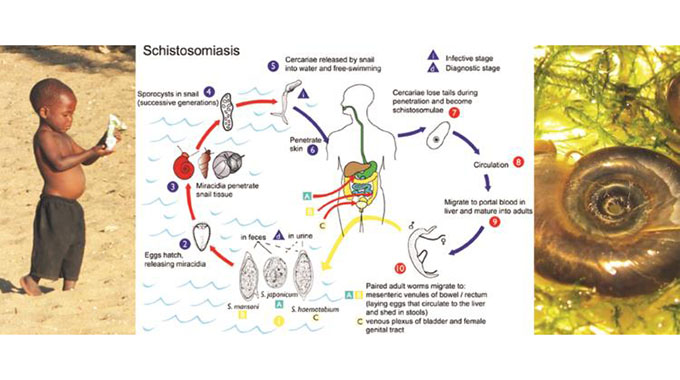
Source: Ending the scourge of NTDs | The Herald April 4, 2019A diagrammatic representation of the bilharzia lifecycle Sifelani Tsiko Senior Writer THE recent launch of a book on neglected tropical diseases (NTDs) and a discussion by health experts on NTDs has helped the country to scale up efforts to raise awareness of this group […]

The post Ending the scourge of NTDs  appeared first on Zimbabwe Situation.

Source: Ending the scourge of NTDs | The Herald April 4, 2019Ending the scourge of NTDsA diagrammatic representation of the bilharzia lifecycle

Sifelani Tsiko Senior Writer
THE recent launch of a book on neglected tropical diseases (NTDs) and a discussion by health experts on NTDs has helped the country to scale up efforts to raise awareness of this group of diseases which cause long-term suffering for millions worldwide.

Nearly one in six people worldwide are affected by NTDs — a group of bacterial, viral and parasitic diseases which disproportionately affect the poorest and most vulnerable people in the world.

Experts say NTDs disable, disfigure and stigmatise. They cause long-term illnesses, severe pain, and are the cause of death for over 170 000 people per year.

Zimbabwe is one of the countries most affected by NTDs and public experts say that the country could save up to $143 million if efforts are scaled up to eliminate five of the NTDs that affect people the country.

According to a Ministry of Health and Child Care report, the country is affected by four of the five most common NTDs — lymphatic filariasis (elephantiasis), schistosomiasis (bilharzia), soil-transmitted helminths (intestinal worms) and trachoma.

Of the country’s 63 districts, 57 are prone to bilharzia, which, if untreated, can cause infertility and other health complications.

For the five most common NTDs — lymphatic filariasis (LF), intestinal worms (ascariasis, trichuriasis, and hookworm), schistosomiasis (snail fever or bilharzia), onchocerciasis (river blindness), and trachoma — which represent 90 percent of the total NTD disease burden, disease control and even elimination is possible through a coordinated strategy of mass drug administration (MDA).

As part of efforts to combat NTDs, the Ministry of Health and Child Care, Higherlife Foundation and the END Fund recently launched a book, “Under the Big Tree: Extraordinary Stories from the Movement to End Neglected Tropical Diseases (NTDs).”

The book was written by Ellen Agler, public health leader and CEO of the END Fund.

In the book, the writer captures moving stories of people struggling cope with NTDs and simple and cost-effective strategies for combating the diseases.

The book and the END Fund programme are part of the collaborative partnership by the Higherlife Foundation, the END Fund, and the Ministry of Health and Child Care to fight for the elimination of NTDs.

Dr Portia Manangazira, director of Epidemiology and Disease Control in the Ministry of Health and Child Care, gave an overview of the NTDs in Zimbabwe and hailed the partnership with Higherlife Foundation and the End Fund in the fight to end the scourge.

Agler spoke about the book “Under the Big Tree: Extraordinary Stories from the Movement to End NTDs” highlighting how sharing experiences and health outcomes could help build the momentum required to fight NTDs in developing countries.

Warren Lancaster, senior vice president of programmes, END Fund presented the technical perspective involved in various programmes under the fund which was being implemented by Zimbabwe and other partners.

The book launch and a panel discussion with leading experts provided a range of perspectives on NTDs and a question and answer session further gave some useful insight into what people are doing to fight NTDs, the challenges they face and the collaborative opportunities that existed.

Treatment and control are relatively easy, and in most cases, a few doses of inexpensive and widely available medicines with few known side effects can prevent and treat the symptoms for approximately US$,50 per person per annum over five to seven years, public health experts say.

Eliminating NTDs can improve the productivity of workforces, creating a potential “health dividend” — put simply, the socio-economic benefit of having a healthier workforce — on national levels.

There are clear and multiple linkages between SDGs and NTDs. Development experts say combatting NTDs propels progress towards universal health coverage, improves the health of women, children, and adolescents, and ensures that no one is left behind.

NTDs are specifically highlighted in SDG 3 — “Ensuring healthy lives and promoting wellbeing for all at all ages” and further in sub-goal 3.3 — “By 2030 end the epidemics of AIDS, tuberculosis, malaria and neglected tropical diseases and combat hepatitis, water-borne diseases and other communicable diseases.”

NTD interventions are pro-poor and therefore affect poverty (SDG 1) and impact hunger (SDG 2), can improve education (SDG 4) and economic outcomes (SDG 8), and therefore reduce inequalities within and between communities and countries (SDG 10).
The post Ending the scourge of NTDs  appeared first on Zimbabwe Situation.

CHAOS MARS MDC ELECTIONS

CHAOS characterised the recently held MDC ward and district
congresses in Midlands and Beitbridge where new structures were being elected
ahead of the national crunch event set for May.

Top party officials eyeing posts at the provincial as well
as…

CHAOS characterised the recently held MDC ward and district congresses in Midlands and Beitbridge where new structures were being elected ahead of the national crunch event set for May. Top party officials eyeing posts at the provincial as well as national executive levels and those seeking to place their loyalists in the structures to position themselves to contest in the 2023 general

Merchants to recover 30pc of tobacco loans

Source: Merchants to recover 30pc of tobacco loans | Herald (Business) Golden Sibanda and Africa Moyo The Reserve Bank of Zimbabwe says merchants who used offshore funds to support tobacco production are required to use a split ratio of 70 percent US dollar and 30 percent RTGS$ when recovering loans extended to farmers. This policy […]

The post Merchants to recover 30pc of tobacco loans appeared first on Zimbabwe Situation.

Source: Merchants to recover 30pc of tobacco loans | Herald (Business)

Golden Sibanda and Africa Moyo
The Reserve Bank of Zimbabwe says merchants who used offshore funds to support tobacco production are required to use a split ratio of 70 percent US dollar and 30 percent RTGS$ when recovering loans extended to farmers.

This policy position is contained in an exchange control directive, circular number of 2019 issued by the central bank, dated March 27, 2019.

The circular also contains several other directives on the treatment of foreign currency in the country.

According to the circular signed by RBZ exchange control director Farai Masendu, merchants are permitted to borrow funds offshore for purposes of financing production of Zimbabwe’s second largest foreign currency earner, after gold.

Official figures showed that by end of last year Zimbabwe had earned about $892 million from the export of 184,1 million kilogrammes of the golden leaf.

“In order to recover funds advanced to tobacco growers, tobacco merchants shall use a split of 70 percent USD and 30 percent RTGS$.

“This applies only to merchants who financed tobacco production using offshore financing,” he said.

Before the split, merchants will need to show proof that they drew down offshore funds, imported inputs, liquidated 20 percent of offshore funds to finance tobacco and furnish acknowledgement of receipt of inputs or working capital by growers.

Where merchants claim to have lost value as a result of the 70-30 percent split, the central bank will require the claimant to show proof of this to settle the matter.

The Reserve Bank also says farmers will be paid 50 percent of their foreign currency entitlement for tobacco sales after deduction of statutory payments, prescribed costs and input loans.

Meanwhile, the central bank has issued exchange control guidelines on the treatment of foreign currency receipts by holders of free funds, which have no time limit for usage.

Individuals selling goods and services to entities that receive offshore funds, such as embassies, non-governmental and international organisations, are required to keep such funds in domestic foreign currency accounts (FCAs).

Similarly, foreign currency payments to hospital or health institutions by non-residents, and retail shops shall be kept in a nostro foreign currency account of the recipient.

The RBZ said donations and grants shall also be treated as free funds and not subjected to the 30-day retention period before being sold on the interbank market.

Free funds will also not be subjected to retention thresholds.

Further, monetary authorities said in the circular that insurance premiums denominated in foreign currency and paid by non-residents shall be deposited into nostro FCA (transitory) account of the respective insurance company.

The reserve bank also said operation of nostro FAC (transitory) accounts for insurance premiums shall require prior specific exchange control approvals.

On tourism receipts, the RBZ said that the 20 percent foreign currency surrender portion due to it from payments through international Visa Card and MasterCard maybe remitted as bullet transactions on a monthly basis.

Farmers have so far sold 538 147 kilogrammes of tobacco worth US$896 166 since the tobacco marketing season commenced a fortnight ago compared to 6,8 million kg worth US$19 million sold over the same period last year.

This year’s tobacco selling season started on a low note as tobacco farmers withheld their crop while protesting low prices and the 2 percent intermediated money transfer tax, which the Government has since scrapped.

The post Merchants to recover 30pc of tobacco loans appeared first on Zimbabwe Situation.

RUSHWAYA EMBROILED IN MINERS LEADERSHIP WRANGLE

THE Zimbabwe Miners’ Federation (ZMF), led by Ishmael
Kaguru, has described the disbandment of the ZMF and formation of a new body —
the Zimbabwe Artisanal and Small-Scale Miners’ Federation (ZASMF) — as illegal
and dubious.

ZMF president Henrie…

THE Zimbabwe Miners’ Federation (ZMF), led by Ishmael Kaguru, has described the disbandment of the ZMF and formation of a new body — the Zimbabwe Artisanal and Small-Scale Miners’ Federation (ZASMF) — as illegal and dubious. ZMF president Henrietta Rushwaya recently lost the presidency of the association after the High Court declared null and void the results and proceedings of the