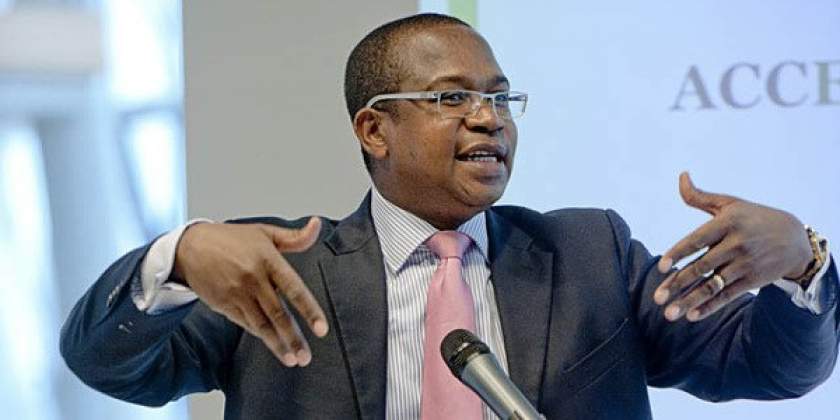
Finance Minister Professor Mthuli Ncube speaks out as RTGS dollar value FALLS

FINANCE minister Mthuli Ncube yesterday told the Senate that the official exchange rate will soon match parallel market levels and hopefully destroy completely the black market after the RTGS dollar’s value fell to 1:3 on the interbank market during th…

FINANCE minister Mthuli Ncube yesterday told the Senate that the official exchange rate will soon match parallel market levels and hopefully destroy completely the black market after the RTGS dollar’s value fell to 1:3 on the interbank market during the week. Ncube was responding to a question by Mashonaland Central Senator Angeline Tongogara, who had […]

Ncube admits to RTGS$ devaluation

Source: Ncube admits to RTGS$ devaluation | Newsday (News) BY VENERANDA LANGA FINANCE minister Mthuli Ncube yesterday told the Senate that the official exchange rate will soon match parallel market levels and hopefully destroy completely the black market after the RTGS dollar’s value fell to 1:3 on the interbank market during the week. Ncube was […]

The post Ncube admits to RTGS$ devaluation appeared first on Zimbabwe Situation.

Source: Ncube admits to RTGS$ devaluation | Newsday (News)

BY VENERANDA LANGA

FINANCE minister Mthuli Ncube yesterday told the Senate that the official exchange rate will soon match parallel market levels and hopefully destroy completely the black market after the RTGS dollar’s value fell to 1:3 on the interbank market during the week.

Ncube was responding to a question by Mashonaland Central Senator Angeline Tongogara, who had asked to inform the House on government policy and measures being taken to curb the foreign currency black market, which she said was currently destabilising the economy.

“What we have done so far is to complete the monetary policy reforms announced on February 22 and the introduction of the market-based exchange rate and designation of the RTGS dollar as local currency,” Ncube said.

“In the last few days the exchange rate has gone up to 1:3 to the US$ and we have made sure that there is a market-based exchange rate whose behaviour approaches the black market, hoping that with time the black market will be eliminated,” he said.

Ncube said the black market was currently also showing signs that there was a shortage of foreign currency in the country.

“I am sure as we trade in tobacco that the black market will diminish. We want to see a Zimbabwe which does not have a black market,” he said.

Mashonaland Central MP Alice Chimbudzi asked the Finance minister to explain the measures being taken to deal with businesses which are demanding payments for goods and services in foreign currency.

Ncube said businesses were entitled to ask for payment in foreign currency as the country was still a multi-currency regime, but said they must rate the prices using the obtaining official exchange rates.

“We are still in a multi-currency regime and so businesses are entitled to demand payment in foreign currency. The RTGS dollar is a unit for accounting purposes, but we cannot say that other currencies are disallowed. Maybe what businesses have to do is to be fair and to convert to the official rate of 1:3, but they are allowed to quote in foreign currency,” he said.

Bulawayo Metropolitan Senator Gideon Shoko also asked Ncube to state measures being taken by government to prevent high price increases as witnessed before and after the increase in fuel prices in January 2019.

“We are trying everything we can to deal with inflation, but I must hasten to say that year-on-year inflation has changed. Our prices will remain high up to October this year and after October, the year-on-year inflation will drop down because the difference will narrow. However, month to month inflation will keep falling. In February it was 1,7% and in March you will see that the figure will drop and I will not be surprised to see prices falling.

“For example, the price of top quality beef used to be $19 per kilogramme, but yesterday the price had dropped to $12. We are doing everything to curb the growth of inflation because we also need to preserve the value of our currency,” Ncube said.

The post Ncube admits to RTGS$ devaluation appeared first on NewsDay Zimbabwe.

The post Ncube admits to RTGS$ devaluation appeared first on Zimbabwe Situation.

Kunaka removed from remand

Source: Kunaka removed from remand | Daily News THE 27 alleged protesters arrested following the August 1 violence were yesterday removed from remand. The alleged protesters, who include former Zanu PF youth leader Jim Kunaka, have been on remand for nearly eight months, with the State yet to finalise its investigations. They had applied for […]

The post Kunaka removed from remand appeared first on Zimbabwe Situation.

Source: Kunaka removed from remand | Daily News

THE 27 alleged protesters arrested following the August 1 violence were yesterday removed from remand.

The alleged protesters, who include former Zanu PF youth leader Jim Kunaka, have been on remand for nearly eight months, with the State yet to finalise its investigations.

They had applied for removal from remand for the second time. The first time they lodged the application, it was dismissed.
But provincial magistrate Rumbidzai Mugwagwa ruled that the accused persons have the right to be tried within a reasonable time.

Mugwagwa noted that the courts had already resolved the public violence trials of January 14 and that there is no reason “to treat this matter differently.”
“When the State is ready, you will be summoned. Further remand is hereby refused,” Mugwagwa said.

Through their lawyer, Gift Mutisi, the protesters challenged further placement on remand after the State sought to have the matter postponed to April 30.

Mutisi said the State is violating his clients’ right to liberty as they are bound by stringent bail conditions.

The post Kunaka removed from remand appeared first on Zimbabwe Situation.

‘Commercial loans won’t help clear debts’

Source: ‘Commercial loans won’t help clear debts’ | The Herald March 29, 2019 Professor Ncube Herald Reporter Government believes using commercial loans for debt cancellation will not save the country from debt, but was rather looking at accessing soft loans or grants to speed the clearance process in order to access fresh capital from multilateral […]

The post ‘Commercial loans won’t help clear debts’ appeared first on Zimbabwe Situation.

Source: ‘Commercial loans won’t help clear debts’ | The Herald March 29, 2019

‘Commercial loans won’t help clear debts’Professor Ncube

Herald Reporter
Government believes using commercial loans for debt cancellation will not save the country from debt, but was rather looking at accessing soft loans or grants to speed the clearance process in order to access fresh capital from multilateral institutions.

Standing in for Finance and Economic Development Minister Mthuli Ncube at the Zimbabwe High Level Debt Conference in the capital yesterday, Martha Mugweni from Zimbabwe Aid and Debt Management Office said the country might consider going the grants way for debt clearance than commercial loans.

“Indications are that if we use commercial loans to clear our arrears the problem we are having will never end, we need either a very soft loan or a grant, but I don’t know if we will be able to convince any country to give us a grant considering our current state.

“That would be the best option, but we are saying failure to that maybe if the G7 can give us a soft loan that has IDA terms, which means it will have zero interest with only service fee of 0,75 percent which we can use,” she said.

According to official statistics the country’s total debt stands at $16,6 billion as at December 31 2018 with an external debt now at US$8,16 billion which is 33,2 percent of the GDP.  BH24.

The post ‘Commercial loans won’t help clear debts’ appeared first on Zimbabwe Situation.

Misa-Zim concerned over  tougher EU copyright rules

Source: Misa-Zim concerned over  tougher EU copyright rules | Daily News Content creators in Zimbabwe who share their works online will have to take extra care not to use any copyrighted work in their productions after a European Parliament committee voted in favour of tougher copyright rules on Tuesday, a Press freedom group has warned. […]

The post Misa-Zim concerned over  tougher EU copyright rules appeared first on Zimbabwe Situation.

Source: Misa-Zim concerned over  tougher EU copyright rules | Daily News

Content creators in Zimbabwe who share their works online will have to take extra care not to use any copyrighted work in their productions after a European Parliament committee voted in favour of tougher copyright rules on Tuesday, a Press freedom group has warned.

The fresh copyright rules, mooted by the European Commission, are designed to take account of the growing role of online platforms, forcing them to share revenues with publishers and bear liability for copyright infringement on the Internet.

The vote by the committee is likely to be the Parliament’s official stance as it heads into negotiations with EU countries on a common position, unless dissenting lawmakers from Germany and Poland, who have already indicated they will fight the full adoption of this directive, overturn its ratification by the EU Council.

While Internet luminaries and activists and some lawmakers have criticised the EU reforms, copyright holders have applauded them.
Media Institute of Southern Africa Zimbabwe Chapter (Misa-Zimbabwe) opposed the EU proposal and said it was a cause of concern for service providers in the tech industry, content creators and Internet users on a global scale.

“More so when one considers the Internet’s universal nature and the fact that EU’s digital laws also affect Internet users from other parts of the world including Zimbabwe. For example, the General Data Protection Regulation (GDPR), was drafted and implemented to protect the privacy rights of European residents, but its effects have extended well beyond the EU’s geographical borders,” Misa-Zimbabwe said in a statement yesterday.

Misa-Zimbabwe said the EU Copyright Directive will have two major effects on the sharing of media and information on the Internet.

“Firstly, Article 17 of the directive states that service providers such as YouTube, Facebook, Google and Instagram, will now be responsible for any copyrighted media or information that is shared on their platforms.

“Secondly, Article 15 of the EU Copyright Directive will impose a ‘link tax’ to search engine service providers such as Google and news aggregator service providers,” the Press freedom group said, adding a local example of a news aggregator service is the Zimbabwe Situation.

“Any online service providers that share or aggregate news sources will have to negotiate a fee with the publishers and authors of the news articles or stories shared. At the moment, the sharing of just news ‘snippets’ and links to news articles are exempt from paying this ‘link tax.’

“Article 17’s successful implementation will rely on the use of service agreements entered into between online service providers such as Facebook and the copyright holders or license holders of copyrighted work. In terms of such an agreement, Facebook for example, will have to police its platforms to ensure that there is no media or information shared in a manner that violates any copyright.”

In the past, this responsibility to police the Internet for copyright violations lay with the owner of the copyright and any other entities wishing to enforce specific copyrighted works.
Any copyright holder that wanted to prevent the unauthorised sharing of its works could make a request to have the offending material taken down.

But the EU Copyright Directive means that online service providers have to proactively watch for copyright breaching posts. Any service provider that fails to police its platforms will be held liable for sharing the content.

Misa-Zimbabwe said this is, however, a beneficial arrangement for music record labels, movie studios and other media entities that own and make money from copyrighted works.

“In theory, this means that Zimbabwean copyright holders will be able to enter into agreements with online service providers for the purpose of preventing the unauthorised sharing of their content in the EU,” Misa-Zimbabwe said.

The post Misa-Zim concerned over  tougher EU copyright rules appeared first on Zimbabwe Situation.