Mathema, Matanga face jail

Source: Mathema, Matanga face jail | Daily News HOME Affairs minister Cain Mathema and commissioner-general of police Godwin Matanga will each face 90 days’ imprisonment if they fail to comply with a High Court order compelling them to compensate a victim of wrongful arrest. Mathema and Matanga were found in contempt of court by Justice […]

The post Mathema, Matanga face jail appeared first on Zimbabwe Situation.

Source: Mathema, Matanga face jail | Daily News

HOME Affairs minister Cain Mathema and commissioner-general of police Godwin Matanga will each face 90 days’ imprisonment if they fail to comply with a High Court order compelling them to compensate a victim of wrongful arrest.

Mathema and Matanga were found in contempt of court by Justice Benjamin Chikowero and ordered to pay $18 075 with prescribed interest within 14 days or go to jail.

“The respondents be and are hereby held to be in contempt of court…shall pay $18 075 together with interest at the prescribed rate from the date of summons to the date of full payment and cost of suit within 14 days of this order failing which they must each be committed to imprisonment for 90 days,” reads the order.
Pro-democracy activist Cynthia Manjoro filed the suit in 2011 claiming she suffered torture and other abuses by police officers.

The police initially entered special pleas to Manjoro’s claim arguing that in terms of the Police Act, any civil proceedings instituted against the State or member in respect of a claim such as the one brought by the pro-democracy activist should be commenced within eight months after the cause of action has arisen.

But the High Court threw out the argument, ruling that the police were answerable to Manjoro’s unlawful arrest and assault.
In her court papers filed on her behalf by Jeremiah Bamu and Fiona Iliff from the Zimbabwe Lawyers for Human Rights, Manjoro, who was arrested together with 28 others, said that she was wrongfully arrested on charges of murdering police inspector Petros Mutedza in May 2011.

She was arrested because her car was spotted at the murder scene. Despite telling the police that she was attending a church service at the material time and was not present at the scene, the police went on to detain her.

She told the police that her boyfriend Darlington Madzanga was the one who was in possession of the car at the material time. Following her arrest, she was denied bail, which resulted in her spending seven months in remand prison. Manjoro was subsequently brought before the courts and acquitted in September 2013.

“During her detention in police custody, she was subjected to routine and incessant questioning by a number of police detectives and during this interrogation, the plaintiff was subjected to assaults and torture and particularly received incessant assaults on her knees with a baton.

“As a consequence of these beatings, the plaintiff had to undergo an operation on her knees to drain pus that had accumulated.
“She is therefore entitled to damages for assault, contumelia, pain, shock and suffering arising from these acts,” the court heard.

The post Mathema, Matanga face jail appeared first on Zimbabwe Situation.

Caaz boss arraigned over criminal abuse of office rap

Source: Caaz boss arraigned over criminal abuse of office rap | Daily News Civil Aviation Authority of Zimbabwe (Caaz) chief executive officer David Chawota appeared in court yesterday facing criminal abuse of office charges. Chawota is accused of fraudulently awarding a €27 900 000 contract to a Spanish company, Indra Sistemus, which did not meet minimum […]

The post Caaz boss arraigned over criminal abuse of office rap appeared first on Zimbabwe Situation.
Source: Caaz boss arraigned over criminal abuse of office rap | Daily News

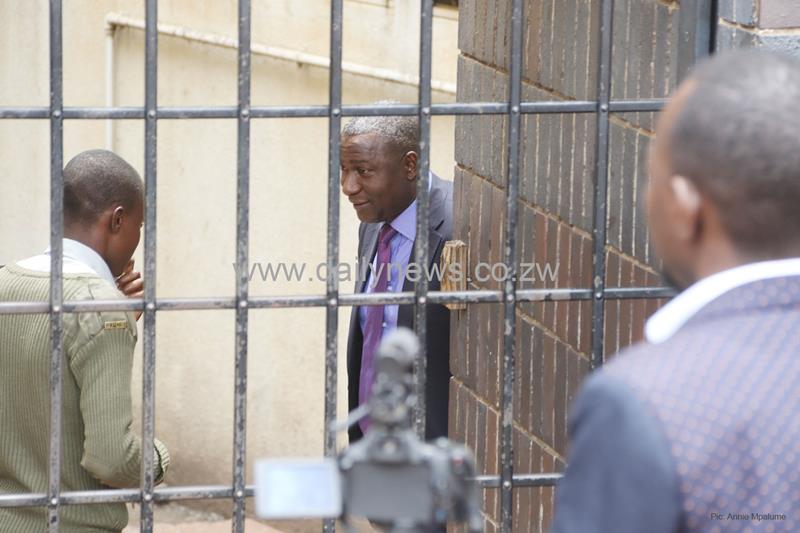
Civil Aviation Authority of Zimbabwe (Caaz) chief executive officer David Chawota appeared in court yesterday facing criminal abuse of office charges.

Chawota is accused of fraudulently awarding a €27 900 000 contract to a Spanish company, Indra Sistemus, which did not meet minimum mandatory requirements in a previous bid. Chawota reportedly engaged the company after the Supreme Court nullified the tender previously awarded to it in January 2016.

He appeared before Harare magistrate Rumbidzai Mugwagwa.
The State opposed bail. In opposing bail, prosecutor Zivanai Macharaga called the investigating officer Lawrence Mashawi who testified that Chawota is not abiding by his existing bail conditions and is threatening witnesses.

Mashawi said Chawota has been threatening senior employees against cooperating with investigations on the current matter.
“Workers now fear that the accused person will terminate their contracts if they cooperate with investigations. He terminated contracts of executives in 2016 after they cooperated with police in a matter involving him,” Mashawi testified.

Mugwagwa rolled the matter to today for bail ruling.
Allegations are that sometime in May 2013, Chawota floated tenders for air traffic control systems. It is alleged that one of the bidders which had submitted bids for the Radar Surveillance Systems, Selex Es, challenged the award to Indra Sistemas resulting in the cancellation of the award by the Supreme Court in January 2016.

The State alleges that Chawota persisted in requesting the direct appointment on Indra Sistemas, defying the Supreme Court ruling that nullified the previous award to the same company.
On July 27, 2016, Chawota allegedly implored the board to directly engage Indra Sistemas, his preferred company which had failed to meet minimum mandatory requirements in the previous bid.

However, the board resolved that a thorough and diligent technical search for companies that develop these systems be conducted and a tender be urgently floated thereafter. Despite the court ruling and the board resolution, Chawota allegedly continued to secretly engage with Indra Sistemus.

On February 14, 2017, the court heard that Chawota defied the board and Supreme Court ruling and presented to the corporate strategy and technical committee a letter for preliminary financial offer for the Design, Supply, Delivery, Installation and Commissioning of ATM system and associated equipment from the Spanish company.

However, the committee refused to recommend the proposal but resolved not to consider the Indra Sistemus proposal because of the risks involved in dealing with a company which had failed to meet minimum mandatory requirements.

The board instructed Chawota to consult with the Defence and Foreign Affairs ministries which advised procuring the equipment from UK, France, Italy, Czech Republic and Finland as Spain was futile because they had imposed trade restrictions on Zimbabwe.

It is the State’s case that Foreign Affairs, Zimbabwe Defence Forces and the board directed that the Procurement Committee develop a special formal tender for the Procurement of Radar Surveillance Systems which is premised on the strategy of reducing exposure of the country to sanctions.

Pursuant to his bid to engage Indra, Chawota allegedly met with Indra officials without approval at the Reserve Bank on his own.
He allegedly continued to solely engage the company and went on to request the State Procurement Board (SPB) to directly engage Indra under the pretext that it brought a funding package which Caaz had been failing to raise.

The State alleges that the award was granted wherein Chawota was directed to carry out due diligence before the engagement.
It is the State’s case that Chawota travelled to Spain in December 2017 to purportedly conduct due diligence in the company of Blessing Ngwarai but went on to sign a contract with Indra valued at €27 900 000.

The signed contract had other systems such as navigational aid systems previously awarded to Intelcan Technosystems of Canada and air traffic control communications system previously awarded to AME ATM which had not be cancelled, thereby creating a double award.

Despite Chawota’s assertions that Indra Sistemus had the funding, the court heard that the company failed to implement the project due to lack of funds and Chawota is now engaging the Afrexim Bank to provide funds.

The post Caaz boss arraigned over criminal abuse of office rap appeared first on Zimbabwe Situation.

High Court to hear Supa’s challenge on April 3

Source: High Court to hear Supa’s challenge on April 3 | Daily News Former ICT minister Supa Mandiwanzira’s challenge against a magistrate’s ruling rejecting his application for exception to charges of breaching procurement regulations will be heard in the High Court on April 3. Mandiwanzira approached the High Court after Harare regional magistrate Elijah Makomo had […]

The post High Court to hear Supa’s challenge on April 3 appeared first on Zimbabwe Situation.

Source: High Court to hear Supa's challenge on April 3 | Daily News

Former ICT minister Supa Mandiwanzira’s challenge against a magistrate’s ruling rejecting his application for exception to charges of breaching procurement regulations will be heard in the High Court on April 3.

Mandiwanzira approached the High Court after Harare regional magistrate Elijah Makomo had thrown the application out, insisting the ex-minister contravened the Procurement Act.
The Nyanga South legislator has been directed to file his heads of argument by the High Court.

Mandiwanzira, who is accused of corruptly engaging Megawatt for consultancy services rendered to NetOne Pvt Ltd, had argued before Makomo that the charges were misplaced because the telecommunications company was not a procuring entity.

However, Makomo ruled that Mandiwanzira in his capacity as minister then, could not have acted on behalf of NetOne because it had its own directors and employees. “The charge and outline are clear that the issue is not about proceeding to tender but that as minister the accused person handpicked Megawatt. According to papers, it was not NetOne but the minister,” Makomo ruled.

“…by acting in that manner, the minister became a procuring entity and was bound by procurement regulations.
“The accused person argued that the services had been proffered on pro bono basis but it was only pro bono on paper because payment was later demanded.”

Mandiwanzira had argued that Statutory Instrument 160/2012 removed NetOne from the list of public enterprises that were deemed to be procuring entities. “The accused person’s lawyers in asserting that NetOne is not a procurement entity are ignorant of the law…section three of the repealed S.I 160/2012 was corrected in the same year thus he relied on an incorrect and repealed piece of legislation,” the State responded.

“SI 160/2012 is just an addition of those that were stated in S.I 171/2002 where NetOne is number 28. Further, section two of the Public Finance Management Act defines a public entity as any company in which the State has a controlling interest whether by virtue of holding or controlling shares therein or of right of appointment of members to the controlling body…”

Mandiwanzira is facing charges of criminal abuse of office.
He is accused of awarding Megawatt Energy, a South African-based company consultancy, work to audit the US$218 954 843.00 deal between NetOne and Huawei Technologies.

In his application for exception to the charges against Mandiwanzira, defence lawyer Advocate Tembinkosi Magwaliba said the former minister acted in public interest and recovered US$30 million that NetOne had lost in the contract for network expansion and modernisation of equipment.

The deal was signed by former NetOne CEO Reward Kangai, who is the State’s star witness. The defence lawyer described allegations against Mandiwanzira as “fatally defective and incurably bad.”

On the potential prejudice of $4 million to NetOne, Magwaliba said Megawatt Energy had offered its services on a pro bono basis as confirmed in the State outline and that the payment would not be made by the government of Zimbabwe or NetOne Cellular for the services.

“The payment of US$4 million was a success-based fee recoverable from Huawei Technologies if it was found to have overpriced,” the defence lawyer said.

“Megawatt Energy successfully carried out the verification in terms of its contract with NetOne Cellular in the recovery of US$30 million which was credited to NetOne Cellular.”

The post High Court to hear Supa’s challenge on April 3 appeared first on Zimbabwe Situation.

Prices of goods continue to go up

Source: Prices of goods continue to go up | Daily News Prices of mostly basic commodities have significantly gone up over the past month, with analysts blaming it on exchange rate developments. A survey by the Daily News yesterday showed that prices of basics have gone up by between 20 percent and 100 percent, thus overburdening […]

The post Prices of goods continue to go up appeared first on Zimbabwe Situation.

Source: Prices of goods continue to go up | Daily News

Prices of mostly basic commodities have significantly gone up over the past month, with analysts blaming it on exchange rate developments. A survey by the Daily News yesterday showed that prices of basics have gone up by between 20 percent and 100 percent, thus overburdening the cash-strapped consumer.

For instance, a two-litre bottle of cooking oil, which was selling at around $7 has increased to $11, 49, while two kilogrammes (kg) of flour now retails at $7, 19 from $5, 45. A 2kg packet of rice has also gone up from $5, 70 to $6, 49, with a kg of salt fetching $1, 89 from $1.

The price of sugar has also gone up from $2 per 2kg to $5, 29 with 10kg of mealie-meal now going for $9, 99. Following the latest price increases, many are expecting the cost of living to shoot through the roof. In December last year, the Consumer Council of Zimbabwe said the food basket had increased by 9, 7 percent from $211, 68 at the end of October 2018 to $232, 31 by end of November 2018.

This resulted in the cost of living for a family of six increasing from the end of October 2018 figure of $666, 93 to $697,76 by end of November, translating to an increase of $30, 83 or 4, 6 percent. Analysts said the price increases mirror the movement in the exchange rate following the announcement of the Monetary Policy Statement (MPS) on February 20.

As part of his MPS, Reserve Bank of Zimbabwe governor John Mangudya floated the local unit, which for a very long time had been trading at par against the United States dollar (USD). The liberalisation of the exchange rate, which brought relief to industry, saw the RTGS dollar trading at 2,5 against the USD before depreciating further.

“The price of commodities is a result of the interaction between supply and market demand. Price increases can be best described under two scenarios: when there is a surge in demand and if there is undersupply of commodities,” said economist Kipson Gundani.

“In the Zimbabwean case, we discover that there is what we call pull-demand; there is a lot of liquidity in the market chasing too few goods. This is because since January, some companies have been adjusting their employees’ salaries, which has increased the buying power against disrupted production,” he said.

Due to low levels of production, retailers have been forced to import most basic goods that range from cooking oil, soap and wheat for bread, bringing in the yesteryear memories of the 2008 hyper-inflationary period, where government had to introduce price control measures.  During the period, inflation in Zimbabwe was estimated at 500 billion percent.

Gundani said in the current situation price controls will not be ideal.
“Price controls do not work in practice and theory. There is need to address the supply side constraints to ensure industries produce and the market then sets its own prices,” he said.

President of the Confederation of Zimbabwe Retailers Denford Mutashu said there was price madness in the market, adding price controls will be bad news for the country, considering the precedent set during the 2007/8 era. He also said there was need for the country to produce more than what the market requires in order to curtail high demand for too few goods.

“The economy came to its knees after price controls that were not thought out. Price controls do not and will never work the much they have failed dismally in the past. One of the few solutions to price escalation is to produce more than what the market requires forcing supply to outstrip demand.

“The economy is not producing and conditions under which production is taking place ought to improve also. But the general pricing in the economy resembles madness in some cases.
“A vehicle tyre costs US$110 yet same is selling at R750 across the Limpopo.

Most of the high prices resemble greed bordering on fictitious costing models adopted at dollarisation,” Mutashu said.
The Zimbabwean economy continues to face challenges owing to low production levels as well as inflation and high black market exchange rates.

According to US economist Steve Hanke, Zimbabwe’s inflation is 198 percent, which is however, three times more than the recorded official rate by local authorities. Former Finance minister in the government of national unity Tendai Biti, said the Monetary Policy Statement announced five weeks ago has failed to stabilise the exchange rates.

“It is now five weeks since the monetary policy was announced on February 20. During this period, as we foresaw market disequilibrium has increased with the parallel exchange rate firming up to 4, 5. The fixed exchange rate of 2, 5 has failed & foreign exchange shortage is huge,” Biti wrote on Twitter.

The post Prices of goods continue to go up appeared first on Zimbabwe Situation.

MDC-T spokesperson Linda Masarira under fire for wearing ED Mnangagwa’s ‘Zambia’

The Thokozani Khupe-led MDC-T has said it is probing why its national spokesperson Linda Masarira was pictured wearing Zanu PF regalia. All registered political parties in Zimbabwe have paraphernalia that contain symbols and colours which identify them…

The Thokozani Khupe-led MDC-T has said it is probing why its national spokesperson Linda Masarira was pictured wearing Zanu PF regalia. All registered political parties in Zimbabwe have paraphernalia that contain symbols and colours which identify them distinctively and also undoubtedly help in many ways to enhance their respective political campaigns across the length and […]