Crisis drives the S.Africa to Zimbabwe cargo shuttle

Crisis drives the S.Africa to Zimbabwe cargo shuttle Source: Crisis drives the S.Africa to Zimbabwe cargo shuttle – France24 Household essentials have become in short supply in Zimbabwe as the economic situation has worsened, driving a cross-border delivery service from South Africa Household essentials have become in short supply in Zimbabwe as the economic situation has […]

The post Crisis drives the S.Africa to Zimbabwe cargo shuttle appeared first on Zimbabwe Situation.

Crisis drives the S.Africa to Zimbabwe cargo shuttle

Source: Crisis drives the S.Africa to Zimbabwe cargo shuttle – France24

Household essentials have become in short supply in Zimbabwe as the economic situation has worsened, driving a cross-border delivery service from South Africa
Household essentials have become in short supply in Zimbabwe as the economic situation has worsened, driving a cross-border delivery service from South Africa Household essentials have become in short supply in Zimbabwe as the economic situation has worsened, driving a cross-border delivery service from South Africa AFP

Johannesburg (AFP) – Towering piles of oil, tyres, biscuits, microwaves and toilet paper filled a small and damp Johannesburg basement — all destined for Zimbabwe.

The items are loaded onto trailers attached to minibuses which make the 550-kilometre (340-mile) journey north to the border.

Within 48 hours, each shipment is delivered to addresses in Zimbabwe after being “couriered” over the frontier, sometimes illicitly.

As Zimbabwe’s economic situation has dramatically deteriorated, pushing inflation above 50 percent, shortages of household essentials have become widespread.

“When the situation is bad that side, things are better for us,” said Charles, one of the deliverymen who makes a weekly round trip with precariously loaded trailers.

He manages orders from individuals and small businesses via WhatsApp before dispatching items northward.

Charles (not his real name) and hundreds like him across South Africa offer a uniquely Zimbabwean “personal shopper” service.

Known in the local Ndebele language as “malayitsha” (transporters), they mostly fly below the radar and do not declare their wares to Zimbabwean customs.

“We sell and carry everything,” added Charles, who delivers in the western Bulawayo region. Others that AFP met also deliver to the capital Harare.

Food, alcohol, sanitary products, furniture, electrical appliances, coffins and even salt licks for livestock flow across the border daily.

Gas and fuel, in high demand since prices doubled in January, are also a staple of the malayitshas despite the risk of explosions.

“It is dangerous. As long as they are ready to pay, I carry. If I say ‘I don’t carry this’, my kids will go on an empty stomach,” said Charles, who has two children in Zimbabwe but spends much of his time in South Africa where he also has two children.

– ‘People are very desperate’ –

Though Charles is prepared to risk flammable cargo, he won’t take perishable goods.

But his fellow malayitsha, Precious, does and she told AFP that “the craziest thing I had to buy was five big pizzas”.

“We bought them on a Saturday, they were delivered on Sunday. People are very desperate,” she said.

Impromptu warehouses have sprung up in Johannesburg’s gritty Hillbrow district where pavements serve as loading bays.

Yvonne, a Zimbabwean secretary in South Africa, arrived with an enormous sack brimming with items for her parents and sister back home — a monthly ritual.

Yvonne trusts the couriers and pays with an electronic transfer or cash.

Her latest shipment included toothpaste and sanitary pads, as well as candles and matches.

“I can sleep easy knowing that they have what they need,” said the young woman.

Prices are surging in Zimbabwe and even with shipping costs, a malayitsha is often cheaper than buying locally.

Charles charges 5 rands ($0.34) for 20 bags of crisps, 150 rands for 20 litres of petrol, and 5,000 rands for a fridge.

“The fridge… was also bought in South Africa because if I were to buy it here the amount would be enough to buy three,” said Emily Maphosa, a resident of Zimbabwe’s second city, Bulawayo.

The 78-year-old grandmother had just received cooking oil, a sack of rice and frozen chickens.

– ‘We feel we are doing good’ –

“In South Africa with 500 rands, it’s better — I can buy and afford groceries that can last me almost a month,” she said.

“In this country, 500 rand can only get a few items that won’t last even a week,” she added, while cooking kale.

Fellow Bulawayo resident Nokuthaba Tshuma, a 38-year-old single mother, had also received a delivery.

“With about 250 rand, I managed to buy all 36 (exercise) books required for my son,” she said, adding that locally they would have cost more.

“I can even buy a bag of potatoes for them to pack in their lunchbox,” she said.

To keep customers like Tshuma happy, malayitshas must avoid attracting attention.

Many drive at night, avoiding Zimbabwean police roadblocks, while in South Africa they bribe officers to ignore overloaded trailers — sometimes stacked four metres (just over 13 feet) high.

Customs officials are bribed to ignore items that should be declared.

Charles spends “between 1,500 rands and 2,000 rands for bribes” every trip.

“Officers in Zimbabwe are not paid enough, so it is a way for them to make a better living,” said another deliveryman, Valentine Kembo.

Kembo and his partner, who started an officially registered company in South Africa called Cleeka, also buy in bulk to deliver to Zimbabwe.

But their consignments are neatly packed in identical boxes intended for an upmarket clientele that includes a former minister, according to Kembo.

As Zimbabwe’s economy floundered over the past year, their business has grown by up to 30 percent, he said, and goes above and beyond to satisfy customers.

“A pharmacy would not give us 10 boxes of the same medicine. So we had to go to 10 pharmacies,” said Kembo.

“We delivered an injection at a critical time to someone suffering from diabetes. We feel we are doing good.”

The post Crisis drives the S.Africa to Zimbabwe cargo shuttle appeared first on Zimbabwe Situation.

GMB unbundling pays off

Source: GMB unbundling pays off | The Herald March 28, 2019 Minister Mutsvangwa Tendai Mugabe Senior Reporter The Public Enterprise Reform Programme by Government is already paying off, with Silo Food Industries set for operations next month following the de-merger of the Grain Marketing Board (GMB) into two companies. As part of the State Enterprises […]

The post GMB unbundling pays off appeared first on Zimbabwe Situation.

Source: GMB unbundling pays off | The Herald March 28, 2019

GMB unbundling pays offMinister Mutsvangwa

Tendai Mugabe Senior Reporter
The Public Enterprise Reform Programme by Government is already paying off, with Silo Food Industries set for operations next month following the de-merger of the Grain Marketing Board (GMB) into two companies.

As part of the State Enterprises reform, GMB was unbundled into the Strategic Grain Reserve and the Silo Food Industries.

Updating journalists on the outcome of yesterday’s Cabinet meeting, Information, Publicity and Broadcasting Services Minister Monica Mutsvangwa said: “With respect to the Public Enterprise Reform Programme, the Minister of Finance and Economic Development (Professor Mthuli Ncube) updated Cabinet on progress made following the de-merger of the Grain Marketing Board (GMB) into the Strategic Grain Reserve division and a commercial arm, Silo Food Industries.

“The minister highlighted that the following steps of progress had been made towards operationalisation of Silo Food Industries:

That Silo Food Industries is set to begin operations in its new status from 1 April, 2019

That various institutions have already expressed interest to partner Silo Food Industries and

That Silo Food Industries requires US$54,7 million and RTGS $40 million to finance its operations over a five-year period.

Taking into cognisance the critical role Silo Food Industries is set to play in the economy, Cabinet approved the following:

That the process of appointing the Silo Food Industries Board be expedited to give necessary strategic guidance and oversight to the entity.

That funding proposals from potential strategic partners for Silo Food Industries be submitted for consideration and approval by Government and

That Government’s minimum equity holding in Silo Food Industries be 26 percent.”

She said Cabinet also approved a proposal by the Minister of Justice, Legal and Parliamentary Affairs on Principles to Amend the Labour Act (Chapter 28.01) in order to align it with the Zimbabwe Constitution.

The amendments principally seek to provide for the qualifications and appointment of all judges of the Labour Court.

Minister Mutsvangwa said Cabinet also had a discussion on the proposal on de-siltation and riverbed mining.

She said Cabinet considered and approved a proposal by the Minister of Mines and Mining Development (Winston Chitando) to grant 11 companies permission to undertake mechanised riverbed mining.

“The applications by the companies had previously been approved by Government,” she said.

“However, Government had subsequently issued a Statutory Instrument to ban all mechanised riverbed mining in 2014. The Statutory Instrument was amended in 2018 by the repeal of these restrictions.”

Furthermore, it was resolved that any new applicants for de-siltation and/or riverbed mining be considered under joint venture arrangements with the Zimbabwe Mining Development Corporation, which will be tasked with the responsibility of overseeing compliance with environmental provisions.


The post GMB unbundling pays off appeared first on Zimbabwe Situation.

Granville Mbudzi Cemetery ‘resurrection’ drama latest: New details emerge

There was furore at Granville Cemetary (Mbudzi) yesterday as people flocked a hearse carrying a deceased girl, to witness her resurrection by two prophetesses who claimed to have divine powers to conduct the miracle. In a sad twist, the family of a for…

There was furore at Granville Cemetary (Mbudzi) yesterday as people flocked a hearse carrying a deceased girl, to witness her resurrection by two prophetesses who claimed to have divine powers to conduct the miracle. In a sad twist, the family of a form four girl Dephine Mutemeri who passed on some days ago had to […]

Cyclone Idai hits Manicaland business

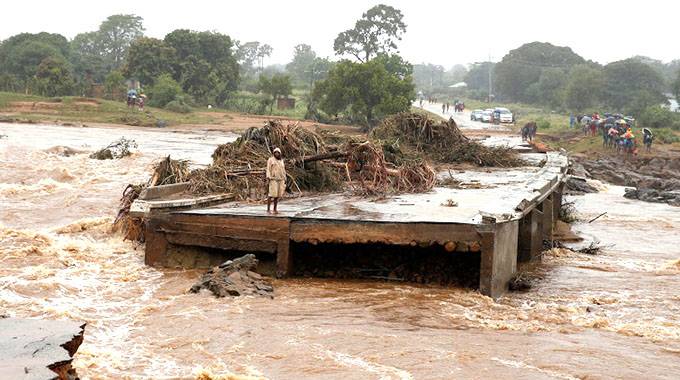
Source: Cyclone Idai hits Manicaland business | The Herald March 28, 2019 Cletus Mushanawani in Chimanimani THE devastating Cyclone Idai has affected Manicaland’s agro-based industry thereby reducing exports, while players in the small to medium enterprises sector were either forced to close shop or downscale operations. The most affected big players include Border Timbers, Wattle […]

The post Cyclone Idai hits Manicaland business appeared first on Zimbabwe Situation.

Source: Cyclone Idai hits Manicaland business | The Herald March 28, 2019

Cyclone Idai hits Manicaland business

Cletus Mushanawani in Chimanimani
THE devastating Cyclone Idai has affected Manicaland’s agro-based industry thereby reducing exports, while players in the small to medium enterprises sector were either forced to close shop or downscale operations.

The most affected big players include Border Timbers, Wattle Company, Allied Timbers, Tanganda, Matanuska, and Manica Boards and Doors as some of them could not access their premisses or raw materials as the roads remain unusable.

Confederation of Zimbabwe Industries’ Manicaland Chapter president, Mr Remington Mpande, said: “Most companies in Chimanimani and Chipinge are currently not able to access their facilitation in terms of outcome and outgoing logistics. Some are still to resume operations a fortnight after the devastating cyclone.

“This has affected the export market as the bulk of the companies are agro-based that produces for that particular market.

“Other companies like Manica Boards and Doors that depend on raw materials from the affected areas were not able to access timber. This slowed down all business operations.

“We are still quantifying the losses,” he said.

Mr Mpande said the damage of the Beira Corridor also had negative effects on businesses in Manicaland.

“We depend so much on the Beira Road and railway line and their closure affected operations. We are happy that the Beira Road has since been repaired, while activity is now up along Mutare and Chimoio railway line,” he said.

Mr Mpande said as the business community they were among the first to react to the national distress call to assist the affected communities.

“As the business community, we played our part by making contributions in cash and kind towards the relief programme. The timber companies were the first at the scene to clear roads. We will also play our part in the reconstruction process,” he said.

For the SMEs, most of them are feeling the brunt as some lost their wares and tools of the trade.

A food vendor at Tanganda Halt in Chipinge, Ms Tatenda Mhlanga, said all her cooking utensils, benches, shed and stocks were swept away by the flooded Tanganda River.

“We were the most affected. We are also lucky to be alive as the flooded river destroyed the room where we were sleeping in. The river burst its banks and water flooded this business centre.

“Everything that we had worked for all these years was swept away. I lost my kitchen utensils and benches.

“All stocks were also gone and we are now using makeshift structures. Business is now low because people are no longer coming as they used to do because the bridge linking this part and the main road to either Chipinge town or Chiredzi was swept away,” she said.

A bartender, Ms Melody Mhlanga, said their bottle-store was flooded and this damaged all their electrical appliances.

“Two of our deep freezers were badly damaged. We are now putting all our beer stocks in a chiller and this is affecting the temperatures as some people prefer ice-cold beer.

“Some of perishable stocks were also affected. Restocking is now a challenge as some of the money is now being diverted towards repairs,” she said.

A vendor and a mother of three young boys at Skyline Junction in Chimanimani, Ms Sibongile Mapatire, said she was now surviving on hand-outs from well-wishers as she lost her source of income.

“I am into vending because I want the best for my boys. I used to get my supplies from Nyanga, but since the roads are impassable I am grounded here.

“It is now expensive to be in this line of business as one has to travel via Chipinge. The transport costs are exorbitant.

“All my wares were swept away and I don’t have anywhere to start from. My savings were also washed away as we had to abandon our homes to higher grounds as the mudslide was wreaking havoc at our homesteads. Most of what we used to call home is now rubble,” she said.

A pirate taxi driver at Wengezi, Mr Tawanda Musarira, said the damaged bridges along the Mutare-Chimanimani Road had badly affected them.

“People have been forced to reschedule their travelling plans as they now being have to pay three times more than the normal price.

“We hope the situation will be addressed urgently because we are spending most of the time idle and counting our losses,” he said.

The post Cyclone Idai hits Manicaland business appeared first on Zimbabwe Situation.

Zim, Zambia JPC opens 

Source: Zim, Zambia JPC opens | The Herald March 28, 2019 Mr Martin Rushwaya Zvamaida Murwira  in VICTORIA FALLS Defence and War Veterans Affairs Minister Oppah Muchinguri-Kashiri and her Zambian counterpart Mr Stephen Kampyongo are today expected to officially open the 32nd Session of the Zimbabwe-Zambia Joint Permanent Commission on Defence and Security aimed at […]

The post Zim, Zambia JPC opens  appeared first on Zimbabwe Situation.

Source: Zim, Zambia JPC opens | The Herald March 28, 2019

Zim, Zambia JPC opensMr Martin Rushwaya

Zvamaida Murwira  in VICTORIA FALLS
Defence and War Veterans Affairs Minister Oppah Muchinguri-Kashiri and her Zambian counterpart Mr Stephen Kampyongo are today expected to officially open the 32nd Session of the Zimbabwe-Zambia Joint Permanent Commission on Defence and Security aimed at deepening collaborations and containing security threats.

Officials from the two countries led by Zimbabwe’s Secretary for Defence and War Veterans Mr Martin Rushwaya and his counterpart from Lusaka, Mr Stardy Mwale held closed door meetings on Tuesday and yesterday.

Service chiefs from the two countries are also attending the Joint Permanent Commission which started on Tuesday.

Zimbabwe Defence Forces Commander, General Philip Valerio Sibanda, Police Commissioner-General Godwin Matanga and Deputy Director-General in the President’s Office, Mr Aaron Nhepera are also in attendance.

According to the programme, Minister Muchinguri-Kashiri and Mr Kampyongo will officially open the meeting.

It will be followed by closed deliberations before a communiqué is  issued.

The two countries are discussing an array of security issues affecting the two countries and how security threats could be prevented, detected and contained.

In his speech on Tuesday, Mr Rushwaya called for stronger cooperation in combating security threats facing the two nations.

Mr Rushwaya said the meeting offered a platform to deepen bilateral relations in areas of defence and security.

“The defence and security meetings provide us an important platform to exchange notes and pave way for stronger cooperation in combating the common security threats that confront, not only our two countries, but the entire Sadc region and the African continent,” said Mr Rushwaya.

“These threats continue to evolve, riding on the exponential growth in information and communication technology and the accelerated pace of globalisation.

“This is leading to a rise in transitional organised crime and as such, the need for stronger bilateral and multilateral defence and security cooperation can never be overemphasised.”

He said the influx of irregular migrants, particularly from the Great Lakes Region and the Horn of Africa, poaching of wildlife heritage and smuggling were some of major security challenges facing the region.

In his remarks, Mr Mwale said defence and security services personnel from the two counties should continue to explore more areas of cooperation and ensured continued peace and security not only along the common border, but also within the two countries.

He bemoaned the effects of Cyclone Idai that affected Zimbabwe, Malawi and Mozambique and killed hundreds of lives and a trail of destruction saying that was the effects of climate change which has not spared Africa.

“Our continued interaction between our defence and security institutions accords us an opportunity to find ways of addressing effects of such calamities and other matters of concern,” said Mr Mwale.


The post Zim, Zambia JPC opens  appeared first on Zimbabwe Situation.