Fuel crisis hurts business: Mudenda

Source: Fuel crisis hurts business: Mudenda | Newsday (News) BY VENERANDA LANGA SPEAKER of the National Assembly Jacob Mudenda on Friday said the resurfacing of fuel queues and electricity outages were symptomatic of challenges in the energy sector, which must be urgently resolved because they were inconsistent with government’s thrust of enhancing the ease of […]

The post Fuel crisis hurts business: Mudenda appeared first on Zimbabwe Situation.

Source: Fuel crisis hurts business: Mudenda | Newsday (News)

BY VENERANDA LANGA

SPEAKER of the National Assembly Jacob Mudenda on Friday said the resurfacing of fuel queues and electricity outages were symptomatic of challenges in the energy sector, which must be urgently resolved because they were inconsistent with government’s thrust of enhancing the ease of doing business.

Mudenda said this while officially opening an induction workshop for members of the Parliamentary Portfolio Committee on Energy in Kadoma. The workshop aims to capacitate MPs on the operations of the energy sector so that they effectively provide oversight over it.

“The reliability of energy supply in Zimbabwe is cause for grave concern as the country generates far less than its optimum requirements and this retards socio-economic development as more often than not frequent blackouts are experienced, leading to diminished economic activity and household comfort,” Mudenda said.

“This is certainly not consistent with the thrust to enhance the ease of doing business in Zimbabwe.

“Relatedly, the resurfacing of petrol and diesel queues was symptomatic of deep-rooted challenges in the energy sector, and as such the Energy Parliamentary Portfolio Committee should leave no stone unturned as it entangles the energy conundrum in Zimbabwe,” he said.

Mudenda said many productive hours were being lost as people spend endless hours queuing for fuel.

“The energy committee’s reports and recommendations, therein, must lead the process of identifying solutions that will close the energy gap in Zimbabwe. Parliament’s role is to ensure that sound policies are in place to attract the much-needed investment in the energy sector.”

The Speaker said the committee should drive the clean energy agenda which compels countries to migrate to carbon neutral and clean energy sources such as solar and wind energy.

He said unsustainable energy production practices fuel climate change which in turn threatens the capacity to generate more energy.

Mudenda said the energy sector was one of the major drivers of greenhouse gas emissions that lead to climate change and pollution.

“There is no State institution that should not be accountable to Parliament. This means, therefore, that this committee must ensure that all State institutions involved in the energy sector act constitutionally and in the national interest,” Mudenda said.

Chairperson of the energy committee Joel Gabuzza told NewsDay that while the fuel port and pipeline in Beira, Mozambique, was damaged, Zimbabwe was still assessing the damage in terms of fuel supplies to the country.

“Three days ago, the energy committee visited NOIC (National Oil Company of Zimbabwe) fuel tanks and we were told that there is enough fuel stored in the tanks and that we will be able to survive. It is just an issue of fuel companies getting enough foreign currency to purchase the fuel which could be the bottleneck,” Gabuzza said.

The post Fuel crisis hurts business: Mudenda appeared first on NewsDay Zimbabwe.

The post Fuel crisis hurts business: Mudenda appeared first on Zimbabwe Situation.

Govt set to ferry fuel by road 

Source: Govt set to ferry fuel by road – NewsDay Zimbabwe March 25, 2019 BY TATIRA ZWINOIRA GOVERNMENT is considering bringing in fuel by road after Cyclone Idai flattened Mozambique’s port city of Beira linking the country’s fuel pipeline. The port, which houses the control room which pumps fuel into the pipeline, was the worst […]

The post Govt set to ferry fuel by road  appeared first on Zimbabwe Situation.
Source: Govt set to ferry fuel by road – NewsDay Zimbabwe March 25, 2019

BY TATIRA ZWINOIRA

GOVERNMENT is considering bringing in fuel by road after Cyclone Idai flattened Mozambique’s port city of Beira linking the country’s fuel pipeline.

The port, which houses the control room which pumps fuel into the pipeline, was the worst affected with reports suggesting that more than 90% of the city had been destroyed when the tropical storm made landfall on March 14.

As a result, fuel supplies to Zimbabwe via the pipeline have been suspended causing supply gaps and long queues at service stations.

Cyclone Idai left a trail of destruction and killed hundreds of people in Zimbabwe, Mozambique and Malawi.

“The pipeline has not been affected, it is intact. The pipeline itself has not been affected. What has been affected on the Beira side is the pump station to pump the fuel into the pipeline, which is why I am saying they are now working on something there. But, we as government we are not just sitting…” Ministry of Energy and Power Development acting permanent secretary Benson Munyaradzi told NewsDay, at the weekend.

“. . . but in case the damage was very severe and at this moment they (Companhiado De Pipeline Mozambique-Zimbabwe (CPMZ)) are still analysing, we are already working on other means of bringing in fuel. For example, you know that you can bring in fuel by road?”

Mozambique operates the CPMZ pipeline from the coastal town of Beira to Feruka in Mutare while the National Oil and Infrastructure Company operates the Feruka Pipeline from Mutare to Mabvuku or Msasa depots in Harare.

“We, as ministry, are in constant contact with CPMZ, who are managing the pipeline from Mozambique to Zimbabwe as well as the pumping station from Beira. The pump station was affected, but I think it was only the control room that was affected a bit, but within the next week they (CPMZ) would have resumed pumping,” he said.

Despite the apparent shortages, authorities in Zimbabwe still insist that the country has enough fuel stocks.

The post Govt set to ferry fuel by road  appeared first on Zimbabwe Situation.
Woman who died in stampede at National Sports Stadium identified (PICS & VIDEO)

The Warriors fan who died at National Sports Stadium in Harare just before the match between Zimbabwe and Congo Brazzaville yesterday has been identified Mai Tadiwa. She was based in Mutare and was also a CAPS United supporter. Mai Tadiwa died in the p…

The Warriors fan who died at National Sports Stadium in Harare just before the match between Zimbabwe and Congo Brazzaville yesterday has been identified Mai Tadiwa. She was based in Mutare and was also a CAPS United supporter. Mai Tadiwa died in the presence of her husband, who she had invited all the way from […]

Cyclone Idai Victims Appeal to Zimbabwean Government for Relief

Emergency workers call the flooding the region’s most destructive in 20 years Source: Cyclone Idai Victims Appeal to Zimbabwean Government for Relief – VOA A family in Chimanimani digs, March 22, 2019, without protective clothing, for their missing 17-year-old nephew after Cyclone Idai hit the area. The body was found late Friday a week after […]

The post Cyclone Idai Victims Appeal to Zimbabwean Government for Relief appeared first on Zimbabwe Situation.
Emergency workers call the flooding the region’s most destructive in 20 years

Source: Cyclone Idai Victims Appeal to Zimbabwean Government for Relief – VOA

A family in Chimanimani digs, March 22, 2019, without protective clothing, for their missing 17-year-old nephew after Cyclone Idai hit the area. The body was found late Friday a week after he was trapped in his bedroom while asleep.

A family in Chimanimani digs, March 22, 2019, without protective clothing, for their missing 17-year-old nephew after Cyclone Idai hit the area. The body was found late Friday a week after he was trapped in his bedroom while asleep.

The Zimbabwean government says it is appealing to the international community for help with medicine, food and infrastructure, as victims of Cyclone Idai push for expedited aid.Better Mungana’s father died and his cousin went missing when the cyclone hit Zimbabwe, Malawi and Mozambique last week. Mungana, of the hard-hit city of Chimanimani, wants President Emmerson Mnangagwa’s government to assist him and his family.

WATCH: Cyclone Idai Victims Appeal for Quick Relief

“Since Cyclone Idai, we are struggling to have food, our clothes were washed away, so we are wondering what to do,” he said. “The government promised to assist us with shelter, but it seems that help will come even to those who never lost anything. I lost my father, we are still looking for my cousin. It is painful. We have no shelter and no food.”

The body was recovered and buried late Friday, but food and shelter remain scarce.

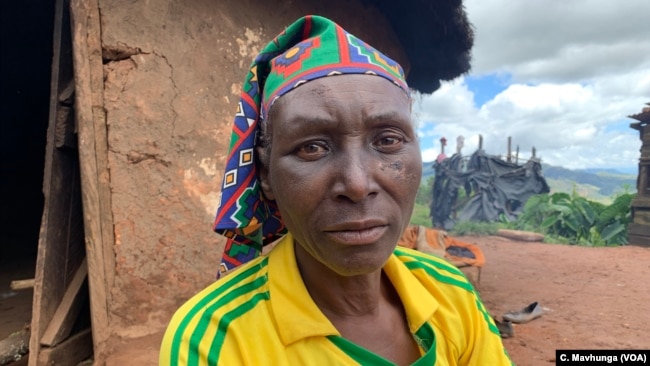
Anne Dube-Magoso in Chimanimani, March 22, 2019, was lucky to escape alive, but with several injuries, when her family's house collapsed during the cyclone March 16. But her 83-year-old father was suffocated.
Anne Dube-Magoso in Chimanimani, March 22, 2019, was lucky to escape alive, but with several injuries, when her family’s house collapsed during the cyclone March 16. But her 83-year-old father was suffocated.

It is the same for the Dube-Magoso family about 500 meters away. Their 83-year-old father died when their house collapsed during the cyclone; their mother escaped, but suffered several injuries.

Their son, Musavengana Dube Magoso, says they want the Zimbabwe government chip in.

“The government must look for a better place to resettle us so that we can get some income to ensure the remaining get some source of livelihood,” he said. “So far, we have no food — all we have planted to get food was washed away by the rains. We have been reduced to zero.”

Emergency workers have described the flooding after Cyclone Idai as the region’s most destructive in 20 years.

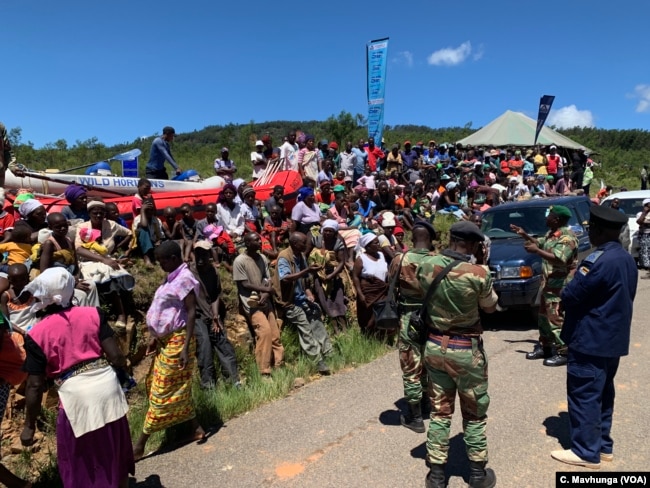
People in Chimanimani complain, March 22, 2019, to senior army officials in charge of a temporary camp set up after Cyclone Idai that food is not reaching them.

Zimbabwe’s government says it is having trouble keeping track of the death toll; it says the number is now “over 100.”

It also cannot meet the demand for medicine, food and other essentials.

Visiting the area, July Moyo, Zimbabwe’s minister of local government, says the international community can assist in the areas of need.

“The commanders are telling me that they are retrieving people being buried everywhere,” July said. “We understand that some of them were swept away into Mozambique. We will be checking to see what we can do to retrieve those. We are dropping medicines so that we do not have more [people] dying. We have moved food that is in Mutare [the region’s biggest city] to forward places so that we can start moving along roads that are now passable.”

Mnangagwa has declared Saturday and Sunday days of mourning for the victims of Cyclone Idai.

The post Cyclone Idai Victims Appeal to Zimbabwean Government for Relief appeared first on Zimbabwe Situation.

How we can minimise future cyclone damage 

Source: How we can minimise future cyclone damage – NewsDay Zimbabwe March 25, 2019 develop me: Tapiwa Gomo Zimbabwe, like its neighbours Mozambique and Malawi, is reeling from the effects of Cyclone Idai, which caused loss of lives and left a trail of destruction. For once, for a nation that has become inherently politically polarised, […]

The post How we can minimise future cyclone damage  appeared first on Zimbabwe Situation.

Source: How we can minimise future cyclone damage – NewsDay Zimbabwe March 25, 2019

develop me: Tapiwa Gomo

Zimbabwe, like its neighbours Mozambique and Malawi, is reeling from the effects of Cyclone Idai, which caused loss of lives and left a trail of destruction. For once, for a nation that has become inherently politically polarised, we were united by one cause – to help those affected by the cyclone. In the midst of mourning, this has brought a rare and renewed sense of unity.

It is very rare to see various groups from different walks of life converging, mobilising and ensuring that those in need of assistance received it. There will be loopholes and a few misguided opportunists who may want to take advantage of the situation. But the spirit of togetherness demonstrated by Zimbabweans so far is highly commendable.

As the country begins to count the costs, the million-dollar question is what could have been done right to minimise the impact of the cyclone? It is not an easy question to answer for countries that are resource and technologically challenged such as Zimbabwe. While we know that the most recent devastating cyclones in southern Africa occurred between February and March in the recent decades, tropical cyclones historically have a reputation of being unpredictable, which makes it even harder to forecast their routes and intensity.

And in the recent case, no one had an idea that Cyclone Idai would be regarded as one of the long-lived and worst tropical cyclones to affect Africa and the southern hemisphere, considering how it mutated over a period of 10 days.

It was on March 4 that Cyclone Idai began forming as a tropical depression off the eastern coast of Mozambique. The depression re-emerged on March 9 in the Mozambique channel before upgrading into moderate tropical storm the following day, but continued to intensify reaching a wind speed of 175km/hour on March 11. If, by this time, its direction and intensity were clear, perhaps early warning systems would have been triggered. But again, most of these storms form and dissipate in the oceans without causing any harm.

Between March 11 and 13, it weakened again and remained stagnant, which meant that there was no cause for concern. It was on March 14 that Cyclone Idai gained momentum and reached its peak intensity with a wind speed of 195km/hour, making a landfall in Beira on March 14, causing catastrophic damage in Malawi, Mozambique and Zimbabwe, leaving hundreds of people dead and hundreds more missing. There was no time to raise the alarm in those areas in Malawi and Zimbabwe, bordering Mozambique as the cyclone hit almost simultaneously.

But in Australia, they were able to minimise the damage after the Australia government evacuated thousands of people from the northern parts of the country ahead of two cyclones — Trevor and Veronica — that were expected to hit last weekend. In those two days before the cyclones made landfalls, the Australian authorities were able to save lives and minimise the damage to property. All the cyclone preparedness was done when both air and road transport were still usable and safe. The evacuees were being moved to higher and safer places.

This brings us back 19 years ago when Cyclone Eline hit Mozambique, Zimbabwe, and South Africa in March 2000, leaving another trail of destruction and loss of lives. Due to its colossal impact, it attracted international and global media attention. Several academic studies have been conducted after the impact of Cyclone Eline caused human suffering, but most importantly it was the huge donor investment into cyclone preparedness and early warning systems. One wonders what happened to those efforts.

Given the unpredictable nature of cyclones, the concept of preparedness, back then, was premised on various models. The first model was that the southern Africa region experiences major cyclones every eight to ten years and communities in cyclone-prone areas were asked to factor that into their planning. The second model was that communities needed to build houses and structures that can withstand the vagaries of cyclones and flooding. During the various awareness campaigns, this was considered the least safe, but more convenient to cultural considerations as some of the communities refused to relocate for several reasons, including looking after their land, property and ancestors’ graves.

The most effective model which should have been triggered — only if there was enough lead time — was that in the event of a cyclone early warning sign, communities through their leadership were supposed to move to higher ground. This was one of the most popular models during the post-Cyclone Eline awareness campaigns as the Department of Civil Protection was heavily involved in it, including making recommendations to their parent Ministry of Local Government for resettlement and encourage communities to build their houses on higher ground. While community leaders mobilised people to move, the co-ordination of the operation was done by a district level taskforce, comprising of different arms of government. This taskforce replicated the national inter-ministerial taskforce on disaster preparedness and management. The co-ordination then was much stronger and effective.

The post How we can minimise future cyclone damage  appeared first on Zimbabwe Situation.