Killing “the farmer” that grows the golden leaf 

Source: Killing “the farmer” that grows the golden leaf – NewsDay Zimbabwe March 22, 2019 Editorial Comment EVERY year around this time, a hype of activity characterises the economy as our hard-working farmers ship to the market the country’s most valuable export crop — tobacco. Ever since the crop started being commercially grown 109 years […]

The post Killing “the farmer” that grows the golden leaf  appeared first on Zimbabwe Situation.

Source: Killing “the farmer” that grows the golden leaf – NewsDay Zimbabwe March 22, 2019

Editorial Comment

EVERY year around this time, a hype of activity characterises the economy as our hard-working farmers ship to the market the country’s most valuable export crop — tobacco. Ever since the crop started being commercially grown 109 years ago, it has deservedly earned the name Golden Leaf because it has sustained Zimbabwe’s economy in good and bad times.

For most of the past century the crop has, however, been grown commercially by mainly white farmers despite the fact that the white farmers, who settled here in the 1880s, found indigenous people already growing the crop which they called Nyoka. The invading colonialists saw great value in this crop and never shared the secret for generations.

Fortunately, as fate would have it, the indigenous population finally became independent from colonial rule in 1980. And since then, black farmers have been slowly waking up and warming up to the lucrative tobacco growing business to a point where today, the country is Africa’s biggest producer of tobacco, with more than 100 000 farmers now tilling the leaf. In 2000, only 1 500 farmers were commercially growing the crop, and that number rose to nearly 170 000 for the current season. In 2016 alone, the farmers generated nearly a billion dollars in foreign currency.

Despite the obvious priceless significance of this group of people to our very survival, the government of the day appears to be unaware of their importance. After promising to pay golden leaf producers at 50% hard currency and 50% local currency, our most able government has decided to pay them 100% in local currency. Our government has told the farmers that if they want the hard currency that they have generated themselves, they will have to buy it at the prevailing 1:2,75 to the US dollar rate. Please pardon us for expressing our utter disgust at this ludicrous arrangement. This is absolute nonsense!

How can government expect someone to buy back money they have sweated for, at whatever rate for that matter? This arrangement sounds like daylight robbery and is so grossly unfair to the extent that this will effectively kill the goose that has been laying the golden eggs for the country all these past decades. Honestly, how will these farmers be motivated to grow the crop next season if they are being forced to buy back money they have devotedly earned? Even then, they are compelled to produce foreign invoices to prove that they need the money! What chicanery is this?

It becomes quite difficult for some of us to understand the logic behind government’s brazen about turn. In our view, that is literally stabbing the farmers in the back. If the government had at least reconfigured the payment arrangement to maybe 40% hard currency and 60% local currency, we may have understood that they desperately need the foreign currency to patch up the tattered economy. But grabbing everything that the farmers have sweated for and asking them to buy it back extinguishes all the goodwill the farmers may have had.

The post Killing “the farmer” that grows the golden leaf  appeared first on Zimbabwe Situation.

Cyclone Idai rescue mission makes progress

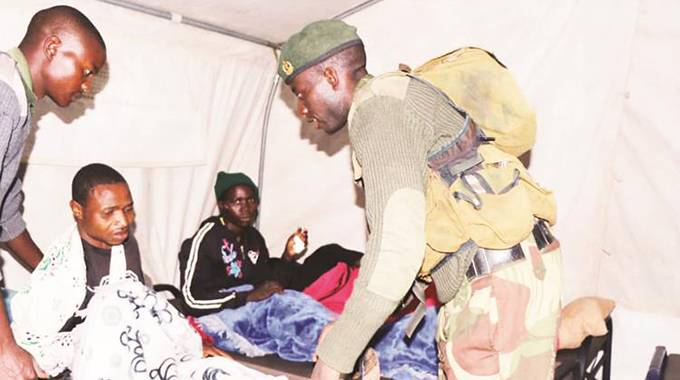
Source: Cyclone Idai rescue mission makes progress | The Herald March 22, 2019 Cyclone Idai victims being attended to by members of the uniformed forces Cletus Mushanawani in Chimanimani THE Cyclone Idai rescue mission has made significant progress in clearing some of the blocked roads to pave way for easy distribution of relief aid to […]

The post Cyclone Idai rescue mission makes progress appeared first on Zimbabwe Situation.

Source: Cyclone Idai rescue mission makes progress | The Herald March 22, 2019

Cyclone Idai rescue mission makes progress
Cyclone Idai victims being attended to by members of the uniformed forces

Cletus Mushanawani in Chimanimani
THE Cyclone Idai rescue mission has made significant progress in clearing some of the blocked roads to pave way for easy distribution of relief aid to affected families.

In an interview at Skyline Junction yesterday, 3 Infantry Battalion public relations officer Major Exavier Chibasa said yesterday they airlifted supplies to affected boarding schools whose supply line was cut after bridges were washed away by the floods.

“Schools like Mutambara, Lydia Chimonyo and Biriiri are no longer accessible by road after two bridges were washed away by Umvumvumvu River and are having challenges accessing basic commodities.

“We airlifted basic commodities to these schools. This is also applying to some areas like Ngangu and Vimba which are still not accessible by road,” he said.

Eight helicopters, two from the Air Force of Zimbabwe and six from private companies are leading in the rescue and relief distribution efforts.

Major Chibasa said the search and recovery efforts were progressing well as the rains have since stopped.

“All critical cases are being attended to as soon as we get reports. Some of the critical ones are being airlifted to Mutambara Mission Hospital and Chipinge District Hospital,” he said.

Major Chibasa said more bodies of the victims were being recovered each day.

“Although the actual number of bodies recovered is still to be verified, over 145 bodies have been recovered in Ngangu, Vimba and Rusitu.

“Three bodies were recovered in Nyanyadzi today (yesterday). The three were identified as the passengers who were on board the Trip-Trans bus what was swept away at Skyline.

“All areas that were affected by the floods need visiting for evacuation purposes. Our members will remain on the ground working with the local communities to accord the deceased ones a decent burial,” he said.

Major Chibasa said some relief stocks had now arrived in Chipinge, but could not be transported to most areas because of the poor state of the roads.

Yesterday, Zimbabwe Defence Forces Commander General Phillip Velario Sibanda and popular musician Jah Prayzah also visited Skyline.

Jah Prayzah also donated towards the Cyclone Idai victims.

The post Cyclone Idai rescue mission makes progress appeared first on Zimbabwe Situation.

PICS: Six days after Cyclone Idai, 15,000 people still stuck in trees, on rooftops 

Source: PICS: Six days after Cyclone Idai, 15,000 people still stuck in trees, on rooftops – The Citizen Residents stand on rooftops in a flooded area of Buzi, central Mozambique, on March 20, 2019, after the passage of Cyclone Idai. Picture: ADRIEN BARBIER / AFP ‘The situation is very bad, we haven’t eaten since Thursday, […]

The post PICS: Six days after Cyclone Idai, 15,000 people still stuck in trees, on rooftops  appeared first on Zimbabwe Situation.

Source: PICS: Six days after Cyclone Idai, 15,000 people still stuck in trees, on rooftops – The Citizen

Residents stand on rooftops in a flooded area of Buzi, central Mozambique, on March 20, 2019, after the passage of Cyclone Idai. Picture: ADRIEN BARBIER / AFP

Residents stand on rooftops in a flooded area of Buzi, central Mozambique, on March 20, 2019, after the passage of Cyclone Idai. Picture: ADRIEN BARBIER / AFP

‘The situation is very bad, we haven’t eaten since Thursday, until today. We are sleeping outside, everything is destroyed,’ said a survivor in Mozambique.

A cyclone that ravaged three southern African countries last week has officially killed at least 350 people, affected more than 1.7 million others and left 15,000 people still stranded by floods, according to estimates today.

As the toll surged from the region’s biggest storm in years, the World Health Organization (WHO) announced plans to tackle an emerging threat to survivors from malaria and cholera.

An Oryx helicopter from the SANDF (South African National Defence Forces) flies during an air relief drop mission over the flooded area around Beira, central Mozambique, on March 20, 2019. Picture: MARYKE VERMAAK / AFP

Cyclone Idai smashed into the coast of central Mozambique last Friday, unleashing hurricane-force winds and rains that flooded the hinterland and drenched eastern Zimbabwe.

Mozambican Land and Environmental Minister Celso Correia said 217 lives had been lost and 15,000 out of 18,000 stranded people still needed to be saved.

This handout satellite image from Copernicus Sentinel-1 and released by the European Space Agency (ESA) on March 20, 2019 shows the extent of flooding, depicted in red, around the port town on Beira in Mozambique on March 19, 2019 as Tropical Cyclone Idai cut a swathe through Mozambique, Zimbabwe and Malawi. Picture: AFP PHOTO / EUROPEAN SPACE AGENCY/ COPERNICUS SENTINEL

“Yesterday we had counted 15,000 people that still need rescue today — 15,000 people who are in bad shape. They are alive, we are communicating with them, delivering food, but we need to rescue them and take them out,” he told reporters.

A total of 65,000 people are in transit centres, he said.

“Our priority now is to make sure we take food, shelter and medicine to the people that are isolated in small islands or in big islands and villages,” Correia said at Beira airport, the humanitarian relief coordination hub.

SANDF (South Africa Defence Forces) personnel deliver relief aid in Buzi, central Mozambique, on March 20, 2019 after the passage of Cyclone Idai. Picture: ADRIEN BARBIER / AFP

World Food Programme (WFP) spokesman Herve Verhoosel said the number of people affected in Mozambique was 600,000, but warned: “That number will definitely go up.”

Ultimately, around 1.7 million people in Mozambique will need assistance, Verhoosel said in Geneva.

In Zimbabwe, state broadcaster ZBC said the death toll had risen to 139, up from 100 on Wednesday, while the WFP said its estimates of the number of people there affected by the cyclone had jumped from 15,000 to 200,000.

Families conduct traditional rituals on March 20, 2019 at the mass grave site of victims of Cyclone Idai that hit Ngangu, a township of Chimanimani, Zimbabwe. Picture: ZINYANGE AUNTONY / AFP

In Chimanimani, close to Zimbabwe’s border with Mozambique, “some 90 percent of the district has been significantly damaged,” Verhoosel said.

An AFP reporter in the area said the district had been cut off.

Roads had been gobbled up by massive sinkholes and bridges ripped to shreds by flash floods — a landscape that Zimbabwe’s acting defence minister Perrance Shiri, who is also agriculture minister, said “resembles the aftermath of a full-scale war”.

Soldiers help residents retrieve their lost belongings on March 19, 2019 in Chimanimani as the military was deployed to assist civilians, after the area was hit by the Cyclone Idai. Picture: ZINYANGE AUNTONY / AFP

Families on Wednesday were using hoes to dig through mounds of soil in search of their missing relatives, the reporter saw.

In Malawi, the WHO said on Wednesday, the storm had affected 922,000 others, of whom 82,000 had been displaced.

The WHO announced an emergency plan for 10,000 people.

“The displacement of large numbers of people and the flooding triggered by Cyclone Idai significantly increases the risk of malaria, typhoid and cholera,” said Matshidiso Moeti, the agency’s regional director for Africa.

People carry the coffin of Tomas Joaquim Chimukme during his funeral, after his home collapsed following a strong cyclone that hit Beira, Mozambique, on March 20, 2019. Picture: Yasuyoshi CHIBA / AFP

The three countries are some of the poorest in the region and depend heavily on foreign aid.

The UN launched an appeal for assistance overnight.

“We do not yet know enough about the level of destruction to give an accurate estimate of the amount of this call for funds, but it will be important,” spokesman Farhan Haq said at UN headquarters in New York.

Aid agencies said they were prepared for the cyclone which made landfall early Friday, but not for the massive floods that followed.

A man with an injured foot arrives at a temporary medical treatment camp after he was rescued and airlifted by helicopter by the Air Force of Zimbabwe in Chimanimani, on March 20, 2019 following the devastation caused by Cyclone Idai. Picture: Jekesai NJIKIZANA / AFP

Mozambique bore the brunt from rivers that flow downstream from its neighbours.

Air force personnel from Mozambique and South Africa have been drafted in to fly rescue missions and distribute aid in central Mozambique.

Roads out of Beira have been destroyed and the city itself, home to around half a million people, has been 90-percent damaged or destroyed.

Residents gather stranded on the stands of a stadium in a flooded area of Buzi, central Mozambique, on March 20, 2019, after the passage of Cyclone Idai. Picture: ADRIEN BARBIER / AFP

Perched on the terraces of a sports stadium, scores of marooned people stare down at a basketball court filled with dirty brown water.

Six days after a vicious tropical storm tore through their neighbourhood in Buzi, central Mozambique, they remain trapped by flood water.

A short distance away, another group is huddled together under an orange garden umbrella, on the roof of a church.

Stranded residents are desperate to be evacuated, but food and clean water are even more pressing needs.

People take part in the looting sacks of Chinese rice printed “China Aid” from a warehouse which is surrounded by water after cyclone hit in Beira, Mozambique, on March 20, 2019. Picture: Yasuyoshi CHIBA / AFP

“The situation is very bad, we haven’t eaten since Thursday, until today. We are sleeping outside, everything is destroyed, our houses are destroyed, everything is gone, we have recovered nothing,” said Aunicia Jose, 24, speaking in Gwara-Gwara, near Buzi.

A mob of villagers rushed to an open space where a helicopter had just dropped food, an AFP reporter saw.

Joel Baertschi, a chopper pilot for a Christian humanitarian group, told AFP his organisation had flown in tonnes of food, sometimes plucking people from treetops and roofs, and was now setting up a camp for survivors.

Patients sit inside an ambulance after receiving medical assistance in a temporary treatment camp after they were rescued in Chimanimani, on March 20, 2019, following the devastation caused by Cyclone Idai. Picture: Jekesai NJIKIZANA / AFP

“We can tell clearly that there is a lot less water now. I reckon one to two metres (3.5 to seven feet) (down) although I am not an expert,” he said.

“When we first saw them on Monday, they were in water up to their necks.”

He added: “Most of them were on rooftops or gathered on trees huddling into each other and today we actually saw (some of) them walking in Buzi.

“Although the town is still flooded, it gives an indication that the water is going down and help will be easier to access the place.”

The post PICS: Six days after Cyclone Idai, 15,000 people still stuck in trees, on rooftops  appeared first on Zimbabwe Situation.

Idai death toll hits 139 in Zimbabwe, corpses allegedly floating into Mozambique 

Source: Idai death toll hits 139 in Zimbabwe, corpses allegedly floating into Mozambique – The Citizen Members of the rescue team offload a body retrieved from areas flooded in the aftermath of Cyclone Idai in Chimanimani, Zimbabwe, March 21, 2019. Picture: REUTERS / Philimon Bulawayo As the rescue efforts continue, Zimbabweans have come together to […]

The post Idai death toll hits 139 in Zimbabwe, corpses allegedly floating into Mozambique  appeared first on Zimbabwe Situation.

Source: Idai death toll hits 139 in Zimbabwe, corpses allegedly floating into Mozambique – The Citizen

Members of the rescue team offload a body retrieved from areas flooded in the aftermath of Cyclone Idai in Chimanimani, Zimbabwe, March 21, 2019. Picture: REUTERS / Philimon Bulawayo

Members of the rescue team offload a body retrieved from areas flooded in the aftermath of Cyclone Idai in Chimanimani, Zimbabwe, March 21, 2019. Picture: REUTERS / Philimon Bulawayo

As the rescue efforts continue, Zimbabweans have come together to mobilise aid for Idai victims.

The official death toll from Cyclone Idai has hit 139 in Zimbabwe, with fears that the figure could rise, as close to 200 people remain unaccounted for and over 100 are still marooned in the country’s two worst affected districts, Chipinge and Chimanimani.

According to official figures released by the information, media and broadcasting services ministry on Thursday afternoon, Chimanimani recorded the highest number of deaths, which stand at 127, while Chipinge recorded six.

One hundred and eighty-seven are reported missing in Chimanimani and two in Chipinge, while the number of those who remain marooned stands at 136 and three respectively.

Idai, which formed over the Mozambique Channel before moving inland via Beira on Thursday last week, has sparked a serious humanitarian crisis, as 4 313 people have been displaced, according to the ministry.

Chimanimani, being the hardest hit, has the highest number of displacements followed by Makoni, Buhera, Mutare rural, Mutasa and Mutare urban.

Three thousand and eighty-five people were displaced in Chimanimani’s ward 15, while 600, 529, 63, 45 and 31 were displaced in Makoni, Buhera, Mutare rural, Mutasa and Mutare urban respectively.

Local government and national housing minister July Moyo, who heads the inter-ministerial task force on Idai, told the media after Tuesday’s cabinet briefing that there are fears that the total number of dead could rise.

“There are reports that bodies believed to be from Zimbabwe have been seen floating in Mozambique,” he said.

“Some have floated all the way into Mozambique and some of the peasants in that country were calling some of our people saying ‘we see bodies, we believe those bodies are coming from Zimbabwe’”.

“The total number we were told there could be 100, some going as far as saying there could be 300, but we cannot confirm this situation. Our army is going on foot to Rusitu in order to go and assess the situation on the ground.”

As the rescue efforts continue, Zimbabweans have come together to mobilise aid for Idai victims.

President Emmerson Mnangagwa on Wednesday visited the victims and said it was impossible for aid to reach the affected because of the massive destruction of the provincial road network.

“The cyclone destroyed roads in this area and this means that aid can only come through using helicopters, but we have not been able to do so because of the weather,” he said while addressing victims at a safe house in Chimanimani.

“However, since it has cleared, you will be assisted with things like medication, food and other consumables.”

Of the deceased, 74 people have already been buried. Due to the inaccessibility of the area, locals had to use makeshift coffins as they laid to rest their loved ones.

However, Zimbabwe’s leading funeral insurance companies – Doves and Nyaradzo Funeral Services – have since chipped in to offer decent burials for the dead.

Across the border in Mozambique, according to the Red Cross, the cyclone destroyed 90% of the fourth-largest city, Beira, and submerged villages after the Pungue and Buzi rivers overflowed.

The post Idai death toll hits 139 in Zimbabwe, corpses allegedly floating into Mozambique  appeared first on Zimbabwe Situation.

Army to replace ED with military general in 2020, civilian leader to takeover in 2023: China told

A special delegation of senior military officials reportedly told Chinese generals that President Emmerson Mnangagwa’s political reign will expire in 2020, and that he was going to be an interim caretaker president up to the period, before the military…

A special delegation of senior military officials reportedly told Chinese generals that President Emmerson Mnangagwa's political reign will expire in 2020, and that he was going to be an interim caretaker president up to the period, before the military replaces him with their preferred successor, a few days prior to former leader Robert Mugabe's November […]