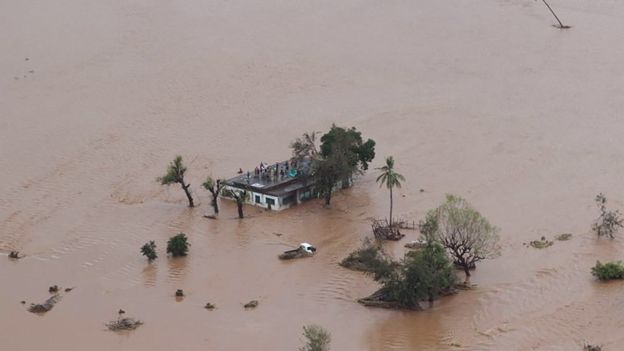
Cyclone Idai deaths: Lack of political will and poor preparedness 

Source: Cyclone Idai deaths: Lack of political will and poor preparedness – NewsDay Zimbabwe March 21, 2019 guest column: Gaylord Munemo The Department of Civil Protection (DCP) has been the main body mandated with the responsibility of setting up emergency plans from the national level. The department is housed and operates under the Local Government […]

The post Cyclone Idai deaths: Lack of political will and poor preparedness  appeared first on Zimbabwe Situation.

Source: Cyclone Idai deaths: Lack of political will and poor preparedness – NewsDay Zimbabwe March 21, 2019

guest column: Gaylord Munemo

The Department of Civil Protection (DCP) has been the main body mandated with the responsibility of setting up emergency plans from the national level.

The department is housed and operates under the Local Government ministry as the implementing body of national government-initiated disaster preparedness and mitigation programmes.

The department is responsible for conducting all national response efforts, based on the Civil Protection Act (2001, chapter 10:06).

Its primary mandate includes preparing for prevention where possible and mitigating the effects of disasters as they occur. Largely the department’s mandate is to encompass resource mobilisation in preparation for managing and responding to major events and disasters. In addition, the department is the centre for dissemination of information related to disasters.

In relation to Tropical Cyclone Idai, the role of the DCP, prior to the engaging of other stakeholders in a bid to rescue the trapped and assist the displaced through provision of substantial and incidental needs, was to avoid the trapping, displacement and injury of people forecasted in relation to the tropical cyclone.

Anyone who has understood emergency management will tell you that you prioritise emergence preparation through avoiding the effects of the emergency and this is done through vacating of people from hazardous zones to safe highland places after the forecast of a tropical cyclone.

Cyclone Idai cannot be equated to any other strong winds and heavy rains where the DCP can just broadcast text messages of warning and publicise cautions on visual, print and social media.

Understanding that this is forecasted as the deadliest cyclone in 2019, developing in category 3&4, with winds of 175 km/h, the department could have done better in engaging relevant stakeholders and proposing relocation of people ahead of time.

A mere warning and red alert caution to poverty-stricken rural dwellers is not sufficient for them to mobilise themselves and vacate the areas. Some of the Chimanimani dwellers did not even know about a cyclone coming because they don’t have access to social media and newspapers, let alone the money to vacate the area if they did know.

We might understand that Mozambique was the worst hit, but as emergency response specialists, we were aware that it was also going to hit the Eastern parts of our country.

After its identification by Meteo France on March 1, monitoring began and accurate forecast was given. It was on March 4 that the cyclone originated from a tropical depression that formed off the eastern coast of Mozambique. It is upon the knowledge of this forecast that our DCP should have jumped out of their leather chairs, establish effective emergency management protocols and disaster prevention mechanisms.

While we appreciate the efforts done to bury the deceased and give shelter and food to the displaced; more could have just been preventing this magnitude of death toll and displacement.

Mozambique was hit severely by the cyclone during its (the cyclone) most developed and strong stage for an area close to thirty times larger than ours, while we were only struck by the cyclone in its weakening stage but our death toll is above two thirds of Mozambique’s. You should digest about that.

What we need now are district, provincial and national leaders who engage in a progressive emergency management dialogue, whether the right-wing or the leftists; not Twitter pages flooded with selfies they are taking with the victims. Some of us were at the scenes before them, we could not even manage to have time for smiles and selfies, we expect better from them. This is not a time for political mileage and significance; this is a state of emergency.

The community has a role to play as well. The community has a central role in long and short-term disaster management. The focus of attention in disaster management must be the local community.

Furthermore, disaster risk or vulnerability reduction is the foundation of community-based disaster management; of which disaster risk reduction encompass disaster preparedness which can only be viable if there are leaders with the political will and a properly functional civil protection unit. Thus the primary context of disaster management activities revolves around reducing vulnerable conditions and the root causes of vulnerability. The primary strategies of vulnerability are by increasing a community’s capacities, resources and coping strategies.

Whether a disaster is a major or minor, of national or local proportion, it is the people at the community or village level who suffer most of its effects.

Therefore, they use coping and survival strategies to face and respond to the situation, before the interventions from outsiders.

The communities are eager to protect themselves from risks through community-based disaster preparedness and mitigation. This is only possible with leaders with the political will and a community-engaging civil protection unit. For a detailed narrative of effective emergency management, statistics and what could have been done, email me at the email below.

I want to conclude by saying; we expected better preparedness from our leaders and the ‘experts’ at the DCP. What this reflected was lack of political will and poor preparedness.

The post Cyclone Idai deaths: Lack of political will and poor preparedness  appeared first on Zimbabwe Situation.

E-governance to curb forex leakages in tourism sector

Source: E-governance to curb forex leakages in tourism sector | Newsday (News) BY WINSTONE ANTONIO/ FARAI MATIASHE ZIMBABWE Tourism Authority (ZTA) will tighten its monitoring of the sector to ensure more transparency as well as curb foreign currency leakages, an official has said. ZTA acting chief executive Rita Likukuma told NewsDay that government was adopting […]

The post E-governance to curb forex leakages in tourism sector appeared first on Zimbabwe Situation.

Source: E-governance to curb forex leakages in tourism sector | Newsday (News)

BY WINSTONE ANTONIO/ FARAI MATIASHE

ZIMBABWE Tourism Authority (ZTA) will tighten its monitoring of the sector to ensure more transparency as well as curb foreign currency leakages, an official has said.

ZTA acting chief executive Rita Likukuma told NewsDay that government was adopting e-governance systems in order to deal with revenue leakages.

“We work well with players in the tourism sector. Government has adopted e-governance as a management tool, so we are going to automate a lot of the systems, including revenue automated collection. That way, you take out any possible leakages if they were there and take (away) any unsubstantiated accusations,” she said.

“I want to try and deal with facts, and then also use systems to make sure that we manage the process without pointing fingers. So we are taking on board our stakeholders and players from a good faith point of view and then moving ahead on an automated system. It is something that we are already working on and hope to see coming into effect within the next three months.”

Meanwhile, ZTA has opened registration for this year’s edition of the Sanganai/Hlanganani World Tourism Expo set for September 12 to 14 in Bulawayo.

Likukuma said ZTA was looking forward to a bigger expo as they expected to host over 100 international buyers from various source markets across the globe.

“The 2018 edition of the Sanganai/Hlanganani World Tourism Expo registered 318 exhibitors and we envisage surpassing this given the interest that has come through from first time exhibitors. We want the 2019 edition to be bigger and better,” she said.

“The screening criteria for international buyers will be strict as our focus is to host buyers who are serious about bringing business to Zimbabwe and who also have the potential to invest in the tourism industry.”

She encouraged small-to-medium tourism operators and suppliers to register for the expo, adding that there was no small operator in tourism since everyone had a market to serve.

“I am appealing to every operator throughout the country to come out and take advantage of the fair. In order to give every operator an opportunity to meet with international buyers at Sanganai/Hlanganani, we will be offering a 10% discount to exhibitors who register at the ZTA stand during ZITF,” she said.

Likukuma said Sanganai/Hlanganani World Tourism Expo had contributed to the increase in numbers of tourist arrivals in the country.

“We want to get back to where young people used to be active in tourism. So we are looking at more activity from the youths. There is a lot of work that needs to done, but we need to persuade the people who support incomes and revenues for the younger generation, so that we can have those packages back. That way we can have more activity in domestic tourism,” she said.

“There is a lot of tourism going on and there are a number of people who want to hold conventions. Earlier on, we met a group of young people who said there were two conventions earmarked for this year. Then we are going to have many more other local groups enjoying our local tourism products.”

The post E-governance to curb forex leakages in tourism sector appeared first on NewsDay Zimbabwe.

The post E-governance to curb forex leakages in tourism sector appeared first on Zimbabwe Situation.

High Court lifts NGO suspension

Source: High Court lifts NGO suspension | Newsday (News) BY CHARLES LAITON/TATENDA CHITAGU HIGH Court judge Justice Loice Matanda-Moyo has nullified the suspension of Community Tolerance Reconciliation and Development Trust (Cotrad), a local youth non-governmental organisation (NGO), saying government action was illegal. Masvingo district administrator (DA) Roy Hove suspended the NGO on March 11, 2019 […]

The post High Court lifts NGO suspension appeared first on Zimbabwe Situation.

Source: High Court lifts NGO suspension | Newsday (News)

BY CHARLES LAITON/TATENDA CHITAGU

HIGH Court judge Justice Loice Matanda-Moyo has nullified the suspension of Community Tolerance Reconciliation and Development Trust (Cotrad), a local youth non-governmental organisation (NGO), saying government action was illegal.

Masvingo district administrator (DA) Roy Hove suspended the NGO on March 11, 2019 pending an investigation into its registration.

However, the NGO challenged the decision at the High Court, and Justice Matanda-Moyo yesterday upheld Cotrad’s application.

“The first respondent (DA)’s decision to suspend the first applicant (Cotrad)’s operations is set aside and declared to be null and void and accordingly of no force and effect. The first applicant is not a voluntary organisation as contemplated in terms of the Private Voluntary Organisation Act. The first respondent is not empowered by any law to suspend or stop the operations of the first applicant and the first respondent is ordered to pay the cost of this application on a legal practitioner and client scale,” Justice Matanda-Moyo said.

On Monday last week, the DA wrote a letter instructing Cotrad not to carry out any activities “of any kind” in the jurisdiction of Masvingo district until investigations on the registration and approval issues concerning the organisation had been carried out.

This prompted Cotrad to engage Denford Halimani of the Zimbabwe Lawyers for Human Rights to file an urgent chamber application at the High Court challenging the DA’s decision to outlaw the NGO’s operations and seeking an order to be allowed to resume full operations in Masvingo without any interference.

In the application, Halimani argued that the DA was not empowered by any law to suspend or stop Cotrad’s operations because it is not registered as a Private Voluntary Organisation (PVO), but as a Trust, created by a Notarial Deed of Donation and Trust, registered at the Deeds Registry.

The order compelling Cotrad, to cease operations had left over 5 000 underprivileged individuals prejudiced and without recourse and this included the organisation’s eight employees, he added.

Speaking to Southern Eye yesterday, Halimani said the judgment had set a legal precedent that will also protect other NGOs that may have been targeted by the authorities.

“This means that Cotrad is free to proceed with operations without any interference. It’s good news to other organisations that were at risk of facing such bans. It makes it clear that authorities cannot stop a legitimately registered trust, it was absurd and unlawful,” he said.

Cotrad programmes officer Brighton Ramusi said they felt elated by the decision and will continue to serve the more than 5 000 beneficiaries of their programmes.

“We welcome the lifting of the suspension. It is not only a relief to us, but also to our beneficiaries in the rural areas, who were prejudiced by the suspension. We are not at war with government, but we are actually complementing it,” Ramusi said.

Government accused Cotrad, formed in 2012 and largely involved in peace-building and national healing activities to mainly victims of political violence, of having a hand in the January bloody protests against a 150% fuel price hike.

The suspension came weeks after President Emmerson Mnangagwa addressed a rally in the province, where he threatened to come hard on lawyers, doctors and NGOs perceived to have backed the January protests over fuel price hikes.

Zanu PF has always accused civic organisations of being agents of opposition parties and perpetrating a regime change agenda.

The post High Court lifts NGO suspension appeared first on NewsDay Zimbabwe.

The post High Court lifts NGO suspension appeared first on Zimbabwe Situation.

Chaos as angry bouncer bashes sexy dancer Bev Sibanda for turning down his request

POPULAR dancer Beverly Sibanda and her manager Harpers Mapimhidze were left nursing injuries after they were assaulted by a bouncer at Peter Moyo’s show at a local bar Saturday night. They have since lodged a complaint with a police after they were rep…

POPULAR dancer Beverly Sibanda and her manager Harpers Mapimhidze were left nursing injuries after they were assaulted by a bouncer at Peter Moyo’s show at a local bar Saturday night. They have since lodged a complaint with a police after they were reportedly assaulted by the security personnel identified as Romeo who was manning the […]

Cyclone Idai: ‘Massive disaster’ in Mozambique and Zimbabwe 

Hundreds of thousands of people in Mozambique, Zimbabwe and Malawi could be affected, UN says. Source: Cyclone Idai: ‘Massive disaster’ in Mozambique and Zimbabwe – BBC News Cyclone Idai: Survivors rescued by land and air Cyclone Idai has triggered a “massive disaster” in southern Africa affecting hundreds of thousands if not millions of people, the […]

The post Cyclone Idai: ‘Massive disaster’ in Mozambique and Zimbabwe  appeared first on Zimbabwe Situation.

Hundreds of thousands of people in Mozambique, Zimbabwe and Malawi could be affected, UN says.

Source: Cyclone Idai: ‘Massive disaster’ in Mozambique and Zimbabwe – BBC News

Cyclone Idai: Survivors rescued by land and air

Cyclone Idai has triggered a “massive disaster” in southern Africa affecting hundreds of thousands if not millions of people, the UN has said.

The region has been hit by widespread flooding and devastation affecting Mozambique, Zimbabwe and Malawi.

Mozambique’s President Filipe Nyusi called it “a humanitarian disaster of great proportion”.

He said more than 1,000 people may have been killed after the cyclone hit the country last week.

Idai made landfall near the port city of Beira in Sofala province on Thursday with winds of up to 177 km/h (106 mph).

“This is shaping up to be one of the worst weather-related disasters ever to hit the southern hemisphere,” Clare Nullis, from the UN’s weather agency, told the BBC on Tuesday.

Image shows a general aerial view of a damaged neighbourhood in Beira, Sofala Province, Central MozambiqueAn aerial view of a severely damaged neighbourhood in Beira

Christian Lindmeier from the World Health Organization, said: “We need all the logistical support that we can get.”

Mozambique’s government said the confirmed death toll so far was 200, and 100,000 people needed to be urgently rescued near Beira.

An aerial survey of the province showed that a 50km (30 mile) stretch of land was under water after the Buzi river burst its banks, charity Save The Children said.

The governor of neighbouring Manica province, Manuel Rodrigues, says there is an urgent need to rescue people still trapped, the BBC’s Jose Tembe reports from the capital, Maputo.

Aerial footage showing the disaster in Mozambique

“It’s very sad and very complicated, given what we saw when we flew over the area. We saw people besieged and asking for help,” Mr Rodrigues told reporters.

“They were on top of their roofs made up of zinc sheets. Others under flood waters. We saw many people.

“We can only imagine that they had been there for more than two or three days, without food and without clean drinking water.”

Presentational grey line

‘It was like a war’

People stand on a roof of a house cut off by flood waterRICK EMENAKET/AFP
Mozambique’s government says 100,000 people need to be rescued from Beira

Nelson Moda was in Beira in Mozambique when the storm hit. He told his story to the BBC OS radio programme:

It was my son’s birthday on 14 March and we were all at home. In the morning this strong storm started and it was moving the city, the trees, and the houses.

It was like a war. It was horrific. The children were crying and we were hiding in the bathroom. I could see people dying and the house where I live has been destroyed.

There are children who now have no father, no mother, and no home. I saw the city where I grew up being destroyed with my naked eyes.

In Beira, there are no basic services and people don’t know what they’re going to eat or where they’re going to sleep.

I haven’t been able to sleep since that night.

Presentational grey line

In Zimbabwe, the government says 98 people have been killed and more than 200 are missing.

President Emmerson Mnangagwa said that the government was conducting rescue missions and delivering food.

In the south-eastern town of Chimanimani residents told harrowing stories of how they lost their relatives when the storm hit.

Some rescuers said homes and even bodies were washed away, the BBC’s Shingai Nyoka reports.

Timber company workers stand stranded on a damaged road on March 18, 2019, at Charter Estate, Chimanimani, eastern ZimbabweAFP
Timber company workers were stranded after a road was damaged in Chimanimani, eastern Zimbabwe

Floods of up to six metres deep had caused “incredible devastation” over a huge area in Mozambique, World Food Programme regional chief Lola Castro said.

At least 1.7 million people were in the direct path of the cyclone in Mozambique and 920,000 have been affected in Malawi, the UN said.

In Zimbabwe, at least 20,000 houses have been partially damaged in the south-eastern town of Chipinge, 600 others were completely destroyed.

Local officials say they are distributing rice and maize from the national food reserve to those displaced.

Quote box
Presentational white space

What are the relief teams doing?

In Mozambique, several aid agencies are assisting government efforts in the search and rescue operations and in the distribution of food aid, ReliefWeb reports.

The charity Télécoms Sans Frontières has sent a team to Beira to set up communication networks for humanitarian operations.

Graphic showing path of the cyclone
Presentational white space

Many aid trucks are stuck on the impassable roads and unable to reach their destinations. The conditions have also limited air operations.

Mozambique’s National Institute for Disaster Management is also housing 3,800 families in Sofala province.

The Red Cross has warned there could be an outbreak of waterborne diseases, including cholera, due to the expected contamination of the water supply and disruption of usual water treatment.

The post Cyclone Idai: ‘Massive disaster’ in Mozambique and Zimbabwe  appeared first on Zimbabwe Situation.