100 TRUCKS OF WHEAT STUCK IN MOZA

CLOSE to 100 truckloads of Zimbabwe’s wheat imports are
holed up in Beira after Cyclone Idai damaged infrastructure and made most roads
impassable.

Chairperson of the Grain Millers Association of Zimbabwe
(GMAZ) Tafadzwa Musarara revealed this aft…

CLOSE to 100 truckloads of Zimbabwe’s wheat imports are holed up in Beira after Cyclone Idai damaged infrastructure and made most roads impassable. Chairperson of the Grain Millers Association of Zimbabwe (GMAZ) Tafadzwa Musarara revealed this after appearing before the Justice Mayor Wadyajena-led Parliamentary Portfolio Committee on Lands and Agriculture. Musarara had been summoned to

Zimbabwe drifts toward online darkness

Source: RapplerRapplerZimbabwe drifts toward online darkness – Rappler Ordinary Zimbabweans face a new era of repression from surveillance systems created in China and Japan ZIMBABWE ONLINE. Photo by Getty Images/AFP One year after jubilant residents celebrated in the streets of Harare when Zimbabwe’s army removed Robert Mugabe from power, the country is in darkness. Last month, after […]

The post Zimbabwe drifts toward online darkness appeared first on Zimbabwe Situation.

Source: RapplerRapplerZimbabwe drifts toward online darkness – Rappler

Ordinary Zimbabweans face a new era of repression from surveillance systems created in China and Japan

ZIMBABWE ONLINE. Photo by Getty Images/AFP

ZIMBABWE ONLINE. Photo by Getty Images/AFP

One year after jubilant residents celebrated in the streets of Harare when Zimbabwe’s army removed Robert Mugabe from power, the country is in darkness. Last month, after days of protests over a doubling of fuel prices, security forces launched a crackdown in which 12 people were killed and 600 arrested. Zimbabwe’s government also ordered its first, countrywide internet shutdown.

The country’s largest mobile provider, Econet Wireless Zimbabwe, said it had suspended services following an order from the government. “We are obliged to act when directed to do so and the matter is beyond our control,” said the company in a text message to customers. In a Facebook post, Strive Masiyiwa, an exiled Zimbabwean billionaire who made his fortune after setting up Econet Wireless in 1999, said that “acts of government” had forced the company to switch off internet connectivity. He added that he was informed “non-compliance would result in imprisonment of our managers on the ground for three years.”

Partial internet service was recently restored, but social media apps and messaging services such as Facebook, WhatsApp and Twitter remained blocked for days longer.

Zimbabwe’s assault on the internet is the government’s latest attempt to impose its will on ordinary Zimbabweans, observers and activists fear. A year ago, incoming president Emmerson Mnangagwa promised the start of a “new democracy” and an end to the country’s political divisions. In a piece published in the New York Times, Mnangagwa vowed to transform Zimbabwe into a country with a “thriving and open economy, jobs for its youth, opportunities for investors, and democracy and equal rights for all.”

In the year since the ouster of Mugabe—who once proclaimed “only God will remove me” – Zimbabwe’s economic problems have worsened as the country wrestles with vast debts, a battered infrastructure, soaring food prices, hyperinflation and unemployment.

Having failed to bring prosperity, Zimbabwe’s government now seems determined to establish dominion over all aspects of its digital and public spaces. As it enlists foreign firms from China and Japan to help build a surveillance state, activists and researchers are worried that what lies ahead could be worse than the Mugabe era.

“Shutting down the internet has become a go-to tactic. Robert Mugabe, who was rightly reviled for the human rights abuses, did not go so far as to order a blackout. The (new) government has shown zero political will to protect rights,” said Jeffrey Smith a founding director of Vanguard Africa, a foundation advocating for open democracy, with a special interest on Zimbabwe.

The recent internet shutdown may be a harbinger of human rights abuses to come, said Zimbabwean lawyer, Arthur Gwagwa, who is a cyber threat modelling expert and Open Technology Fund Fellow at Strathmore University Law School. “Arrests, torture and beatings were perpetrated under the shadow of the shutdown, so people are fearful,” he said. “They are resigned to the militarized state, mentally preparing for it.”

Importing authoritarian tech

Zimbabwe’s control of online and offline spaces rests largely on foreign suppliers, who have provided the government with a host of new cyber-control tools. Last November, Japan’s ambassador to Zimbabwe, Toshiyuki Iwado, delivered a grant for $3.6 million of cybersecurity equipment to Zimbabwe’s finance minister Mthuli Ncube. According to the Japanese Embassy in Zimbabwe, the grant was part of Japan’s “Grant Aid Project for Cybercrime Equipment Supply.”

Zimbabwe’s minister of communication technologies was more forthcoming about what the tech will be used for. Police will deploy it to boost digital forensics and facial recognition systems, and introduce a new data sharing platform, said Kazembe Kazembe. The technology would also allow the government to tap electronic communications to prevent crime and animal smuggling into Zimbabwe.

But technology experts worry that Japan’s grant may inadvertently help the government crack down on dissent.

“Although Japan has not been Zimbabwe’s ally in repressing its people, Japan may not be able to control the nefarious objectives towards which its technology may be employed,” said Gwagwa. He added, “[P]ro-democracy activists, in the eyes of the government may be classified as part of the smugglers and wildlife.”

‘He now is unable to walk but whatever he asks for we will provide,’ says President Emmerson Mnangagwa

The Japanese contract is part of a wave of imported surveillance tech. Another is China’s recent involvement in building a national artificial intelligence facial recognition database. According to a report in China’s Global Times, CloudWalk Technology, a Guangzhou-based startup signed a deal with Zimbabwe last year to provide facial recognition software for public use throughout the country.

The agreement is part of “Belt and Road,” a Chinese soft-power initiative and will extend to building infrastructure like airports, railways and bus stations as well as smart financial systems. China has traditionally been a close ally of Zimbabwe and is the single biggest financial investor in the country’s beleaguered economy. China has invested billions in diamond and platinum mines, new highways and electricity-generating dams.

The deal potentially means Zimbabwe is one of the first countries in the region to adopt this kind of technology. CloudWalk uses 3D light facial software, which is better than traditional facial recognition at reading dark-skinned faces. Crucially, the deal will let CloudWalk train its algorithms on data taken from Zimbabwean citizens. The resulting information will help China build one of the world’s most comprehensive and racially-diversified facial recognition databases.

This has activists worried. Essentially, Zimbabwe may be giving away large amounts of private data on Zimbabwean citizens to an unaccountable overseas tech giant.

“(These deals) allow Beijing to use developing countries as laboratories to improve its surveillance technologies,” said Gwagwa.

This is part of a larger pattern. For China, exports of AI technology have multiple purposes, said Gwagwa. “It is win-win diplomacy—Chinese AI companies get to train their algorithms on darker-complexioned Africans while collecting and retaining DNA, while at the same time setting up data centres to spur digital trade and aid conventional economic transactions.”

CloudWalk officials did not respond to Coda requests for an interview, though it told the Global Times that, “The Zimbabwean government did not come to Guangzhou purely for AI or facial ID technology, rather it had a comprehensive package plan for such areas as infrastructure, technology and biology.”

Chinese companies have also signed similar deals have in Angola and Ethiopia.

Another Chinese deal involves the Zimbabwe Republic Police, which has jumped onto the authoritarian technology bandwagon and is due to introduce powerful night vision surveillance cameras across Harare. Drivers will be asked to install dashboard mounted cameras and upload videos of driving infractions to a Dropbox folder. According to police, the goal is to curb driving violations and crime. The Dropbox captures the names and email addresses of motorists and citizens who upload any footage.

A Chinese company, Hikvision, will provide the police with high-tech surveillance cameras. Hikvision is closely involved with large-scale surveillance projects across Xinjiang, where the Chinese government is persecuting Uighur Muslims. One projectwon by Hikvision in Urumqi is worth $79 million and incorporates some 30,000 security cameras. Hikvision’s projects also utilise video analytics hubs, big data centerspolice checkpoints and drones.

Harare City Council have also separately spent $2 million installing Hikvision surveillance cameras at traffic lights across the city. “The cameras will help identify traffic offenders, especially those who impede the smooth flow of traffic” said the city’s chief engineer of works George Munyonga. The cameras will monitor all roads and parking spaces within the central business district. Installation of the network is 70 percent complete.

Tefo Mohapi, the founder and chief executive of iAfrikan, a digital-tech hub based in Johannesburg, is concerned about Zimbabwe’s increasing reliance on surveillance systems created in China.

“There are many possible negative concerns, especially regarding a government like Zimbabwe’s which has demonstrated it can use any means to infringe on citizens’ rights,” he said. “One of those is of restricting the movement of people deemed not to be towing the line and opposing the state.”

National security

The commander of Zimbabwe’s defence forces has long been enthusiastic about such technology.

“As an army, at our institutions of training, we are training our officers to be able to deal with this new threat we call cyber warfare where weapons [are] not necessarily guns but basically information and communication technology,” said Valerio Sibanda.

At other times, the army has used internet access to its advantage. Crucially, during the coup, the army allowed unfettered access to the web to ensure global acceptance of the army’s narrative as it seized power.

“Rather than cut access to the web, the military allowed a free flow of online information; carefully crafted discourses and opinions,” said Gwagwa. “It used soft power and allowed citizens freedom of social media as a grand strategy to allow a fast-pace exchange of information. This was key to ensure local and global acceptance of the coup.”

Gwagwa compares the army’s strategy with the example of Turkey, where President Recep Erdogan used Facetime to build resistance to an attempted coup in 2016.

“Authority led-information manipulation is highly dynamic when digital information has high value. In Zimbabwe the army carefully co-opted the masses through a choreographed scheme,” Gwagwa said. “The public easily bought into the narrative.”

More worryingly, he thinks the army successful manipulation of digital technology to suit its goal of portraying an “open and peaceful” transfer of power could be widely copied across Africa.

Locally, however, Zimbabwe’s government continues to tighten its hold over the internet. And it may have recently received the best defence of its push to increase surveillance. On 21 January, an anonymous band of hackers calling itself “Anonymous” claimed to have struck down 70 government websites like justice, central bank, and water ministries in a DDoS (denial of service) attack. The hacker claimed that they were motivated by Zimbabwe’s political unrest, rather than money. “Your banking is next,” warned the hackers. – Rappler.com

Ray Mwareya is a journalist and fellow of the ZKM.de Global Exhibition on digital surveillance. His work has been published in The Guardian, Reuters and the Financial Times.

This article has been republished from Coda Story with permission.

The post Zimbabwe drifts toward online darkness appeared first on Zimbabwe Situation.

I was raped by the late Vice President after finishing my A-Levels: 42 year old Zim female teacher

With so many rapes going unreported and unprosecuted, victims are instead forced by circumstances to commit paternity fraud. Most have managed to keep their secrets, but the arrival of affordable DNA technology is now threatening to expose them. For 42…

With so many rapes going unreported and unprosecuted, victims are instead forced by circumstances to commit paternity fraud. Most have managed to keep their secrets, but the arrival of affordable DNA technology is now threatening to expose them. For 42-year-old Shingai, a schoolteacher in Zimbabwe’s capital Harare, the past year has been the best of […]

Relief reaches Zimbabwe’s cyclone survivors as death toll rises

Source: Relief reaches Zimbabwe’s cyclone survivors as death toll rises | News | Al Jazeera Bulldozers and road graders struggled through the night to clear obstructed roads after Cyclone Idai strands thousands. A woman walks away with emergency relief supplies distributed by soldiers in Sanctuary [Tendai Marima/Al Jazeera] Chimanimani, Zimbabwe – Rescue efforts in eastern Zimbabwe picked up […]

The post Relief reaches Zimbabwe’s cyclone survivors as death toll rises appeared first on Zimbabwe Situation.

Source: Relief reaches Zimbabwe’s cyclone survivors as death toll rises | News | Al Jazeera

Bulldozers and road graders struggled through the night to clear obstructed roads after Cyclone Idai strands thousands.

Relief reaches Zimbabwe's cyclone survivors as death toll rises
A woman walks away with emergency relief supplies distributed by soldiers in Sanctuary [Tendai Marima/Al Jazeera]

Chimanimani, Zimbabwe – Rescue efforts in eastern Zimbabwe picked up the pace on Tuesday in distressed areas from Cyclone Idai’s trail of destruction with nearly 100 people dead and hundreds missing.

Poor weather conditions and destroyed infrastructure hampered efforts by the military and humanitarian agencies to reach thousands of stranded people. A massive landslide blocked access to the town of Chimanimani – about 400km southeast of the capital Harare – and there was limited access to the worst-affected areas by air.

But in lower altitude regions there was some relief.

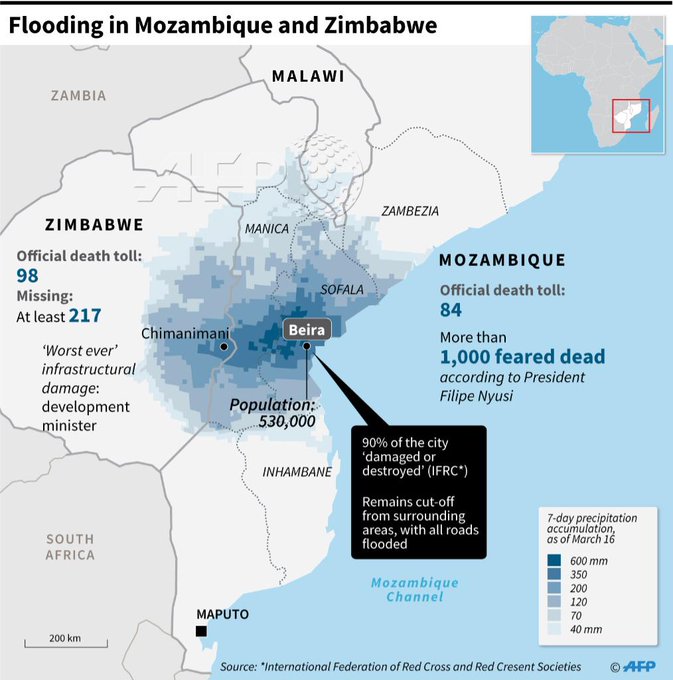
The cyclone killed at least 98 people and more than 200 are missing in Zimbabwe, the government said on Monday.

While cyclones are not uncommon in this area, Idai is said to be the worst to hit the Southern Africa region since the devastating Cyclone Eline in 2000.

Mozambique has been hardest hit with the president saying more than 1,000 people may have been killed. Dozens have also died in Malawi.

Bulldozers and road graders struggled through the night to clear obstructed muddy roads in parts of the Chipinge and Chimanimani districts. In the previously inaccessible villages of Sanctuary, in eastern Chimanimani, the army handed out basic food items – beans, mealie meal, and cooking oil – to hundreds of affected families.

View image on Twitter

AFP news agency

✔@AFP

“This is a real humanitarian disaster. More than 100,000 people are in danger” – Mozambican President Filipe Nyusi

More than 1,000 feared killed by Cyclone Idai in Mozambique http://u.afp.com/JTci  @AFPgraphics

504 people are talking about this

Helicopter rescue

Hundreds of high school boys were evacuated by helicopter from a school buried by a mudslide. Survivors will be transported to Harare for medical checks and support. Two people, including a student, died in the landslide at St Charles Luwanga Seminary School.

Zuze Zubuka, 53, who lives on one of Chimanimani’s lower mountain slopes, told Al Jazeera the roof and walls of his three huts were blown away by the rain. Now he and his family of eight squat in a small shack near the original home. Up the road, Zubuka attended the funeral of an in-law, Morgan Chimene Dube, crushed by falling rocks while sleeping in his home as Friday’s massive storm hit.

“I have lost my home, it was impossible to escape the rain, we were trapped but now that the roads are cleared we can move. I came to see how my brother-in-law was doing, but he is dead now.

“We have lost a relative, our fields and our home. My family is there, but I don’t know how we will start all over again,” he said.

Some of the high school students evacuated from St Charles Luwanga Seminary after it was hit by a landslide [Tendai Marima/Al Jazeera]

Everything lost

Another mourner at the funeral Fortunate Saziya, 48, told Al Jazeera she was anxious and hoped for more help as she’d also lost her home.

“Who can I give a list of all the things I have lost? Will we get any support for all we’ve lost? When is the government going to help us?” she asked.

Minister of Defence Oppah Muchinguri visited the area and told victims she hadn’t anticipated Cyclone Idai being so bad, lamenting the lack of preparedness by the community and the government.

“We had heard that floods were coming and a cyclone, but we had not moved or done anything to help ourselves,” Muchinguri said.

“I think we as people of Manicaland [province] have learnt a lesson and next time we will protect lives and urge people to move knowing what will happen, and we move into camps together with the government’s help,” she added.

Follow Tendai on Twitter and Instagram: @i_amten

Zuze Zubuka lost his home during the massive storm in Chimanimani [Tendai Marima/Al Jazeera]

The post Relief reaches Zimbabwe’s cyclone survivors as death toll rises appeared first on Zimbabwe Situation.

Anxious Cyclone Idai survivors assess losses in Zimbabwe

The country’s estimated death toll is 98 and is expected to rise with many people still missing. Source: Anxious Cyclone Idai survivors assess losses in Zimbabwe | News | Al Jazeera The country’s estimated death toll is 98 and is expected to rise with many people still missing. Chimanimani, Zimbabwe – High in the eastern hills […]

The post Anxious Cyclone Idai survivors assess losses in Zimbabwe appeared first on Zimbabwe Situation.

The country’s estimated death toll is 98 and is expected to rise with many people still missing.

Source: Anxious Cyclone Idai survivors assess losses in Zimbabwe | News | Al Jazeera

The country’s estimated death toll is 98 and is expected to rise with many people still missing.

Chimanimani, Zimbabwe – High in the eastern hills of Zimbabwe rescue efforts continue and medical services are starting to reach some stranded communities.

Roads are slowly becoming more accessible and aid organisations are arriving to help to those in need in the wake of deadly Cyclone Idai.

In Chimanimani district, which borders Mozambique, critically injured villagers are being airlifted to hospitals. Tents for a temporary clinic and an aid camp have been set up in the mountainous section locally known as Skyline.

Chipo Liwayo and her six-month-old baby have bruises on their face that will forever remind them of what the storm took from them.

Liwayo lost two children when a rockfall and mudslide enveloped her home just beneath Skyline.

The children aged four and eight were swept away and are still missing.

“The rocks hit us as we tried to get out of the kitchen where we had run to hide, but my four-year-old child didn’t make it. The other one was already taken when the rains destroyed the bedroom where he slept. God has his ways, but I don’t know why this. It hurts,” Liwayo said as she cradled her only surviving child.

Farai Muskwe says she is nervous about returning to the area where a mudslide killed her two grandchildren [Tendai Marima/Al Jazeera]

Her 77-year-old mother, Farai Muskwe, survived the rocks and mud but complained of a swollen leg and needs blood pressure pills that were swept away by the storms.

Farai Marume, emergency co-ordinator for NGO, Doctors without Borders (known by its French initials, MSF) told Al Jazeera that while medical rescue efforts had just begun, the agency had already received many injuries.

“The magnitude of this cyclone was huge. We have received a lot of patients with fractures and some others with more serious wounds.”

“We are making efforts but the major challenge is accessibility. We are working on that and trying to collaborate with our other partners to reach those in remote places.

“We’ve managed to send out medication to Chimanimani hospital via helicopter with the help of our partners,” he told Al Jazeera in an interview.

On the other side of the impassable mountain range lies Ngangu, a poor township in Chimanimani town where 40 victims of Cyclone Idai were buried on Monday according to the state-owned daily paper, The Herald.

It said the government had advised residents to go ahead with burials as there were no adequate mortuary facilities.

The news of the burials has unsettled those who are unable to reach their relatives stranded in other areas.

Witness Nyandoro, 36, a vendor in Chipinge town told Al Jazeera she was worried about her family in a village in Nyanyandzi area, about 85km further north.

“All the roads to my home area are bad, I can’t try going there, what if the cars cannot make it? I keep trying to phone but the numbers can’t get through so I don’t even know if my family is OK,” he said.

In a statement issued today, the spokesman for the UN Secretary-General Antonio Guterres expressed his sadness at the loss of life, destruction of property and displacement of millions by the cyclonic rains and subsequent flooding.

According to UN estimates 600,000 people in Mozambique and 900,000 in Malawi have been affected by Cyclone Idai.

Assessments in Zimbabwe are still ongoing, but the death toll continues to rise. The current estimate from the Ministry of Information is 98 dead, with many more still missing.

The UK’s International Development Secretary Penny Mordaunt has announced Britain will provide up to 6 million pounds ($7.96m) in humanitarian aid for Mozambique and Malawi.

The post Anxious Cyclone Idai survivors assess losses in Zimbabwe appeared first on Zimbabwe Situation.