Govt must free up fuel imports 

Source: Govt must free up fuel imports – NewsDay Zimbabwe March 13, 2019 Guest column: newZWire Sardonic Zimbabweans have a joke for every crisis. One of the many crisis-fueled wisecracks goes: What’s the best time to fill up your fuel tank? Answer: “When a government official tells you not to panic.” Last week, Cabinet, which […]

The post Govt must free up fuel imports  appeared first on Zimbabwe Situation.

Source: Govt must free up fuel imports – NewsDay Zimbabwe March 13, 2019

Guest column: newZWire

Sardonic Zimbabweans have a joke for every crisis.

One of the many crisis-fueled wisecracks goes: What’s the best time to fill up your fuel tank?

Answer: “When a government official tells you not to panic.”

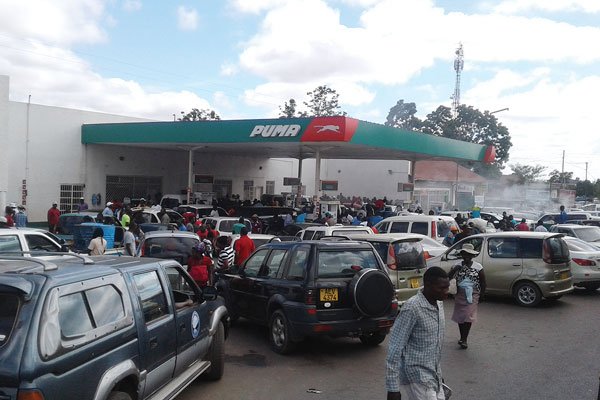
Last week, Cabinet, which is struggling to resolve fuel shortages that intensified in October last year, announced that major corporations would now be allowed to import their own petrol and diesel.

This is the latest in a growing list of government’s failed attempts to end the crisis.

In October, Energy minister Joram Gumbo, whose communication during the fuel crisis has not done his already suspect credibility any good, announced that government was finalising a deal with Sakunda, which would see the commodity firm supplying Zimbabwe with 1,6 billion litres of fuel.

The country consumed 1,63 billion litres of petrol and diesel in 2018, according to the Zimbabwe Revenue Authority data.

At the time of Gumbo’s announcement, there was a brief reprieve as some 100 million litres of the product, sourced through Sakunda, temporarily eased the shortages.

In the midst of it all, Zimbabweans got treated to a bizarre side-show in which four senior central bank officials were suspended, incredibly on the strength of unsubstantiated allegations of exaccarbating the fuel crisis by a Facebooker. The officials were eventually cleared and reinstated.

Away from the side-shows, the situation got worse, and it was the Reserve Bank of Zimbabwe (RBZ) governor John Mangudya’s turn to attempt to calm down the market.

Appearing before a Parliamentary portfolio committee on December 20, 2018, Mangudya, who revealed he had a habit of counting cars in fuel queues, declared the lines would be gone “by Christmas”.

This wasn’t to be. The lines got longer in January, traditionally a period of a lull in demand.

As the situation grew more desperate, President Emmerson Mnangagwa took the unprecedented step of personally announcing a 150% fuel price increase in a live television address on January 12.

The move precipitated bloody protests in which a reported 17 people died, according to rights groups, and millions of dollars worth of property destroyed.

For a while, the new high prices, which tracked the black market exchange rate, appeared to douse demand.

Queues disappeared, but only for a couple of weeks. By early February, long lines were, once again, a common feature across the country.

With money supply slowing down and the black market exchange rate holding steady, it quickly became clear that supply, not demand side dynamics, was at play.

Put simply, the RBZ does not have the foreign currency to maintain adequate fuel supplies.

The centralised forex allocation regime maintained by the RBZ since mid-2016 has struggled to cope with demand, while major sources of dollar liquidity, such a gold producers, have cut back on production due to uneconomic forex retention rules imposed by the central bank.

The goose laying the golden egg is hardly thriving.

Given this grim reality, it is surprising that the central bank still insists on a role in fuel procurement, even after freeing up forex allocation in the economy through the re-introduction of an inter-bank forex market on February 20.

Apart from fuel, the central bank also wants to continue allocating forex for the importation of cooking oil, medicines and electricity.

Not only are the optics of fuel queues bad for a government which insists it’s succeeding in fixing the ailing economy, the long lines, in which precious productive time is lost at a huge cost to the economy, also accentuate a crisis mentality which undermines confidence.

Government’s inability to deal decisively with an issue of such importance does not inspire the confidence that it has what it takes to not only stop the bleeding, but to set the economy on a path of sustained growth.

Mnangagwa and his government need to go beyond Tuesday’s half-hearted liberalisation of fuel procurement.

They must leave oil marketing companies to import the product and sell it at prices which allow them to thrive.

This is by no means a revolutionary idea.

All of Zimbabwe’s neighbours, some which have far less export earnings than us, are well served by letting the market be.

Filling up fuel tanks and putting cooking oil on citizens’ tables is not the central bank’s business.

It is way past time for the government to leave the fuel business to private players. After all, the sector has firms connected to major international oil industry operators such as Total, Engen, Glencore and Kuwait’s Independent Petroleum Group. — newZWire
The post Govt must free up fuel imports  appeared first on Zimbabwe Situation.
ED sued over RTGS currency 

Source: ED sued over RTGS currency – NewsDay Zimbabwe March 13, 2019 BY CHARLES LAITON Harare businessman and University of Zimbabwe (UZ) lecturer, Shakespear Hamauswa, has petitioned the High Court seeking a court order to declare unconstitutional the Presidential (Temporary Measures) Act, which President Emmerson Mnangagwa evoked as legal basis to introduce the RTGS$. Hamauswa also […]

The post ED sued over RTGS currency  appeared first on Zimbabwe Situation.

Source: ED sued over RTGS currency – NewsDay Zimbabwe March 13, 2019

BY CHARLES LAITON

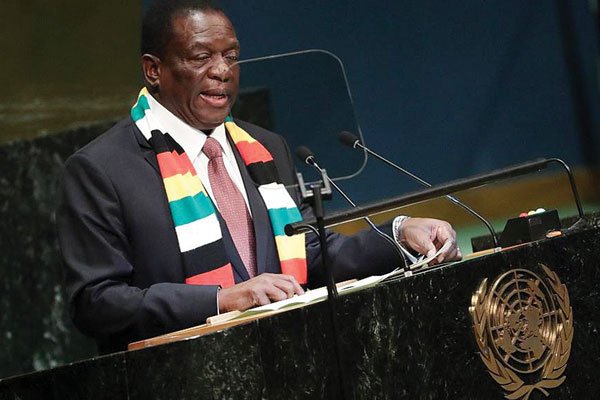
Harare businessman and University of Zimbabwe (UZ) lecturer, Shakespear Hamauswa, has petitioned the High Court seeking a court order to declare unconstitutional the Presidential (Temporary Measures) Act, which President Emmerson Mnangagwa evoked as legal basis to introduce the RTGS$.

Hamauswa also said he was seeking another court order declaring null and void the Presidential (Temporal Measures) Act, amendment of the Reserve Bank of Zimbabwe (RBZ) Act (SI33/2019), through which the RTGS$ was issued.

“In the regulations, gazetted on February 22, 2019, the first respondent (Mnangagwa) purported to amend section 44 of the RBZ Act, by addition of a new section 44 (c) that had the effect of the following; allowing and authorising the RBZ to use electronic cards, recognising that the RBZ had with effect from the effective date that is February 22, 2019 issued an electronic currency called RTGS$, that people’s existing balances in their banks held the RTGS system as well as bond notes and were now to constitute a new currency known as the RTGS,” Hamauswa said.

In his court application, Hamauswa cited, in their official capacities, Mnangagwa, Minister of Finance and Economic Development, Mthuli Ncube and RBZ governor John Mangudya as respondents.

“It is my respectful contention that the Act, that is the Presidential (Temporal Measures) Act, is unconstitutional. This Act gives the sweeping powers to the President of making laws virtually on every subject….what this means is that the President has sweeping powers to make laws that are above even laws that have been made by Parliament,” he said.

“For the purpose of this case, it is disheartening that the President has in fact amended the Act of Parliament; namely the RBZ Act. Surely that on its own is a breach of section 134 of the Constitution of Zimbabwe.

“The Presidential Powers (Temporal Measures) Act is ultra vires the Constitution. The subsidiary legislation envisaged in section 134 cannot be delegated to President whose functions are defined in section 110 alone and in any event, the President acting in terms of the Act or any other law, does not have the power to override Parliament, through a legislative amendment or the making of a law that overrides existing law. I thus seek declarations to this effect.”

The businessman said to buttress his statement of May 4, 2016, Mangudya, on May 5, 2016, issued ECOGAD8 of 2016 (exchange guidelines), which was revolving, adding by that date the RBZ knew it had a Ponzi currency called RTGS.

“It (RBZ) knew that people’s US$ balances accumulated from time of dollarisation in 2009 were no longer in existence. Quite clearly, we have been taken for a ride, the respondents through and among other things deficit financing exhausted our US$ balances. To monetise the “theft” the third respondent created the RTGS account and later bond note,” Hamauswa said.

“In fact, as ECOGAD8 shows, the RTGS$ has been with us since May 2016. That the first respondent (Mnangagwa) now calls it a RTGS$ does not detract from the fact that de facto, and despite the vigorous denials by the third respondent (RBZ) in many court actions brought before this court, the RTGS$ and the bond note were a currency.

“That currency had an exchange rate. So the creation of the RTGS$ was not a national urgency. Equally the partial floating of the action was also not urgent. This could have easily been done by an amendment of the exchange control regulations.”

The UZ lecturer further said indeed, one notes that in the same extra-ordinary government gazette, in respect of which the regulations were passed, Mnangagwa amended the Exchange Control Regulations of 1996 by Statutory Instrument 32, 2019.

“By issuing bond notes and RTGS currency at par with the US$ and then devaluing the same on February 20, 2019 the respondent has robbed us. Section 71 does not permit expropriation of people’s property,” he said.

“The net effect is that the third respondent and indeed the first respondent have devalued the RTGS$ balances by 2,5. The RTGS$ must, therefore, be set aside on the basis that it is an infringement of section 71 of the Constitution of Zimbabwe.” The matter is pending.

The post ED sued over RTGS currency  appeared first on Zimbabwe Situation.
Harare runs out of water chemicals 

Source: Harare runs out of water chemicals | The Herald March 13, 2019 Eng Chisango Innocent Ruwende Senior Reporter Most suburbs in Harare are experiencing serious water woes due to the shortage of water treatment chemicals with the city now pinning hopes on Higherlife Foundation to provide the required foreign currency to purchase chemicals. Town […]

The post Harare runs out of water chemicals  appeared first on Zimbabwe Situation.

Source: Harare runs out of water chemicals | The Herald March 13, 2019

Harare runs out of water chemicals
Eng Chisango

Innocent Ruwende Senior Reporter
Most suburbs in Harare are experiencing serious water woes due to the shortage of water treatment chemicals with the city now pinning hopes on Higherlife Foundation to provide the required foreign currency to purchase chemicals.

Town Clerk Mr Hosiah Chisango confirmed that Harare had run out of liquid and granular aluminium, lime and HTH with only 25 cubic metres of aluminium sulphate in stock.

The Urban Councils’ Association of Zimbabwe (UCAZ) says it will approach Local Government, Public Works and National Housing Minister July Moyo over the issue.

Harare is also pinning its hopes on Higherlife Foundation, a family foundation of Econet founders Strive and Tsitsi Masiyiwa whose philanthropic work is anchored around transforming Zimbabwe’s socio-economic narrative and further develop and pivot Zimbabwe into a middle-income country by 2030.

The organisation was pivotal in fighting a cholera outbreak last year donating $10 million towards the cause.

Sources at Harare Water revealed that a council team led by Harare Mayor Herbert Gomba was close to striking a deal worth more than $100 million with the largest local non-governmental organisation in Zimbabwe after having numerous meetings last week.

During a meeting with Sentosa residents and their councillor, Denford Ngadziore, who were complaining about water problems at Town House, Mayor Gomba revealed that council had made a proposal to Higherlife Foundation which could solve some of the water and sanitation problems faced by the city.

Cllr Ngadziore had highlighted that the water problems in Sentosa had gone for more than 15 years without a resolution.

Council sources said if the deal pulls through it will enable council to buy three mobile treatment plants, pumps for Morton Jaffray Treatment Plant and the Prince Edward  Plant.

It is understood that the city wants one of the mobile treatment plants to be stationed at Upper Manyame to serve areas such as Glenara, Budiriro, Mufakose, Glen View, Glen Norah, Mufakose and Highfield.

The other plant will be stationed at Gletwyn Dam which is earmarked to supply northern suburbs, most of which have been receiving erratic water supplies like Glen Lorne, Glenwood and Shawasha Hills.

The last one will be at Mazowe Dam earmarked to supply water to Borrowdale, Hatcliffe, Mt Pleasant, Vainona, Avondale and surrounding areas.

Addressing delegates at the City of Harare peer review session at Town House yesterday Eng Chisango said the water situation in Harare remain dire owing to pumping capacity as well as the water sources.

“Harare has had several water and sanitation infrastructure projects, but these have not solved the challenges we are facing.

“Currently, we are implementing a water demand management system because the water is not enough. We had a poor rainy season and demand continues to outstrip supply,” he  said.

“What is needed, therefore, is investment in new water sources.”

The post Harare runs out of water chemicals  appeared first on Zimbabwe Situation.

Implement BNC decision, ministers and officials told 

Source: Implement BNC decision, ministers and officials told | The Herald March 13, 2019 President Mnangagwa chats with his South African counterpart Cyril Ramaphosa Joint communiqué on the Third Session of the Bi-National Commission between Zimbabwe and South Africa, March 7-12 2019, Harare, Zimbabwe At the invitation of His Excellency, Cde Emmerson Dambudzo Mnangagwa, President […]

The post Implement BNC decision, ministers and officials told  appeared first on Zimbabwe Situation.

Source: Implement BNC decision, ministers and officials told | The Herald March 13, 2019

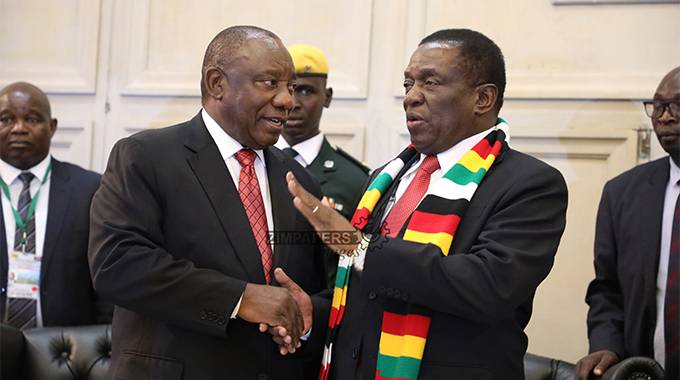
Implement BNC decision, ministers and officials toldPresident Mnangagwa chats with his South African counterpart Cyril Ramaphosa

Joint communiqué on the Third Session of the Bi-National Commission between Zimbabwe and South Africa, March 7-12 2019, Harare, Zimbabwe

  1. At the invitation of His Excellency, Cde Emmerson Dambudzo Mnangagwa, President of the Republic of Zimbabwe, his Excellency, Cde Matamela Cyril Ramaphosa, President of the Republic of South Africa, paid an official visit to Zimbabwe from March 11-12, 2019, for the Third Session of the Bi-National Commission (BNC) between the two countries. President Ramaphosa was accompanied by five Cabinet ministers and one deputy minister.
  2. The third session was preceded by the meetings of the ministers on March 11, 2019 and senior officials from March 7-8, 2019
  3. During the meeting, the two Heads of State held discussions with a view of further strengthening and deepening bonds of friendship and cooperation between Zimbabwe and South Africa. They also exchanged views on regional, continental and international issues of mutual interest.

4.The two Presidents underlined the close and friendly bilateral ties deeply rooted in shared history, sustained and nourished through growing economic partnership, multifaceted cooperation as well as vibrant people-to-people contracts.

  1. The discussions were held in a very cordial atmosphere.
  2. The two Heads of State welcomed the positive outcomes of the Third BNC held in Harare in 2019.

They directed the ministers and officials to implement the decision taken by the Heads of State to further cement the strategic bilateral partnership.

  1. The two sides emphasised the importance of expanding trade and investments to drive the strategic engagement forward. In this regard, the Heads of State directed their Finance and Trade Ministers to work together to achieve these goals.
  2. Zimbabwe highlighted the key initiatives taken by Government to improve the ease of doing business in the country and further informed on the country’s efforts to simplify and rationalise investments rules with the view to attract Foreign Direct Investment.
  3. The two sides agreed to consider options for expanding the standing facility arrangement between the respective central banks.

Other financing options beyond this are also being explored (for example a facility from South African government with an appropriate counter-guarantee from the Zimbabwe Government).

  1. They also agreed to work together on re-engagement with the International Cooperation Partners in support of Zimbabwe’s economic reform and debt arrears clearance agenda.
  2. Zimbabwe expressed appreciation for the unwavering commitment of the government and people of South Africa in calling for the removal and unwarranted sanctions which are stifling the country’s economic recovery programme.
  3. The two leaders equivocally called for the removal of sanctions on Zimbabwe, whose adverse effects have been far reaching across the political and socio-economic spectrums.

13.The two Presidents emphasised the importance of enhancing strategic bilateral engagement, particularly in defence and security cooperation, to accomplish the common interest of the two countries and their people.

  1. At multilateral level, the commission welcomed the convergences of views on regional, continental and international issues and agreed to further harmonise their positions, especially in view of South Africa’s non-permanent membership of the UN Security Council and its upcoming assumptions of the Chair of the Africa Union in 2020.
  2. Zimbabwe expressed goodwill and confidence in the successful holding of elections in South Africa, which will take place on May 8, 2019.

16.The two leaders expressed their deepest condolences to the Government and people of the Federal Democratic Republic of Ethiopia and all the other nations on the sad loss of lives in the recent air disaster involving flight ET302.

  1. At the conclusion of the BNC, His Excellency, Cde Matamela Cyril Ramaphosa expressed gratitude to His Excellency, Cde Emmerson Dambudzo Mnangagwa and the people of the Republic of Zimbabwe for the warm welcome and hospitality accorded to him and his delegation.
  2. His Excellency, President Ramaphosa extended an invitation to his counterpart, His Excellency, President Mnangagwa, to attend the Fourth Session of the BNC, to be hosted by South Africa in 2020, on the date to be agreed and communicated through diplomatic channels.

Third Zimbabwe-South Africa BNC highlights

ECONOMIC

SA is Zimbabwe’s biggest trading partner

President Mnangagwa  assures President Ramaphosa that South African investments are to get priority and will be secure in Zimbabwe

Agreements on energy signed

Agreements on air transport signed

Agreements on railways signed

Agreements on mining signed

Agreements on customs signed

MoA on agriculture signed yesterday

Work underway on the operationalisation of the Beitbridge One-Stop Border Post

Zimbabwe and South Africa agree to work together with international cooperating partners in support of Zimbabwe debt arrears clearance agenda

POLITICAL

Defence cooperation

President Ramaphosa for the third time this year calls for immediate removal of sanctions

President Mnangagwa wishes South Africa successful elections set for May

President Ramaphosa acknowledges Zimbabwe’s reform efforts through alignment of laws to the Constitution and entrenching rule of law

The two Presidents exchanged views on regional and continental issues of mutual interest

SOCIAL

South Africa donates $55 million Rand police training kit

Improvement of people to people relations

Zimbabwe thanks South Africa for scrapping VISAs

President Mnangagwa applauds South Africa for taking care of Zimbabweans working in that country.

Cultural cooperation between the two countries hailed

The two Presidents hailed friendly bilateral ties rooted in common history.

The post Implement BNC decision, ministers and officials told  appeared first on Zimbabwe Situation.

Ramaphosa wants sanctions gone . . . Hails Zim reforms . . . ED touched by solidarity 

Source: Ramaphosa wants sanctions gone . . . Hails Zim reforms . . . ED touched by solidarity | The Herald March 13, 2019 President Mnangagwa (right) speaks to his South African counterpart, President Cyril Ramaphosa, during the just-ended Third Session of the Zimbabwe-South Africa Bi-National Commission meeting in Harare yesterday. – Picture by Justin […]

The post Ramaphosa wants sanctions gone . . . Hails Zim reforms . . . ED touched by solidarity  appeared first on Zimbabwe Situation.

Source: Ramaphosa wants sanctions gone . . . Hails Zim reforms . . . ED touched by solidarity | The Herald March 13, 2019

Ramaphosa wants sanctions gone . . . Hails Zim reforms . . . ED touched by solidarity
President Mnangagwa (right) speaks to his South African counterpart, President Cyril Ramaphosa, during the just-ended Third Session of the Zimbabwe-South Africa Bi-National Commission meeting in Harare yesterday. – Picture by Justin Mutenda

Felex Share Senior Reporter
South African President Cyril Ramaphosa yesterday said his country will support Zimbabwe’s economic growth and reform efforts and called on the West to remove all sanctions imposed on Zimbabwe immediately to allow unhindered recovery.

Giving his remarks during the official opening and closing ceremony of the third session of the Zimbabwe-South Africa Bi-National Commission (BNC) in Harare, President Ramaphosa said his government demanded more than just piecemeal lifting of sanctions.

He said the reform efforts being undertaken by President Mnangagwa’s administration were on point and deserved the support of everyone.

“We commend your new administration for all your efforts through your programme of action to take Zimbabwe out of its current difficulties and make it a viable partner to South Africa, to the region and other development partners,” President Ramaphosa said.

“In support of your commendable efforts in February this year at the World Economic Forum, South Africa made a clarion call to the international community to assist Zimbabwe and support the reform efforts that your Government has embarked on by lifting the unfair and unjustified sanctions that have been imposed on Zimbabwe. We even addressed the European Union and made this call. We are pleased that the EU heeded the call and in February 2019 decided to lift sanctions on the current members of your administration but we want more than just that!”

He added: “We are very clear as South Africa that the sanctions are unjust, unfair and the time has come for them to be lifted immediately because they impede the growth of the Zimbabwean economy and they also have an adverse effect on the ordinary people of Zimbabwe. We want these sanctions lifted yesterday. We want to see meaningful support being given by the international development partners to Zimbabwe because Zimbabwe does deserve the support that the world can give. This is the first of the many steps needed to support Zimbabwe’s recovery.”

In response, President Mnangagwa said despite being on sanctions for nearly two decades, Zimbabwe was using domestic resources to resuscitate, grow and modernise its economy.

“We as Zimbabwe and in particular under the Second Republic we have said to ourselves yes we want the sanctions, which are unjust and illegal, to be removed yesterday but we will not bury our heads in the sand and cry,” he said.

“We are determined to use our domestic resources to grow our economy. We are happy that our sister member states in Sadc are in full support of our endeavour to modernise our economy in pursuit of the industrialisation policy of Sadc. But to do that we don’t have both the skills and technology nor capital to implement our vision. Therefore, we appeal through our engagement and re-engagement approach to the member states of the world family of nations to engage with us so that we may access global capital to exploit opportunities in our economy.”

President Mnangagwa said through its Transitional Stabilisation Programme, Zimbabwe was implementing tough “unpalatable” decisions.

These hard-hitting decisions, he said, would see Government springing from economic stagnation.

“To instil confidence in our economic landscape we are enforcing fiscal discipline, stabilising the macro-economic fundamentals, aligning our laws to the Constitution and entrenching the rule of law,” he said.

“The creation of an environment which welcomes business and investments from both local and international investors remains high on our agenda.”

President Mnangagwa said to record desired results, Zimbabwe needed help from countries like South Africa.

“We must, therefore, continue to work closely together, hand in hand, as we journey towards the progress and prosperity our people yearn for and indeed deserve,” he said.

“Your outspoken support for the new Zimbabwe is not taken for granted. You understand that our success is your success. You have stood by us in solidarity. I exhort our two countries to continue to ward off the machinations of those who wish to break our strong ties. While our friends are many and their efforts appreciated; our detractors, on the other hand, are tireless and unrelenting in their ill intentions.”

The President said investments in Zimbabwe were secure and any challenges faced by investors will be addressed efficiently.

The conclusion of the Zimbabwe- South Africa BNC comes barely two weeks after Zimbabwe had a similar convention with its western neighbour, Botswana, solidifying President Mnangagwa’s growing influence in the region and beyond.

President Ramaphosa flew back yesterday evening.

The post Ramaphosa wants sanctions gone . . . Hails Zim reforms . . . ED touched by solidarity  appeared first on Zimbabwe Situation.