‘Black market can’t determine forex rates’ 

Source: ‘Black market can’t determine forex rates’ | The Herald March 12, 2019 Dr Mangudya Zvamaida Murwira Senior Reporter Government cannot allow itself to be influenced by the black market in determining foreign exchange rates on interbank transactions as the parallel market is run by a few individuals transacting on nominal amounts, Reserve Bank of […]

The post ‘Black market can’t determine forex rates’  appeared first on Zimbabwe Situation.

Source: ‘Black market can’t determine forex rates’ | The Herald March 12, 2019

‘Black market can’t determine forex rates’Dr Mangudya

Zvamaida Murwira Senior Reporter
Government cannot allow itself to be influenced by the black market in determining foreign exchange rates on interbank transactions as the parallel market is run by a few individuals transacting on nominal amounts, Reserve Bank of Zimbabwe Governor Dr John Mangudya has said.

Dr Mangudya said people running the black market in the streets took a position to influence the country’s economy for selfish ends  and it would be folly for Government to make decisions based on their activities.

He said this while giving oral evidence before Parliament’s joint Portfolio Committee on Public Accounts chaired by Harare East legislator Mr Tendai Biti and that of Budget and Finance chaired by Bikita West MP Mr Elias Musakwa.

Mr Tendai Biti (file picture)

Mr Biti had asked why the central bank was not using the prevailing “street rate” in relation to export retention for tobacco farmers.

“I think it will be wrong for the bank to purchase export retention United States dollars from our exporters at the fixed rate at the moment which is 1: 2,5 when the market is 3,5. Can you give us confidence that you will purchase at the street rate. If that is not the case why not just liberalise,” said Mr Biti, in a heated exchange with Dr Mangudya.

“If Government are managed by street rates, I think we need to call some equilibrium. I am not sure if you want Government to be led by street rates,” quipped Dr Mangudya.

Mr Biti insisted saying: “That is reality.”

“You should also be aware that those people in the streets took the position that they are trying to influence this economy. We should never allow people who have taken position on this economy to run it. That will be failure on the part of Parliament or Government of Zimbabwe,” said Dr Mangudya.

“These are past effects of parallel exchange rate. If we allow that to happen prices will shoot through the roof. I think we have had enough in this country. I think we need to have discipline in this economy; that is what is missing.

“We need to have confidence, yes we love the market rate, but who determines that market. Somebody will just say on social media ‘today it’s five.’ If you go and check if there has been any trade to match that level, you will be surprised. Why should a $1 000 transaction move the whole market.”

Dr Mangudya said tobacco farmers will have 50 percent retention of the hard currency to be deposited in their nostro accounts.

“In terms of tobacco it is not 30 percent retention, it is 50 percent of the net proceeds. We met the tobacco industry, gold and merchants. We agreed at 50 of the net proceeds to be in their nostro accounts and we want them to open nostro accounts, so that we do not consume from cash. We want people to use bank accounts. The way it will happen is very simple. On the day of the auction, merchants will bring foreign currency into Zimbabwe, tobacco will be sold in RTGS dollars and then they will get their US dollar, they will get their money from nostro money and RTGS dollar,” said Dr Mangudya.

Tobacco selling season is expected to start on March 28. Dr Mangudya denied that the central bank was involved in quasi-fiscal activities despite insistence by Mr Biti.

The post ‘Black market can’t determine forex rates’  appeared first on Zimbabwe Situation.

RTGS to gain more value

Source: RTGS to gain more value | Herald (Top Stories) Bulawayo Bureau FINANCE and Economic Development Minister, Professor Mthuli Ncube, says the country’s financial situation is improving positively with the newly introduced RTGS dollar set to gain more value on the back of ongoing fiscal reforms and control of money supply into the market. In […]

The post RTGS to gain more value appeared first on Zimbabwe Situation.
Source: RTGS to gain more value | Herald (Top Stories)

Bulawayo Bureau
FINANCE and Economic Development Minister, Professor Mthuli Ncube, says the country’s financial situation is improving positively with the newly introduced RTGS dollar set to gain more value on the back of ongoing fiscal reforms and control of money supply into the market.

In an interview with United States’ National Public Radio (NPR) during his recent trip to Washington, Prof Ncube said Government’s transformative reform drive was slowly pulling the economy back to stability.

“The situation is improving, but improving slowly. But it will improve faster as we go along,” said the minister.

“I am hopeful we will see this through. Zimbabwe will be normal again. We’ll turn it around.”

Asked about the public confidence factor on the new RTGS dollar and the need to tame inflation, which had spiralled into double digits, he said prudent macro-economic management and capacity exhibited by President Mnangagwa’s new dispensation would yield the desired confidence and focus, which was absent in the past.

“That has changed since four months ago since we came in. We are running a budget surplus. We are containing the growth of money supply. We’re determined to give value to the currency that we’ve launched and want people to believe in us. We’re determined to make this right,” said Prof Ncube.

The latest progress report on reforms issued by Treasury already shows that Government has scored major milestones in containing fiscal deficit and broadening revenue base through curbing leakages and expenditure containment. The target this year is to reduce budget deficit from about 12 percent of GDP in 2018 to five percent. Inflation is also expected to slow down to single digit benefiting from the fiscal consolidation measures and containment of money supply growth to below 10 percent by year end, says Treasury.

“These are being complemented by the recent Monetary Policy Statement, which introduced interbank foreign currency exchange and separate FCA accounts and RTGS accounts. These have set the tone for the implementation of currency reforms.

The minister said President Mnangagwa’s “Zimbabwe is open for business”, was genuine and was being expressed in the ongoing reforms meant to create a favourable investment climate and an inclusive economic growth.

He said the recent MDC-Alliance instigated violent protests that resulted in wanton destruction of property and looting of businesses were regrettable, and exposed institutional gaps reminiscent of the old regime as the intensity of protests ovrwhelmed the enforcement — law enforcement agents. He, however, commended President Mnangagwa for coming out very strongly and clear in condemning violence from both sides.

The post RTGS to gain more value appeared first on Zimbabwe Situation.

PIC: Boyfriend pulls a shocker, jumps durawall and snatches cheating woman in her husband’s presence

Chitungwiza residents were left shell shocked over the weekend after a cheating woman’s boyfriend came to her house and forcefully took her with him despite the presence of her husband. Penelope Ruswa who is the second wife of a man only identified as …

Chitungwiza residents were left shell shocked over the weekend after a cheating woman’s boyfriend came to her house and forcefully took her with him despite the presence of her husband. Penelope Ruswa who is the second wife of a man only identified as Mark was cheating on her husband with another man only identified as […]

Zimbabwe economy: Animation explains currency shortage

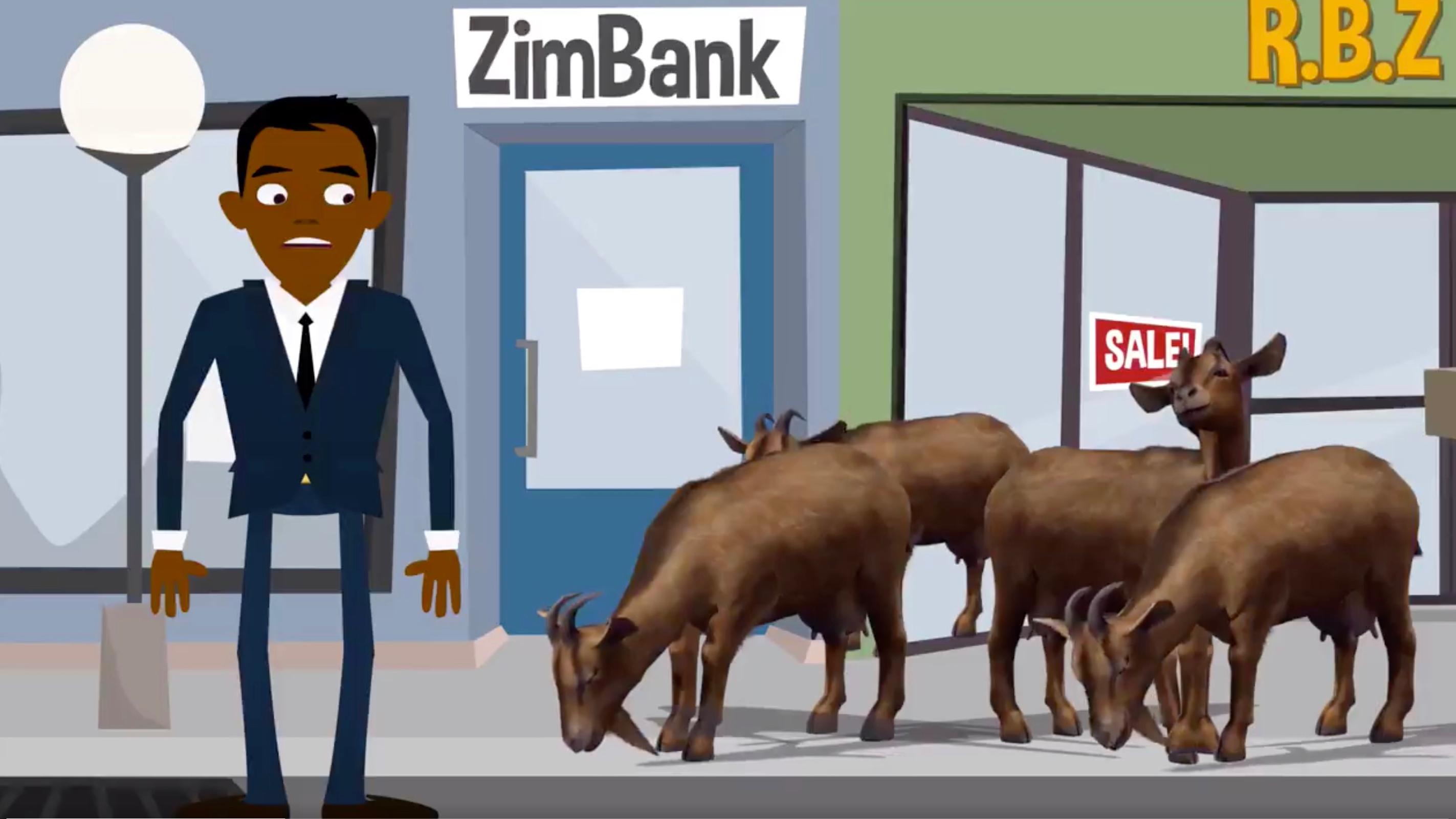
This short “cows and goats” animation is the best explainer of Zimbabwe’s currency madness Source: Zimbabwe economy: Animation explains currency shortage — Quartz Africa Zimbabwe’s economic crisis is complex. Since 2008’s hyperinflation, a brief recovery was thwarted by falling commodity prices, a drought and political instability that has led to an economy spiraling downwards since 2015. The […]

The post Zimbabwe economy: Animation explains currency shortage appeared first on Zimbabwe Situation.

This short “cows and goats” animation is the best explainer of Zimbabwe’s currency madness

Source: Zimbabwe economy: Animation explains currency shortage — Quartz Africa

Zimbabwe’s economic crisis is complex.

Since 2008’s hyperinflation, a brief recovery was thwarted by falling commodity prices, a drought and political instability that has led to an economy spiraling downwards since 2015. The situation has been complicated by the introduction of questionable bond notes, a vulnerable mobile money service, and an ever-changing policy that introduced yet another currency.

While policymakers use technical vagaries to explain away the crisis, an ordinary Zimbabwean has created the most succinct explanation through a two-minute animation.

“I created it because I had the impossible task of explaining what happened to the money to my daughter’s Grade 7 class,”  Kuda Musasiwa told Quartz Africa. “I needed an easy illustration which even a child would understand, with simplification that would still hold true when looked at from an economic lens.”

The post Zimbabwe economy: Animation explains currency shortage appeared first on Zimbabwe Situation.