Zim must focus on tackling chronic challenges: Mudzuri

Source: Zim must focus on tackling chronic challenges: Mudzuri | Newsday (News) BY OBEY MANAYITI MDC deputy president Elias Mudzuri says Zimbabweans must focus on tackling the country’s chronic challenges and avoid being swayed into “small” debates about his party’s elective congress set for May this year. In an interview with NewsDay, Mudzuri described the […]

The post Zim must focus on tackling chronic challenges: Mudzuri appeared first on Zimbabwe Situation.

Source: Zim must focus on tackling chronic challenges: Mudzuri | Newsday (News)

BY OBEY MANAYITI

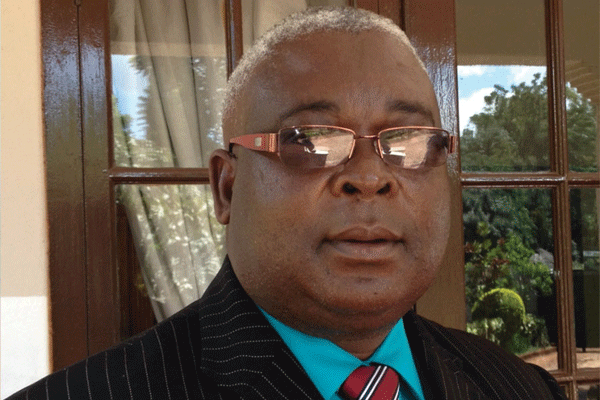
MDC deputy president Elias Mudzuri says Zimbabweans must focus on tackling the country’s chronic challenges and avoid being swayed into “small” debates about his party’s elective congress set for May this year.

In an interview with NewsDay, Mudzuri described the May congress as a family affair, which must not be a sideshow of the real challenges of reviving the economy.

“I really want us to talk about the economic situation, we want the government to account. People are struggling. I am moving around and people cannot afford [basics]. They don’t have the money and there are no jobs,” he said.

His comments came amid reports that the ruling Zanu PF party had infiltrated the MDC to influence the outcome of its congress.

“There are fuel queues everywhere and people are talking about the ease of doing business. That must be the debate because this country is not going to work with political arguments alone. At the end of the day, this country belongs to all of us and if we are not careful and concentrate on political personalities, we will not find a solution,” Mudzuri said.

He warned that Zimbabwe was risking going the way of Syria.

“Look at Syria, it has been 10 years with civil war and if we are not serious, we will find ourselves in that situation. Even if we don’t agree, we must find a common vision. We can talk at individual level,” he said.

“Right now, we have a dead economy and people are too poor. We have a drought and it is real. We must seek solutions and we are a family as Zimbabweans. There is need to remove the them-against-us mentality. We are one.”

Mudzuri, who has been touted as a possible presidential candidate, refused to discuss the party’s elective congress.

“People are the ones that nominate. They haven’t said anything as yet. I will announce my decision at the right moment. It is a democratic process and everything will come out,” he said.

The post Zim must focus on tackling chronic challenges: Mudzuri appeared first on NewsDay Zimbabwe.

The post Zim must focus on tackling chronic challenges: Mudzuri appeared first on Zimbabwe Situation.

BREAKING NEWS: ZBC Reporter Judith Makwanya dies

Veteran ZBC reporter Judith Makwanya has died. Makwanya was admitted into a hospital on Monday with a medical emergency. The Ministry of Information, Publicity and Broadcasting confirmed Makwanya’s death but did not give details. Writing on Twitter, th…

Veteran ZBC reporter Judith Makwanya has died. Makwanya was admitted into a hospital on Monday with a medical emergency. The Ministry of Information, Publicity and Broadcasting confirmed Makwanya’s death but did not give details. Writing on Twitter, the Information Ministry said: Government learns with sadness of the untimely passing on of Diplomatic Correspondent Ms Judith […]

Zanu PF youths lash out at Ncube

Source: Zanu PF youths lash out at Ncube | Newsday (News) BY OBEY MANAYITI ZANU PF youths yesterday reacted angrily to suggestions by Finance minister Mthuli Ncube that foreign investors retain 100% ownership of their investments in the mining sector, saying the move was ill-informed. During an interview with Bloomberg last week, Ncube said the […]

The post Zanu PF youths lash out at Ncube appeared first on Zimbabwe Situation.

Source: Zanu PF youths lash out at Ncube | Newsday (News)

BY OBEY MANAYITI

ZANU PF youths yesterday reacted angrily to suggestions by Finance minister Mthuli Ncube that foreign investors retain 100% ownership of their investments in the mining sector, saying the move was ill-informed.

During an interview with Bloomberg last week, Ncube said the country was working on scrapping the Indigenisation Act, which restricts foreign shareholding in platinum and diamond ventures to 49% as the country seeks to attract foreign capital.

But Zanu PF youth commissar Godfrey Tsenengamu said there was no wisdom in reversing President Emmerson Mnangagwa’s decision.

“What is it we are driving at as a country? What has informed that decision by the Finance minister? What has happened to the declaration by the President which the Finance minister seems to be overturning?” Tsenengamu said.

“I don’t think 51/49% (threshold) on platinum and diamonds was really driving away investors, but here is a very good example of what drives away investors, policy inconsistency.

“The President saw reason in partially reserving that sector for the indigenous [investor] as this would ensure the empowerment and economic emancipation of the previously disadvantaged, but what’s surprising today is how the Finance minister can just change that today.

The post Zanu PF youths lash out at Ncube appeared first on NewsDay Zimbabwe.

The post Zanu PF youths lash out at Ncube appeared first on Zimbabwe Situation.

Attitude, training key in pedagogy 

Source: Attitude, training key in pedagogy | The Herald March 12, 2019 Elliot Ziwira Senior Writer The recent recruitment of 1 300 teachers, by the Ministry of Primary and Secondary Education, with the bulk of them being deployed to Matabeleland provinces, is a stride in the right direction. With the national teacher shortfall at 18 […]

The post Attitude, training key in pedagogy  appeared first on Zimbabwe Situation.

Source: Attitude, training key in pedagogy | The Herald March 12, 2019

Attitude, training key in pedagogy

Elliot Ziwira Senior Writer
The recent recruitment of 1 300 teachers, by the Ministry of Primary and Secondary Education, with the bulk of them being deployed to Matabeleland provinces, is a stride in the right direction.

With the national teacher shortfall at 18 000, which has seen the teacher-pupil ratio deteriorating to 1:165 in some cases, against the recommended 1:30 ratio, the recruitment may appear to be a drop in the ocean, but the fact that it has come at a time the Government is keen on tightening the purse strings, is an indication of the seriousness with which authorities take the education issue.

There has been an outcry that some provinces, such as Matabeleland North, for example, have become perennial hotbeds due to dismal pass rates in public examinations at Grade Seven and Ordinary Level year in, year out, due mainly to lack of adequately trained teachers.

However, the issue of poor results is not only prevalent in Matabeleland provinces. It is a national challenge.

Whereas there is no holistic approach in the quest to drop good results into parents’ laps, and position the nation state for prosperity through total development of the individual, need arises for analysis of matrixes at play in the education conundrum.

Putting the cart before the horse

The ethnical card has been thrown about in the quest to find solutions to the deteriorating pass rates in Matabeleland provinces, a situation that prompts probe through projection of figures.

In the 2018 Zimbabwe School Examinations Council (Zimsec) Grade Seven examinations, 29 schools in Matabeleland North Province recorded zero percent pass rate. The same number of primary schools scored a zero percent pass rate in 2017 in the same province.

Yes, no single candidate passed Grade Seven in 29 schools in Matabeleland North, two years in a row, and none in those schools could qualify for secondary school if regulations were silent on the issue. If they so decide to go to secondary school without Grade Seven passes, as most will certainly do, it would be tempting fate a notch too high to expect them to sail through with at least five O-Level passes after four years of having to battle the same conditions that could have overwhelmed them for seven years in primary school.

The province has a total of 600 primary schools, and 563 of them had candidates sitting the Grade Seven examinations, and of the 563 schools, 29 (5,2 percent) scored zero percent pass rate.

Before looking at the possible reasons for the poor showing in Matabeleland North schools, it is imperative here to draw comparisons with other provinces to determine whether the ethnical card is such an issue.

In Mashonaland West Province there are 429 satellite schools  232 primary and 197 secondary. Reportedly, in the 2018 national examinations 13 satellite primary schools scored zero percent pass rate in the province.

In the Matabeleland North scenario, the poor showing, according to officials, is attributable to teacher shortages and lack of teaching materials since most of the schools were new and small, with a staff complement of three teachers teaching across grades, hence, the need to acquaint the teachers with necessary skills.

In the Mashonaland West case, satellite schools do not fall into the category of small schools as some are said to have enrolments of over 1 000 learners. Poor results are attributed to resource constraints, which include shortage of trained teachers.

In 2014 Bulawayo Province scored the highest overall pass rates in Grade Seven and O-Level national examinations, while posting exceptional results at A-Level, with Masvingo coming second, Matabeleland South third, and Harare on fourth position. Matabeleland North was on eighth position ahead of Mashonaland West and Mashonaland Central on ninth and tenth position, respectively.

After dominating in Grade Seven examinations results three years in a row between 2012 and 2014, and doing exceptionally well in both O-Level and A-Level, Bulawayo slumped to the bottom in 2015 and eighth in 2016. Matabeleland South came sixth in the Grade Seven examinations in 2018.

That the reason for failure is attributable to non-Ndebele and non-Tonga speaking teachers in Matabeleland North and Matabeleland South fails to hold water when scrutinised on the background of the good results obtained in Bulawayo at Grade Seven, O-Level and A-Level, before slumping between 2015 and 2018. Both Matabeleland North and Matabeleland South recorded better overall results ahead of Mashonaland West and South provinces before 2017, and Matabeleland South maintains its dominance over the provinces.

Harare Province could be leading throughout if infrastructure, ethnical balance and teacher deployment were the only factors determining pass rates.

Though it is important in early development, up to Grade Three that vernacular language is used to hone the cognitive skills of learners, it cannot be an issue after Grade Five and in secondary school.

If teachers are adequately trained, have the right mindset, are well remunerated and adopt the attitude expected of the profession, the issue of the so-called language barrier falls away. In Matabeleland North, which is said to have inadequate Tonga speaking teachers, 139 pupils out of the 3 980, who sat the Tonga Grade Seven exam, scored distinctions. Comparatively of 51 pupils who wrote the Shona examination, four passed with distinctions, with a pass rate of 92,28 percent.

A pass rate of 62,24 percent could not have been achieved had the issue been to do with native speakers of Tonga as teachers. The challenge only comes if teachers are to cross grades, especially if they are poorly resourced and inadequately trained.

Government can tackle the problem thorough encouraging would be teachers to enrol for training in Ndebele, Shona, Venda, Tonga etc. at tertiary institutions, if current numbers are anything to go by.

Due to lack of attractive infrastructure, rural schools have been shunned by teachers for some time, regardless of province. Now that there are close to 17 000 trained teachers awaiting employment, the luxury to choose may be a thing of the past.

What is required now is for those employed or offered employment to step up to the plate and perform, and the infrastructure in such areas to be improved. Parents, learners and teachers should be on the same plate with regards to the new curriculum and its expectations. There is a worrisome lack of information on the new curriculum, compounded by scarcity of learning materials.

If parents are of the belief that their children fail because of teachers from other regions, who are non-speakers of their mother tongue, they aid in raising the affective filter of learning in their children, thus impeding the learning process.

As an interactive process, learning thrives in a conducive environment, which begins with accepting each other as Zimbabweans first. The temptation to hire or recruit those from our provinces, on the part of those in positions of influence, should be subdued, for the tendency is to engage non-competent teachers on the basis of being speakers of the vernacular language in particular provinces, ahead of competent non-speakers of said languages. If this is allowed to happen then the same problem of dismal pass rates will remain to haunt us all, and create cry-babies out of our children.

Learning also prevails if both learners and teachers do not think with their stomachs. The recruitment of the 1 300 teachers to complement Government efforts, therefore, should be applauded, especially so when 300 of them will take their posts in Matabeleland North, and 242 will be in Matabeleland South.

Imparting education is more than teaching, neither is passive learning enough in developing the complete individual. Instead, effective learning involves both cognitive and psychomotor skills made to interact through a shared vision.
The post Attitude, training key in pedagogy  appeared first on Zimbabwe Situation.

Zim pleads for SA assistance

Source: Zim pleads for SA assistance | Newsday (News) BY XOLISANI NCUBE THE Zimbabwean government has pleaded with South Africa to help revive its collapsing economy to avoid a contagion effect. Addressing a ministerial meeting of the third session of the Zimbabwe-South Africa Bi-National Commission (BNC) in Harare yesterday, Foreign Affairs and International Trade minister […]

The post Zim pleads for SA assistance appeared first on Zimbabwe Situation.

Source: Zim pleads for SA assistance | Newsday (News)

BY XOLISANI NCUBE

THE Zimbabwean government has pleaded with South Africa to help revive its collapsing economy to avoid a contagion effect.

Addressing a ministerial meeting of the third session of the Zimbabwe-South Africa Bi-National Commission (BNC) in Harare yesterday, Foreign Affairs and International Trade minister Sibusiso Moyo said a weaker Zimbabwe was a threat to South Africa’s economy.

“A stronger Zimbabwe is one that is capacitated to effectively partner South Africa in shouldering the burden of leading the southern African development region towards prosperity. It is for this reason that the Republic of South Africa, should find it in its interest to create an environment and conditions that stimulate a quick turnaround of Zimbabwe’s economy,” Moyo said.

The ministerial meeting was a precursor to today’s BNC Heads of States summit between President Emmerson Mnangagwa and his South African counterpart, Cyril Ramaphosa who jetted into Harare last night.

Zimbabwe last month held a similar indaba with Botswana and Harare took its investment plea to Gaborone, with the neighbouring country pledging a $95 million business support package.

Moyo said once Zimbabwe’s economy starts to function well, South Africa would be the biggest winner.

“Furthermore, it goes without saying that a stronger Zimbabwe offers an expanded market for South African manufactured products,” Moyo said.

The minister said SA investors could make use of special economic zones (SEZs) that offer free importation of capital equipment and tax variables in Zimbabwe.

“I am inviting South African businesses to take advantage of the varied incentives provided for by SEZs in Zimbabwe. These zones offer incentives that include, among others, duty-free importation of capital equipment and tax variables. The SEZs that we aim to set up in Zimbabwe’s 10 provinces offer opportunities to create cross-border value tax through partnerships between Zimbabwean companies and South African investors in areas that include mining and engineering, leather, textile and clothing,” he said.

“A prosperous Zimbabwe makes for a prosperous South Africa and vice-versa. As we continue to break new ground within the framework of our bilateral co-operation, I am delighted to note that we have registered tangible progress delivered from our agreements and memorandum of understanding (MOUs) which forms building blocks of our Bi-National Commission.”

Moyo said trade was the major driver for growth.

“Delivering concrete results for the benefit of our people and countries remains our paramount objective bestowed upon us by our leaders and by history. Trade is the major driver for the growth of our two economies. For that reason it has become a major focus of co-operation between our countries,” Moyo said.

The ministerial indaba was co-chaired by South Africa International Relations minister Lindiwe Sisulu, who said her country was ready to support Zimbabwe economically and was eager to fulfil all MOUs that were signed since 2015 when the BNC was launched.

The post Zim pleads for SA assistance appeared first on NewsDay Zimbabwe.

The post Zim pleads for SA assistance appeared first on Zimbabwe Situation.