Ramaphosa  expected   on Monday

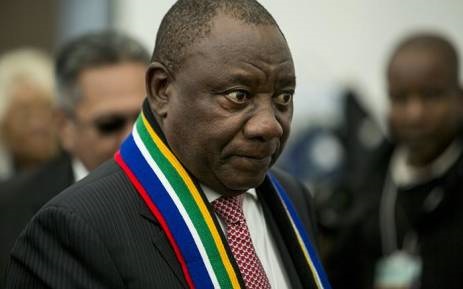
Source: Ramaphosa  expected   on Monday | Daily News South African president Cyril Ramaphosa, pictured, is expected in the country next week on Monday for the third session of the Zimbabwe-South Africa Bi-National Commission (BNC), which will among other things enhance business relations between the two countries. Deputy Information minister Energy Mutodi confirmed to the Daily […]

The post Ramaphosa  expected   on Monday appeared first on Zimbabwe Situation.

Source: Ramaphosa  expected   on Monday | Daily News

South African president Cyril Ramaphosa, pictured, is expected in the country next week on Monday for the third session of the Zimbabwe-South Africa Bi-National Commission (BNC), which will among other things enhance business relations between the two countries.

Deputy Information minister Energy Mutodi confirmed to the Daily News yesterday that Ramaphosa will be in the country on Monday next week. “The South African President Cyril Ramaphosa is expected in the country 11 March 2019 and will be on a two-day working visit. The two heads of State and government are scheduled to discuss bilateral issues agreed earlier on during the inaugural BNC meeting and the subsequent meetings.

“President Emmerson Mnangagwa is geared to revive the economy through enforcing regional and international cooperation following many years of isolation. South Africa is our biggest trading partner in Africa and we expect discussions to focus around how the two countries can improve their trade ties and grow their economies,” Mutodi said.

According to the Foreign Affairs and International Trade ministry, a team of senior government officials from South Africa will be in the country this week ahead of Ramaphosa’s visit.

“The Third Session of the Zimbabwe-South Africa Bi-National Commission (BNC) will be held on 12 March 2019 at Meikles Hotel in Harare. The meeting will be headed by the two countries’ heads of State and Government…Mnangagwa, and his South African counterpart…Ramaphosa.

“The BNC is the highest bilateral framework of cooperation between Zimbabwe and South Africa. It will be preceded by a Ministerial Meeting on 11 March 2019, and a Senior Officials meeting on 7 and 8 March 2019,” the ministry said.

South Africa has been a crucial business partner to Zimbabwe following years of economic meltdown. Millions of Zimbabweans fleeing the economic pressures at home are living in South Africa where they are working in various sectors of that country’s economy.
World leaders have been pressuring South Africa, which is Africa’s second largest economy, to assist Zimbabwe politically and economically.

Calls for such intervention increased in January following protests that led to the death of at least 17 people at the hands of alleged State security agents. There are claims the opposition leader Nelson Chamisa will likely use Ramaphosa’s visit to approach him over the country’s political environment, which has immensely affected economic growth and the country’s efforts to engage with other countries around the globe.

Chamisa, who challenged Mnangagwa’s last year presidential win, recently rejected the Zanu PF leader’s call for a meeting to discuss the framework for possible dialogue among political actors in the country. He, however, set conditions for that dialogue, which include the release of activists arrested following deadly protests in January and the need for a neutral convener.

The post Ramaphosa  expected   on Monday appeared first on Zimbabwe Situation.

Parly grills  Mangudya

Source: Parly grills  Mangudya | Daily News HARARE – Members of Parliament’s Public Accounts Committee (PAC) yesterday took Reserve Bank of Zimbabwe (RBZ) governor John Mangudya to task over the rising public debt and the activities of a vehicle established by the apex bank in 2014 to manage non-performing loans (NPLs). At yesterday’s PAC hearing that had […]

The post Parly grills  Mangudya appeared first on Zimbabwe Situation.

Source: Parly grills  Mangudya | Daily News

HARARE – Members of Parliament’s Public Accounts Committee (PAC) yesterday took Reserve Bank of Zimbabwe (RBZ) governor John Mangudya to task over the rising public debt and the activities of a vehicle established by the apex bank in 2014 to manage non-performing loans (NPLs).

At yesterday’s PAC hearing that had to be adjourned to a later date, the PAC felt that the way the burgeoning national debt was accrued over the years violated the law. For the past three decades, Zimbabwe has incurred a huge debt that now weighs heavily on the country’s economy.

Much of it, according to critics, went into funding government’s insatiable appetite for consumptive spending. Statistics put the national debt at US$16,9 billion, of which the domestic debt accounts for US$9,5 billion while US$7,4 billion is foreign debt.

In the last two years alone, a significant portion of the domestic debt was incurred through Treasury Bills (TBs) which critics allege were issued outside the RBZ’s precincts. Yesterday, Mangudya was hauled over the coals for continuing to issue the Bills.

The PAC was also not amused by the fact that the RBZ and its parent ministry of Finance did not consult Parliament before assuming external debts that included US$641 million from the Cairo-based Africa Export-Import Bank (Afreximbank); US$152 million from PTA Bank and US$25 million from Bank of Mozambique, among others.

“We, as a committee, are concerned with the issue of compliance and we would like to establish — as a matter of fact — that there was non-compliance which is why we want a breakdown of each year…,” thundered the committee chair, Tendai Biti.

“Our problem is there has been so much non-compliance with the Constitution, people not bothering to come to Parliament thus disrespecting this Parliament…,” he added.
In response, Mangudya said the RBZ Act gives the central bank relief from consulting Parliament.

The committee had also queried why the central bank had allowed government to borrow from it beyond the 20 percent statutory requirement through its overdraft facility. While Mangudya acknowledged the anomaly, amid pledges by the Finance minister Mthuli Ncube to keep the borrowings below five percent, he also took the fight to the PAC by questioning Parliament’s logic in approving a national budget which cannot be funded from the existing revenues.

“Where would Members of Parliament and Senators think the money would come from…I’m just asking because we are all to blame for this,” he said. Mangudya had to clear the air over allegations that the central bank was using the public’s deposits to finance government expenditure, saying this was not the case.

“We used the investments in the bank and not deposits from people. These are service bonds which amount to $2,9 billion.
“The RBZ can borrow funds the way it sees fit and request the minister of Finance, that’s according to the current RBZ Act.

So all the loans that we have acquired from Afreximbank, PTA Bank have all ministerial consent and legal opinion from the Attorney General’s Office …,” he said, adding that the loans were “well-structured facilities”. The committee also claimed that the bond notes introduced by the RBZ in 2016 as an export incentive had failed dismally, daring Mangudya to resign since he had indicated that he would quit if the surrogate currency fails.

Mangudya insisted that the bond notes were a success.
“For starters, people always want to put words into my mouth and I (want to) say this under oath; if the bond notes (as an export incentive scheme) fail to promote exports in this country I will resign,” he said.

He also revealed that Zimbabwe currently sits on US$500 million in foreign currency, enough to take the country for the next three to four weeks. The hearing essentially became a fishing expedition by the senior MDC official, Biti, who presided over the national purse between 2009 and 2013 when the unity government was liquidated,

While Mangudya rose to the occasion in fielding questions from the PAC, Biti, who has been using every forum presented to him to talk down Mangudya and government’s policies, was in a warring mood yesterday. He also grilled Mangudya over the Zimbabwe Asset Management Company (Zamco).

Zamco was set up in July 2014 as part of measures to deal with NPLs. Modelled along similar asset management companies in South Korea, Nigeria, Indonesia and Malaysia, the central bank had to give life to Zamco to prevent moral hazards in the banking sector where systemic vulnerabilities were quite rampant.

These NPLs were to be funded through long-term debt instruments approved by government. PAC members alleged, however, that Zamco was subjective in its acquisition of NPLs, and tended to favour political heavyweights. To the contrary, Mangudya said the vehicle mitigated a disaster that could have plunged the entire banking system and the country’s economy at large into chaos.

At the time, he argued that most companies had found themselves unable to service their loans due to a punitive interest rates regime that obtained when the country dollarised in 2009. “Zamco’s intervention was to make sure that companies become viable, secure and create employment, increase production,” he argued.

Thanks to the RBZ’s efforts, Mangudya revealed that NPLs have come down from a peak of 20 percent to eight percent.
Zamco has so far acquired 1 160 NPLs from banks valued at US$1,13 billion in the form of Treasury Bonds (Bonds), thus adding to the $6,3 domestic debt.

Mangudya said the beneficiaries have since repaid $360 million, leaving an outstanding amount of $770 million.
The committee pressed Zamco chief executive officer Cosmas Kanhai and Mangudya to disclose the names of individuals and companies that have benefited from the NPL relief.

Both declined saying they were bound by client confidentiality clauses not to disclose the names.
The PAC, however, insisted that Zamco was not a bank and that the borrowers housed in that vehicle no longer enjoyed the client-confidentiality clause.

The committee still wants Mangudya to disclose the names on his forthcoming appearance, including a breakdown of debts and TBs issued by government.

The post Parly grills  Mangudya appeared first on Zimbabwe Situation.
Ipec orders Apex pensions liquidation

Source: Ipec orders Apex pensions liquidation – DailyNews Live Business Writer      5 March 2019 HARARE – The Insurance and Pensions Fund (Ipec) has finally ordered the liquidation of Apex Corporation Pension Fund. The fund is part of Apex Corporation were the former Zimbabwe Stock Exchange (ZSE)-listed company was placed under provisional liquidation due […]

The post Ipec orders Apex pensions liquidation appeared first on Zimbabwe Situation.

Source: Ipec orders Apex pensions liquidation – DailyNews Live

Business Writer      5 March 2019

HARARE – The Insurance and Pensions Fund (Ipec) has finally ordered the
liquidation of Apex Corporation Pension Fund. The fund is part of Apex
Corporation were the former Zimbabwe Stock Exchange (ZSE)-listed company
was placed under provisional liquidation due to viability challenges after
failing to attract new investment while under judicial management in 2013.

In a government gazette, commissioner of Ipec said independent consulting
actuary David Mureriwa has been appointed liquidator of the fund. “Notice
is hereby given that Ipec has approved the liquidation of the Apex
Corporation Pension Fund in terms of Section 10(1)(a) of the Pension and
Provident Fund Act (Chapter 24:09) and Section 9.2 and 9.3 of the rules of
the Apex Corporation Pension Fund as at October 31, 2018,” the February 22
gazette said.

For Apex Corporation, creditors presented claims worth over $7 million,
among them POSB which is owed $1 million, Infrastructure Development Bank
owed $1,2 million, TelOne, $61 000 and Interfin Bank and NMB Bank whose
amounts were not disclosed.

Provisional judicial manager, Reggie Saruchera of Grant Thornton told
creditors that the company had a net asset liability of $2,6 million while
its liabilities were at $11 million. In 2016, the liquidation process
suffered a setback after there were no bidders for its commercial
properties at an auction held.

The company had 11 buildings which were being auctioned to raise money to
settle the debts. It was estimated that the company would raise about $9
million from the sale of the properties.
Apex Pension Fund is Phoenix’s major shareholder with a 46 percent stake.

The foundries and engineering group disposed of its non-performing
business units among them Phoenix Consolidated Industries, to clear the
contingent liabilities of $10 million.

The post Ipec orders Apex pensions liquidation appeared first on Zimbabwe Situation.

Chance for a youth-owned conversation

Source: Chance for a youth-owned conversation | Herald (Opinion) Leroy Dzenga Features Writer President Mnangagwa made a clarion call a few weeks ago when he challenged the youth to contribute to the country’s growth. In his eulogy at the burial of national hero Professor Callistus Ndlovu, President Mnangagwa emphasised the need to incorporate youthful reasoning […]

The post Chance for a youth-owned conversation appeared first on Zimbabwe Situation.

Source: Chance for a youth-owned conversation | Herald (Opinion)

Leroy Dzenga Features Writer
President Mnangagwa made a clarion call a few weeks ago when he challenged the youth to contribute to the country’s growth. In his eulogy at the burial of national hero Professor Callistus Ndlovu, President Mnangagwa emphasised the need to incorporate youthful reasoning into the national development narrative.

“Youthful ingenuity, creativity and innovation must be harnessed to drive our desire to leapfrog the country’s industrialisation and modernisation agenda,” he said.

“We are in a defining phase in our country’s economic history; hence, I call upon students throughout our institutions of higher learning not to be spectators in our country’s development epoch,” said President Mnangagwa.

It is dialogue season in Zimbabwe, the nation has finally realised that conversations will always be central to any effort that may lead to the attainment of its collective aspirations.

On the political front, there is movement and many are hoping that engagement at that level will define the future trajectory of Zimbabwean politics where political parties understand that there is more to national participation than elections.

As we wait for hard ground, but necessary answers, there is a separate question which needs a response from a different demographic altogether. What is the Zimbabwean dream?

The answer to the long unanswered question lies in the youth of today.

A dream in this context is an expected future ideal and it cannot be defined in the absence of 77 percent of the country’s population who are below the age of 35. So, as politics happens on one end, there was need to get young people of various beliefs, dispositions into a single space and talk.

Ideas from different sources being projected and weighed at a national platform

Thankfully, the Ministry of Youth, Sport, Arts and Recreation identified the need for a wide-ranging conversation and are acting upon it. They are in the process of organising a National Youth indaba slated for March 14.

Unlike previous scenarios where events were enunciated from a central point, the indaba will be including youths from different demographics in the planning process.

Minister of Youth Kirsty Coventry called for people to nominate young people they felt would add value if included in the team bring together the event, which will be the first of a yearly cycle.

“Zimbabwe will have a National Youth Indaba which will be an important platform for us Youth to work together in taking Zimbabwe forward. Youths are our future leaders so this annual event will be created in collaboration with our youth, for our youth,” wrote Minister Coventry on Twitter.

This if executed properly should translate in an enhanced sense of ownership in the event and its processes as the intended audience was involved in putting the puzzle together.

There are expectations that the indaba will this time not give precedence to prominent young people who already have platforms in their own spheres of influence, but to the ordinary dreamer who on a normal day would struggle to meet with policy makers.

It should also be an opportunity for the organisers to bring forward high rising young people who have managed to break barriers so as to inspire the many who will be gathered.

The event, should be backed by a genuine intent to listen to the problems being faced by the youth in the country.

Issues like unemployment, drug abuse, the increasing cost of living should naturally take centre stage as they easily come to mind if one thinks of topical problems youths have complained about at different forums.

After listening, quantifiable change should be visible in the areas raised so as to justify the convening. Additionally, young people are active within politics as foot soldiers and this is a chance for them to prove their worth in a different space altogether.

We must begin to witness a break from the past in youth political involvement and this is a chance to detoxify our polarised environment where youths play a key role.

The platform is being readied, the onus is on the youths to bring lucid presentations to the table.

They must not waste a platform by bringing generic conversations, there is need for young economists, engineers, doctors, writers and others to bring the issues to the attention of the national leadership.

This is the chance to begin the journey into a real generational consensus where there is a singular voice on what young people expect from the country they call home.

A chance for young people to define what they truly feel in the absence of political pressure or influence, where Zimbabwe will be the point of confluence. Africa is the youngest continent on the planet and Governments have begun listening to their respective social pulses, the youth.

South Sudan in August 2018 held their first ever National Youth Conference and Zimbabwe is following suit.

Maybe in future, a continental event following a similar template could help solve some of Africa’s headaches.

But for now as they say, charity begins at home.

Feedback: dzengavisuals@gmail.com.

The post Chance for a youth-owned conversation appeared first on Zimbabwe Situation.

MDC Harare West MP charged with treason

Source: MDC Harare West MP charged with treason | Daily News MDC MP for Harare West Joana Mamombe who was arrested on Saturday after attending to Parliament business in Nyanga, yesterday appeared before the Harare Magistrates’ Courts where she was formally charged with treason. Mamombe yesterday challenged her placement on remand arguing that the police […]

The post MDC Harare West MP charged with treason appeared first on Zimbabwe Situation.

Source: MDC Harare West MP charged with treason | Daily News

MDC MP for Harare West Joana Mamombe who was arrested on Saturday after attending to Parliament business in Nyanga, yesterday appeared before the Harare Magistrates’ Courts where she was formally charged with treason.

Mamombe yesterday challenged her placement on remand arguing that the police had breached the 48-hour provision, which is the time between a suspect’s arrest and the time s/he is brought before a court of law.

She said before her arrest, her mother was put under house arrest by unidentified security agents who demanded to know her whereabouts. “I had gone for a Media and Parliamentary Workshop in Nyanga and around midnight of February 25, my mother called saying she was in trouble because six men were at the house looking for me.

The second call was from one of the men who was at my mother’s house and he told me that I was in hot soup,” she said.
Mamombe told the court that she then contacted her lawyer Obey Shava to find out if she was wanted by the police and was advised that the six men at her mother’s residence were not under police sanction.

She was later arrested on Saturday before being brought to court yesterday. Her lawyer argued that the 48-hour provision had been breached. Shava also claimed that one of the arresting details Dennis Muroyiwa was a bogus cop who had been sent by the army to execute Mamombe’s arrest. Muroyiwa claimed to be a member of CID Law and order but failed to name his superiors or appreciate basic police procedures.

“You do not know anything about police structures; you do not even know your previous boss or the department where you are supposedly based. Who is making you masquerade as an officer and when are you going to return to the barracks?” Shava queried.
Allegations against Mamombe emerged on January 14, 2019, when she held a presser at Civic Centre, Marlbrough in Harare in her capacity as MDC MP.

The court heard Mamombe together with members of her constituency planned to join hands with other trade unions to coerce and invite them to overthrow President Emmerson Mnangagwa’s government.

It is further alleged the 25-year-old legislator urged members of her constituency to resort to civil disobedience and demonstrations to shut down Zimbabwe in response to public outcry over fuel price hikes, shortages and high cost of living.

The court heard that between January 14 and 16, 2019 and in response to Mamombe’s presser,  members of the opposition, various trade unionists, pressure groups, youth forums and members of the public engaged in violent protests across the country.

As a result property was destroyed, lives were lost, several police officers and members of the public were also injured.
Ruling of her bail hearing has been set for today.

The post MDC Harare West MP charged with treason appeared first on Zimbabwe Situation.