Mr President, you have the keys to opening investment opportunities 

Source: Mr President, you have the keys to opening investment opportunities – NewsDay Zimbabwe February 23, 2019 Just saying: Paul Kaseke SINCE taking office after the 2017 coup, President Mnangagwa’s administration has rallied behind the theme: “Zimbabwe is open for businesses.” This has hardly yielded any tangible results and if anything, public opinion suggests that […]

The post Mr President, you have the keys to opening investment opportunities  appeared first on Zimbabwe Situation.

Source: Mr President, you have the keys to opening investment opportunities – NewsDay Zimbabwe February 23, 2019

Just saying: Paul Kaseke

SINCE taking office after the 2017 coup, President Mnangagwa’s administration has rallied behind the theme: “Zimbabwe is open for businesses.”

This has hardly yielded any tangible results and if anything, public opinion suggests that Zimbabweans are in a worse off position than they were prior to the coup and investors have not come flocking in as claimed previously.

In my view, the reason for this is that government has failed to read the signs of an investor friendly country and furthermore, has failed to get the basics of investor confidence right.

There are many economic reasons why Zimbabwe is in the mess it is, and these have been articulated by various economists.

It’s not my plan to engage on these, but one common aspect that keeps being flagged as a precondition for engagement and investor confidence is the rule of law.

The rule of law, at its simplest, means that all individuals are subject to the law and that it must be adhered to by all. In terms of the traditional rule of law theory, where there are laws, they must be followed and nobody, including members of the Executive, is exempted from the law.

Additionally, orders of the courts must be respected. In our Constitution, the rule of law is both a founding value and principle of the Republic.

One of the biggest challenges in Zimbabwe under former President Robert Mugabe’s administration was the erosion of the rule of law.

This was manifest through the wanton disregard of laws, including those relating to property rights and freedom from torture.

Court orders were of little effect in most cases as the Zimbabwe Republic Police and other arms of the State ignored these.

Who can forget the numerous land invasion cases that were decided in favour of farmers, but were dismissed and condemned by the former President and his government?

Or the orders to reinstate mayors that were ignored by government? Who can forget the forced evictions on Arnold Farm in Mazowe, contrary to a court order?

The lengthy and unlawful detention of Zipra supremo Dumiso Dabengwa and others in the 80s and the deportation of two journalists, Winter and Andrew Meldrum, who were cleared of wrong doing by the courts, but remained guilty in the eyes of the government, comes to mind

An entire thesis can be written on what the previous administration did to erode the rule of law, but the ‘new dispensation’ is proving no different and at this rate it may well beat the track record held by the Mugabe administration (hard to separate the two since a lot of people have served under both administrations including the President himself).

I must admit to having had hopes that things would be different, but alas, not a week goes by without the Constitution being undermined and the rule of law ignored. Let’s place this in context with some examples to show what I mean.

The President has used subsidiary legislation to amend primary legislation, but this has also been done by his ministers.

It is now common cause that Parliament as the primary law maker, is the only competent body to amend primary law (statutes) and the Constitution is clear on this, but the President continues to use constitutionally repugnant laws like the Presidential Temporary Measures Act to amend laws.

The first challenge is that the Act confers the power to make regulations, but the President has, in some cases, used it to do more than that and secondly, the only proper way to amend legislation is for Parliament to do so since it enacted the laws.

This is a clear breach of our separation of powers doctrine which the country is founded on.

The security sector has embarked on a series of unlawful detentions and arbitrary arrests, contrary to the dictates of the rule of law and the Constitution.

The Human Rights Commission has already released a report on these and other issues despite the government’s denial of these acts.

The number of acquittals and the flimsiness of the charges brought against many individuals arrested during the #ShutDownZimbabwe protests is evidence of the arbitrary nature of the arrests.

The Motlanthe Commission indicated in no uncertain terms that the State’s response to the protests was both disproportionate and incompatible with the law. This has not ceased and if anything, there has been a heightened degree of continued disproportionate and lethal force by State security agents. Not only is this contrary to our Constitution, but to international law.

Instead of condemning the acts by those involved, the President has now seemingly endorsed it and threatened more for future protests, which he believes are caused by a third hand bent on removing him from office. Regrettably, the government has rubbished the report released by the Human Rights Commission, an independent constitutional commission, which is mandated to investigate human rights abuses. This too shows a disregard for the law since s235 of the Constitution is clear that the commission must be respected and allowed to work without interference. In fact, s244 of the Constitution places the government under a responsibility to action reports from the commission and to ensure that it informs it of measures it will take to remedy violation of rights reported by the commission.

Speaking of the army, there is still the question of the unlawful deployment of the forces around the country in violation of s213 of the Constitution, which requires the President to inform Parliament of where and why the army is deployed, whenever it is. Opposition legislators have raised this question, but the ministers seem to duck and dive and avoid the question altogether.

Since the rule of law requires an adherence to and respect of the law, a misuse of the law is a violation of the rule of law, yet the government has, on several occasions, made such blunders. One recent example is the appointment of the Prosecutor-General. His appointment is technically invalid on the basis that the President did not follow the set-out process and procedure once he rejected the first submitted names. Embarrassingly, during the last protests, the government purported to have a legal basis to shut down the Internet or restrict access by relying on the Interception Act. Not only does the Act not speak to the kind of power the government believes it had, but it was exercised by the wrong functionary as the High Court later declared. All these are indications of a government that is at odds with the rule of law.

One major thing that investors are attracted to is the existence of a functional, stable and reliable legal system because they can be guaranteed that should a dispute arise, it will be resolved fairly and in accordance with the country’s laws. Currently, there is no legal certainty on the enjoyment of rights because this depends on the government, ultimately. This is undesirable. We have seen that court orders are of little value in most cases where government is involved. The State security apparatus ignores these orders and, therefore, there is sometimes no enforcement of judicial orders. All these factors make it difficult for anyone to seriously invest in Zimbabwe. After all, history has shown that government, through its various agencies and regulatory groups, can ultimately frustrate a business or force it to close down if it does not meet its terms. There is no point in globetrotting and asking for investors to invest when the fundamentals of business do not exist. What guarantees do investors have that their investments are protected from government abuse or arbitrary forfeiture? How do they know that government will not unilaterally acquire interests in a company or interfere with its management? These are the basics that any investor is likely to ask before considering investing. If government cannot commit itself to the rule of law, then Zimbabwe is certainly not open for business…just saying!

Paul Kaseke is a legal adviser, commentator, policy analyst and former law lecturer with the Wits Law School & Pearson Institute of Higher Education (formerly Midrand Graduate Institute). He serves as senior managing partner and current group chair of AfriConsult Firm. He writes in his personal capacity. Feedback: justsaying@paulkasekesnr.com or follow him on Twitter @paulkasekesnr

The post Mr President, you have the keys to opening investment opportunities  appeared first on Zimbabwe Situation.

Providence native faces diplomatic challenge as U.S. ambassador to Zimbabwe

U.S. Ambassador Brian Nichols, a Moses Brown School graduate and son of a Brown University professor, has an opportunity to help foster democracy in the African nation at a “pivotal and precarious time” in its history, according to one observer. Source: Providence native faces diplomatic challenge as U.S. ambassador to Zimbabwe – Providence Journal By Mark […]

The post Providence native faces diplomatic challenge as U.S. ambassador to Zimbabwe appeared first on Zimbabwe Situation.

U.S. Ambassador Brian Nichols, a Moses Brown School graduate and son of a Brown University professor, has an opportunity to help foster democracy in the African nation at a “pivotal and precarious time” in its history, according to one observer.

Source: Providence native faces diplomatic challenge as U.S. ambassador to Zimbabwe – Providence Journal


U.S. Ambassador Brian Nichols, a Moses Brown School graduate and son of a Brown University professor, has an opportunity to help foster democracy in the African nation at a “pivotal and precarious time” in its history, according to one observer.

The air traffic control tower at the airport in Zimbabwe’s capital city has a distinctive design, inspired by African history.

A Rhode Islander willing to look past the tower’s triangular windows and other style details could easily liken it to a New England lighthouse.

But Zimbabweans associate the tower’s cone-like form with a beloved stone silo among the ruins from the Kingdom of Zimbabwe, which existed from about 1220 to 1450.

Last July, the descendants of that kingdom had much to hope for as air traffic controllers in the lookout tower coordinated with an inbound plane carrying the newly appointed U.S. ambassador, Providence native Brian Nichols, son of a Brown University professor and a graduate of the Moses Brown School.

At that time in mid-2018, less than a year after the overthrow of dictator Robert Mugabe, Zimbabweans were counting down to a long-awaited election, Nichols recalled on Thursday during a visit to Providence.

In the opinion of Nichols, a veteran Foreign Service officer and a nominee of President Donald Trump, the upcoming election was an “absolutely critical test.” Zimbabwe was approaching “a crossroads.”

Nichols had said as much to the U.S. Senate Committee on Foreign Relations just weeks before, calling for “profound” reforms in the country, as well as continued international humanitarian aid and other support.

“The government and people … have an opportunity to follow a new path,” he had said, “to become a stable and democratic country while returning to the prosperity of the past.”

Nichols also made reference to the Zimbabwean civilization credited with the stone ruins that inspired the triangular markings on the airport’s control tower and on Zimbabwe’s flag.

“Today’s Zimbabweans,” Nichols told the senators, “can look back across the centuries at a creative and complex civilization that built Great Zimbabwe and influenced an entire continent.”

He was hopeful, he said, that with the right help, Zimbabweans would “find the best path forward.”

Now, from the air, he marveled at the nation’s topography, lush and greener than he had expected. The country of Zimbabwe, named after a phrase that means “great house of stone,” awaited him.

The opportunity that Nichols had mentioned involved the ouster of Zimbabwe’s longtime dictator, Mugabe, in 2017.

Once heralded as a revolutionary leader against British colonialism and white minority rule, Mugabe had ruled Zimbabwe since 1980. During that time, the country’s economy fell apart, and Mugabe was accused of atrocities.

By late 2017, when Mugabe was in his 90s, the Zimbabwean army sensed that Mugabe’s unpopular wife, Grace, was making a power grab.

Soldiers effectively derailed any chance of that, taking to the streets and forcing the president’s resignation. Many Zimbabweans euphorically embraced the transition and anticipated a new election.

Still, the presidency was not vacant as Nichols touched down at the airport in Harare last summer.

He had plans to present his credentials to the man who had taken power from Mugabe, the country’s acting president, Emmerson Dambudzo Mnangagwa. Nicknamed “The Crocodile,” the acting president was known for wearing a scarf striped with the colors of Zimbabwe’s flag.

A candidate in the upcoming election, Mnangagwa had promised to relinquish the presidency if he lost.

He was tied, strongly, to the former Mugabe regime.

Mgangagwa has been widely blamed for brutal killings in southwestern Zimbabwe that left 10,000 to 20,000 civilians dead from 1983 to 1987, according to The Associated Press.

Known as Operation Gukurahundi — “the early rains that blow away the chaff,” in the local Shona language — the killings had been carried out by a North Korean-trained military unit known as the Fifth Brigade.

Residents in the region had been forced to attend all-night rallies for Zimbabwe’s ruling party. Men of all ages dug their own graves before they were shot and buried in them, the AP reported. Survivors, according to the AP, were forced to dance on the victims’ graves, sometimes until blood bubbled up to the surface.

Nichols, the son of a professor in Brown’s Africana studies department, intended to meet Mnangagwa as soon as possible after he arrived at Harare’s airport on July 17, setting foot in sub-Saharan Africa for the first time in his life.

Embassy staff, including the regional security officer, had brought his vehicle to the airport. The armored BMW 750′s right-side steering column makes it well-suited for Zimbabwean roads.

Within two days of his arrival, the car took Nichols to Zimbabwe’s version of the White House, a colonnaded building with ornate gables.

The ambassador entered through a front portico. A set of French doors opened. Mnangagwa was there, with the country’s foreign minister and senior officials.

Nichols recalls saying: “I have the honor to present my letters of credence from the president of the United States, which accredit me as ambassador to Zimbabwe.”

He said he then sat down with the president “and had a good conversation for a little over a half hour.”

Nichols says Mnangagwa, who speaks English quite well, told him that Zimbabwe intended to reengage with the world and turn the page on the country’s relationship with the U.S.

“He noted,” Nichols says, ”… that he was committed to changes to make Zimbabwe more democratic and a more open economy, not because the United States wanted that, but because it was the right thing to do for Zimbabwe.”

Did Nichols need to be assertive?

“The art of diplomacy,” he answers, “is communicating clearly what it is that you and your government are trying to achieve, but doing so in a manner that is … designed to achieve the objective and … to preserve a longer-term relationship.”

Nichols can trace a significant part of his interest in foreign affairs and diplomacy back to Moses Brown, where he says teachers encouraged students to put effort into understanding other people, including people from other backgrounds elsewhere in the world.

“Promoting consensus,” was another value deeply ingrained in the school’s teaching, he says, recalling an approach where people on opposing sides of an issue meet with each other until they find consensus.

With such values helping to guide him, Nichols says he’s quite happy to say that the U.S., despite its polarizing domestic politics, has managed to produce a bipartisan policy toward Zimbabwe. He credits both the Trump administration and others, too, including Trump critic and Zimbabwe observer, former U.S. Sen. Jeff Flake.

With direction from a law that Flake helped to pass in 2018, U.S. policy aims to reform the government and economy left by Mugabe. With help from Nichols last year, the U.S. provided just over $293 million in assistance while enforcing sanctions targeting 144 specific persons or companies linked to Zimbabwe’s government leaders.

“I think it is the right approach,” the 53-year-old says, describing the response as appropriate to the Zimbabwean government’s gross corruption and serious human-rights violations, particularly during the Mugabe era.

So far, the policy has not produced all of the desired results.

“Ambassador Nichols has arrived in Zimbabwe at a really pivotal and precarious time, which is exciting for a diplomat,” says a prominent Zimbabwe observer, Todd Moss, a senior fellow at the Center For Global Development. “But it also makes it difficult.”

“It’s going to be a challenge,” Moss says.

The election itself, while a marked improvement from the Mugabe era, fell short of international standards, according to observers sponsored by the U.S.

The situation worsened in August, when soldiers dealt with rioting protesters by shooting indiscriminately into crowds, wounding dozens and killing six, according to a Washington Post report.

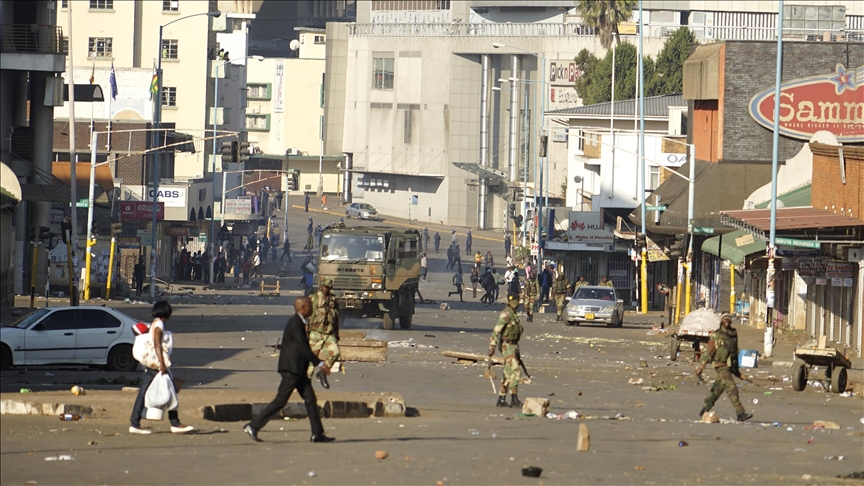
More recently, in January, protesters acted out again after the government doubled fuel prices, barricading streets, setting fire and looting. Some published reports say the government’s response left 12 dead and hundreds jailed. Government forces engaged in “systematic torture,” according to a human rights commission.

As pessimism has set in among those previously hopeful for real change, Nichols calls some of the developments “disturbing,” but the former ambassador to Peru says he also sees “significant steps.”

The diplomat says he is gratified that he and Mnangagwa have been able to have “very frank” discussions. He saw him twice in the weeks before Nichols returned to Rhode Island to celebrate his mother’s 90th birthday on Saturday.

“I’ve been very straightforward in the priority that we place on issues like the rule of law, development of democracy and respect for human rights in Zimbabwe and our desire to have a positive and constructive relationship with the country going forward,” he told The Providence Journal during the interview on Thursday.

Nichols says he has continually delivered one message:

“Our desire,” he says, “is to see those pillars that he campaigned on and talked about in his inaugural address, implemented.”

The post Providence native faces diplomatic challenge as U.S. ambassador to Zimbabwe appeared first on Zimbabwe Situation.
GOOD NEWS: Mnangagwa’s government to provide basic commodities at fair and affordable prices

Government is presently developing the framework for providing basic commodities at fair and affordable prices within the next two months. President Emmerson Mnangagwa has already given his blessings to the programme, which is expected to cushion consu…

Government is presently developing the framework for providing basic commodities at fair and affordable prices within the next two months. President Emmerson Mnangagwa has already given his blessings to the programme, which is expected to cushion consumers against extortionate and punitive prices. The envisaged programme will begin in rural areas before spreading to urban centres. […]

Activist released after month in prison

Source: Activist released after month in prison | Daily News BULAWAYO – Activist Charles Thomas who was arrested last month for allegedly stoning a police officer to death during violent protests that rocked the second largest city has been released on bail. Thomas, who is jointly charged with Bernard Sibanda spent more than a month […]

The post Activist released after month in prison appeared first on Zimbabwe Situation.

Source: Activist released after month in prison | Daily News

BULAWAYO – Activist Charles Thomas who was arrested last month for allegedly stoning a police officer to death during violent protests that rocked the second largest city has been released on bail.

Thomas, who is jointly charged with Bernard Sibanda spent more than a month behind bars as their lawyer Dumisani Dube of Mathonsi Ncube Attorneys fought to secure their release.

Yesterday, Bulawayo High Court judge Nokuthula Moyo granted the two $100 bail each and remanded them to March 11, for commencement of their trial.

The court heard that during the shut-down protests last month Thomas and Sibanda ganged up with a mob who stoned Zimbabwe Republic Police officer Ekson Maune, leaving him for dead.

Maune succumbed to the injuries the following day at the United Bulawayo Hospitals (UBH) where he was admitted in the Intensive Care Unit (ICU).

The court heard the deceased who was in police uniform, was carrying out his duties of maintaining peace and order in Njube Suburb when he got attacked.

Just before his arrest, Thomas had organised a march from Large City Hall to the Bulawayo High Court to deliver a petition as part of a push to set up a special commission to address the Gukurahundi post-independence mass killings. However the march was blocked by the police.

Thomas was once arrested alongside exiled Paul Siwela in 2011 then under the banner of Mthwakazi Liberation Front, a secessionist movement for allegedly distributing fliers calling on Zimbabweans to revolt against the government.

The two were charged with treason. However, Thomas was later acquitted while Siwela fled the country during his trial after he claimed that his life was in danger.

The post Activist released after month in prison appeared first on Zimbabwe Situation.

Zimbabwe: New face to an old regime

As it stands, Zimbabwe is a fragile climate in which citizens are subjected to harsh police actions and the president has no short-term solutions – Anadolu Agency Source: Zimbabwe: New face to an old regime – Anadolu Agency ISTANBUL  President Emmerson Mnangagwa’s 150-percent fuel hike announcement almost three weeks ago triggered protests, which followed brutal police […]

The post Zimbabwe: New face to an old regime appeared first on Zimbabwe Situation.

As it stands, Zimbabwe is a fragile climate in which citizens are subjected to harsh police actions and the president has no short-term solutions – Anadolu Agency

Source: Zimbabwe: New face to an old regime – Anadolu Agency

ISTANBUL 

President Emmerson Mnangagwa’s 150-percent fuel hike announcement almost three weeks ago triggered protests, which followed brutal police measures. With his words taking immediate effect, the public took to the streets. This was not the hope envisioned for a post-Mugabe government. The unrest continues to escalate each day, and Mnangagwa finds himself increasingly positioned between a rock and a hard place.

The fuel price increase is not a sudden decision but one made after an economic bottleneck caused by a lack of resources left little room for maneuver. Inflation is no stranger to Zimbabwe’s currency, and bond notes could only temporarily hold the crumbling economic pillars. Although Finance Minister Mthuli Ncube has expressed the introduction of a new currency, there has been no substantial progress or clarity as to how much of a change this would bring.

The protests ensued as the police resorted to iron-fist tactics to establish some form of order. Zimbabwean-based independent journalist Frank Chikoware explained that violent nighttime police raids and summary daytime trials were exacerbating the security condition. Furthermore, arrests do not leave enough time for any proper defense to be made. This is combined with an increase in public melancholy over the political affairs and people see the democratic future of Zimbabwe rapidly turning into merely an optimist’s far-fetched dream.

“While Mnangagwa is trying to portray himself as a reformist, he is not walking the talk as he continues to target those with dissenting voices, especially pro-democracy campaigners,” said Chikowore.

Although the president brought a new ruling face in late 2017, it seems rather like a façade masking the old familiar oppressive force whose use of live ammunition had become the standard practice against protest rallies, and crackdowns on dissenting voices have become the terrifying norm.

After Mnangagwa’s failed attempt to convince Russia to invest, the Zimbabwean president had to cut short his foreign financial tour. In a Machiavellian tactical response, the president had to sacrifice investments to protect his rule. A monarchical ruler cannot spend too long outside his kingdom particularly if there is an ambitious opposition waiting for the opportunity to overthrow him. Although the opposition within the ruling Zimbabwe African National Union – Patriotic Front (ZANU-PF) remains minuscule and is at most only partially influential, in Zimbabwe’s delicate atmosphere, it takes but a moment to achieve a political outcome from chaos.

The UN Human Rights Commission has called for the Zimbabwean government to resort to negotiations rather than its current abusive action. The evasion of a dialogue approach is eroding the confidence of foreign investors, who favor stable socio-political climates. Nelson Chamisa, the leader of the opposition Movement for Democratic Change Alliance (MDC), has also been advocating for national dialogue but his calls have so far been to no avail. It seems unlikely for Mnangagwa to adopt a softer stance when using force sets him as the lion of his forest.

However, these ‘jungle cat strategies will just paw the political ball out of his reach’, as it were, unless he somehow manages to secure investment from Russia despite the lack of public approval from them. This grants Putin a more powerful position, rather than appearing as a simple savior who is trying to address his country’s economic woes. The other alternative is for Mnangagwa to appeal to the good relations he established with China during his vice presidency. If China were to decide to extend a helping hand, then Zimbabwe would have to sacrifice more than it wanted to bargain for. These options are not contingent on whether Mnangagwa has a positive global image or not. The art of the deal takes precedence here. Or it might as well take a president to achieve.

Mnangagwa’s announcements on deals with China and Russia have nothing real on the ground, according to Chikoware. It certainly raises the doubts as to whether the new foreign investments would ever reach people or be simply funneled into certain pockets in the process. Total internet shutdowns and a president appalled by televised police abuses give the impression of an almost oblivious leader, which does not bode well for his public credibility.

In addition, the presidency’s claim of innocence has lost credibility since it has pinned the military “misconduct” on Vice President Constantino Chiwenga for far too many times. The blame game depicts a weakness that Zimbabwe cannot afford to have at this time. It needs a clear direction with honest admissions on the country’s problems. However, transparency could reveal a president glued to Mugabe’s throne with the engravings of a past ruler’s calamitous economic policies still damaging a country attempting to recover.

As it stands, Zimbabwe is a fragile climate in which citizens are subjected to harsh police actions and the president has no short-term solutions. If Mnangagwa can initiate a dialogue, he will only find hesitation in his interlocutors because trust must be rebuilt. Using the police force may seem like a quick and easy solution for the president but such decisions will apparently lead to the repetition of what happened as a result of the previous regime’s systemic faults: a president eventually removed.

* Opinions expressed in this article are the author’s own and do not necessarily reflect the editorial policy of Anadolu Agency.


The post Zimbabwe: New face to an old regime appeared first on Zimbabwe Situation.