COMESA chairmanship: Bulawayo’s golden ticket to industrial revival

Source: COMESA chairmanship: Bulawayo’s golden ticket to industrial revival – herald Nqobile Bhebhe Zimpapers Business Hub BULAWAYO should use Zimbabwe’s position as chair of the Common Market for Eastern and Southern Africa (COMESA), which it assumes in October, as a springboard for industrial revival given its comparative advantages. Zimbabwe’s second-largest city boasts an established manufacturing […]

The post COMESA chairmanship: Bulawayo’s golden ticket to industrial revival appeared first on Zimbabwe Situation.
Source: COMESA chairmanship: Bulawayo’s golden ticket to industrial revival – herald

Nqobile Bhebhe Zimpapers Business Hub

BULAWAYO should use Zimbabwe’s position as chair of the Common Market for Eastern and Southern Africa (COMESA), which it assumes in October, as a springboard for industrial revival given its comparative advantages.

Zimbabwe’s second-largest city boasts an established manufacturing base, a skilled workforce and strategic location, which position it to capture a larger share of the regional market.

This comes as the country prepares to assume the 2026-2027 COMESA rotational chairmanship for the 2026-2027 term in October, presenting Bulawayo with a window to rebuild its industrial base.

Experts believe that this leadership role boosts national diplomatic clout and accelerates domestic economic growth under Vision 2030, by which Zimbabwe is targeting to have achieved upper-middle-income status.

Bulawayo has a good opportunity to position itself well for increased access to a regional market of more than 640 million people and a combined Gross Domestic Product of nearly US$1 trillion.

COMESA links 21 member states and holds billions in untapped intra-regional trade potential, anchored by vast agricultural, mineral and manufacturing expansion goals through deeper market integration and tariff elimination.

Key COMESA trade terms centre around preferential market access, simplified border procedures and regional integration frameworks designed to eliminate barriers among member states.

Still grappling with deindustrialisation, ageing machinery, high production costs, electricity challenges and limited access to affordable finance, Zimbabwe’s COMESA chairmanship can provide fresh impetus for investment, market expansion and industrial retooling.

Regional trade expert Mr Alois Chibvuri said Bulawayo had the industrial capabilities required to become a regional manufacturing hub if its infrastructure and utility constraints were addressed.

“Bulawayo has the industrial base, the skills and the infrastructure to become a major manufacturing centre for the region, but this will depend on investment in infrastructure and reliable utilities,” said Mr Chibvuri.

He said the city’s concentration of manufacturing companies, engineering firms and supporting industries provided a platform to respond to growing regional demand for value-added products.

“This could create opportunities for Bulawayo and surrounding manufacturers producing steel products, engineering equipment, processed foods, textiles, chemicals and mining supplies,” he said.

Economist Ms Alice Chikonzo said Bulawayo’s existing industrial ecosystem was an advantage that could help the city attract investment and regain its position as an industrial powerhouse.

“Bulawayo has an existing industrial ecosystem and that is an advantage. What is required is to recapitalise industry, improve infrastructure and make it easier for companies to export competitively into the region,” she said.

Industrialist Mrs Monica Moyo said the development of the Bulawayo Special Economic Zone (SEZ) can provide an important economic base from which the city could position itself for increased regional trade and investment.

Bulawayo has for close to four decades transitioned from Zimbabwe’s thriving manufacturing capital into a quiet industrial zone due to economic decline, factory closures and relocations.

The Government’s ongoing initiatives, new agro-processing investments and plans for SEZs have sparked hope that the city can rebuild its industrial base.

Bulawayo’s industrial areas (Belmont, Donnington and Kelvin) were formally declared and approved as SEZs effective August 24, 2018. An upgraded framework for an Integrated Provincial

Special Economic Zone for Bulawayo received Cabinet approval on May 26, 2026.

She said businesses should begin aligning their operations and investment plans with opportunities emerging from the SEZ rather than waiting until the infrastructure was fully developed.

“Bulawayo’s business sector needs to be proactive and position itself now. The COMESA chairmanship will create visibility for Zimbabwe, but businesses must be ready with products, partnerships and market strategies to take advantage of that exposure,” said Mrs Moyo.

Mrs Moyo said the SEZ, combined with Bulawayo’s existing industrial base and regional connectivity, could create a stronger platform for attracting investors targeting the COMESA market.

“The Bulawayo Special Economic Zone is another economic base that the city can capitalise on. It can complement the existing industrial base by attracting new investment, encouraging value addition and creating capacity for companies to produce competitively for regional markets,” she said.

She said the SEZ should be viewed as part of a broader strategy to reposition Bulawayo as a manufacturing and distribution centre.

“Businesses should be looking beyond the summit itself and asking what products they can take into the COMESA market, which countries offer the greatest opportunities and what partnerships they need to establish. This is an opportunity to expand beyond the domestic market and businesses in Bulawayo should make use of it.”

Bulawayo’s location along major regional transport routes linking Zimbabwe with Botswana, South Africa and Zambia further strengthens its prospects of becoming a manufacturing and distribution gateway.

Its connectivity to the Beitbridge and Plumtree corridors provides access to major regional markets, while improved links towards Zambia and the Democratic Republic of Congo could open further opportunities for locally manufactured products.

The development and upgrading of the Bulawayo-Beitbridge corridor could also strengthen the city’s links to the port of Durban, potentially improving the movement of raw materials and finished products.

However, experts said the geographical advantage would only translate into export growth if supported by reliable electricity, efficient rail and road infrastructure, streamlined border processes and competitive logistics costs.

Ms Chikonzo said local companies should build on Bulawayo’s industrial heritage instead of waiting for new opportunities to emerge.

“Bulawayo already has an industrial foundation, and the private sector should build on that advantage rather than waiting for someone else to create the opportunities. Companies need to engage with Government, trade promotion agencies and regional buyers and position themselves for increased demand,” she said.

Zimbabwe will host the 25th COMESA Heads of State and Government Summit at the new Parliament Building in Mt Hampden on October 22 under the theme: “One Market, One Future: Advancing Inclusive Industrialisation, Investment and Regional Integration in COMESA.”

The chairmanship comes as COMESA seeks to boost intra-regional trade, which remains relatively low despite the existence of a free trade area and various trade facilitation instruments.

Economic analyst Mr Kangausaura Mahawani said Zimbabwe should treat the chairmanship as an economic opportunity rather than simply a diplomatic milestone.

“COMESA has a market of over 640 million people with a combined GDP of nearly US$1 trillion, but intra-COMESA exports are only about US$14 billion.

“That means there is still a lot of untapped potential for regional trade,” said Mr Mahawani.

He said Zimbabwe already had a base from which to expand exports.

“Zimbabwe already has a platform to build on. According to statistics from ZimStat, our exports to COMESA range from iron and steel products, tobacco products, coke and coal, agricultural machinery, paper products and other manufactured commodities.

“We have also witnessed the impact of focused market growth with Zimbabwe’s exports to DRC increasing from an estimated US$26,6 million in 2019 to US$132,2 million in 2023, while Zimbabwean companies won confirmed orders of about US$5,77 million at DRC Mining Week in 2025.”

Mr Mahawani urged companies to understand COMESA trading rules, improve competitiveness and build distribution networks in target markets.

“The private sector should consequently use the chairmanship to actively seek markets throughout the 21-member bloc, especially for value-added products.

“Companies need to grasp the laws of origin and trade preferences of COMESA, enhance product quality and packaging, increase manufacturing capacity and develop distributors and strategic alliances in individual markets,” he noted.

He said financial institutions and trade promotion agencies also had a role to play in supporting exporters.

“Institutions such as ZimTrade need to ramp up market information and business-to-business linkages. Initiatives like the Kasumbalesa warehouse in Zambia, which acts as a gateway to the DRC and the wider COMESA market, are crucial because firms need physical distribution infrastructure on the ground.”

For Bulawayo, the COMESA chairmanship therefore presents more than diplomatic visibility. The city’s existing industrial base, the planned SEZ and strategic transport links provide several economic platforms that can be leveraged to expand production, attract investment and penetrate regional markets.

Ultimately, Mr Mahawani said, the success of Zimbabwe’s chairmanship would be measured by commercial outcomes rather than the number of meetings held.

“At the end of the day, the economic success of Zimbabwe’s COMESA chairmanship should not be assessed by the meetings and agreements made, but whether Zimbabwean enterprises get new clients, new markets and raise the country’s share of intra-COMESA trade.

“We have a chance to turn regional leadership into regional market share,” said Mr Mahawani.

The post COMESA chairmanship: Bulawayo’s golden ticket to industrial revival appeared first on Zimbabwe Situation.

NEW: Zimbabwe ready for second phase of the exhumation and repatriation of South African liberation fighters, President Mnangagwa says

Source: NEW: Zimbabwe ready for second phase of the exhumation and repatriation of South African liberation fighters, President Mnangagwa says – herald Nduduzo Tshuma in PRETORIA, South Africa ZIMBABWE is ready to facilitate the second phase of exhumation and repatriation of South African liberation fighters who died in exile in Zimbabwe, President Mnangagwa has said. […]

The post NEW: Zimbabwe ready for second phase of the exhumation and repatriation of South African liberation fighters, President Mnangagwa says appeared first on Zimbabwe Situation.

Source: NEW: Zimbabwe ready for second phase of the exhumation and repatriation of South African liberation fighters, President Mnangagwa says – herald

Nduduzo Tshuma in PRETORIA, South Africa

ZIMBABWE is ready to facilitate the second phase of exhumation and repatriation of South African liberation fighters who died in exile in Zimbabwe, President Mnangagwa has said.

He also called for closer collaboration between the two countries in preserving and curating their shared history of the struggle against colonialism and apartheid.

The call comes amid heightened cooperation between Zimbabwe and South Africa in the heritage sector, with President Mnangagwa in April receiving the Zimbabwe Bird, a plinth, ancestral human remains and wartime digital photographs repatriated from South Africa.

South Africa’s Minister of Sports, Arts and Culture Mr Gayton McKenzie officially handed over the artefacts to President Mnangagwa at State House in Harare following a directive by South African President Cyril Ramaphosa.

In September 2024, Zimbabwe handed over to South Africa the remains of 16 South African liberation stalwarts who died in Zimbabwe during the struggle against the apartheid regime.

Speaking during the Zimbabwe-South Africa Bi-National Commission here on Friday, President Mnangagwa said the two countries enjoyed excellent relations founded on shared history, solidarity, geography and enduring people-to-people ties.

“I am most grateful to you, Your Excellency President Ramaphosa, for the timely intervention in the repatriation of the Zimbabwe Bird, the plinth and eight ancestral human remains, along with wartime digital photographs. Your personal leadership and devotion in handling this delicate and sacred exercise demonstrates Pan-African solidarity and shared commitment to the restitution and rectification of past injustices,” said President Mnangagwa.

“In September 2024, Zimbabwe handed over to South Africa 16 remains of South Africa’s fallen liberation stalwarts who passed on in Zimbabwe during your country’s fight against the brutal apartheid regime. My Government is ready to facilitate Phase II of the exhumation and repatriation programme of formerly exiled South Africans who died in Zimbabwe.”

President Mnangagwa also reiterated his invitation for South Africa to participate in the development of the Museum of African Liberation, which is being spearheaded by the Institute of African Knowledge (INSTAK).

“In our view, South Africa’s heroic anti-apartheid struggle for the dignity of our people deserves to be appropriately curated and immortalised at the museum, alongside others of the continent,” he said.

“Zimbabwe looks forward to South Africa taking steps to develop land allocated to it at the Museum of African Liberation. The museum provides a unique platform to showcase the country’s heroic anti-apartheid struggle and its significant contribution to the liberation of African countries.”

This, the President said, will go a long way in preserving this legacy, as well as inspiring present and future generations.

The post NEW: Zimbabwe ready for second phase of the exhumation and repatriation of South African liberation fighters, President Mnangagwa says appeared first on Zimbabwe Situation.

NEW: AFM church commended for socio-economic development, handed 50 hectares for university by President Mnangagwa

Source: NEW: AFM church commended for socio-economic development, handed 50 hectares for university by President Mnangagwa – herald Zvamaida Murwira PRESIDENT MNANGAGWA has commended the Apostolic Faith Mission in Zimbabwe for various socio-economic developmental projects that include construction of schools and health facilities. In a speech read on his behalf by Defence Minister Oppah Muchinguri-Kashiri […]

The post NEW: AFM church commended for socio-economic development, handed 50 hectares for university by President Mnangagwa appeared first on Zimbabwe Situation.

Source: NEW: AFM church commended for socio-economic development, handed 50 hectares for university by President Mnangagwa – herald

Zvamaida Murwira

PRESIDENT MNANGAGWA has commended the Apostolic Faith Mission in Zimbabwe for various socio-economic developmental projects that include construction of schools and health facilities.

In a speech read on his behalf by Defence Minister Oppah Muchinguri-Kashiri at the church’s annual general conference held today at Rufaro Conference Centre in Chatsworth, Masvingo province, the President said the church continued to register several milestones in complimenting Government’s efforts to improve people’s lives.

He said his administration recognised AFM in Zimbabwe as a consistent, dependable and reliable partner in the country’s ongoing development agenda.

“The unbreakable relationship between the State and the Church is one that we cherish and continue to strengthen. After all, we share a common responsibility towards moulding a morally upright united, peaceful and prosperous nation,” said President Mnangagwa.

“The church’s role in a modern-day economy is not only limited to prayer but broadly to also help build, industrialise and modernise our country. Together, let us work hand in hand, accelerating the realisation of our national development aspirations and Vision 2030.”

AFM in Zimbabwe leader Bishop Amos Madawo pledged to continue working with the Government.

Minister Muchinguri-Kashiri later handed an offer letter of 50 hectares of land to the church to construct a university as part of its contribution to heritage-based education 5.0 Model and also commissioned Rufaro Clinic, which was constructed by the church to provide health services to the local community.

The post NEW: AFM church commended for socio-economic development, handed 50 hectares for university by President Mnangagwa appeared first on Zimbabwe Situation.

Ingwebu on brink of collapse, loses US$250 000 a month

Source: Ingwebu on brink of collapse, loses US$250 000 a month – herald Sunday News Reporter INGWEBU Breweries is technically insolvent and losing about US$250 000 every month, with the City of Bulawayo warning that the struggling municipal-owned company could collapse unless it urgently secures private investment of up to US$5 million. The revelations are […]

The post Ingwebu on brink of collapse, loses US$250 000 a month appeared first on Zimbabwe Situation.

Source: Ingwebu on brink of collapse, loses US$250 000 a month – herald

Sunday News Reporter

INGWEBU Breweries is technically insolvent and losing about US$250 000 every month, with the City of Bulawayo warning that the struggling municipal-owned company could collapse unless it urgently secures private investment of up to US$5 million.

The revelations are contained in a confidential council report submitted by the Town Clerk to council on July 13, detailing the deteriorating financial and operational position of the brewery.

According to the report, Bulawayo mayor, Councillor David Coltart revealed that the City was not in a financial position to inject the capital required to rescue Ingwebu and directed the company’s board to urgently engage potential investors,

“He (Clr Coltart) directed the Board to urgently engage with both Mutapa and Innscor and obtain formal written investment proposals without delay to facilitate informed decision- making.

“He advised that, should the company fail to secure satisfactory investment proposals, the Board should immediately initiate corporate rescue proceedings to safeguard the business and its stakeholders. The Mayor cautioned that the company had only a narrow window of opportunity to secure its future and stressed that urgent action was required,” reads the report.

The mayor further revealed that the company is now insolvent and is incurring losses of approximately US$250 000 per month.

He said the brewery required a substantial capital injection of approximately US$5 million to restore operations, adding that cost-cutting measures already implemented were insufficient to reverse its deteriorating financial position.

The revelations come as Ingwebu struggles with ageing machinery, unreliable production equipment, inadequate working capital, poor distribution and declining product quality, while employees have reportedly gone without salaries.

The brewery’s board chairperson, Mr Kalani Ndlovu told the meeting that the company was facing “significant operational and financial challenges”, with previous investments failing to be strategically co-ordinated and ageing machinery severely affecting production capacity.

“He emphasized the need to attract private equity investment and recommended actively engaging potential investors. He informed the meeting that Mutapa, Inscor and Delta had expressed interest in investing in the company. However, he noted that progress with Mutapa had been delayed due to Government processes. Despite the institution having requested the company’s documentation and indicating its willingness to provide funding.

“The board chairperson further recommended that a forensic audit be undertaken before any investment transaction proceeded. He proposed that a comprehensive investment proposal, supported by evaluated cash flow projections, be prepared within 30 days,” reads the report.

The board chairperson revealed that Ingwebu had failed to secure additional funding from Ecobank and that its weak financial position meant shareholders would need to inject fresh capital.

The brewery’s managing director, Mr Dumisani Mhlanga painted an equally bleak picture of the company’s production capacity.

Of the six boilers the brewery originally operated, only one remains functional, with the remaining unit described as unreliable.

The boiler reportedly operates for about two days before breaking down and requiring between three and four days of repairs, severely disrupting brewing operations.

“As a result, production capacity has declined, leading to poor product quality He noted that customers had increasingly complained about the quality of Ingwebu products, with many switching to competing brands

“The managing director also identified poor distribution as another major challenge, explaining that the company’s delivery trucks frequently broke down, affecting product availability He emphasized that distribution challenges should be addressed as a priority. He also noted a shortage of refrigeration equipment despite customer preference for chilled products,” reads the report.

Despite the challenges, management believes Ingwebu can still be revived.

A two-phase recovery plan has been developed, with the first phase requiring an estimated US$2,7 million.

The funding would include about US$180 000 for a second-hand boiler, among other interventions.

Management also proposed the installation of a pasteurisation plant to improve the shelf life of the company’s Cream Tataa product, which currently lasts only 15 days because Ingwebu does not have pasteurisation facilities.

“Regarding phase two, the managing director stated that it would require substantial capital investment and would focus on the company’s long-term sustainability. He informed the Committee that both Delta and Mutapa had expressed interest in investing in the company.

“He further advised that representatives from Mutapa were expected to visit on Friday, with the intention of concluding discussions by August 2026. He emphasized that external investment represented the most viable long-term solution for the busıness, reads the report.

In the ensuing debate, councillors warned that the collapse of Ingwebu would have wider economic and social consequences.

Councillor Mxolisi Mahlangu said all efforts should be made to secure investment, particularly from Mutapa, before considering closure of the brewery.

He called for a stakeholder engagement plan to address concerns among paid and unpaid employees and improve strained relations between workers and management.

In response, the managing director said the company had secured US$13 000 on the previous Sunday, allowing it to make a once-off payment of US$100 to some employees.

However, he said the funds were inadequate to meet the expectations of all workers and that the company also lacked sufficient money to buy raw materials, further hampering production.

The post Ingwebu on brink of collapse, loses US$250 000 a month appeared first on Zimbabwe Situation.

BEYOND TRADE! Zim, SA step up regional industrial integration

Source: BEYOND TRADE! Zim, SA step up regional industrial integration – herald Nduduzo Tshuma in Johannesburg, South Africa ZIMBABWE’S economic resurgence and growing appeal as a safe investment destination, driven by policy reforms under President Mnangagwa, took centre stage at the Zimbabwe-South Africa Business Forum here yesterday amid calls for deeper economic cooperation to drive […]

The post BEYOND TRADE! Zim, SA step up regional industrial integration appeared first on Zimbabwe Situation.

Source: BEYOND TRADE! Zim, SA step up regional industrial integration – herald

Nduduzo Tshuma in Johannesburg, South Africa

ZIMBABWE’S economic resurgence and growing appeal as a safe investment destination, driven by policy reforms under President Mnangagwa, took centre stage at the Zimbabwe-South Africa Business Forum here yesterday amid calls for deeper economic cooperation to drive regional growth.

The forum, held on the sidelines of the Fourth Zimbabwe-South Africa Bi-National Commission (BNC), brought together 250 business leaders from the two countries, with the discussions focusing on moving beyond traditional trade towards investment, industrialisation, innovation and value addition.

Addressing the Presidential Session at the Gallagher Convention Centre in Midrand, President Mnangagwa said the two countries should strengthen their economic partnership by pursuing joint investment, research, innovation and high-impact projects.

He said recent SADC engagements in Durban had reinforced the importance of industrialisation in driving regional development, with Zimbabwe and South Africa playing pivotal roles in advancing that agenda.

President Mnangagwa said disruptions to global supply chains, rapid technological advances and growing competition for strategic resources had exposed the vulnerability of countries that lacked strong productive capabilities.

“Our answer is not to withdraw from the world, but to participate in it from a stronger position. That position of strength is derived from closer cooperation back home, and here,” he said.

He said Zimbabwe remained committed to working with its neighbours, the region, Africa and international partners to strengthen production, innovation and livelihoods.

The President said while Southern Africa was endowed with critical minerals, fertile agricultural land, industries, universities and technical institutions, the region must ensure its natural resources feed local industries instead of creating value elsewhere.

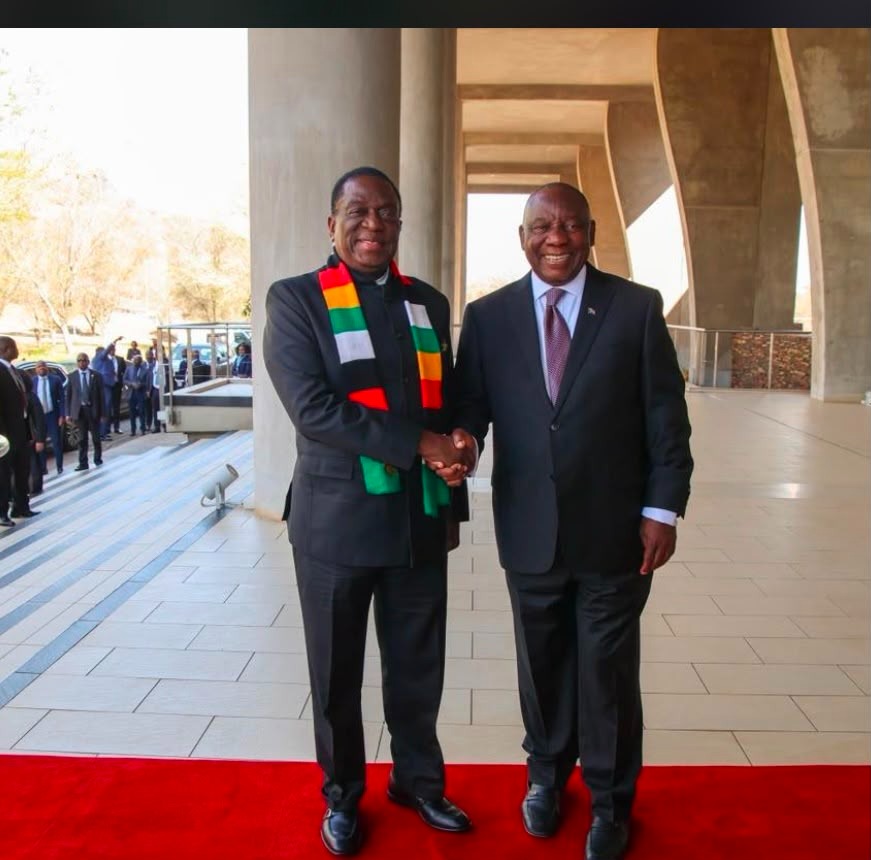
Presidents Mnangagwa and Cyril Ramaphosa

He said young people represented another important resource, with universities, tertiary institutions and innovation hubs already producing ideas and prototypes in agriculture, mining, manufacturing, engineering, energy and information technology.

President Mnangagwa called on financial institutions, development finance institutions and private investors to identify promising innovations and support their mass production, saying some of the industrial solutions required by the region could already be in the hands of its young people.

“Some of the industrial solutions we require may already be sitting in the hands of our young people. This is where the relationship between Zimbabwe and South Africa assumes even greater importance,” said the President.

“Our co-operation must not be limited to how much we sell to one another. We need to consider partnerships across the borders, that is, what we can do together.”

Zimbabwean and South African businesses, President Mnangagwa said, are already interconnected through trade in machinery, technology, inputs, services and markets, but the next step should be co-investment, joint research, technological innovation and mobilisation of financing for regional high-impact projects.

“Then, our businesses can use these partnerships to reach markets beyond Zimbabwe and South Africa. That is how a bilateral relationship begins to contribute to the transformation of an entire region,” he said.

President Mnangagwa said governments would continue providing political direction through the BNC and other frameworks while creating an environment where productive investment could thrive, technology could be exchanged and innovation commercialised.

President Ramaphosa said his country was Zimbabwe’s largest single source of imports from the rest of the world, but there remained considerable scope to grow bilateral trade.

He welcomed Zimbabwe’s decision to eliminate trade restrictions in line with SADC trade protocols, saying this would help unlock further opportunities between the two economies.

He said the African Continental Free Trade Area also presented an opportunity to expand intra-African trade but stressed that businesses had to turn government agreements into tangible economic activity.

“Governments can determine policy, sign agreements and ratify protocols, but it is business that turns a signed agreement into a shipment, a factory or a job,” he said.

President Ramaphosa said South Africa regarded Zimbabwe as a key regional market for its goods, products and services and remained optimistic about the prospects of the Zimbabwean economy.

Citing the African Development Bank, he said Zimbabwe’s real GDP growth rose to an estimated 7,5 percent in 2025, driven by growth in sectors including mining and agriculture, while inflation had declined following the introduction of the Zimbabwe Gold currency.

He said greater economic stability and predictability would give South African exporters and investors confidence to commit capital at scale.

“Zimbabwe is moving ahead in more ways than one, is modernising, it is punching ahead, growing at 7,25 percent and so the economy of Zimbabwe is in great recovery. The mining sector is growing and they are doing a number of very wonderful things,” said President Ramaphosa.

“The Zimbabwe that we are dealing with, that we are trading with is a Zimbabwe that is on the move. So, for us as South Africa, it is a real joy to have a neighbour on our northern side who is growing, becoming a market for us but also a neighbour who would want to start making South Africa a market, creating finished goods that they can bring to South Africa so that we are not the only ones that export finished goods.

“This is where the equalisation must come from; we don’t compete against each other, we compete with each other against the world and indeed the continent.”

President Ramaphosa said the modernisation of the Beitbridge Border Post had helped address long-standing challenges, including inadequate infrastructure, inefficient processes and limited staffing, which had previously resulted in trucks waiting several days to cross.

He said the developments formed part of a broader vision for a corridor linking the Port of Durban to the Democratic Republic of Congo, transforming transport routes into arteries of industry, commerce and employment.

The Musina-Makhado Special Economic Zone was cited as an example of the potential to develop industrial corridors supporting mining beneficiation, agriculture, agro-processing, milling and packaging.

President Ramaphosa said Zimbabwe’s exports of gold, chromium ore and semi-finished steel to South Africa presented opportunities for joint ventures that would ensure more refining and finishing took place within the region.

The two governments have established a Joint Technical Committee on Trade and Industry to facilitate cooperation in industrial value chains, infrastructure, special economic zones, trade, tourism, transport and logistics, while work is also progressing on a draft Memorandum of Understanding on Economic Cooperation.

President Ramaphosa said the Business Forum should translate these frameworks into partnerships that create decent jobs, particularly for women and young people, transform value chains and combine the strengths of both economies.

Meanwhile, President Mnangagwa arrived back home last night and was welcomed at the Robert Gabriel Mugabe International Airport by Vice President Constantino Chiwenga, Cabinet Ministers, Service Chiefs and other senior Government officials.

The post BEYOND TRADE! Zim, SA step up regional industrial integration appeared first on Zimbabwe Situation.