US Ambassador Throws a Big-Baby Tantrum Over South Africa’s Diplomatic Relations With China and Iran

PRETORIA – South Africa’s department of international relations and cooperation has hit back at United States ambassador Leo Brent Bozell III after he publicly accused Pretoria of abandoning its claimed foreign policy of non-alignment, pointing to Pretoria’s simultaneous hosting of Iran’s deputy foreign minister and deputy president Paul Mashatile’s visit to China as evidence the […]

The post US Ambassador Throws a Big-Baby Tantrum Over South Africa’s Diplomatic Relations With China and Iran appeared first on The Zimbabwe Mail.

PRETORIA – South Africa’s department of international relations and cooperation has hit back at United States ambassador Leo Brent Bozell III after he publicly accused Pretoria of abandoning its claimed foreign policy of non-alignment, pointing to Pretoria’s simultaneous hosting of Iran’s deputy foreign minister and deputy president Paul Mashatile’s visit to China as evidence the country had “chosen” sides against Washington.

In a post on X on Wednesday under the hashtag #NotSoNonAligned, Bozell wrote that “the government of South Africa rolls out the red carpet for Iran’s deputy foreign minister, while deputy president Mashatile is in Beijing deepening ties with China.”

He said Pretoria’s description of this as non-alignment was, in his words, “a choice,” adding that “the South African people deserve an honest conversation about who their government is choosing to stand with.”

The remarks come just months after Bozell was issued a formal démarche by South Africa’s department of international relations and cooperation, and weeks after President Cyril Ramaphosa publicly warned foreign envoys against criticising their host government in public.

Bozell, a conservative writer and activist nominated by United States President Donald Trump in March 2025, has had a turbulent tenure in Pretoria almost from the outset.

Less than a month after arriving in the country, he told a business conference in Hermanus that he “didn’t care” what South African courts had ruled on the liberation-era chant “Kill the Boer, kill the farmer,” insisting it amounted to hate speech despite the Constitutional Court having found otherwise.

DIRCO summoned him over the remarks, with director-general Zane Dangor confirming Bozell “expressed his regrets that these comments detracted from any impression that he wanted to work with us constructively,” after which the US mission issued a public apology.

A parliamentary portfolio committee separately rejected Bozell’s description of black economic empowerment and land reform policies as “apartheid-like,” with committee chairperson Xola Nqola saying that publicly dismissing rulings of the Constitutional Court and Supreme Court of Appeal breached diplomatic protocol and amounted to “an affront to the sovereignty of the South African state.” The Economic Freedom Fighters called at the time for Bozell to be declared persona non grata and expelled.

Bozell went on to formally present his credentials to Ramaphosa on April 8. At that ceremony, Ramaphosa is reported to have issued a veiled warning to the assembled diplomats that they should rely on “quiet, constructive diplomacy” and should “never criticise their host countries publicly and in a confrontational manner.”

Wednesday’s posts appears to test that warning directly.

The ambassador has previously laid out a list of US demands of Pretoria, including that South Africa reconsider its Expropriation Act and BBBEE policies, condemn the “Kill the Boer” chant, prioritise farm murders, withdraw its genocide case against Israel at the International Court of Justice, and adopt a genuinely non-aligned foreign policy distancing itself from Iran, Russia and China. Bozell has said Washington is “running out of patience” with South Africa’s failure to respond to those demands.

China’s ambassador to South Africa, Wu Peng, responded to Bozell’s post.

“Out of respect and diplomatic protocol, we don’t make comments on South Africa’s relations with other countries,” Wu said. “Likewise, we oppose envoys of other countries publicly commenting on relations between China and South Africa.”

The United States ambassador to South Africa Brent Bozell
South Africa’s presidency, for its part, confirmed that Mashatile held bilateral talks in Beijing with Chinese vice president Han Zheng, describing the meeting as reaffirming “the strong political trust and historic solidarity that continue to underpin South Africa-China relations” within what it called the two countries’ “All-Round Strategic Cooperative Partnership in the New Era.”

The statement said the meeting followed the ninth South Africa-China Bi-National Commission, hosted in Cape Town in March.

Mashatile separately addressed the China International Supply Chain Expo this week, reaffirming South Africa’s commitment to the partnership and signalling a shift towards value-added exports and infrastructure cooperation with Beijing.

Iran’s deputy foreign minister, Saeed Khatibzadeh, was in Pretoria the same week, though it was not immediately clear what was discussed. The visit comes weeks after the end of a US-Israeli war with Iran, fought between February and June this year, which has left China positioning itself as a continuing strategic partner to Tehran even as Washington and Iran signed a memorandum of understanding on a first stage of negotiations.

DIRCO issued a media statement on Thursday responding directly to Bozell. The department said it had noted “the recent public statement attributed to the United States Ambassador,” and while South Africa “does not engage in public disputes with resident envoys,” the remarks “necessitate a clear reaffirmation of our guiding principles.”

“As a sovereign nation, South Africa pursues an independent foreign policy firmly anchored in the principle of non-alignment,” the statement read. “Non-alignment must not be conflated with neutrality, we refuse to be drawn into geopolitical contestations or be pressured to take sides; instead, we prioritise inclusive dialogue, global peace, and our own national interests. Accordingly, we reserve the right to cultivate bilateral relations across the global spectrum.”

DIRCO pointedly turned the criticism back on Washington, saying it noted “the inherent contradiction in being publicly scrutinised for engaging Iran and China, the very same states with which the United States itself continues to actively interact.”

The department said South Africa remained “committed to utilising established diplomatic channels to engage the United States,” and trusted “that such protocols will be mutually upheld moving forward” – a line that reads as a pointed reminder to Bozell about the public criticism he has now levelled at Pretoria on two separate occasions.

South Africa’s international relations minister, Ronald Lamola, has consistently defended Pretoria’s posture as principled rather than anti-Western.

“On foreign policy, South Africa does not take sides with any one country,” Lamola has said, describing non-alignment as the country’s “ability to engage all international partners and take positions on a case-by-case basis, guided by our human rights outlook and international law.”

Washington has remained unconvinced. Relations between the two countries have deteriorated sharply since Trump returned to office, marked by the expulsion of South Africa’s former ambassador to Washington, Ebrahim Rasool, the suspension of US aid, tariffs on South African exports, and Trump’s repeated and widely disputed claims of a genocide against white farmers.

South Africa has not had an ambassador in Washington since Rasool’s expulsion in March 2025, though Roelf Meyer has now been deployed in an effort to stabilise the relationship. – ZimLive

The post US Ambassador Throws a Big-Baby Tantrum Over South Africa’s Diplomatic Relations With China and Iran appeared first on The Zimbabwe Mail.
Mnangagwa’s Ally shells out R160 million on Clifton mansion, becomes Black Coffee’s neighbour

CAPE TOWN, South Africa – Zimbabwean businessman Wicknell Chivayo has acquired and furnished a mansion in Clifton, one of Cape Town’s most exclusive oceanfront suburbs, for a reported R160 million (about $10 million), joining a roster of wealthy and celebrity residents that includes South African DJ Black Coffee. Chivayo announced the acquisition on social media […]

The post Mnangagwa’s Ally shells out R160 million on Clifton mansion, becomes Black Coffee’s neighbour appeared first on The Zimbabwe Mail.

CAPE TOWN, South Africa – Zimbabwean businessman Wicknell Chivayo has acquired and furnished a mansion in Clifton, one of Cape Town’s most exclusive oceanfront suburbs, for a reported R160 million (about $10 million), joining a roster of wealthy and celebrity residents that includes South African DJ Black Coffee.

Chivayo announced the acquisition on social media on Tuesday, saying he and his family had moved into the property after extensive interior work.

“We were welcomed to our new home in Clifton, Cape Town, last weekend. A cool R160 million in total well spent including everything done and delivered with utmost class and attention to detail,” he wrote, thanking interior designer Stephen Pelerade and his team at Pelerade Design House.

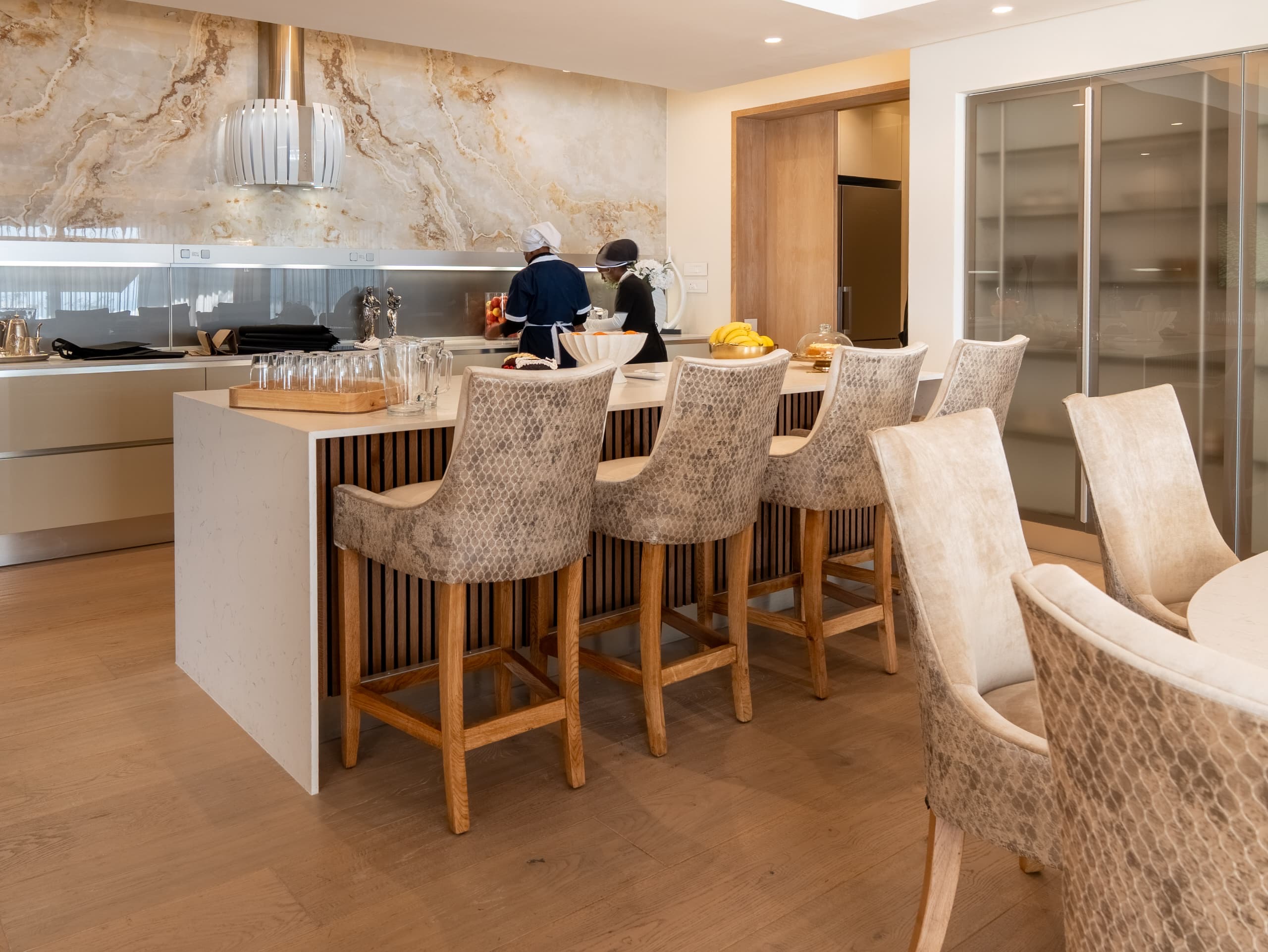
The four-bedroom, five-and-a-half bathroom home was designed by SAOTA, the Cape Town architectural firm known for high-end residential work, and was marketed as bordering the Table Mountain Nature Reserve with panoramic views across Table Bay and Robben Island.


Promotional material for the property described it as a “masterpiece of design and craftsmanship,” featuring solid French Oak wide-plank flooring, a front door crafted from Murba wood, a Eurocasa kitchen with a separate scullery, a Kone lift serving all four floors, and a lower-level gym, games area and space designed for a home theatre. The master suite was advertised as a private retreat with a dressing room, an en-suite bathroom set within an indigenous garden and its own private deck.

The purchase makes Chivayo a neighbour of Black Coffee, the internationally acclaimed South African DJ and producer who acquired a nearby Clifton property, as well as mining and logistics businessman Solly Madibela. Clifton is consistently ranked among South Africa’s most expensive residential addresses.


The Cape Town purchase follows Chivayo’s acquisition of a mansion on a 17-hectare property in Harare’s Chishawasha Hills, reported to have cost around R129 million and which includes a tennis court and a helipad.

Chivayo, the founder of Intratrek Zimbabwe, has built a fortune through state contracts in Zimbabwe’s energy and infrastructure sectors worth close to US$1 billion, and is a prominent financier of the ruling Zanu PF party and an ally of President Emmerson Mnangagwa. He has faced sustained scrutiny over the award of those contracts, allegations he denies.

The Clifton acquisition adds to a string of high-value disclosures by Chivayo in recent months, including the acquisition of a $34 million Gulfstream G550 private jet. Last week, he was granted Eswatini citizenship by King Mswati III after pledging to build a 300MW solar power plant for a reported $182 million.

Source: ZimLive

The post Mnangagwa’s Ally shells out R160 million on Clifton mansion, becomes Black Coffee’s neighbour appeared first on The Zimbabwe Mail.

Poison in the Beer Bottle: Inside the Secret Msasa Factory Making Fake Vodka

HARARE – The corrugated iron sheets of the Msasa industrial area have long hidden the hum of legitimate machinery, but behind the nondescript walls of one particular warehouse, a far more sinister operation was bubbling. For months, perhaps years, a so…

HARARE – The corrugated iron sheets of the Msasa industrial area have long hidden the hum of legitimate machinery, but behind the nondescript walls of one particular warehouse, a far more sinister operation was bubbling. For months, perhaps years, a sophisticated “spirit mafia” has been operating in the heart of Zimbabwe’s capital, turning industrial chemicals […]

The post Poison in the Beer Bottle: Inside the Secret Msasa Factory Making Fake Vodka first appeared on My Zimbabwe News.

Econet Provides Bundle Offers Clarity on Smart4U Changes

HARARE – Zimbabwe’s largest mobile network operator, Econet Wireless Zimbabwe, has moved to clarify recent changes to its popular Smart4U bundle offering, following growing customer enquiries about personalised bundle allocations, internet speeds and the company’s Fair Usage Policy (FUP). According to reports by NewZWire, the telecommunications giant said the review of Smart4U bundles forms part […]

The post Econet Provides Bundle Offers Clarity on Smart4U Changes appeared first on The Zimbabwe Mail.
HARARE – Zimbabwe’s largest mobile network operator, Econet Wireless Zimbabwe, has moved to clarify recent changes to its popular Smart4U bundle offering, following growing customer enquiries about personalised bundle allocations, internet speeds and the company’s Fair Usage Policy (FUP).

According to reports by NewZWire, the telecommunications giant said the review of Smart4U bundles forms part of an ongoing process to align the service with evolving customer needs, consumption trends and network management requirements.

The clarification comes amid widespread questions from subscribers who noticed variations in available Smart4U packages, while others reported that some bundles had disappeared from their menus altogether. Customers have also sought explanations regarding changes in browsing speeds after reaching certain usage levels.

Econet said Smart4U is fundamentally different from conventional data bundles because it is a personalised package that combines voice, data and SMS services based on an individual’s usage history.

The company explained that Smart4U offers are generated using a customer’s voice, data and messaging activity over the previous three months. As a result, no two customers are guaranteed to receive identical offers.

“Smart4U is designed to provide customers with value based on their unique usage patterns,” the company said. “Because every customer’s needs and usage habits differ, the available offer per customer will vary.”

This personalised structure means a subscriber’s offer can increase, decrease, disappear or reappear over time depending on changes in their communication and internet consumption patterns.

Fair Usage Policy Explained

A significant aspect of Econet’s clarification focused on the Fair Usage Policy, a network management practice used by telecommunications operators globally to ensure equitable access to network resources.

The company said the policy is intended to prevent excessive usage by a small number of subscribers from negatively affecting service quality for the broader customer base.

According to Econet, the policy helps maintain network performance, promotes fair allocation of network capacity and safeguards access to critical communication services as demand for data continues to grow.

Under the policy, customers initially enjoy the highest internet speeds available in their location. However, once specified usage thresholds are reached, browsing speeds may be gradually reduced in stages to manage network congestion and preserve service quality.

The Smart4U system operates through three usage phases. During the first stage, customers access maximum available network speeds. Once Fair Usage thresholds are exceeded, users move into a second stage where speeds are moderated. A further reduction may occur in the final stage if data consumption continues beyond prescribed limits.

Top-Up Option Restores Maximum Speeds

Econet noted that subscribers who wish to continue enjoying higher speeds after reaching Fair Usage thresholds can purchase Smart4U Top-Up bundles.

The company said these top-up packages restore browsing speeds to the maximum available level in a customer’s location, subject to prevailing network conditions, device capabilities and coverage quality.

Industry analysts note that Fair Usage Policies have become standard practice across global telecommunications markets as operators seek to balance rapidly rising demand for data services with finite network infrastructure and capacity.

Key Conditions for Smart4U Users

The mobile operator also reminded customers that Smart4U bundles remain valid for 30 days or until the allocated data is exhausted, whichever occurs first.

Subscribers are only permitted to purchase one Smart4U bundle per calendar month. However, those who deplete their allocation before the expiry date can continue accessing the service through Smart4U Top-Up bundles.

Econet further emphasised that Smart4U bundles are non-transferable and are intended solely for use on the purchasing line. The company also confirmed that tethering and hotspot functionality are not supported under the Smart4U offering.

Customers can check their eligibility by dialling *143#, selecting their preferred currency option and navigating to the Data and Smart4U menu. Those who do not qualify for a Smart4U package can still access other available bundle options offered by the network.

The latest clarification is expected to provide greater transparency around one of Econet’s most widely used data products, particularly as mobile data consumption continues to rise across Zimbabwe’s increasingly digital economy.

Source: NewZWire.

The post Econet Provides Bundle Offers Clarity on Smart4U Changes appeared first on The Zimbabwe Mail.

Zimbabwe Advances Local Fertiliser Production Drive Through China Partnership

BEIJING – Zimbabwe is moving closer to achieving self-sufficiency in fertiliser production as part of a broader industrialisation and food security strategy anchored on domestic resource utilisation and deepening cooperation with China. The development follows a recent working visit by Finance, Economic Development and Investment Promotion Minister Professor Mthuli Ncube, who toured Dalian Jinzhou Heavy […]

The post Zimbabwe Advances Local Fertiliser Production Drive Through China Partnership appeared first on The Zimbabwe Mail.
BEIJING – Zimbabwe is moving closer to achieving self-sufficiency in fertiliser production as part of a broader industrialisation and food security strategy anchored on domestic resource utilisation and deepening cooperation with China.

The development follows a recent working visit by Finance, Economic Development and Investment Promotion Minister Professor Mthuli Ncube, who toured Dalian Jinzhou Heavy Machinery Group in China, where fertiliser production equipment destined for Zimbabwe is currently under manufacture.

The project forms part of Zimbabwe’s long-term industrial policy aimed at reducing dependence on fertiliser imports, stabilising agricultural input costs and strengthening national food security systems.

From Import Dependence to Domestic Production Capacity

For decades, Zimbabwe has relied heavily on imported fertilisers, exposing the agricultural sector to global price volatility, foreign currency shortages and supply chain disruptions. This dependency has had direct implications for crop yields, farming input costs and overall agricultural productivity, particularly within the smallholder farming sector that remains central to national food security.

The new investment in fertiliser production infrastructure is expected to significantly alter this structural dependency by establishing local manufacturing capacity supported by Chinese industrial technology and financing.

According to officials familiar with the project, the equipment being manufactured in China is designed to support large-scale fertiliser production facilities capable of processing raw materials locally and producing compounds tailored to Zimbabwe’s agricultural requirements.

Coal as a Strategic Feedstock Advantage

A key feature of Zimbabwe’s fertiliser industrialisation strategy is the utilisation of its abundant coal reserves as a primary feedstock for production processes.

Coal remains one of Zimbabwe’s most significant indigenous energy resources, with established reserves in provinces such as Matabeleland North and Midlands. By integrating coal into fertiliser production value chains, the country aims to reduce reliance on imported intermediate inputs while creating a more vertically integrated industrial ecosystem.

Energy and industrial analysts note that coal-based fertiliser production, particularly ammonia-based processes, has historically been a cornerstone of fertiliser industries in countries such as China, India and South Africa, where domestic resource endowments have been strategically leveraged to support agricultural transformation.

Zimbabwe’s approach mirrors this industrial logic, seeking to convert natural resource endowment into agro-industrial output rather than exporting raw commodities.

Strengthening Agricultural Productivity and Food Security

Agriculture remains one of Zimbabwe’s most important economic sectors, employing a significant proportion of the population and contributing substantially to rural livelihoods and export earnings.

However, productivity in the sector has often been constrained by inconsistent access to affordable fertiliser, particularly during periods of foreign currency shortages and import constraints.

By localising fertiliser production, policymakers expect to stabilise input supply chains and reduce exposure to external shocks. This, in turn, is anticipated to improve crop yields across key staples such as maize, tobacco and wheat, while also supporting horticultural exports.

Government officials have long argued that fertiliser affordability is directly linked to national food security outcomes, with input costs often determining whether smallholder farmers can achieve commercially viable harvests.

Deepening Industrial Cooperation with China

The fertiliser initiative further underscores Zimbabwe’s expanding industrial cooperation with China, which has become a central partner in infrastructure development, mining investment and manufacturing support.

Chinese firms have played a growing role in Zimbabwe’s industrial revival efforts, particularly in sectors requiring heavy machinery, technical expertise and large-scale capital investment.

The Dalian Jinzhou Heavy Machinery Group, which is manufacturing equipment for Zimbabwe’s fertiliser project, is part of this broader ecosystem of industrial collaboration aimed at supporting developing economies in expanding domestic production capacity.

The partnership reflects a broader pattern in which Chinese industrial firms provide turnkey solutions ranging from equipment supply to plant construction and technical support, enabling host countries to accelerate industrialisation timelines.

Potential for Regional Fertiliser Exports

While the immediate objective is import substitution, long-term projections suggest that Zimbabwe could transition into a regional fertiliser exporter if production capacity expands as planned.

Southern Africa remains a structurally fertiliser-deficit region, with many countries relying heavily on imports from outside the continent. This creates a potential market for competitively priced domestically produced fertiliser within regional value chains.

If Zimbabwe successfully scales production and achieves cost efficiency through coal-based inputs and industrial integration, it could position itself as a key supplier within the Southern African Development Community (SADC) agricultural economy.

Such a shift would represent a significant structural transformation, moving Zimbabwe from a net importer of agricultural inputs to a potential net exporter of industrial agricultural products.

Industrialisation, Energy and Policy Coherence

The fertiliser project also highlights the intersection between energy policy, industrial development and agricultural strategy.

Coal-based industrialisation carries both opportunities and challenges. While it provides a reliable and cost-effective feedstock for large-scale production, it also raises long-term considerations related to environmental sustainability and global energy transition trends.

Policy coherence will therefore be essential in ensuring that industrial expansion aligns with broader national development objectives, including energy security, environmental management and export competitiveness.

Towards a More Self-Sufficient Agricultural Economy

Zimbabwe’s fertiliser production initiative represents a broader shift towards economic self-reliance through domestic value addition. By integrating natural resource endowments, foreign investment and industrial technology transfer, the country is attempting to restructure a historically import-dependent agricultural input system.

If successfully implemented, the programme could significantly reduce foreign currency outflows, enhance agricultural productivity and strengthen national food security resilience.

However, its long-term success will depend on sustained investment, reliable energy supply, efficient industrial management and the ability to maintain competitive production costs in comparison to international suppliers.

As Zimbabwe continues to pursue industrial transformation, fertiliser production may emerge as one of the key pillars linking mining resources, energy infrastructure and agricultural development into a more integrated national growth model.

The post Zimbabwe Advances Local Fertiliser Production Drive Through China Partnership appeared first on The Zimbabwe Mail.