Mine workers back fresh bid for RioZim corporate rescue 

Source: Mine workers back fresh bid for RioZim corporate rescue – herald Business Reporter THE Zimbabwe Diamond and Allied Minerals Workers union (ZDAMWU) has backed a fresh High Court application seeking to place embattled diversified miner RioZim Limited under corporate rescue, citing “extraordinary” financial decay. Business Reporter THE Zimbabwe Diamond and Allied Minerals Workers union (ZDAMWU) has backed a […]

The post Mine workers back fresh bid for RioZim corporate rescue  appeared first on Zimbabwe Situation.

Source: Mine workers back fresh bid for RioZim corporate rescue – herald

Business Reporter

THE Zimbabwe Diamond and Allied Minerals Workers union (ZDAMWU) has backed a fresh High Court application seeking to place embattled diversified miner RioZim Limited under corporate rescue, citing “extraordinary” financial decay.

Business Reporter

THE Zimbabwe Diamond and Allied Minerals Workers union (ZDAMWU) has backed a fresh High Court application seeking to place embattled diversified miner RioZim Limited under corporate rescue, citing “extraordinary” financial decay.

The union previously filed an independent corporate rescue application against the diversified miner, which was ultimately struck down on technical grounds regarding legal standing under the Insolvency Act.

RioZim operates a highly diversified asset portfolio across Zimbabwe, spanning gold, diamonds and base metals.

Its core precious metal operations centre on three major gold mines—Cam & Motor, Renco, Dalny and a 22 percent stake in Murowa Diamonds.

The group also wholly owns the Empress Nickel Refinery.

To keep legal pressure on management, minority shareholder Mr Tendai Rwodzi filed a fresh application, and the union has formally joined by submitting a comprehensive supporting affidavit to protect its members.

The union’s submission relies heavily on RioZim’s recently published and delayed audited financial statements for the year ended December 31, 2025, which lay bare a severe liquidity crisis.

RioZim’s financial distress deepened significantly during the year under review as annual net losses increased to ZiG739,1 million, up from ZiG628,5 million incurred in fiscal 2024.

The post Mine workers back fresh bid for RioZim corporate rescue  appeared first on Zimbabwe Situation.

Zim, E. Guinea sign 4 MoUs 

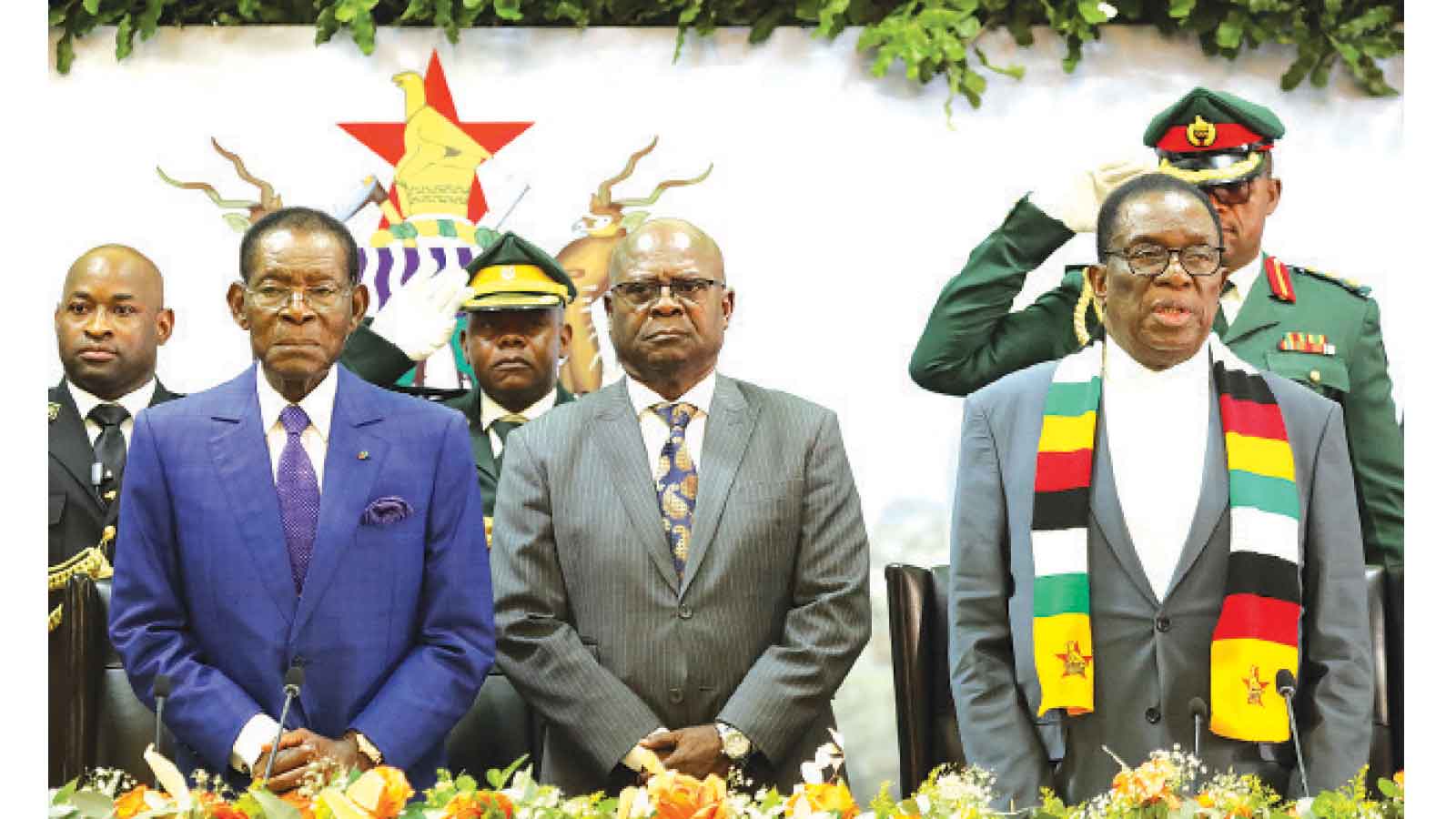
Source: Zim, E. Guinea sign 4 MoUs – herald President Mnangagwa and his Equatorial Guinea counterpart President Teodoro Obiang Nguema Mbasogo (left) follow proceedings at the two countries’ Joint Cooperation Commission signing ceremony at State House in Harare yesterday. In the middle is an interpreter. Picture: Memory Mangombe. Debra Matabvu-Senior Reporter ZIMBABWE and Equatorial Guinea […]

The post Zim, E. Guinea sign 4 MoUs  appeared first on Zimbabwe Situation.

Source: Zim, E. Guinea sign 4 MoUs – herald

Debra Matabvu-Senior Reporter

ZIMBABWE and Equatorial Guinea have pledged to intensify co-operation in trade, tourism and investment following the signing of four Memoranda of Understanding between the two countries.

President Mnangagwa and his Equatorial Guinea counterpart, President Teodoro Obiang Nguema Mbasogo, presided over the signing ceremony at State House in Harare yesterday.

The MoUs, which cover Education, Economic and Trade Co-operation, Co-operation in the training of interpreters and translators, and Rules of Procedure of the Joint Commission for Cooperation (JCC), were a critical part of President Mbasogo’s State visit to Zimbabwe which began on Thursday and ended yesterday.

Speaking during official talks and the signing ceremony, President Mnangagwa said Zimbabwe and Equatorial Guinea must do more to unlock opportunities that exist in both economies.

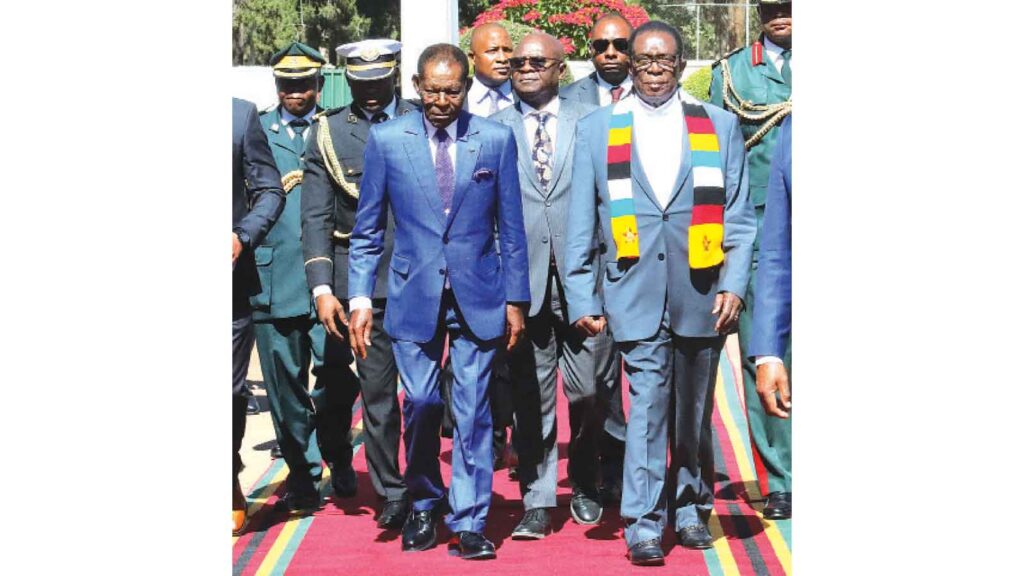
President Mnangagwa and his Equatorial Guinea counterpart, President Teodoro Obiang Nguema Mbasogo, arrive for the two countries’ Joint Commission on Cooperation (JCC) signing ceremony at State House in Harare yesterday. — Picture: Memory Mangombe.

“There remains great potential to enhance our bilateral trade and economic cooperation by unlocking trade, tourism, and mutual investment opportunities that are abundant in our two countries,” he said. 

“The volume of trade and investment has room for further expansion and increase. 

“I, therefore, urge our private and public sectors to pursue bilateral cooperation so that we capitalise on the vast prospects in sectors such as agriculture, mining, tourism, energy, and manufacturing, among others.”

The President stressed the need for greater collaboration between public and private sectors to drive economic growth and shared prosperity.

He also urged both countries to prioritise women and youth in economic programmes. 

“Youth and women remain critical actors for our economies,” the President said. 

“I urge our officials to pursue initiatives that will increase collaboration between our small to medium enterprises, particularly youth and women businesses.”

President Mnangagwa said co-operation in education and wildlife management was progressing well, with Zimbabwe committed to expanding the programmes.

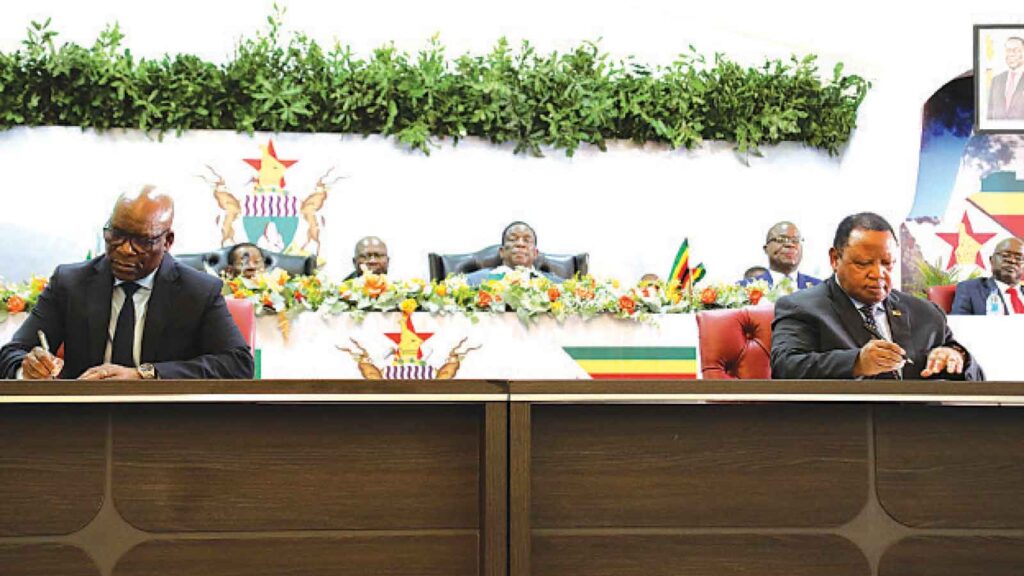
Higher and Tertiary Education, Innovation, Science and Technology Development Minister Frederick Shava (right) and Equatorial Guinea Foreign Affairs Minister Simeón Oyono Esono Angüe (left) sign a Memorandum of Understanding on Education.

“It is pleasing that the scholarship programme is progressing well and some students from Equatorial Guinea have successfully completed their studies at various institutions here in Zimbabwe,” he said.

President Mnangagwa said Zimbabwe was ready to receive more students in diverse learning pathways, as agreed in the cooperation framework.

“This will go a long way towards ensuring that our young people are equipped with the requisite skills and training to take up the vast opportunities to develop and industrialise our countries. 

“Critically important is the need to see more quality made in Africa goods and services. I am equally happy that the collaboration in wildlife management is progressing well.

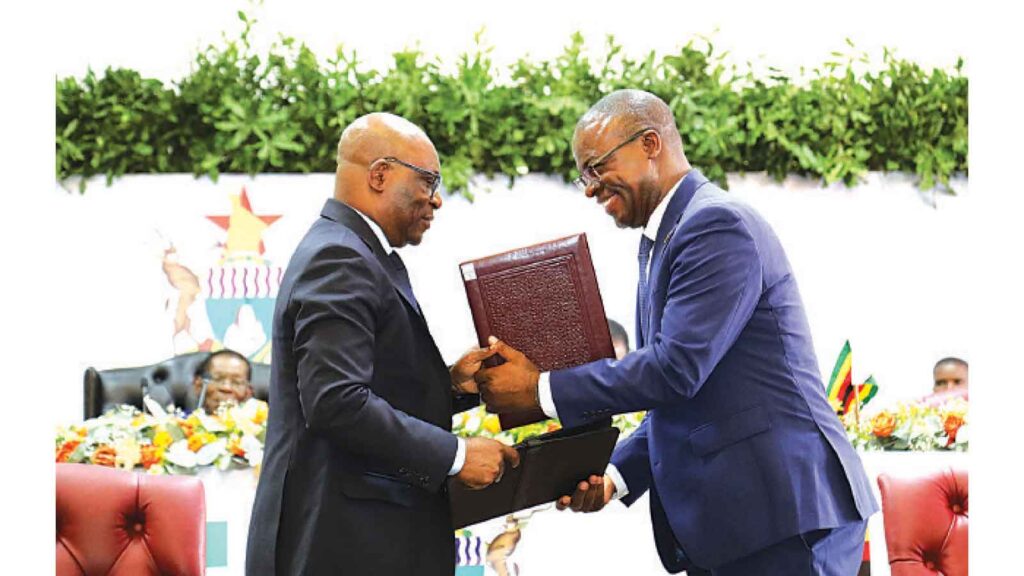
Foreign Affairs and International Trade Minister Professor Amon Murwira (right) and Equatorial Guinea’s Foreign Affairs Minister Simeón Oyono Esono Angüe (left) exchange documents after signing a Memorandum of Understanding on economic and trade cooperation, cooperation in the training of interpreters and translators, and the Rules of Procedure of the Joint Permanent Commission of Cooperation (JPCC)).

“Zimbabwe remains committed to expanding the programme to include exchange of expertise and mutual support at international fora, especially with regards to the sustainable management of wildlife resources.”

The President thanked Equatorial Guinea for condemning sanctions imposed on Zimbabwe by the West and for supporting Harare’s successful bid for a non-permanent seat on the UN Security Council for 2027-2028.

“Meanwhile, Zimbabwe is grateful to you, Your Excellency, the government and people of Equatorial Guinea, for condemning the illegal sanctions imposed on Zimbabwe and calling for their unconditional removal. 

“Equally, we value your country’s support and that of the African continent, among many other nations across the globe, which has seen Zimbabwe being elected as a non-permanent member of the UN Security Council, for the period 2027-2028. 

“We are unwavering in our commitment to promote multilateralism, peaceful settlement of disputes and strengthening of Africa’s collective voice in global peace, security and governance,” he said.

President Mbasogo said the MoUs should translate into real benefits for citizens of both countries. 

“The agreements signed today should result into tangible results,” he said. 

“The agreements should enhance sustainable development for the benefit our people.”

The event was attended by senior government officials from both countries.

Apart from the signing ceremony, President Mbasogo also visited the National Heroes Acre where he inspected the guard of honour, laid a wreath on the Tomb of the Unknown Soldier, and received a briefing on the history and significance of the national shrine.

He then concluded his visit and left Harare yesterday afternoon.

President Mbasogo was seen off at the Robert Gabriel Mugabe International Airport by President Mnangagwa, senior Government officials and service chiefs.

The post Zim, E. Guinea sign 4 MoUs  appeared first on Zimbabwe Situation.

Mutapa Gold declares US$35m first dividend

Source: Mutapa Gold declares US$35m first dividend – herald Nelson Gahadza Senior Business Reporter MUTAPA Gold Resources has declared a maiden dividend of US$35 million for the nine months to December 31, 2025, following a strong financial and operational performance. The company’s performance was driven by firm international gold prices, improved operational efficiencies and gains […]

The post Mutapa Gold declares US$35m first dividend appeared first on Zimbabwe Situation.

Source: Mutapa Gold declares US$35m first dividend – herald

Nelson Gahadza

Senior Business Reporter

MUTAPA Gold Resources has declared a maiden dividend of US$35 million for the nine months to December 31, 2025, following a strong financial and operational performance.

The company’s performance was driven by firm international gold prices, improved operational efficiencies and gains from a restructuring programme undertaken by the mining group.

The dividend marks a significant milestone for the Mutapa Investment Fund-owned gold producer and comes as the company prepares to embark on a US$152 million pipeline of expansion projects aimed at nearly doubling gold output over the next few years.

Under the dividend distribution, Mutapa Investment Fund received US$22,5 million, while the balance was distributed among other shareholders, including Datvest US$4,37 million, National Venture Capital Company of Zimbabwe US$2,63 million and the Public Service Commission Pension Fund US$2,45 million.

Other beneficiaries included the Insurance and Pensions Commission (IPEC) and the Deposit Protection Corporation, which each received US$1,75 million.

Speaking after the company’s trading update and dividend declaration event yesterday, Mutapa Gold Resources chief executive Mr Patrick Maseva-Shayawabaya said the payment reflected the group’s strong cash-generating capacity and demonstrated the success of efforts to improve operational performance across its mining operations.

“This dividend relates to the nine months to December 2025, during which we recorded a profit after tax of US$70 million. Cash generation was very strong during the period. Production was solid, gold prices remained favourable and costs were well controlled,” he said.

The post Mutapa Gold declares US$35m first dividend appeared first on Zimbabwe Situation.

WWF Zimbabwe Launches 2026–2030 Strategic Plan and Responsible Mining Initiative

“We Cannot Mine Our Way into Development if We Mine Our Ecosystems Out of Existence” –Itai Chibaya WWF Zimbabwe Country Coordinator. Source: WWF Zimbabwe Launches 2026–2030 Strategic Plan and Responsible Mining Initiative | WWF wwfafrica “We Cannot Mine Our Way into Development if We Mine Our Ecosystems Out of Existence” –Itai Chibaya WWF Zimbabwe Country […]

The post WWF Zimbabwe Launches 2026–2030 Strategic Plan and Responsible Mining Initiative appeared first on Zimbabwe Situation.

“We Cannot Mine Our Way into Development if We Mine Our Ecosystems Out of Existence” –Itai Chibaya WWF Zimbabwe Country Coordinator.

Source: WWF Zimbabwe Launches 2026–2030 Strategic Plan and Responsible Mining Initiative | WWF wwfafrica

WWF Zimbabwe Launches 2026–2030 Strategic Plan and Responsible Mining Initiative © Kumbirai Comfort Mhandu

“We Cannot Mine Our Way into Development if We Mine Our Ecosystems Out of Existence” –Itai Chibaya WWF Zimbabwe Country Coordinator.

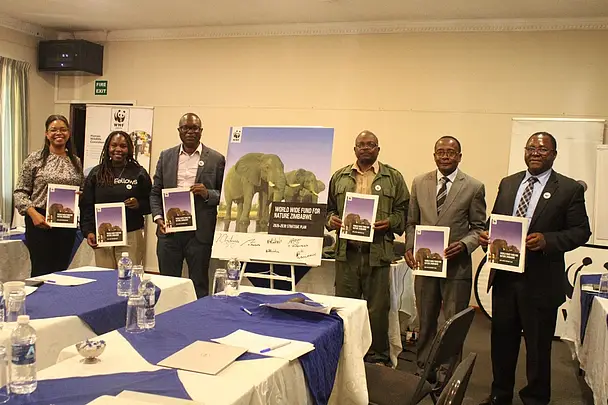
WWF Zimbabwe convened the National Stakeholder Engagement Meeting on Fostering Environmentally and Socially Responsible Mining and officially launched the WWF Zimbabwe Strategic Plan (2026–2030) at Bronte Hotel in Harare.

The event brought together the Permanent Secretary in the Ministry of Mines and Mining Development, Dr. Thomas Utete Wushe, the representative of the Permanent Secretary in the Ministry of Environment, Climate and Wildlife, Mr. Washington Zhakata (Chief Director, Environment, Climate and Wildlife), representatives of Government Ministries, Departments and Agencies, development partners, private sector representatives, civil society organisations, academia, community representatives, the media, and other distinguished guests.

The meeting marked the official start of the implementation phase of the project: “Fostering Environmentally and Socially Responsible, Decarbonized, Inclusive and Transformative Value Chains for Energy Transition Minerals in the SADC Region,” while also setting the tone for WWF Zimbabwe’s new strategic direction under the theme “Together Possible.”

Addressing delegates, Permanent Secretary in the Ministry of Mines and Mining Development, Dr. Thomas Utete Wushe, emphasized Zimbabwe’s commitment to responsible mineral development:

“Zimbabwe will not pursue growth at any cost. Our mineral wealth must translate into tangible national development, community benefit, and long-term environmental sustainability.”

He further stressed the importance of accountability across the mining sector:

“Environmental Impact Assessments are not a formality they are a requirement. Mine rehabilitation and closure obligations will be enforced without exception.”

Speaking on behalf of the Permanent Secretary in the Ministry of Environment, Climate and Wildlife, Mr. Washington Zhakata, Chief Director, Environment, Climate and Wildlife, highlighted the need to balance economic growth with environmental stewardship:

“Sustainable development is not about avoiding difficult choices, it is about managing them in the national interest, transparently and responsibly.”

He also challenged stakeholders to focus on implementation and measurable results:

“The real measure of this strategy will not be what we say today, but what is visible on the ground by 2030.”

WWF Zimbabwe Country Coordinator, Mr. Itai Chibaya, underscored the urgency of ensuring that mineral development benefits both people and nature:

“We cannot mine our way into development if we mine our ecosystems out of existence.”

He highlighted the importance of partnerships, inclusion, and collective action:

“The decisions we make in the coming years will determine whether Zimbabwe becomes a model for responsible mineral development or not.”

Launching WWF Zimbabwe’s Strategic Plan (2026–2030), Mr. Chibaya reaffirmed WWF’s commitment to landscape restoration, climate resilience, biodiversity conservation, sustainable livelihoods, and inclusive governance under the theme ‘Together Possible.’

The engagement reinforced a shared vision where economic development, responsible mining, environmental protection, and community wellbeing go hand in hand. Stakeholders committed to strengthening partnerships, promoting sustainable mining practices, restoring degraded landscapes, and ensuring communities, women, and youth are active participants in shaping Zimbabwe’s development future.

Together, it is possible.

The post WWF Zimbabwe Launches 2026–2030 Strategic Plan and Responsible Mining Initiative appeared first on Zimbabwe Situation.

Mwonzora says even using Zanu PF’s own argument, CAB3 cannot lawfully pass without referendum

Source: Mwonzora says even using Zanu PF’s own argument, CAB3 cannot lawfully pass without referendum — CITEZW Leader of the MDC and constitutional lawyer, Douglas Mwonzora, maintains that the Constitutional Amendment Bill No. 3 cannot lawfully be enacted without a referendum, insisting that even the reasoning advanced by Zanu PF officials ultimately leads to the […]

The post Mwonzora says even using Zanu PF’s own argument, CAB3 cannot lawfully pass without referendum appeared first on Zimbabwe Situation.

Source: Mwonzora says even using Zanu PF’s own argument, CAB3 cannot lawfully pass without referendum — CITEZW
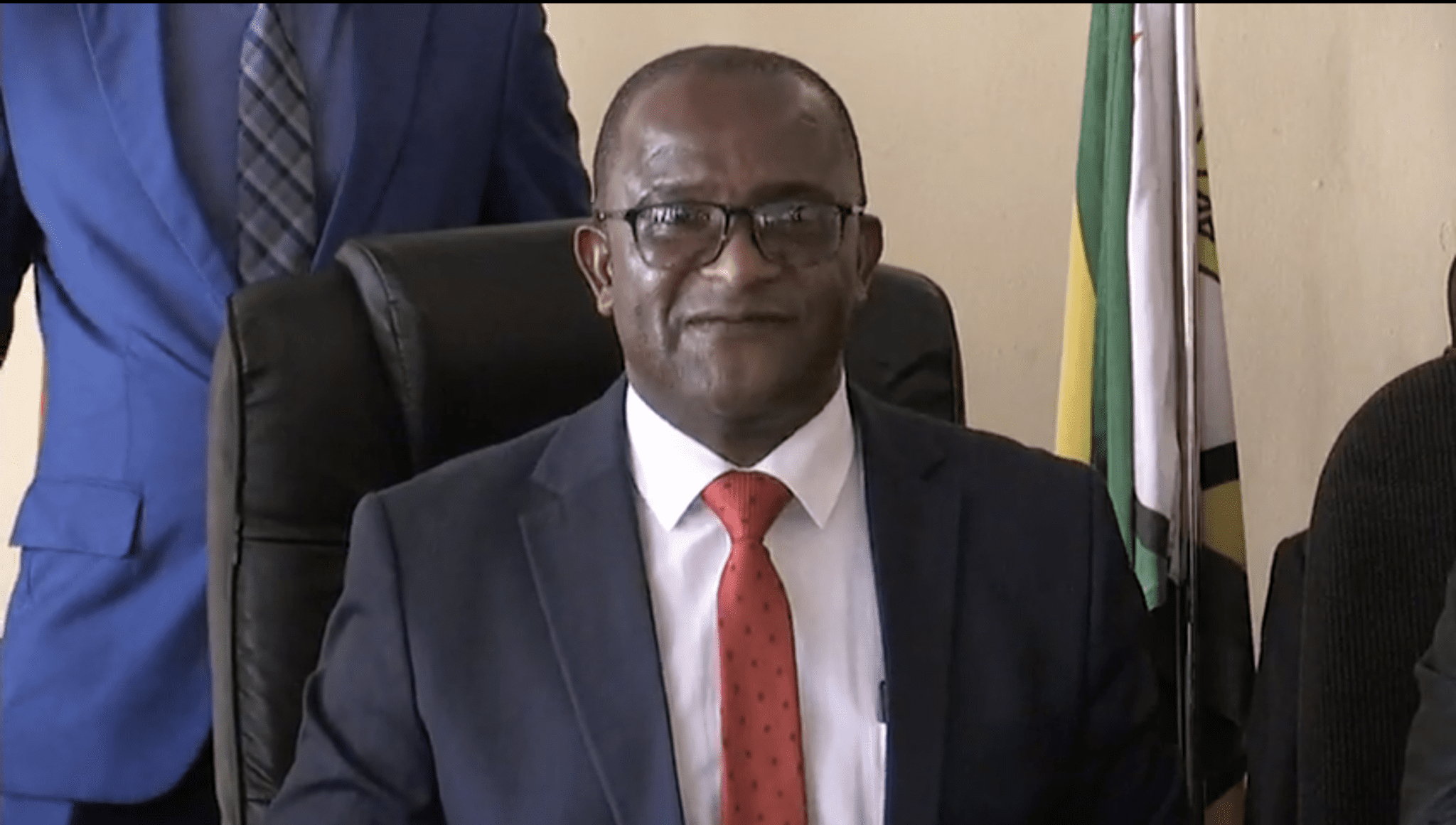
Leader of the MDC and constitutional lawyer, Douglas Mwonzora, maintains that the Constitutional Amendment Bill No. 3 cannot lawfully be enacted without a referendum, insisting that even the reasoning advanced by Zanu PF officials ultimately leads to the same conclusion.

Mwonzora, one of the key negotiators and drafters of Zimbabwe’s 2013 Constitution, said the proposed amendments currently before Parliament affect constitutional provisions contained in the Bill of Rights and therefore require approval through a national referendum.

His remarks come as debate over the bill continues in Parliament, with supporters of the bill maintaining that legislators have the authority to pass the proposed changes without seeking direct approval from voters.

In an interview with CITE, Mwonzora said the argument advanced by Justice Minister Ziyambi Ziyambi and Zanu PF’s legal secretary Paul Mangwana, that CAB3 does not amend the Bill of Rights and therefore does not require a referendum, is flawed.

“By the argument of Zanu PF, the bill has to be taken for a referendum,” he said.

“And there is another justification for the referendum, that is the second referendum. It is that where there is a need to extend the term limit, you must have a referendum. But where there is the need to benefit the incumbent, then you must have another referendum.”

Mwonzora said his position is based on the same constitutional interpretation used by supporters wanting the bill.

“A referendum is unavoidable and I am using Zanu PF’s own argument,” he said.

“Zanu PF says this bill cannot be taken to a referendum because it does not amend the Bill of Rights. Looking at that argument, we then look at whether this bill in any way affects the Bill of Rights.”

The Bill of Rights is contained in Sections 40 to 87 of Zimbabwe’s Constitution, placing Section 67, which deals with political rights, squarely within its scope.

“Section 67 contains what are called political rights and under Section 67 there are two important political rights, the right to vote and the right to be voted for,” Mwonzora said.

“Section 67 says under the right to vote, every Zimbabwean adult over the age of 18 has the right to vote. That means every Zimbabwean, irrespective of station in life, position, whether they are an MP or not, has the right to vote.”

Therefore provisions contained in CAB3 would effectively alter that right by restricting participation in the election of a President under certain circumstances.

“The amendment then goes on to say that the President is only going to be voted for by Members of Parliament, which means that provision has now been effectively amended, and it has been amended by implication,” Mwonzora said.

He noted the practical effect of the proposed amendment would be to qualify an otherwise universal right because it will now be possibly read as follows: “‘every Zimbabwean has the right to vote, provided that if it is a presidential election then only Members of Parliament are allowed to vote,’”

“So Section 67 has been amended by implication and by the argument of Zanu PF, by their own argument, then it has to be taken for a referendum.”

Beyond the issue of political rights, Mwonzora argued that CAB3 also runs into constitutional hurdles relating to term limits and provisions governing incumbents.

He cited Section 328(7) of the Constitution, which was specifically designed to prevent office holders from benefiting from constitutional amendments extending their terms of office.

“In fact, in terms of the Constitution, where there is an extension of term, so assuming that the referendum for extension of term succeeds, the Constitution says that extension cannot benefit the incumbent,” Mwonzora said.

“Now, if you want the extension to benefit the incumbent, then you have to amend Section 328 (7).”

The Constitution imposes a higher threshold for any attempt to amend that safeguard. Mwonzora added.

“Section 328 (7) says if there is any need to extend the period of time that a person holds office and if there is need for the incumbent benefits, then this must be done as if you are amending the Bill of Rights,” he said.

“We all know the Bill of Rights is amended by referendum. So Section 328 is also amended only by referendum.”

Mwonzora argued this makes it impossible for Parliament to lawfully bypass a referendum.

“So they cannot avoid a referendum at all, looking at even their own arguments,” he said.

Even if Zanu PF supporters insist Parliament has the constitutional authority to amend the Constitution without consulting voters in this instance, Mwonzora said such arguments overlook a key constitutional provision governing Parliament’s powers.

“They are not looking at Section 117 of the Constitution. Section 117 says that Parliament has the power to amend this Constitution only in terms of Section 328.”

He argued that Parliament’s authority is therefore not unlimited and must be exercised strictly within the procedures prescribed by Section 328.

“The powers of Parliament are given somewhere around Section 117 and Section 117 says that Parliament has the power to amend the Constitution only in terms of Section 328,” he said.

“And Section 328 provides that if it is the Bill of Rights then it has to be a referendum.”

Mwonzora further contended that CAB3 suffers from another legal defect because it combines several distinct constitutional issues into a single amendment bill.

He explained that Zimbabwe’s Constitution does not permit provisions extending terms of office and provisions allowing incumbents to benefit from those extensions to be dealt with in the same amendment process.

“They cannot afford two referendums but they also have another problem,” Mwonzora said.

“The Constitution clearly says the amendment to change the term limit and the amendment allowing the incumbent to benefit cannot be in the same amendment. The provisions cannot be in the same bill.”

He noted the current bill contains multiple clauses dealing with extensions of terms for the President and Members of Parliament, as well as provisions relating to who benefits from those extensions.

“We have four clauses that deal with extension of time, extension of time for President, extension of time for Members of Parliament, and then extension of term for benefit by the President and benefit by Members of Parliament and that makes the bill inherently illegal,” Mwonzora said.

The post Mwonzora says even using Zanu PF’s own argument, CAB3 cannot lawfully pass without referendum appeared first on Zimbabwe Situation.