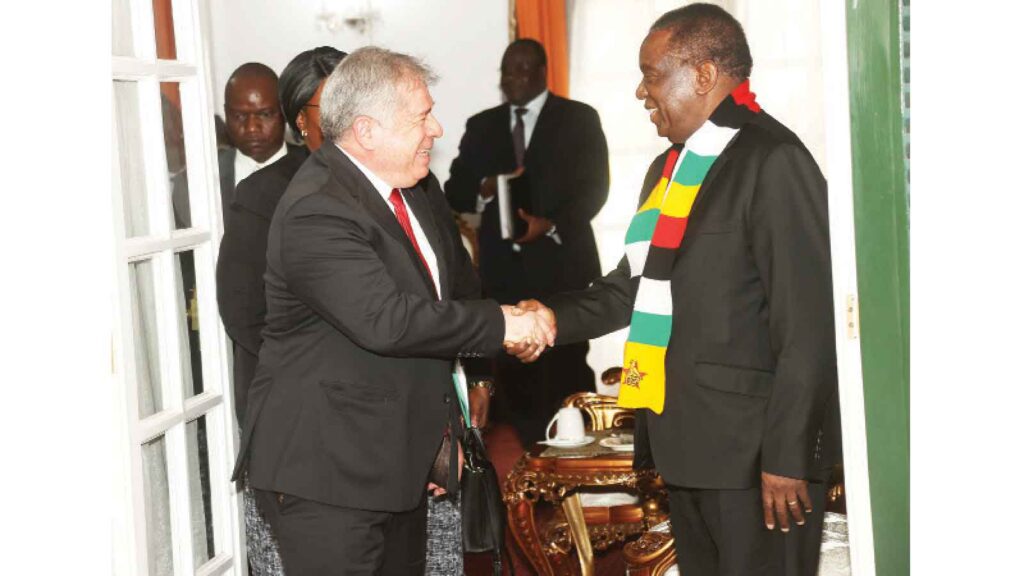
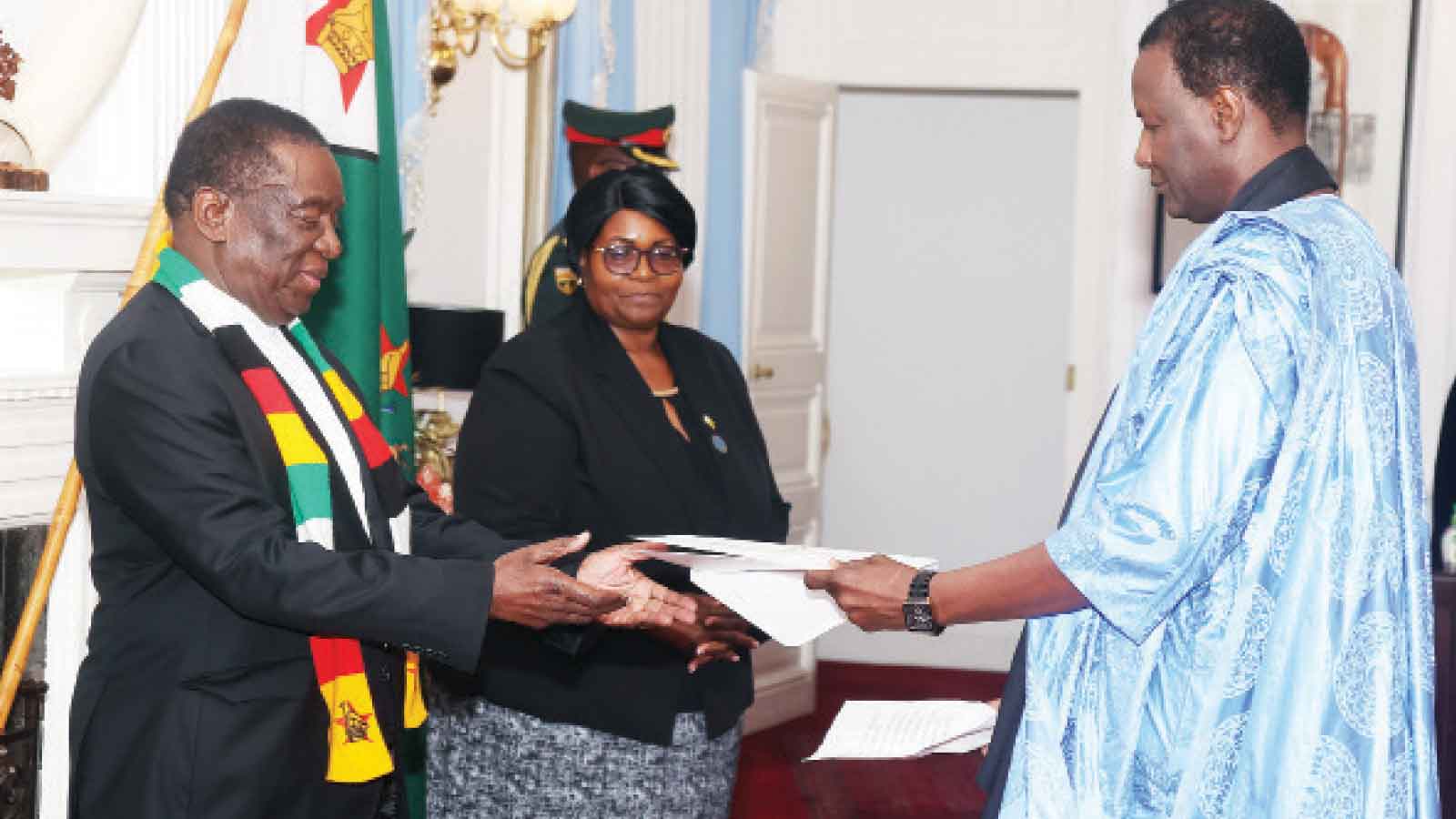
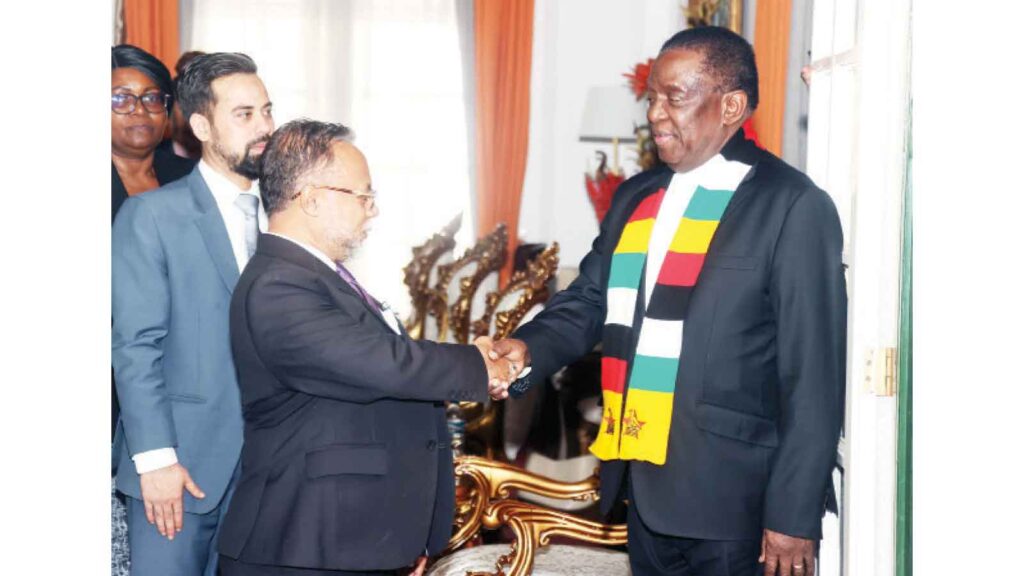
3 diplomats present letters of credence

Source: 3 diplomats present letters of credence – herald Wallace Ruzvidzo-Herald Reporter ACCREDITED Ambassadors from Bangladesh, Peru and Mauritania presented their letters of credence to President Mnangagwa at State House in Harare yesterday. The Ambassadors were Shah Ahmed Shafi of Bangladesh, Jose Javier Augusto Shaw of Peru and Amedi Camara of Mauritania. In an interview […]

The post 3 diplomats present letters of credence appeared first on Zimbabwe Situation.

Source: 3 diplomats present letters of credence – herald

Wallace Ruzvidzo-Herald Reporter

ACCREDITED Ambassadors from Bangladesh, Peru and Mauritania presented their letters of credence to President Mnangagwa at State House in Harare yesterday.

The Ambassadors were Shah Ahmed Shafi of Bangladesh, Jose Javier Augusto Shaw of Peru and Amedi Camara of Mauritania.

In an interview after his closed-door meeting with the President, Ambassador Shafi said his country was looking to open an Embassy in Harare “in the not-so-distant future”.

“Actually, we started our diplomatic relations in 1981,” he said.

President Mnangagwa greets incoming Bangladeshi Ambassador to Zimbabwe, Mr Shah Ahmed Shafi, after receiving his letters of credence at State House in Harare yesterday.

“We will open our diplomatic mission in Harare.

“We are planning because with the growth of the economy, we are opening up in some African countries and Latin American countries.”

Ambassador Shafi also said cricket has served as the impetus for people-to-people relations between Zimbabwe and Bangladesh, as well as agriculture-centric nations.

“The people (of Bangladesh) know Zimbabwe, particularly for cricket here.

“And also, we are both agricultural countries,” he said.

Bangladesh is looking to collaborate with Zimbabwe in the textile and garment-making industries.

“Now, my country is becoming an industrial country and I spoke with His Excellency, the President of Zimbabwe, that we will explore the possibility of cooperation, particularly in the textile and garment industries,” he said.

Ambassador Shaw of Peru began by congratulating Zimbabwe on its election to the United Nations Security Council (UNSC) as a non-permanent member.

President Mnangagwa welcomes Mr Jose Javier Augusto Shaw, Peru’s new Ambassador to Zimbabwe, after receiving his letters of credence at State House in Harare yesterday. — Pictures: Believe Nyakudjara.

“I would like to congratulate the Government and the people of Zimbabwe for the election yesterday (Wednesday) as a non-permanent member of the Security Council of the United Nations,” he said.

This year marks 40 years since the establishment of diplomatic relations between Zimbabwe and Peru.

The diplomat said Peru is looking to collaborate with Zimbabwe in various areas, including mining and agriculture.

“The last opportunity that a Peruvian Ambassador presented credentials here in Zimbabwe was in 1997, almost 29 years ago. Well, we discussed with His Excellency the President the possibility of strengthening and deepening our bilateral relations in many sectors, such as the mining sector, the agricultural sector, but also the possibilities in the cultural and academic sectors.

“We also share a great experience in tourism,” he said.

Ambassador Camara said Mauritania is looking to collaborate with Zimbabwe in several sectors, including education and peace and security.
The post 3 diplomats present letters of credence appeared first on Zimbabwe Situation.

Zim got 182 votes in winning UN Security Council seat after 33 years 

Source: Zim got 182 votes in winning UN Security Council seat after 33 years  –Newsday Zimbabwe HARARE, Jun. 4 (NewsDay Live) – Zimbabwe has been elected to the United Nations Security Council as a non-permanent member, securing 182 votes in the UN General Assembly and returning to the powerful body for the first time in […]

The post Zim got 182 votes in winning UN Security Council seat after 33 years  appeared first on Zimbabwe Situation.

Source: Zim got 182 votes in winning UN Security Council seat after 33 years  –Newsday Zimbabwe

HARARE, Jun. 4 (NewsDay Live) – Zimbabwe has been elected to the United Nations Security Council as a non-permanent member, securing 182 votes in the UN General Assembly and returning to the powerful body for the first time in 33 years.

The election, held Wednesday at UN headquarters in New York, saw Zimbabwe win the African Group’s allocated seat for a two-year term beginning Jan. 1, 2027, and ending Dec. 31, 2028. The country will replace Somalia on the 15-member council.

Zimbabwe previously served on the Security Council in 1983-84 and 1991-92, making this its third stint on the world’s most influential peace and security body.

The 182 votes were cast by 191 member states present and voting in the General Assembly. Zimbabwe was the sole candidate endorsed by the African Group for the seat, although UN rules still required it to secure a two-thirds majority to be elected.

President Emmerson Mnangagwa welcomed the outcome, describing it as evidence of Zimbabwe’s growing international acceptance.

“I am extremely humbled by the support Zimbabwe has received from the international community. It means that Zimbabwe has very excellent relations with the rest of the world,” he said.

In a separate statement, Mnangagwa said the result reflected the success of his government’s engagement and re-engagement policy.

“This resounding victory underscores the effectiveness of our Engagement and Re-engagement agenda,” he said, adding that Zimbabwe would use its tenure to advocate for a more equitable international order while advancing African interests.

The Security Council is the only UN body empowered to make legally binding decisions, including imposing sanctions and authorizing the use of force. While non-permanent members do not possess veto powers, they participate fully in debates and voting on resolutions concerning international peace and security.

Zimbabwe joins Austria, Portugal, Trinidad and Tobago and Kyrgyzstan as the newly elected non-permanent members for the 2027-28 term. Kyrgyzstan secured its seat after defeating the Philippines in a competitive election, while Zimbabwe and Trinidad and Tobago were elected from uncontested regional slates.

The new members will replace Denmark, Greece, Pakistan, Panama and Somalia.

Foreign Affairs and International Trade Minister Amon Murwira said Zimbabwe would pursue principled multilateralism during its tenure and remain guided by a foreign policy anchored on being “a friend to all and an enemy to none.”

The election comes at a time when the Security Council faces mounting challenges, including divisions among major powers over conflicts in Ukraine and Gaza, which have repeatedly exposed the body’s limitations in responding to global crises.

The post Zim got 182 votes in winning UN Security Council seat after 33 years  appeared first on Zimbabwe Situation.

MDC rejects CAB3 results, says consultation process was rigged 

Source: MDC rejects CAB3 results, says consultation process was rigged   –Newsday Zimbabwe HARARE, Jun. 4 (NewsDay Live) – The Movement for Democratic Change (MDC) has rejected parliamentary voting results on Constitutional Amendment Bill No. 3 (CAB3), alleging the public consultation process was manipulated to manufacture support for the proposed constitutional changes. The opposition’s response follows the […]

The post MDC rejects CAB3 results, says consultation process was rigged  appeared first on Zimbabwe Situation.

Source: MDC rejects CAB3 results, says consultation process was rigged   –Newsday Zimbabwe

HARARE, Jun. 4 (NewsDay Live) – The Movement for Democratic Change (MDC) has rejected parliamentary voting results on Constitutional Amendment Bill No. 3 (CAB3), alleging the public consultation process was manipulated to manufacture support for the proposed constitutional changes.

The opposition’s response follows the release of a report by Parliament’s joint portfolio committees on the Constitution Amendment (No. 3) Bill, detailing submissions received during nationwide public consultations.

In a statement, MDC national spokesperson Lloyd Damba dismissed the reported figures, which indicate that 537,102 people supported the bill compared to 2,935 who opposed it.

“Parliament has released results claiming 537,102 citizens support CAB3 against only 2,935 opposed. The MDC rejects these numbers as a fraud, not a reflection of the people’s will,” Damba said.

“A bill that seeks to remove your right to vote, drag chiefs into partisan politics and hand voter registration to the Attorney General cannot win the hearts of 99.5% of Zimbabweans.”

CAB3 has sparked intense debate, with critics arguing that some of its provisions could weaken democratic institutions and expand executive influence over key state functions.

Damba alleged that public consultations were influenced by ruling party structures and traditional leaders.

“This is not a consultation. It is coercion,” he said. “The ‘landslide’ was manufactured through village heads, chiefs and Zanu PF-affiliated structures that threatened villagers, bused supporters to hearings and flooded email platforms with identical submissions.”

He further claimed that some citizens feared reprisals for expressing opposition to the bill.

“When citizens face threats of land confiscation, grain denial or violence for saying ‘no’, the results will always favour the bullies,” Damba said.

The MDC challenged the government and Parliament to subject the proposed amendments to a national referendum.

“If Parliament truly believes its own numbers, then let the people decide. We dare Zanu PF to call a national referendum on CAB3,” Damba said.

“Put the bill to a secret ballot and let Zimbabweans vote without chiefs, village heads or intimidation watching over their shoulders.”

He said the opposition would continue to oppose the bill, arguing that the consultation outcome did not reflect the views of all Zimbabweans.

Several civil society organisations have also questioned the figures contained in the parliamentary report, arguing that independent verification and greater transparency are necessary before the results can be relied upon as evidence of public support for constitutional amendments.

The post MDC rejects CAB3 results, says consultation process was rigged  appeared first on Zimbabwe Situation.

Your tax pays civil servants: Zimra 

Source: Your tax pays civil servants: Zimra –Newsday Zimbabwe OFFICIALS from the Zimbabwe Revenue Authority (Zimra) yesterday delivered a blunt message to civil servants and Karoi’s business community that their salaries depend on the taxes paid by workers. The officials told participants at a National Tax Awareness Campaign in Karoi yesterday that if citizens default, […]

The post Your tax pays civil servants: Zimra  appeared first on Zimbabwe Situation.

Source: Your tax pays civil servants: Zimra –Newsday Zimbabwe

OFFICIALS from the Zimbabwe Revenue Authority (Zimra) yesterday delivered a blunt message to civil servants and Karoi’s business community that their salaries depend on the taxes paid by workers.

The officials told participants at a National Tax Awareness Campaign in Karoi yesterday that if citizens default, teachers, nurses and soldiers will go unpaid.

Claitus Munhande, Zimra communication and advocacy officer on tax education programmes, told SMEs, farmers, business community, artisanal miners and traders at a Hurungwe tax education workshop that it is everyone’s duty to pay taxes.

“Civil servants salaries are determined by low taxes that we contribute as citizens,” he said.

Munhande tore into the common belief that government pays civil servants, adding that “every teacher in class, nurse at the clinic and soldier on patrol” was paid from taxes collected from citizens and businesses.

“There is no separate government money. Your tax is their salary,” he said, framing compliance as a survival issue for public services.

He, however, defended controversial levies saying the government introduced the Aids levy to “deter recklessness” in communities and fund the national HIV response.

On the sugar tax, Munhande said the levy targeted health challenges and excessive fast-food consumption.

“These taxes change behaviour, not just fill coffers,” he said.

“We tax what harms the nation.”

In a clear shift in tone, Munhande warned: “Government enforces compliance through tax audits.”

He said Zimra was moving beyond education and voluntary payment.

Poor interpretation of tax laws has crippled many operations, he noted, hence the outreach targeting artisanal miners, farmers and SMEs.

But Munhande said enforcement would match education.

Meanwhile, an official from the Finance, Economic Development and Investment Promotion ministry, Kudakwashe Venge, told participants that tax is a “social contract between citizens and the nation at large” which funds infrastructure, health, electricity and economic growth under National Development Strategy 2.

The official said widening the tax base remained critical as government pushed to fund service delivery without overburdening compliant taxpayers.

The post Your tax pays civil servants: Zimra  appeared first on Zimbabwe Situation.

Zanu PF uses disputed polls to justify CAB 3

Source: Zanu PF uses disputed polls to justify CAB 3 -Newsday Zimbabwe JUSTICE, Legal and Parliamentary Affairs minister Ziyambi Ziyambi yesterday admitted that Zimbabwe’s presidential elections have repeatedly been marred by allegations of violence, vote-rigging and disputed outcomes, as he defended the controversial Constitution Amendment No 3 Bill (CAB 3) in Parliament. During the second […]

The post Zanu PF uses disputed polls to justify CAB 3 appeared first on Zimbabwe Situation.

Source: Zanu PF uses disputed polls to justify CAB 3 -Newsday Zimbabwe

JUSTICE, Legal and Parliamentary Affairs minister Ziyambi Ziyambi yesterday admitted that Zimbabwe’s presidential elections have repeatedly been marred by allegations of violence, vote-rigging and disputed outcomes, as he defended the controversial Constitution Amendment No 3 Bill (CAB 3) in Parliament.

During the second reading of the Bill, Ziyambi argued that Zimbabwe’s experience with contested elections justified constitutional reforms, including changes to the electoral system and the extension of the electoral cycle from five to seven years.

In a rare admission, Ziyambi said every presidential election held since the turn of the century had been disputed.

“Every contest for the President this nation has held since the turn of the century — in 2002, 2008, 2013, 2018 and again in 2023 — has been marred by relentless allegations of violence, of rigging, of opacity, eroding public trust and the legitimacy of the result,” he told Parliament.

Ziyambi said the disputed elections had become a recurring feature of Zimbabwe’s political landscape and had negatively affected the country’s economic prospects.

“This is not my characterisation alone. It is documented notably in the observer reports of the African Union, Sadc and the Commonwealth,” he said.

The minister claimed the controversies surrounding elections contributed to sanctions and discouraged foreign investment, costing Zimbabwe billions of dollars in lost economic opportunities.

Ziyambi dismissed claims that the Bill seeks to extend President Emmerson Mnangagwa’s tenure or postpone elections.

“Let me state clearly and without qualification five things this Bill simply does not do. First, it does not give the President a term extension or a third term,” he said.

“Second, it does not take away the right to vote. Third, it does not concern itself with succession in any political party. Fourth, it does not postpone the nation’s elections.

“Lastly, it does not concentrate power or the running of elections in the hands of the President.”

Ziyambi’s remarks came as the government moved to accelerate debate on CAB 3 by suspending normal parliamentary business to allow lawmakers to focus on the constitutional amendment

Meanwhile, Ziyambi, the leader of government business in Parliament, successfully moved a motion suspending government business, paving way for debate that could extend into the night.

However, opposition legislators objected to the move, accusing the government of attempting to rush through a constitutional amendment with some implications.

Dzivaresekwa MP Edwin Mushoriwa said there was no justification for fast-tracking the Bill and warned against debating it during late-night sitting when many Zimbabweans will be unable to follow proceedings.

“There is no need to fast-track CAB 3. Let us discuss it, debate it, agree or disagree so that the people of Zimbabwe will follow,” Mushoriwa said.

“So it is wrong to then suspend normal parliamentary business. I think let’s just continue with parliamentary business as usual and we will debate and we will do it in the proper manner.

“And I think this is important because we as Parliament, we represent the people and we represent the citizens.”

Despite the objections, Speaker of the National Assembly Jacob Mudenda ruled in favour of the government, clearing the way for Parliament to continue debating the Bill.

Ziyambi maintained that the proposed amendments were intended to address what he described as “mischief” arising from decades of disputed presidential elections and a political system he said had become trapped in a cycle of election-related conflict and instability.

In a statement yesterday, the Zimbabwe Constitutional Movement (Zicomo), a grassroots movement established to promote and defend constitutional principles and democracy, said any amendment affecting presidential terms, electoral rights, democratic participation, or the separation of powers should be approved by the people of Zimbabwe through a national referendum, as required by Section 328.

“Parliament has no authority to substitute itself for the sovereign will of the people,” it said.

“The Constitution belongs to the people of Zimbabwe. Not to Parliament. Not to political parties. Not to any individual.”

Zicomo made its demands, saying Parliament should reject every provision that “undermines constitutional democracy, electoral independence, and judicial independence; Government must obey Section 328 — no shortcuts, no circumvention; Citizens, churches, unions, students, traditional leaders, and civil society must stand up and defend the Constitution before it is stolen; and, Sadc, AU, and the international community must act — monitor CAB 3 and speak out against constitutional manipulation in Zimbabwe.”

Zicomo said the Parliament report read “more as an endorsement of Constitutional Amendment No. 3 Bill than as an objective parliamentary assessment of its constitutional validity and democratic implications”.

“For a constitutional amendment of such far-reaching significance, Zimbabweans deserve a more rigorous, transparent and constitutionally grounded analysis.

“Zimbabwe’s future will be determined by constitutional democracy, not by constitutional manipulation.

“Zicomo will use every lawful means to defend constitutionalism, term limits, democratic accountability, separation of powers, and the sovereign right of Zimbabweans to determine their own future.”

It stated: “The Constitution is the People’s Covenant. It will not be amended against the people.”

The post Zanu PF uses disputed polls to justify CAB 3 appeared first on Zimbabwe Situation.