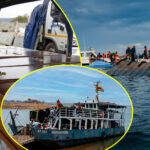
Disaster in Kariba ferry accident as divers, police, army & CPU teams recover 80 dead bodies… “some dead victims have crossed to Zambian side”

KARIBA – The death toll from the Mbuya Nehanda ferry disaster on Lake Kariba has risen to 80 after recovery teams retrieved eight more bodies, deepening a tragedy that has left families waiting for news of relatives still missing across the vast …

KARIBA – The death toll from the Mbuya Nehanda ferry disaster on Lake Kariba has risen to 80 after recovery teams retrieved eight more bodies, deepening a tragedy that has left families waiting for news of relatives still missing across the vast reservoir. The latest bodies were recovered on Sunday, August 16, as police divers, […]

The post Disaster in Kariba ferry accident as divers, police, army & CPU teams recover 80 dead bodies… “some dead victims have crossed to Zambian side” first appeared on My Zimbabwe News.

How they used his wife to catch him: Deadly armed robber who escaped from Mutimurefu prison re-arrested after shootout with police

Masvingo — One of the two dangerous prisoners who escaped from Mutimurefu Prison has been re-arrested after a shootout with police in the Renco area, bringing an end to a week-long manhunt marked by alleged armed robberies, a home invasion and the hija…

Masvingo — One of the two dangerous prisoners who escaped from Mutimurefu Prison has been re-arrested after a shootout with police in the Renco area, bringing an end to a week-long manhunt marked by alleged armed robberies, a home invasion and the hijacking of a village head’s car. James Masunda, 34, was arrested on Friday, […]

The post How they used his wife to catch him: Deadly armed robber who escaped from Mutimurefu prison re-arrested after shootout with police first appeared on My Zimbabwe News.

Batoka Gorge Procurement for Zambia and Zimbabwe’s Future

Learn about the Batoka Gorge procurement efforts at the Africa Energy Forum and the financial commitments from Zambia and Zimbabwe. Source: Batoka Gorge Procurement for Zambia and Zimbabwe’s Future – Energy News Network The Zambezi River Authority held a market sounding session for the 2,400MW scheme at the Africa Energy Forum in June, described as preparation for […]

The post Batoka Gorge Procurement for Zambia and Zimbabwe’s Future appeared first on Zimbabwe Situation.

Learn about the Batoka Gorge procurement efforts at the Africa Energy Forum and the financial commitments from Zambia and Zimbabwe.

Source: Batoka Gorge Procurement for Zambia and Zimbabwe’s Future – Energy News Network

The Zambezi River Authority held a market sounding session for the 2,400MW scheme at the Africa Energy Forum in June, described as preparation for the formal procurement process. Zambia and Zimbabwe have each committed $220 million from their 2026 budgets, and a second Zambezi scheme is now in prefeasibility behind it.

Zambia and Zimbabwe have each put $220 million into their 2026 budget cycles for the dam at Batoka Gorge, which is the first time either country has committed public equity to a scheme first conceived in 1972.

The Zambezi River Authority’s Council of Ministers approved the contributions at its 43rd meeting in December 2025, alongside a resource mobilisation committee led by the finance ministers of both countries to raise the rest of the publicly owned dam infrastructure component. The same communiqué directed that project timelines be revised in line with what Presidents Emmerson Mnangagwa and Hakainde Hichilema agreed at the Bi-National Commission in Zimbabwe the month before, with the stated aim of accelerating implementation.

What follows is a formal procurement. The ZRA, together with both governments and implementing partners ZESCO Limited and ZESA Holdings, held a market sounding session for the scheme at the Africa Energy Forum in Cape Town on 17 June, which the Authority described as part of preparations for that process. AFRY has been updating key studies since December.

The structural change matters more than the money. Batoka has shifted to a public-private partnership model exploring equity partnerships to improve bankability, rather than relying on debt alone. The previous approach produced a 2019 award to General Electric and PowerChina that Zambia withdrew from in 2023, citing procurement irregularities, and the scheme has been retendering since. State equity in the dam changes what a private developer is being asked to carry.

The design is a 181-metre arch-gravity dam with two surface power plants, one on each bank, giving a combined 2,400MW split equally between the two countries. UNESCO granted permission for the project to proceed in late 2023 despite objections over its proximity to Victoria Falls, roughly 47 to 54km upstream. Against a shared shortfall of around 1,500MW, the scheme would close it twice over.

A second Zambezi project sits behind it. The Devils Gorge Hydro-Electric Scheme is undergoing prefeasibility work by Tractebel Engineering, which has delivered an inception report along with environmental and social screening. Two schemes on the same river under the same authority is a different proposition to one, since a river basin with a pipeline attracts developers that a single project does not.

Not everyone agrees the economics work. Eddie Cross, a former Zimbabwean legislator and adviser to the Reserve Bank of Zimbabwe, has argued that Batoka will be expensive to operate and that sites on the lower Zambezi in Mozambique are more productive, boosted by inflows from the Kafue, Luangwa and Shire. That argument gets tested by whoever bids, which is what makes the procurement worth watching rather than the announcement.

The post Batoka Gorge Procurement for Zambia and Zimbabwe’s Future appeared first on Zimbabwe Situation.

BUSSW Researchers Lead a Global Conversation on Women’s Entrepreneurship | Boston University School of Social Work

Emilia Bianco stood in front of a wall that wasn’t really a wall. It was fabric, painted to look like brick, built to represent the barriers women entrepreneurs face across sub-Saharan Africa. Source: BUSSW Researchers Lead a Global Conversation on Women’s Entrepreneurship | Boston University School of Social Work Emilia Bianco stood behind a wall that […]

The post BUSSW Researchers Lead a Global Conversation on Women’s Entrepreneurship | Boston University School of Social Work appeared first on Zimbabwe Situation.

Emilia Bianco stood in front of a wall that wasn’t really a wall. It was fabric, painted to look like brick, built to represent the barriers women entrepreneurs face across sub-Saharan Africa.

Source: BUSSW Researchers Lead a Global Conversation on Women’s Entrepreneurship | Boston University School of Social Work

Emilia Bianco stood behind a wall that wasn’t really a wall. It was fabric, painted to look like brick, built to represent the barriers women entrepreneurs face across sub-Saharan Africa. Then she and Belinda Onyango handed the audience sticky notes and invited them to help take it down.

Bianco, an assistant professor at Boston University School of Social Work (BUSSW) and Onyango, a BUSSW doctoral student who grew up in Kenya, co-led this unique workshop presentation at the recent Social Work and Social Development (SWSD) 2026 International Conference in Nairobi, Kenya. This year’s conference theme, Harambee: For Sustainable Shared Futures, centered on collective action across borders to advance human rights and social justice. The researchers shared findings from an ongoing project on women entrepreneurs in Zimbabwe that focuses on the contributions the women make to local communities.  

Professor Bianco and Associate Professor Margaret Lombe, both in the macro department at BUSSW, have led the project through a partnership with E4Impact, the University of Sacro Cuore in Milan and Catholic University in Zimbabwe. Beginning in 2021, they held three focus groups with 18 women entrepreneurs living in Harare and in rural and peri-urban areas of Zimbabwe. Contributors to the project also include BUSSW’s Assistant Dean of Teaching & Innovation Lyndsey McMahan, and MSW student Sophie Bailard (SSW ‘25). 

What the Data Reveals on Gender Inequity 

The research findings point to gender inequality that is woven into daily business life. Women described juggling household and maternal responsibilities that left them less time and flexibility than men to travel, train, or attend business events. Many struggled to access financing because they lacked collateral, since men typically own land in Zimbabwe. Networking mattered to them, but male-dominated business spaces made it hard to break in. Across the focus groups, women called for more government support, easier access to credit, and more flexible regulations. 

From Research Findings to a Live Conversation 

After presenting the findings, Bianco and Onyango opened the room to a world café style discussion. Attendees, who came from Kazakhstan, the United Kingdom and countries across Africa and Latin America, wrote their ideas on sticky notes and added them to the fabric wall. Suggestions included expanding access to inclusive UN financing, advocating for gender equality laws, helping communities set up shared childcare, and documenting women’s vulnerability to abuse from law enforcement and intimate partners. Several attendees pointed to the value of connecting Zimbabwean women’s stories to entrepreneurs elsewhere, including those working in Brazilian favelas. 

By the end of the session, the fabric wall was no longer blank. Sticky notes covered nearly every brick; each one was a small piece of the collective response to the conference theme, Harambee. The ideas gathered in Nairobi will carry into the next phase of the research, as the project team finds ways to translate them into interventions that support women entrepreneurs in Zimbabwe and beyond. 

Additional authors of the presentation and partners in the project include Bertha Ndlovu, formerly of Catholic University in Zimbabwe, Bradley Googins from Boston College, Mukobe Mwale from Fresenius Kidney Care, and Gladys Lois Appia, a child protection social worker with the government of Nova Scotia.

The post BUSSW Researchers Lead a Global Conversation on Women’s Entrepreneurship | Boston University School of Social Work appeared first on Zimbabwe Situation.

Climate Bill sails through Senate, heads to President

Source: Climate Bill sails through Senate, heads to President – herald Zvamaida Murwira Senior Reporter ZIMBABWE is a step closer to establishing a National Climate Fund to finance climate change adaptation and mitigation programmes after the Climate Change Management Bill sailed through the Senate and has been cleared to proceed to the President for assent. […]

The post Climate Bill sails through Senate, heads to President appeared first on Zimbabwe Situation.

Source: Climate Bill sails through Senate, heads to President – herald

Zvamaida Murwira

Senior Reporter

ZIMBABWE is a step closer to establishing a National Climate Fund to finance climate change adaptation and mitigation programmes after the Climate Change Management Bill sailed through the Senate and has been cleared to proceed to the President for assent.

The proposed fund will support a range of climate-related programmes, including initiatives to help communities adapt to this phenomenon, reduce greenhouse gas emissions and respond to unforeseen climate emergencies.

It will also be used to promote public awareness and information sharing on climate change, support training and capacity building, facilitate access to climate data and encourage the transfer of climate-smart technologies and services from national, regional and international partners.

The fund will further provide incentives to public and private entities working towards clean-energy transition and sustained reductions in greenhouse gas emissions.

The Bill, steered through Parliament by Environment, Climate and Wildlife Minister Evelyn Ndlovu, seeks to establish a coordinated legal framework for climate action by mainstreaming climate change across all sectors of the economy.

During Senate debate, Masvingo Senator Sam Chapfudza proposed an amendment to Clause Six to decentralise climate change issues, arguing that the subject cut across several ministries and Government departments.

However, Minister Ndlovu rejected the proposal, saying existing Government structures already provided mechanisms for consultation and coordination among ministries.

“In every Act there is a responsible minister, then the responsible minister within Government systems. We have what we call Cabinet committees where the minister consults other ministers who are affected by the Act,” she said.

“So, there is no centralisation because I have to call Cabinet committee meetings or inter-ministerial meetings to address the issues that might arise.”

Minister Ndlovu also said the proposed national climate fund would take into account the needs of vulnerable groups, including women, children, the elderly, persons with disabilities and the youth.

She said these groups would be prioritised in the disbursement of funds once the proposed law comes into effect.

“The Bill already takes into account the needs of all vulnerable groups, being women, children and the elderly, the disabled and youth. All these are priority groups in the disbursement of funds from the national climate fund to be established upon enactment of the Climate Change Management Act,” Minister Ndlovu said.

She said detailed rules governing the disbursement of funds would be provided through regulations rather than the main Act.

“The finer details of disbursement cannot be broken down in the enabling Act; rather, the ministry will promulgate an enabling Statutory Instrument to operationalise the Act once it is passed into law,” she said.

On greenhouse gas emissions, Minister Ndlovu said the Bill already contained provisions requiring public and private entities to invest in the collection, verification and compilation of emissions data.

She pointed to Clauses 14, 15, 16 and 17 as providing the framework for emissions monitoring.

The minister said the provisions were also aligned with Zimbabwe’s obligations under the Paris Agreement, which requires countries to develop and communicate Nationally Determined Contributions (NDCs) setting out their climate action targets.

Zimbabwe has already submitted its third-generation NDCs, covering the period 2025 to 2035.

Minister Ndlovu said the country had committed to a 40 percent per capita emissions reduction below the business-as-usual baseline over the period.

She said Zimbabwe would continue to track implementation of its NDCs and update its greenhouse gas inventory through the transparency reporting process under the Paris Agreement.

However, Minister Ndlovu argued against putting specific greenhouse gas reduction targets directly into the proposed law, saying these were better addressed through the country’s NDCs.

The post Climate Bill sails through Senate, heads to President appeared first on Zimbabwe Situation.