‘Broke’ govt cuts isolation period 

Source: ‘Broke’ govt cuts isolation period – NewsDay Zimbabwe PRESIDENT Emmerson Mnangagwa’s government has slashed the recommended period that residents returning from COVID-19 hotspots should be quarantined from 14 to eight days, due to a cash squeeze. However, health experts yesterday described the decision as suicidal in light of rising coronavirus cases in the country. […]

The post ‘Broke’ govt cuts isolation period  appeared first on Zimbabwe Situation.

Source: ‘Broke’ govt cuts isolation period – NewsDay Zimbabwe

PRESIDENT Emmerson Mnangagwa’s government has slashed the recommended period that residents returning from COVID-19 hotspots should be quarantined from 14 to eight days, due to a cash squeeze. However, health experts yesterday described the decision as suicidal in light of rising coronavirus cases in the country.

BY Everson Mushava/Rex Maphisa

Health minister Obadiah Moyo confirmed on Tuesday that government had decided against the World Health Organisation (WHO)’s recommended 14-day quarantine as a cost-cutting measure.

WHO demands a strict 14-day quarantine measure by member countries for people coming from other States to contain the spread of the virulent coronavirus that has so far killed over 186 000 people and infected close to 2,7 million others globally.

Many Zimbabweans trooping back into the country from various countries, particularly the United Kingdom, a COVID-19 hotspot in Europe, Botswana and South Africa had been subjected to the 14-day mandatory isolation.

But on Tuesday, Moyo said the country did not have enough resources to look after the increasing number of returnees for two weeks hence had put a new strategy where rapid tests would be conducted on the returnees and after seven days of isolation, those who test negative would be allowed to join their families.

“We will now conduct rapid tests on the eighth day and if they are found to be positive, they will be sent to an isolation centre. And if they are found to be negative they will be released. It decongests the facilities,” Moyo said in response to questions from journalists after the Cabinet meeting.

On Wednesday, Information secretary Ndavaningi Mangwana said government had so far forked out $5 million to look after about 900 returnees staying at various quarantine centres throughout the country.

“’The Ministry of Public Service, Labour and Social Welfare has so far spent over $5 million on food and basic needs for 950 returning residents. The cost of accommodation is not included,” Mangwana tweeted.

Mangwana made the disclosure after returnees from the United Kingdom had refused to be quarantined at Belvedere Technical Teachers’ College, claiming the facilities were substandard and exposed them to contracting the virus.
Earlier, returnees from Botswana quarantined at a high school in Plumtree also protested over the squalid conditions they were subjected to, forcing government to relocate some of them to Bulawayo.

Public Service, Labour and Social Welfare minister Paul Mavima said the returnees should not expect red carpet treatment as government had other pressing commitments.

Zimbabwe Hospital Doctors’ Association president Tawanda Zvakada said the slashing of quarantine days would result in the spread of the deadly virus.

“It is better to have abundant caution by increasing the days to 21. Reducing the days puts the country at risk of infections. It is unfortunate that government has highlighted the issue of resources, it confirms what we have always said that government is not prepared,” Zvakada said.

He added: “This shows loopholes in the way government is conducting the quarantine. The returnees need strict monitoring and need a designated isolation centre. Who will monitor them as they are going to their respective districts?”
Community Working Group on Health executive director Itai Rusike also raised fears, saying: “The proposal to reduce the number of quarantine days from 21 to eight for returning residents must be informed by the WHO guidelines and restrictions. Before reducing the number of quarantine days at this stage of the pandemic, the government should conduct a COVID-19 – specific risk assessment to determine the level of risk of transmission the reduction may pose and identify areas for modification that could reduce or mitigate these risks. The country still has active COVID-19 cases and local transmission, poorly equipped treatment facilities, a serious shortage of PPE (personal protective equipment) and disgruntled health workers who were always threatening to go on strike.
“The country should have an honest reflection on how effectively are we identifying cases and preventing transmission given our capabilities for case and community testing – the strength of the link between testing and case tracing and quarantine and the time from onset of symptoms to testing, the test-turnaround time and share of tests administered with results pending; the total positive persons and the positive results as a proportion of tests done. This also includes the coverage and impact of case tracing, the level of imported or local transmission; and risk factor co-morbidities of cases. The WHO among others, provides risk assessment and mitigation tools for compulsory quarantine along with several technical guidance,” Rusike said.

The Health ministry has also directed that: “All bodies being repatriated to Zimbabwe for burial will be treated as contagious except in cases where the cause of death is road accident, murder or other body injuries.

“Consequently, all such mortal remains will require clearance by the Health and Child Care ministry in Zimbabwe using the usual clearance channels.

“Relatives accompanying the remains will be subjected to a 21-day mandatory quarantine at the designated points before proceeding to the funeral. (The same applies in cases where the body is transiting through Zimbabwe).

“Only the driver of the hearse is allowed to proceed to the final place of burial in Zimbabwe and is required to return to South Africa immediately after burial.

Following the relaxation of the quarantine conditions, repatriates from South Africa who had earlier been earmarked to stay at a NSSA building in Beitbridge, will now be escorted to their respective districts unless they fail screening tests for which they will be detained.

In a statement to the district development committee yesterday, Beitbridge district medical officer Linus Samhere said more information about the new development would be announced later.

“Good morning. The returnees coming from South Africa will now be screened and documented in Beitbridge then they will be escorted to their provinces as they come. Official communication to this effect will follow,” Samhere said.

Scores of Zimbabweans resident in South Africa are reportedly applying for voluntary repatriation after failing to secure food adequate to last them until after the lockdown period in that country.

The post ‘Broke’ govt cuts isolation period  appeared first on Zimbabwe Situation.

Cops accused of hoarding basic goods 

Source: Cops accused of hoarding basic goods – NewsDay Zimbabwe THE Zimbabwe Republic Police (ZRP) has ordered its members to purchase basic commodities from their cantonment shops following accusations that they were using their authority to jump queues at retail shops to hoard the commodities for resale on the black market. BY BLESSED MHLANGA/PRAISEMORE SITHOLE […]

The post Cops accused of hoarding basic goods  appeared first on Zimbabwe Situation.

Source: Cops accused of hoarding basic goods – NewsDay Zimbabwe

THE Zimbabwe Republic Police (ZRP) has ordered its members to purchase basic commodities from their cantonment shops following accusations that they were using their authority to jump queues at retail shops to hoard the commodities for resale on the black market.

BY BLESSED MHLANGA/PRAISEMORE SITHOLE

National police spokesperson Assistant Commissioner Paul Nyathi yesterday confirmed that police officers were now obliged to buy basic commodities from their camps to guard against compromising their integrity.

“Yes, there are arrangements that officers will get their supplies in police cantonment areas, this is to ensure that they don’t jostle for food in queues with members of the public, and also that they observe discipline,” he said.

Nyathi dismissed reports that security officers were hoarding basics for resale at inflated prices on the parallel market.

“We investigated those reports, but they turned out to be exaggerated. We checked with supermarkets and were told that while police bought mealie-meal no one was allowed to buy more than the quantities allowed for everyone,” he said.

The officer-in-charge at Mzilikazi police in Bulawayo, recently issued a memorandum advising his subordinates to use camp shops.

In the memorandum dated April 18, the provincial police officer warned that disciplinary measures would be meted against those who defied the directive.

“This office has observed with great concern the serious contempt and disregard of police standards of discipline in central business district and various locations in Bulawayo. Members are seen moving around carrying bags of mealie-meal in uniform. It is against this background that with immediate effect officers cease to purchase mealie-meal in police uniform,” the memo read.

“Officers and members-in-charge of stations are thus directed to compile lists of members under their command and forward them to this headquarters as arrangements have already been made with miller’s to deliver the commodity at police camps for their convenience.”

MDC Alliance secretary for elections Jacob Mafume said government should least concern itself with how police officers purchase mealie-meal, but instead make the commodity available.

“After spending US$3 billion on Command Agriculture, we should not be having these shortages. They should not treat symptoms, but address the cause,” he said.

The post Cops accused of hoarding basic goods  appeared first on Zimbabwe Situation.
Brawl as 4 women heavily bash MDC Alliance councillor at relief registration centre

Police in Chipinge are looking for four women who allegedly assaulted and injured MDC Ward 4 councillor, Raina Madanyika at Matione Primary School in Chipinge where the Social Welfare Department was registering residents for the $600 million Covid-19 r…

Police in Chipinge are looking for four women who allegedly assaulted and injured MDC Ward 4 councillor, Raina Madanyika at Matione Primary School in Chipinge where the Social Welfare Department was registering residents for the $600 million Covid-19 relief fund. Madanyika confirmed the incident and said that she suffered a swollen eye and was left […]

Illegalities, human rights violations and inadequacy of measures in response to COVID-19 

Zimbabwe, like most countries, is facing the threat of an unprecedented pandemic in COVID-19. The Zimbabwe Human Rights NGO Forum (the Forum) supports good faith, evidence-based interventions designed to slow down and respond to infections. Source: Illegalities, human rights violations and inadequacy of measures in response to COVID-19 – The Zimbabwean As Zimbabwe goes through […]

The post Illegalities, human rights violations and inadequacy of measures in response to COVID-19  appeared first on Zimbabwe Situation.

Zimbabwe, like most countries, is facing the threat of an unprecedented pandemic in COVID-19. The Zimbabwe Human Rights NGO Forum (the Forum) supports good faith, evidence-based interventions designed to slow down and respond to infections.

Source: Illegalities, human rights violations and inadequacy of measures in response to COVID-19 – The Zimbabwean

As Zimbabwe goes through an extended national lockdown, the Forum is concerned about the state of Zimbabwe’s response, in particular the effectiveness and adequacy of the measures adopted by the government.

The right to health

The extraordinary threats to the right to health that Zimbabweans face come on the backdrop of a distressed healthcare system. The country’s public healthcare system, upon which most are dependent, is severely underfunded, and the government is yet to meet its obligations to commit 15% of its budget to health, per the Abuja Declaration. While it is impossible to revamp the healthcare system overnight in response to COVID-19, the government is duty-bound to commit sufficient resource to confront this urgent need. This is yet to happen. While the Forum welcomes the judgment of the High Court in Zimbabwe Association of Doctors for Human Rights v Minister of Health & Others compelling government to ensure capacitation of medical personnel and facilities, the Forum remains concerned that the government has not moved swiftly to comply with the order. More worrisome is that after the initial 21-day lockdown, meant in large part to slow infections while allowing for time to set up a robust response, we find ourselves largely in the same situation we were in at the beginning of the lockdown period. The levels of testing are low, meaning that Zimbabwe’s true rate of infection remains unknown, an extremely dangerous situation to be in, in a pandemic. This situation is compounded by the fact that the Ministry of Health’s current tally of positive cases includes cases of community transmission.

Access to information and freedom of the media

The right of access to information is central to the management and containment of the virus. It is reckless and irresponsible for the government to continually dismiss the harsh realities the nation is facing, and to fake satisfaction with the state of preparedness in response to the COVID-19 pandemic. Transparency is key to ensuring that the government gets the necessary support and cooperation, and also for the government to remain accountable to the people. The Government Task Force on COVID-19 has not been providing the nation with detailed situational updates. Other than the daily summary report shared by the Ministry of Health, the government is not releasing substantive information and has not designated a contact person through which two-way communication is channelled, fuelling misinformation, speculation and conjecture.

Socio-economic rights

COVID-19 strikes Zimbabwe at a time when half the population is projected to need food aid, according to the UN Special Rapporteur on the Right to Food. Government has already launched a humanitarian appeal for aid. The majority are dependent on the informal sector for livelihoods. Confining people to their homes without any accompanying support can only mean hunger and starvation. Government has been extremely slow and indecisive in providing safety nets. While the government has recently committed to providing ZWL200 per each individual identified to be in need, this is not enough to sustain a one-person family for any period of note. This gesture by the government is no more than tokenism and betrays sincerity. Additionally, there is no timeline for distribution nor transparency on how the disbursement will be carried out.

The Forum is aware of reports of partisan distribution of government food aid in various parts of the country. Notwithstanding court orders for the provision of clean, safe and portable water, relevant authorities have not taken sufficient steps to ensure that all people have access to water. Without water, the hygiene necessary to prevent COVID-19 remains impossible, let alone survival.

Enforcement of lockdown

As the Forum earlier warned, a number of violations of human rights have thus far been recorded throughout the country, including arbitrary arrests, assault, malicious damage to property and arrests of journalists engaged in their lawful duties. More concerning is that the majority of those facing this brutality, are the vulnerable who are left with no choice but to leave their homes in search of survival. Not only is this group suffering human rights violations at the hands of law enforcers; the group is dangerously exposed to the virus itself. The need for security forces to comply with constitutional stipulations, and human rights-based policing, cannot be overemphasised, more so given the exigencies of the present times. To that end, the Forum welcomes the order of the High Court in Masvondo and Another v Minister of Home Affairs and Others for the police and the army to comply with the Constitution and the law in law enforcement. Similarly, the Forum welcomes the High Court judgment in Media Institute of Southern Africa v Minister of Information, Publicity and Broadcasting Services and Others, which ordered the police to allow journalists to do their work unhindered. Current lockdown regulations designate journalists as an essential service.

A deliberate, measured and well-resourced approach to COVID-19 is needed. Without ensuring a balanced and human rights-based approach, efforts that include a lockdown would bear little fruits in curtailing the spread of the virus. Instead, we will only see a compounded human rights situation. The government must avoid this, as its greatest charge is the protection of the lives of its people. The government of Zimbabwe is called upon to exercise sound leadership in mounting an effective response to the global pandemic while protecting the best interests of citizens. In particular, the Forum calls for the following:

  • Government must commit adequate resources to the national response, including accelerating increased testing and provision of lifesaving healthcare countywide.
  • Government must comply with all the court orders that have been issued concerning protection of human rights during the state of national disaster.
  • Government must urgently provide meaningful and sufficient social and economic safety nets to all vulnerable communities including the elderly, children, economically marginalised and those with physical and mental disabilities. These measures must be rolled out transparently.
  • Government must mount a coordinated and effective information dissemination system, taking into account the accessibility of information; and
  • Everyone in Zimbabwe is encouraged to comply with lawful measures adopted in response to the virus and to practice good hygiene and observing physical distancing.

The post Illegalities, human rights violations and inadequacy of measures in response to COVID-19  appeared first on Zimbabwe Situation.

Their Voices Matter: Week 3 Report 

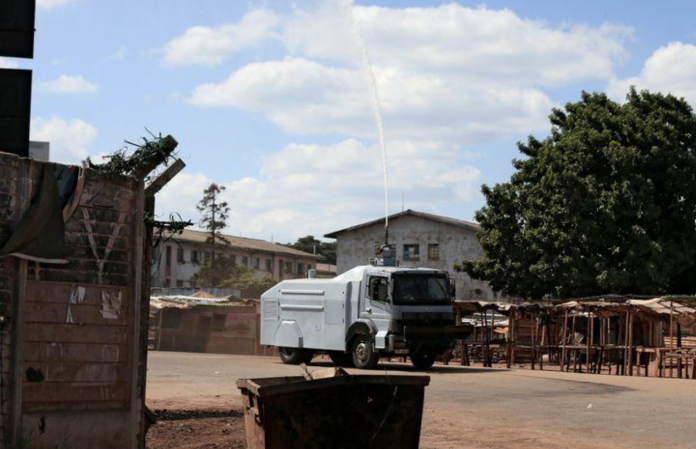
Dear Friends and Partners Source: Their Voices Matter: Week 3 Report – The Zimbabwean A police water canon sprays disinfectant over residential flats during a 21-day nationwide lockdown called to help curb the spread of coronavirus disease (COVID-19), in Harare, Zimbabwe, April 3, 2020. REUTERS/Philimon Bulawayo Today we release the Third Edition of our report […]

The post Their Voices Matter: Week 3 Report  appeared first on Zimbabwe Situation.

Dear Friends and Partners

Source: Their Voices Matter: Week 3 Report – The Zimbabwean

A police water canon sprays disinfectant over residential flats during a 21-day nationwide lockdown called to help curb the spread of coronavirus disease (COVID-19), in Harare, Zimbabwe, April 3, 2020. REUTERS/Philimon Bulawayo

Today we release the Third Edition of our report ‘Their Voices Matter: Community Reponses to COVID 19 Measures’. The report covers week three of the lock-down in Zimbabwe.

The report, a continuing conversation on how communities are experiencing and responding to the human rights issues emerging from the fight against COVID 19, capture community voices and proffer suggestions on how policy makers can implement these measures in a manner that respects the fundamental rights and advances the needs of the communities.

In this report, we tackle four critical issues.

Women and the Fight Against COVID 19. We speak to women across the country in Hurungwe, Mount Darwin and Epworth who reflect on the burden of COVID 19 on women. They reflect on the national compassion burden as women find themselves in the frontlines both in the hospitals as well as fighting poverty at home.

PWDs and COVID 19. We also cover the issue of how the COVID 19 fight has impacted persons with disabilities, with many persons in this category feeling left out of the national priorities.

The Rise of Conspiracy Theories and Church Leadership: As the nation witnessed the rise in conspiracy theories, we spoke to church leaders from around the countries and they highlight the importance of restoring the partnership of state and church in ensuring that congregations are not misled into thinking COVID 19 is a myth. It is a reality and churches are coming together to provide safety nets for the vulnerable as well as offering their health facilities in service of the community.

Citizen Initiatives and Stories of Hope: Finally, there are stories of hope. Ordinary people, standing up to assist others, without waiting for government. We document initiatives that show society taking a proactive approach to fighting COVID.

A number of recommendations come out of these conversations begging both state and society to prioritise the needs of the affected communities in designing and implementing recommendations.

Please follow the link here to download the full report. If you missed previous editions of the report, find them here.

ZimRights reports are conversations that bring out community voices in their raw form. We want to hear from you what human rights issues are emerging in your communities and how you are responding to them. What measures can the state take to improve the human rights situation? If you have any ideas, write to us on myvoice@zimrights.org.zw Alternatively, drop us a Whats App on +263 714 724 133.

Download the report


The post Their Voices Matter: Week 3 Report  appeared first on Zimbabwe Situation.