HARARE — The night air at the Tynwald Rail Road Flyover was thick with the smell of damp earth and twisted metal on Wednesday night, as rescue workers waded through a dark, water-filled gully to retrieve the bodies of those lost in Zimbabwe’s latest ro…
HARARE — The night air at the Tynwald Rail Road Flyover was thick with the smell of damp earth and twisted metal on Wednesday night, as rescue workers waded through a dark, water-filled gully to retrieve the bodies of those lost in Zimbabwe’s latest road tragedy. At approximately 10 pm, a commuter omnibus, known locally […]
JOHANNESBURG – Media mogul and philanthropist Oprah Winfrey will wind down the residential operations of the Oprah Winfrey Leadership Academy for Girls by the end of 2027, marking the end of a landmark education project that has transformed the lives of hundreds of young South African women over the past two decades. Instead of operating […]
JOHANNESBURG – Media mogul and philanthropist Oprah Winfrey will wind down the residential operations of the Oprah Winfrey Leadership Academy for Girls by the end of 2027, marking the end of a landmark education project that has transformed the lives of hundreds of young South African women over the past two decades.
Instead of operating a single boarding school, Winfrey will launch a nationwide scholarship programme designed to support academically gifted girls at leading schools and educational institutions across South Africa.
The move represents a strategic shift from a campus-based model to one intended to reach significantly more students from disadvantaged communities.
“The dream was never simply to build a school,” Winfrey said in a statement.
“It was to invest in the limitless potential of young women. That mission doesn’t end with one campus. It continues in every girl whose future can be transformed through education.”
She added that the scholarship initiative would expand the impact of the vision that inspired the academy more than 20 years ago.
“I’m excited that this next chapter will allow us to reach even more young women across South Africa and continue the promise that began more than 20 years ago.”
Founded in 2007, the Oprah Winfrey Leadership Academy for Girls was established to provide high-quality education, leadership training and personal development opportunities to academically talented girls from disadvantaged backgrounds across South Africa.
The academy has produced graduates who have gone on to careers in medicine, engineering, education, business, science, the arts and public service both in South Africa and internationally.
According to an independent evaluation conducted in 2024, the academy has achieved strong educational outcomes. The study found that 99% of graduates progressed to higher education, while nearly nine in ten said the school provided opportunities they would not otherwise have had. Almost all respondents also reported that their education had positively affected their families and communities.
Under the new model, scholarships will enable students to attend some of South Africa’s top educational institutions while continuing to receive mentorship, leadership development and higher education support.
Current students will remain at the academy until they complete their studies, with the institution committing to provide uninterrupted academic, financial and personal support throughout the transition.
Once the final class graduates in 2027, the academy’s campus, located south of Johannesburg, will be transferred back to the Gauteng Department of Education in line with the original partnership agreement.
Gauteng MEC for Education, Arts, Culture and Recreation Lebogang Maile thanked Winfrey for her long-standing investment in education, saying her contribution had created opportunities for generations of young women and would continue to leave a lasting legacy beyond the academy itself.
The transition marks a new chapter in Winfrey’s philanthropic work in South Africa, with the expanded scholarship programme expected to extend educational opportunities to a much broader pool of talented young women across the country.
Amid heightened xenophobia in South Africa, data from Stats SA shows that net migration to South Africa has slowed, but is still estimated to reach over 880,000 immigrants between 2021 and 2026. South Africa has seen several public demonstrations against foreign workers, who have been scapegoated for the nation’s high unemployment, poverty, and inefficient public […]
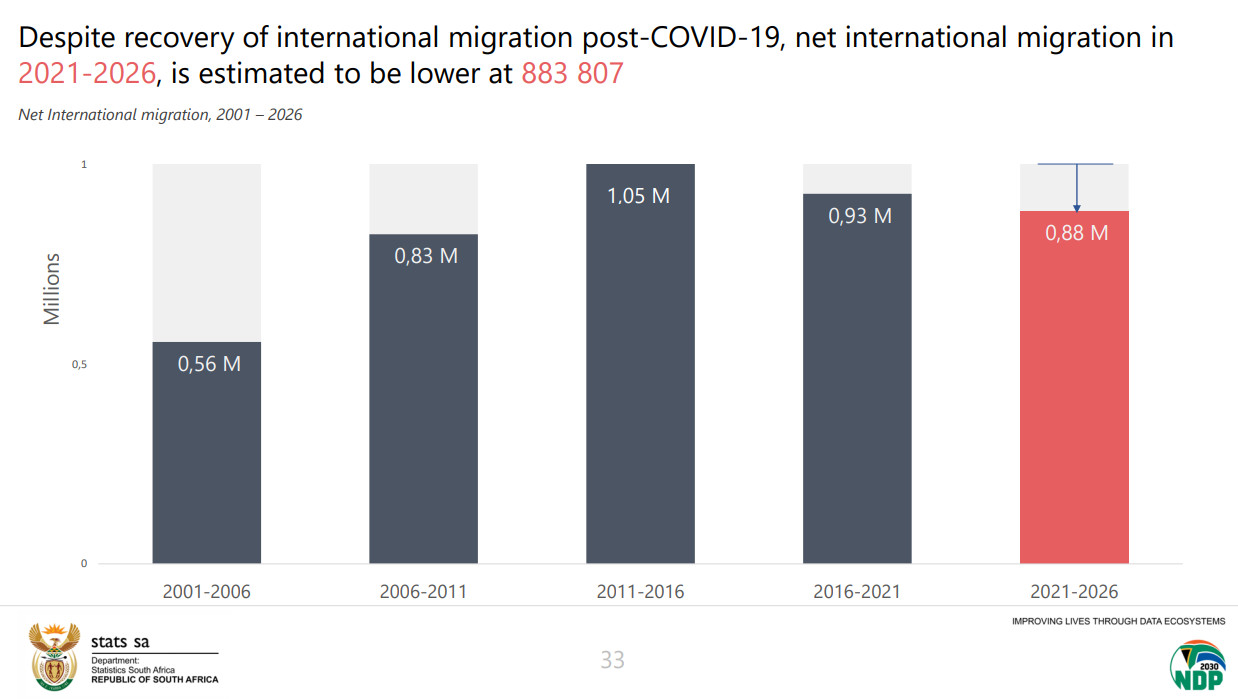
Amid heightened xenophobia in South Africa, data from Stats SA shows that net migration to South Africa has slowed, but is still estimated to reach over 880,000 immigrants between 2021 and 2026.
South Africa has seen several public demonstrations against foreign workers, who have been scapegoated for the nation’s high unemployment, poverty, and inefficient public services.
Despite being targeted, foreign nationals make up an incredibly small amount of the population and data from Stats SA shows that net migration in South Africa has actually declined.
In its mid-year population estimates for 2026, Stats SA said that calculating annual net migration over time is required for its estimates. The study shows that the population is around 63.52 million people in 2026.
While South Africa has a registration of births and deaths with minor incompleteness, international migration surveillance systems have failed to account for migrants in the country accurately.
“Irregular migration is a common problem contributing to migration data accuracy,” the statistics body said.
Stats SA was thus forced to use other data sources, including the census, population age and sex structures seen in other surveillance systems, such as education and health.
It also used censuses from other countries to capture South African migrant and tourist patterns, as well as data from the OECD and UNDESA.
Stats SA said that compared to other components of change, the net migration rate can be volatile, which was the case during the outbreak of the COVID-19 pandemic.
Data from Stats SA shows that net international migration in South Africa slowed from 2021 to 2026, with a net of 883,807 people entering the country over the five years.
This was less than the 926,777 recorded from 2016 to 2021 and the 1,054,900 recorded from 2011 to 2016.
“Given the impact of COVID19 on international movement across the globe, estimates of international migration during the COVID-19 period were disrupted,” said Stats SA.
“Overall, the assumption is that international migration drastically reduced during the COVID-19 period, and there has been a recovery since the end of the pandemic and the corresponding lockdown measures.”
While tourist numbers in South Africa’s international tourism have shown a slight improvement, they still fall short of pre-COVID levels.
Changes across all groups
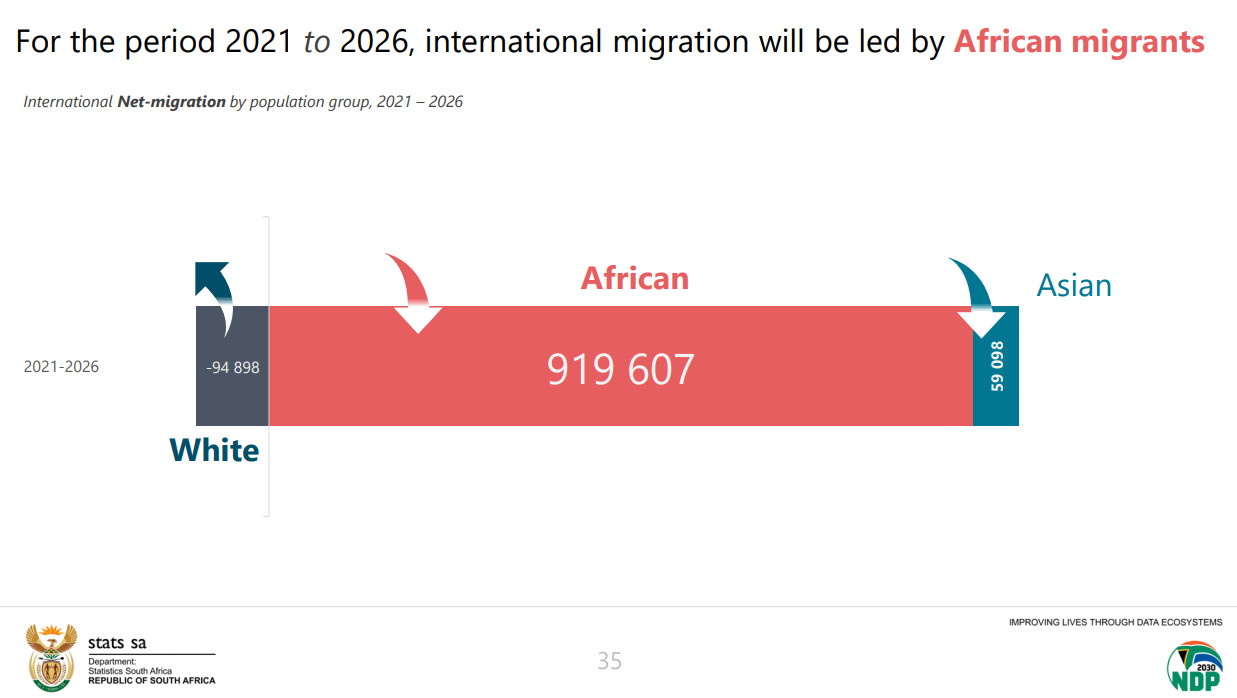
The data show that the net international migration of Black Africans slowed from 1,100,815 between 2011 and 2016 to 919,607 between 2021 and 2026.
The net migration of Indian and Asians also dropped from 65,431 from 2011 to 2016 to 59,098 from 2021 to 2026.
Given their higher wealth and greater access to migration services, the white population again showed a negative net migration estimate, at -94,898 from 2021 to 2026.
Stats SA noted an assumed upward trend in net migration since 2021. However, late May and June 2026 saw a notable number of deportations and voluntary repatriations of foreigners.
Stats SA said that the civil protests and media attention contributed to a decline in immigration from the SADC region to South Africa, as well as an increase in emigration.
As net migration is estimated annually, from July to June, the recent deportations and repatriations would result in a decline in net migration for 2026.
“The intended impact of the enforcement of migration and employment policies is continually evolving,” Stats SA noted.
Huawei hosted the Financial Services Industry Summit as part of Huawei South Africa Connect 2026, bringing together banking leaders, insurers, technology experts and ecosystem partners under the theme “Beyond Digital: Leaping into the Fintelligent Era.” The summit explored how artificial intelligence, resilient digital infrastructure and industry collaboration are helping financial institutions unlock greater business value […]
Huawei hosted the Financial Services Industry Summit as part of Huawei South Africa Connect 2026, bringing together banking leaders, insurers, technology experts and ecosystem partners under the theme “Beyond Digital: Leaping into the Fintelligent Era.”
The summit explored how artificial intelligence, resilient digital infrastructure and industry collaboration are helping financial institutions unlock greater business value and accelerate intelligent transformation.
Opening the summit, Jason Cao, CEO of Huawei Digital Finance BU, said banking is entering a new era where competitive advantage will increasingly depend on how organisations apply AI to deliver measurable business value.
“As open-source models cross the trillion-parameter threshold, AI is evolving from open architecture to open compute. In an era where compute is productivity, competition in “banking has shifted to token efficiency and real-world value creation.”
He added that “trillion-parameter models like Kimi K3 prove that open source has officially become mainstream in banking”.
“Through our Hybrid AI Architecture, Huawei empowers financial institutions to harness massive compute power, ensuring every AI token drives tangible business value,” noted Cao.
Building on this vision, Alvin Feng, President of Huawei’s International BU of Digital Finance, introduced Huawei’s digital finance solution framework, which combines autonomous and elastic infrastructure to carry intelligent service engines, enabling intelligent interaction and providing ultra-personalised services for various scenarios in the financial industry, thus accelerating the digital transformation of the financial industry.
In addition, Huawei, in collaboration with its partners, has developed a financial data solution that provides strong digital & AI foundations through the end-to-end AIDC resilient infrastructure, injecting innovative momentum into South Africa’s financial services industry.
Luke Wang, President of Huawei Insurance BU, released the digital and intelligent insurance solution, highlighting three trends reshaping the insurance industry.
“Three shifts remaking the future of global insurance: the pre-incident prevention of business models, the personalisation of customer experiences, and scenario-based marketing. Huawei has released the digital and intelligent insurance solution, working with partners to support the digital and intelligent transformation of the insurance industry from four key aspects: modernisation of core insurance systems, intelligent upgrade of insurance, insurance cloud upgrades, and insurance resilient infrastructure.”
The summit also featured insights from South Africa’s financial services sector. Senior leadership from top South African banks, along with other clients and partners, shared rich experiences and successful practices in the digital and intelligent transformation of South Africa’s financial services industry.
Looking ahead, Huawei will continue to work closely with its customers and partners, providing advanced ICT infrastructure and customised solutions. Jointly build a thriving ecosystem and usher in a new chapter of digital and intelligent transformation in South Africa’s financial industry.