Amid heightened xenophobia in South Africa, data from Stats SA shows that net migration to South Africa has slowed, but is still estimated to reach over 880,000 immigrants between 2021 and 2026.
South Africa has seen several public demonstrations against foreign workers, who have been scapegoated for the nation’s high unemployment, poverty, and inefficient public services.
Despite being targeted, foreign nationals make up an incredibly small amount of the population and data from Stats SA shows that net migration in South Africa has actually declined.
In its mid-year population estimates for 2026, Stats SA said that calculating annual net migration over time is required for its estimates. The study shows that the population is around 63.52 million people in 2026.
While South Africa has a registration of births and deaths with minor incompleteness, international migration surveillance systems have failed to account for migrants in the country accurately.
“Irregular migration is a common problem contributing to migration data accuracy,” the statistics body said.
Stats SA was thus forced to use other data sources, including the census, population age and sex structures seen in other surveillance systems, such as education and health.
It also used censuses from other countries to capture South African migrant and tourist patterns, as well as data from the OECD and UNDESA.
Stats SA said that compared to other components of change, the net migration rate can be volatile, which was the case during the outbreak of the COVID-19 pandemic.
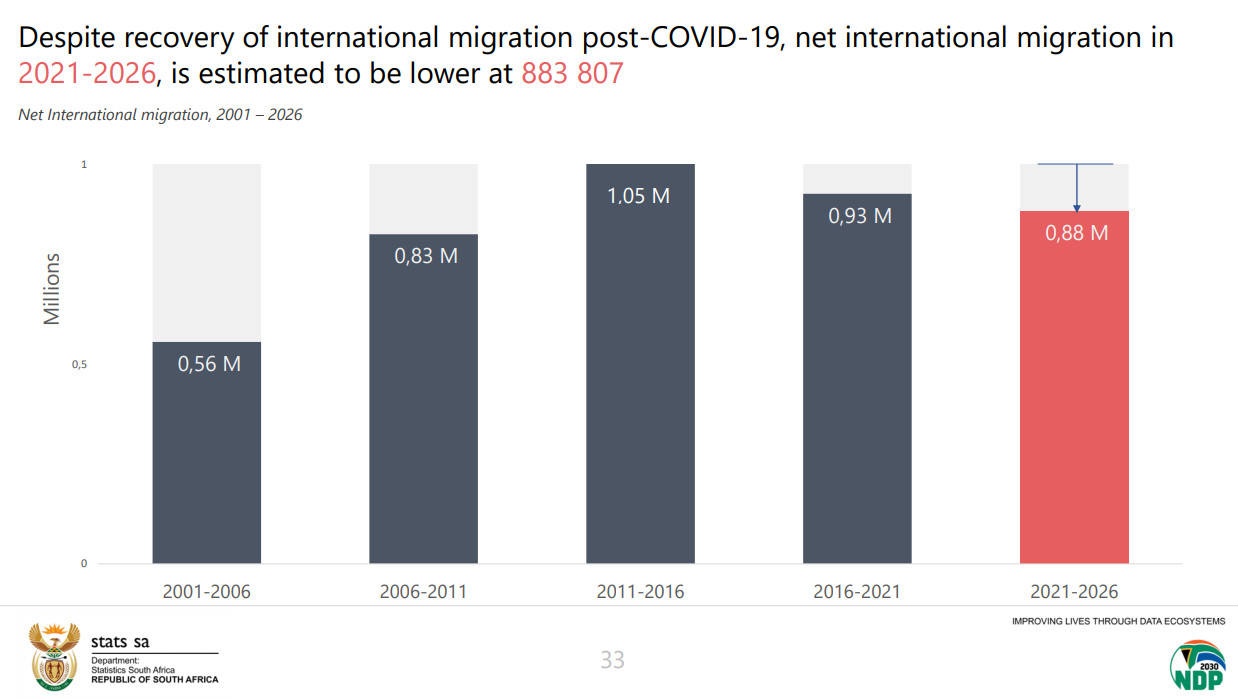
Data from Stats SA shows that net international migration in South Africa slowed from 2021 to 2026, with a net of 883,807 people entering the country over the five years.
This was less than the 926,777 recorded from 2016 to 2021 and the 1,054,900 recorded from 2011 to 2016.
“Given the impact of COVID19 on international movement across the globe, estimates of international migration during the COVID-19 period were disrupted,” said Stats SA.
“Overall, the assumption is that international migration drastically reduced during the COVID-19 period, and there has been a recovery since the end of the pandemic and the corresponding lockdown measures.”
While tourist numbers in South Africa’s international tourism have shown a slight improvement, they still fall short of pre-COVID levels.
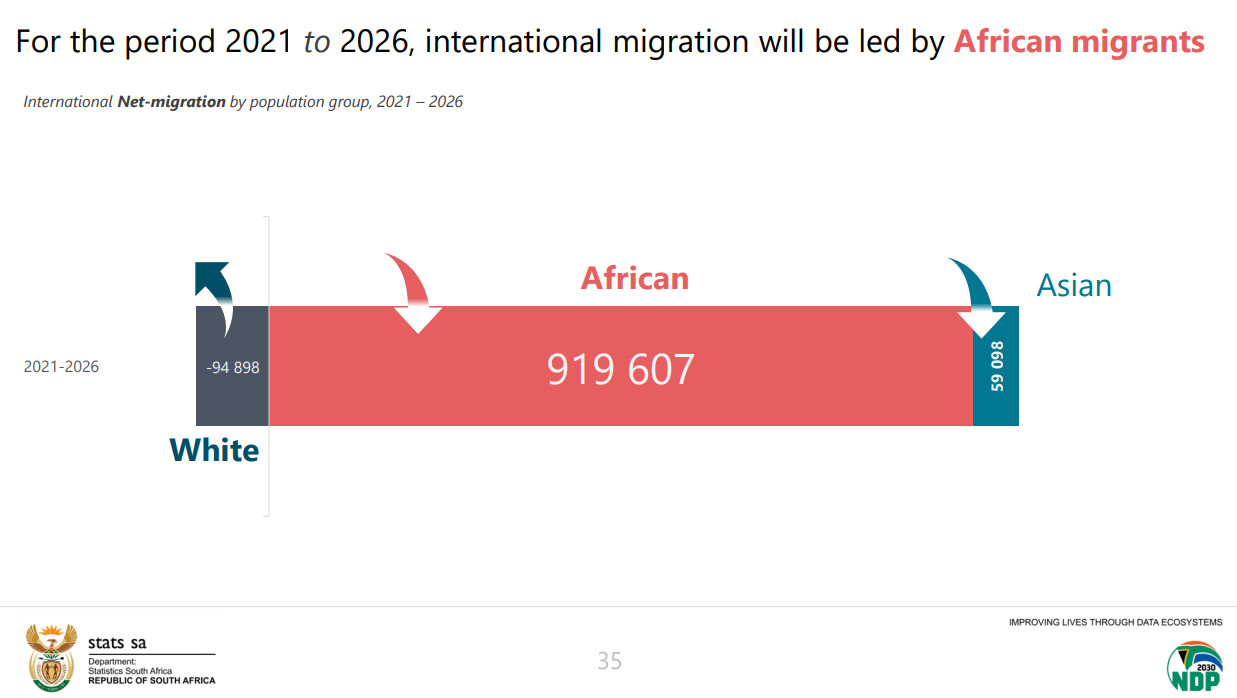
Changes across all groups
The data show that the net international migration of Black Africans slowed from 1,100,815 between 2011 and 2016 to 919,607 between 2021 and 2026.
The net migration of Indian and Asians also dropped from 65,431 from 2011 to 2016 to 59,098 from 2021 to 2026.
Given their higher wealth and greater access to migration services, the white population again showed a negative net migration estimate, at -94,898 from 2021 to 2026.
Stats SA noted an assumed upward trend in net migration since 2021. However, late May and June 2026 saw a notable number of deportations and voluntary repatriations of foreigners.
Stats SA said that the civil protests and media attention contributed to a decline in immigration from the SADC region to South Africa, as well as an increase in emigration.
As net migration is estimated annually, from July to June, the recent deportations and repatriations would result in a decline in net migration for 2026.
“The intended impact of the enforcement of migration and employment policies is continually evolving,” Stats SA noted.
| Period | Black African | Indian/Asian | White | Net International Migration |
| 2001–2006 | 619,509 | 35,562 | -99,574 | 555,497 |
| 2006–2011 | 878,851 | 53,047 | -106,787 | 825,111 |
| 2011–2016 | 1,100,815 | 65,431 | -111,346 | 1,054,900 |
| 2016–2021 | 956,984 | 60,700 | -90,957 | 926,727 |
| 2021–2026 | 919,607 | 59,098 | -94,898 | 883,807 |
Source: BusinessTech.
The post Over 880,000 people flooding to South Africa appeared first on The Zimbabwe Mail.