State moves to attach Kasukuwere’s property – NewsDay Zimbabwe

Source: State moves to attach Kasukuwere’s property – NewsDay Zimbabwe March 7, 2019 BY DESMOND CHINGARANDE The State intends to forfeit an immovable property belonging to former Local Government minister Saviour Kasukuwere, which he surrendered as part of his bail conditions after he allegedly fled the court’s jurisdiction. Presidential Anti-Corruption Unit special prosecutor Zivanai Macharaga […]

The post State moves to attach Kasukuwere’s property – NewsDay Zimbabwe appeared first on Zimbabwe Situation.

Source: State moves to attach Kasukuwere’s property – NewsDay Zimbabwe March 7, 2019

BY DESMOND CHINGARANDE

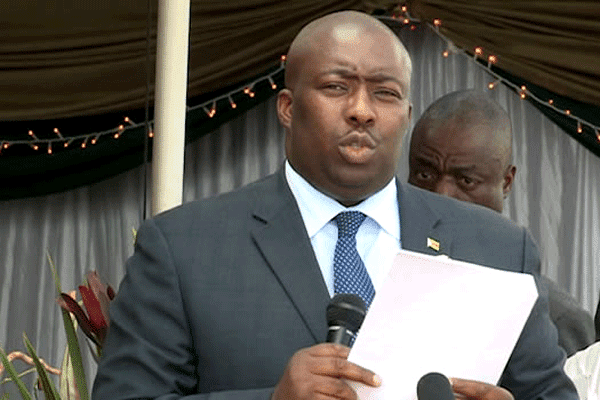
The State intends to forfeit an immovable property belonging to former Local Government minister Saviour Kasukuwere, which he surrendered as part of his bail conditions after he allegedly fled the court’s jurisdiction.

Presidential Anti-Corruption Unit special prosecutor Zivanai Macharaga revealed this in a notice to Kasukuwere’s lawyers Charles Chinyama and Advocate Thembi Magwaliba dated February 27 and also addressed to the clerk of court.

The application was expected to be heard yesterday, but Macharaga and Chinyama agreed to have the matter postponed to March 14.

“We write to advise that on January 17, 2019 accused was issued with a warrant of arrest after he failed to appear for his trial. In terms of section 119 (1) and section 133 (a) of the Criminal Procedure and Evidence Act an order declaring any recognisance forfeited can be made,” the letter read.

“The State, hereby, notifies the court that on March 6, 2019, it shall make an application to have an immovable property surrendered by the accused person as surety to be declared forfeited to the State, as referred to in the minute dated February 22, 2019. The State will proceed to make such an application in view of the fact that accused has clearly defaulted court and has no willingness to stand trial. The accused has no right of audience before the court of law in view of the fact that he is a fugitive.”

Kasukuwere had applied for the release of his passport to enable him to seek medical attention in South Africa.

“The State will make the application as notified unless the accused appears in court in whatever condition be it sick or good health. If the State succeeds and has the immovable property forfeited such a property may be sold by public auction or the State may deal with it any other way allowed by the law and this will be done on the shortest possible time provided by the law,” the letter read.

But Magwaliba further challenged the purported notice of the State saying the section used to file the notice was defective.

“We further notice that your notice is purportedly predicted on section 199 of the Criminal Procedure and Evidence Act and if the reading of the same section is correct, your notice is again defective since it is predicted on the wrong law. You may want to take this opportunity to visit the relevant section,” he said.

The post State moves to attach Kasukuwere’s property – NewsDay Zimbabwe appeared first on Zimbabwe Situation.

Zim platinum output slips

Source: Zim platinum output slips | Daily News Zimbabwe’s platinum output slipped two percent to 10 000 ounces during the fourth quarter of 2018 due to work in progress material processing in 2017, a new study has revealed. According to the World Platinum Investment Council (WPIC) latest report, platinum output from Zimbabwe and Russia is expected […]

The post Zim platinum output slips appeared first on Zimbabwe Situation.

Source: Zim platinum output slips | Daily News

Zimbabwe’s platinum output slipped two percent to 10 000 ounces during the fourth quarter of 2018 due to work in progress material processing in 2017, a new study has revealed.

According to the World Platinum Investment Council (WPIC) latest report, platinum output from Zimbabwe and Russia is expected to remain stable at 470 000 ounces and 675 000 ounces respectively.
“Supply from Zimbabwe fell by 14 percent year-on-year (-20 000 ounces) to 120 000 ounces, with the prior year period boosted by processing of WIP material,” WPIC said.

Zimbabwe has the world’s second biggest known platinum deposits after its neighbour South Africa. One of Zimbabwe’s three largest platinum producers is Zimplats? the other two are Mimosa and Unki. The council said global platinum demand is expected to increase by five percent to 7,7million ounces this year, owing to a significant increase in investment demand, which should offset weaker demand in the automotive, jewellery and industrial segments.

Supply would also likely increase by five percent this year, widening the market surplus, from 645 000 ounces in 2018, to 680 000 ounces. During the year 2018, total platinum supply fell marginally to eight million ounces, owing to lower mining supply and a modest increase in recycled platinum.

Refined production was down one percent to six million ounces, with notable decreases in Zimbabwe and Russia while South African production increased one percent year-on-year as a result of a low level of disruptions.

Platinum demand contracted by five percent to 7,3 million ounces, which resulted in a surplus of 645 000 ounces.
Low levels of demand were attributed to declines in jewellery, automotive and investment demand, which outweighed improved industrial demand.

WPIC said the 2019 forecast now foresees a 680 000 ounces surplus versus the prior estimate of 455 000 ounces, due to temporary higher refined production in South Africa and supply growth elsewhere more than offsetting increased demand in 2019.
Total demand in 2019 is forecast to rise five percent this year, compared to 2018.

The post Zim platinum output slips appeared first on Zimbabwe Situation.

Editorial Comment: Zim must embrace higher standards

Source: Editorial Comment: Zim must embrace higher standards – NewsDay Zimbabwe March 7, 2019 Editorial Comment THE United States has announced the extension of sanctions against targeted individuals and institutions in Zimbabwe, and officialdom cried “bad wolf!” Zanu PF spokesperson Simon Khaya Moyo says the US is perpetuating hostilities … against efforts by the government […]

The post Editorial Comment: Zim must embrace higher standards appeared first on Zimbabwe Situation.

Source: Editorial Comment: Zim must embrace higher standards – NewsDay Zimbabwe March 7, 2019

Editorial Comment

THE United States has announced the extension of sanctions against targeted individuals and institutions in Zimbabwe, and officialdom cried “bad wolf!”

Zanu PF spokesperson Simon Khaya Moyo says the US is perpetuating hostilities … against efforts by the government towards implementation of its national reform agenda, including the engagement and re-engagement policy.

Under the so-called “new dispensation”, Zimbabwe has instituted “remarkable” electoral reforms that create a conducive environment for free and fair and credible elections as manifested in July 2018.

The country has witnessed the upholding of human rights fundamentals and the liberations of the media and many other freedoms as enshrined in the national Constitution, he goes on to add.

We think Khaya Moyo is missing the point.

Last year, the US Congress and Senate passed the amended Zimbabwe Democracy and Economic Recovery Act (Zidera) which US President Donald Trump signed into law.

The signing came just over a week after the July 30, 2018 election and after the events of August 1, in which the army shot dead six civilians during the post-election violence, according to the government-appointed commission of inquiry.

Trump was always going to sign the law, even if the August 1 events had not taken place. Karen Bass, a US Congresswoman who was part of the American IRI-NDI election observer mission had already said Trump was going to sign the new Zidera law, whatever the outcome of the election, telling journalists in Harare that “it went through both houses, so I don’t see any reason why he wouldn’t sign it”.

So the debate continues unabated in the highly polarised political discourse in Zimbabwe. Critics of the sanctions say they are detrimental to development and have hamstrung every government effort to grow the economy, while supporters say Zimbabwe’s blatant human rights abuses and absence of the rule of law make sanctions necessary to keep those in power in check.

Others ask why the West is demanding more from Zimbabwe than it does from other developing nations who have worse records on human rights.

While relevant, the question still misses the fact that it’s not a bad thing to be a standard bearer and that Zimbabwe stands to gain more by aspiring to high standards and by embracing a much more open society. Who can complain about holding a universally accepted and credible election?

In Zidera, the US makes demands that are targeted at democratic and economic reforms, many of which the government itself has been parroting — an independent electoral commission, no military intervention in politics, inviting international observers for elections, an apology for the Gukurahundi atrocities and economic reforms.

Crucially, it wants the government to honour the Sadc tribunal ruling to compensate the white farmers who lost their land under the 2000 chaotic land reform programme.

Zimbabwe needs to be open for business, and has so much to offer. It is not a bad thing to be held up to a higher standard, to show our peers that we can be better.

The post Editorial Comment: Zim must embrace higher standards appeared first on Zimbabwe Situation.

Dynamos In Talks With NetOne For New Deal

Dynamos FC Board chairman Isaiah Mupfurutsa revealed that talks are ongoing with telecoms giants NetOne for the renewal of the sponsorship deal that expired at the end of the previous season. He said: We opened […]

Dynamos FC Board chairman Isaiah Mupfurutsa revealed that talks are ongoing with telecoms giants NetOne for the renewal of the sponsorship deal that expired at the end of the previous season. He said: We opened [...]

ED’s military shake-up: smoke and mirrors 

Source: ED’s military shake-up: smoke and mirrors – NewsDay Zimbabwe March 7, 2019 By Paidamoyo Muzulu THE retirement of four military generals and their immediate reassignment to Foreign Affairs has been widely interpreted as President Emmerson Mnangagwa moving to coup-proof his regime by getting rid of key elements that toppled long-time ruler Robert Mugabe in […]

The post ED’s military shake-up: smoke and mirrors  appeared first on Zimbabwe Situation.

Source: ED’s military shake-up: smoke and mirrors – NewsDay Zimbabwe March 7, 2019

By Paidamoyo Muzulu

THE retirement of four military generals and their immediate reassignment to Foreign Affairs has been widely interpreted as President Emmerson Mnangagwa moving to coup-proof his regime by getting rid of key elements that toppled long-time ruler Robert Mugabe in 2017. However, this could have been a smoke and mirrors game, with the military entrenching itself to drive the country’s diplomatic offensive and direct its foreign policy.

A fortnight ago, Mnangagwa retired major-generals Martin Chedondo, Douglas Nyikayaramba, Anselem Sanyatwe and Air Vice-Marshal Shebba Shumbayawonda, all key figures in the military and part of the machinery that helped remove Mugabe in the November 2017 coup. The quartet was immediately redrafted into the Foreign Affairs ministry and are set for plump postings that could redefine Zimbabwe’s foreign policy – tilting it towards the full militarisation of the diplomatic services at a crucial juncture for the country.

The Foreign Affairs and International Trade portfolio is headed by Sibusiso Busi Moyo, a retired major-general, who only left the army upon his appointment by Mnangagwa to his current position. He was the face of the coup.

A trending theory in Zimbabwe, given wind by some key Zanu PF figures, such as former Deputy Finance minister Terrence Mukupe and Gokwe-Nembudziya MP Justice Mayor Wadyajena, has been that Mnangagwa and his deputy, Constantino Chiwenga are at loggerheads, that the army sees itself as the more equal partner in the current administration and that the fuel riots in January were a smokescreen for another coup that was foiled. Mnangagwa has denied this.

When Mnangagwa retired the generals, many analysts were quick to conclude that Mnangagwa had coup-proofed himself, although rumours are abound that the four generals are resisting their deployment.

However, that synthesis does not take into consideration the fact that diplomatic service is also an influential posting. In Zimbabwe, the military is a pervasive presence in everyday life, with tentacles in business, police, the courts and even the country’s roads. The diplomatic service may well be the last frontier and the military is taking over that part of the government too.

Post the 2017 coup, Mnangagwa brought into government three generals, Vice-President Chiwenga, Moyo and Agriculture minister Perrance Shiri. Initially, Chiwenga also doubled up as Defence minister. All these ministries are part of the Cabinet’s inner circle. In other words, the military through the retired generals had control of the Executive. More importantly, the military now had their own being the top diplomat as the country walked the re-engagement route with Western world.

Isaac Moyo, another retired general was recalled from South Africa, where he was ambassador to head Zimbabwe’s spy agency, Central Intelligence Organisation. Retired Colonel Christian Katsande was moved from the Office of the President and Cabinet to be Zimbabwe’s top diplomat in London.

Close sources have said the newly retired generals are set for postings in China, Mozambique, Tanzania and South Sudan, respectively.

Chedondo is set for China, a country that many still think had an invisible hand in the 2017 coup. China is financially exposed in Zimbabwe. Over the last decade it has extended loans to the country totalling close to US$2bn for infrastructure projects. These projects include the upgrade of Robert Gabriel Mugabe and the Victoria Falls international airports, the National Defence College, the Kariba South hydro-electric scheme, NetOne’s expansion programme and the refurbishment of Hwange Power Station’s units 7 and 8.

It is not far-fetched to assume that the Chinese wanted someone with direct links to the military to be their point-man on Zimbabwe. The Chinese want to be kept on the pulse about developments in the country because of the massive financial exposure and the strategic position in geo-politics, not to mention its platinum and lithium reserves.

Nyikayaramba replaces another military officer in Mozambique, General Nicholas Mahuhuba Dube. Mozambique has since pre-independence played a prominent role to Zimbabwe’s well-being. It shares the longest border stretch with Zimbabwe from the north to south. Nyikayaramba has been at the centre of Zimbabwean politics, having been seconded to the Constitution Parliamentary Committee, which was charged with drawing up a new Constitution for the country during the Government of National Unity era between 2009 and 2013. He also had a stint at the Zimbabwe Electoral Commission.

With rising United States interest in domestic affairs of countries like Venezuela and Zimbabwe, it therefore comes as no surprise that the military wants to keep a keen eye on Mozambique, a country that has been receiving billions in foreign direct investment from the West.

Tanzania is also a curious case in Zimbabwe’s diplomacy. Retired military officers have been posted there and recalled back to rejoin the military. Sanyatwe, who was in charge of the brigade responsible for presidential security during the coup, also had command of the military unit that killed six people in the post election violence of August 1, 2018. He has since been promoted to Brigadier General but is expected to replace Absolom Chimonyo who was recalled from Tanzania to be commander of the Zimbabwe National Army.

Sudan is the new military theatre for big powers as they fight for the control of that country’s oil reserves. The Chinese are trying to carve the market for themselves, the usual Western oil companies are also in the mix and Zimbabwe Defence Industries has been rumoured to be supplying arms to that country. Two years ago, a South Sudan official confirmed his country was negotiating with Zimbabwe for oil supplies. In that regard, the military has a keen interest in Sudan.

It remains to be seen if South Africa and Russia will get military men as top diplomats. If that happens, the military would have near total control of the diplomatic services, with its people in key areas of engagement. Meanwhile, South Africa, where Moyo was recalled to be intelligence boss, most likely will get another military man for the strategic role it has on Zimbabwe’s economy.

It’s clear the military has taken over Zimbabwe’s diplomatic services and trade. SB Moyo is now more powerful than any other Foreign Affairs minister Zimbabwe has had since independence. On that score, the military now controls directly, not only the diplomatic thrust, but engagement with countries seen as key to Zimbabwe’s reintegration into the world.

Mnangagwa after all, may now be a mere face of the military establishment.
The post ED’s military shake-up: smoke and mirrors  appeared first on Zimbabwe Situation.