JUST IN: President launches India-Africa Incubation Centre 

Source: JUST IN: President launches India-Africa Incubation Centre | The Herald February 21, 2019 President Mnangagwa Herald Reporter President Mnangagwa today launched the India-Africa Incubation Centre in Harare which he described as a key conduit that will drive the modernisation and industrialisation of the economy. The centre specialises in equipping young people with entrepreneurial skills […]

The post JUST IN: President launches India-Africa Incubation Centre  appeared first on Zimbabwe Situation.

Source: JUST IN: President launches India-Africa Incubation Centre | The Herald February 21, 2019

JUST IN: President launches India-Africa Incubation CentrePresident Mnangagwa

Herald Reporter
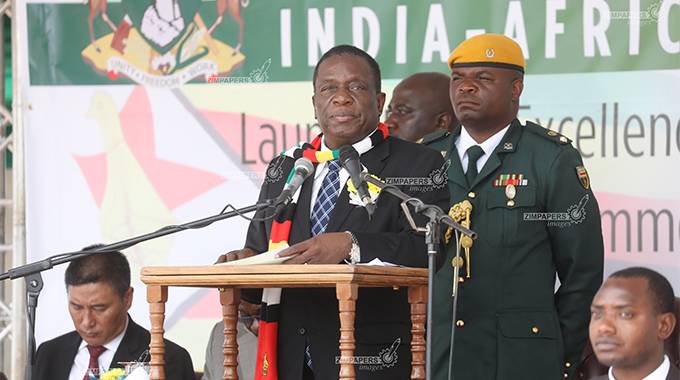
President Mnangagwa today launched the India-Africa Incubation Centre in Harare which he described as a key conduit that will drive the modernisation and industrialisation of the economy.

The centre specialises in equipping young people with entrepreneurial skills to start their own businesses and dovetails with the President’s Vision of transforming the economy into an upper middle income status by 2030.

More to follow…

The post JUST IN: President launches India-Africa Incubation Centre  appeared first on Zimbabwe Situation.

Masvingo gets $33 million for devolution programmes

Source: Masvingo gets $33 million for devolution programmes | The Herald February 21, 2019 Minister Moyo Walter Mswazie Masvingo Correspondent MASVINGO has received the US$33 million that was allocated in the 2019 National Budget for its devolution programmes amid indications that it wants to achieve Gross Domestic Product (GDP) of at least US$ 8 billion […]

The post Masvingo gets $33 million for devolution programmes appeared first on Zimbabwe Situation.

Source: Masvingo gets $33 million for devolution programmes | The Herald February 21, 2019

Masvingo gets $33 million for devolution programmes
Minister Moyo

Walter Mswazie Masvingo Correspondent
MASVINGO has received the US$33 million that was allocated in the 2019 National Budget for its devolution programmes amid indications that it wants to achieve Gross Domestic Product (GDP) of at least US$ 8 billion by the year 2023.

Addressing stakeholders during the inaugural Masvingo devolution conference at a local hotel on Monday, Local Government, Public Works and National Housing Minister July Moyo said the new dispensation had seen it fit to follow the provisions of the 2013 constitution which provided for the decentralisation of the country’s wealth in each

province with the community actively participating in the development matrix.

“The money for devolution amounting to US$33 million for Masvingo province is now available. We expect the Minister of State for Masvingo Provincial Affairs Ezra Chadzamira to work with the elected provincial councillors to see how the money will be used,” said Minister Moyo.

“Secondly the money I said will be released to assist local authorities in addressing marginalisation is now available.

“Bikita will get $3,2 million, Chiredzi $5,6 million, Chivi $3 million, Gutu $3,8 million, Masvingo RDC $4,6 million, Mwenezi RDC $3,9 million, Zaka RDC $3,3 million, Masvingo City $893 000 and Chiredzi Town Council $394 000.

“We will write to local authorities and provincial administrator so that they give use breakdown on how they want to use the money.

“Remember you will get 5 percent which will only be increased as and when the national budget increases,” he said.

He said in devolution local authorities had the right to raise their own funds and it was meant to strengthen their governance systems.

“Local authorities operations are informed by constitutional provisions and they can approach the courts if such operations are violated.

“It is ultra-vies to interfere with the local authority’s operations, especially on raising funds although the government would give guidance given that we are a unitary state.

“The local authorities are empowered by the constitution to approach the Constitutional Court if they feel their rights are violated,” he said.

He said devolution gives these local authorities an opportunity to ascertain how much they can contribute to the national GDP.

Masvingo province, he said, should account for injections from the central government, as part of its income and be able to create its own.

“The province should be able to achieve at least $3500 per capita, as envisaged by President Mnangagwa.”

Speaking earlier Minister Chadzamira said Masvingo had potential to achieve a GDP of $8 billion by 2023 because it was endowed with a lot of resources.

“Masvingo is endowed with both human and economic resources and because of that we have the pedigree to achieve a provincial GDP of $8 billion by 2023.

“We have mining, agriculture, tourism, manufacturing, wildlife and service sectors which can help us achieve per capita of $3500,” said Minister Chadzamira.

He reiterated that Masvingo did not take part in the recent shutdown protests which occurred in other centres and claimed the life of a policeman, saw the destruction of property, looting of shops and barricading of roads.

“We are a peaceful province as shown by not taking part in the violent protests last month, which saw the destruction of property and killing of a policeman.

“This demonstrates that we are a safe destination for investment. I therefore call upon all citizens in this province to embrace love instead of hate.

“Let us do away with petty political differences, as I also urge our media to be supportive in its reportage.”

The meeting was attended by Higher and Tertiary Education, Science and Technology Development Minister Professor Amon Murwira, Mines and Mining development Minister Winston Chitando, among others.

The post Masvingo gets $33 million for devolution programmes appeared first on Zimbabwe Situation.

‘Declare civil imprisonment unconstitutional’

Source: ‘Declare civil imprisonment unconstitutional’ – NewsDay Zimbabwe February 21, 2019 BY CHARLES LAITON A HARARE woman, who was civil imprisoned for slightly over two weeks has petitioned the High Court, seeking an order to declare the punishment unconstitutional and wants $100 000 in damages from the Commissioner-General of Prisons Paradzai Zimondi, Justice minister Ziyambi […]

The post ‘Declare civil imprisonment unconstitutional’ appeared first on Zimbabwe Situation.

Source: ‘Declare civil imprisonment unconstitutional’ – NewsDay Zimbabwe February 21, 2019

BY CHARLES LAITON

A HARARE woman, who was civil imprisoned for slightly over two weeks has petitioned the High Court, seeking an order to declare the punishment unconstitutional and wants $100 000 in damages from the Commissioner-General of Prisons Paradzai Zimondi, Justice minister Ziyambi Ziyambi and the Attorney-General Prince Machaya.

Beverly Jack, recently filed the summons, citing Zimondi, Ziyambi and Machaya as respondents in their official capacities and the three are yet to respond to the litigation.

“(This is an application for an) order declaring that civil imprisonment is unconstitutional as it violates section 49 (2) of the Constitution of Zimbabwe and consequently an order striking down order 28 of the Magistrates Court (civil) Rules, 2018 and Order 41 of the High Court Rules, 1971 and section 26, 27 and 28 of the Magistrates Court Act and section 16 of the High Court Act,” Jack said.

In her declaration, Jack said she was suing the three for general damages emanating from “grave distress, inconvenience, humiliation, injury and infringement of her constitutional rights” she suffered while detained at Chikurubi Female Prison from March 8, 2016 until March 23, 2016.

Jack said the reason for her incarceration was that on February 16, 2015, a provisional order for her personal attachment and committal to prison arising from her inability to discharge a civil debt was applied for and obtained at the High Court.

“In consequences of plaintiff’s (Jack) arrest and committal to prison, plaintiff suffered grave distress and inconvenience, was severely humiliated and was gravely injured in her dignity all of which has given rise to a claim for damages and other relief that is sought,” she said in her declaration.

“Plaintiff’s arrest and detention was unconstitutional violating section 49(2) of the Constitution of Zimbabwe. Additionally and without necessary limitation, plaintiff’s constitutional rights to section 50 (1)(c) of the Constitution have been violated as the prison officers who were at all material times acting under the command and/or authority of the first and second defendants (Zimondi and Ziyambi), abrogated their responsibility to ensure that the plaintiff was treated humanely and with respect … (to her) inherent dignity and that plaintiff had a right not to be subjected to physical or psychological torture or to cruel, inhuman or degrading treatment or punishment as provided for under section 53 of the constitution.”

In her claim, Jack further indicated that on arrival at the Chikurubi Female Prison on March 8, 2016, she was stripped naked, given dirty prison garb to wear, denied access to toiletries and other basic necessities in breach of extant prison regulations and or in violation of section 51 of the Constitution.

As a result, Jack is also seeking an order compelling prisons to upgrade their facilities and improve the institutions’ conditions so as to protect convicts from contracting diseases as a result of overcrowding.

The matter is pending.

The post ‘Declare civil imprisonment unconstitutional’ appeared first on Zimbabwe Situation.

‘No place to sell’: thousands hit in Zimbabwe clampdown on street vendors 

Source: ‘No place to sell’: thousands hit in Zimbabwe clampdown on street vendors | Reuters CHITUNGWIZA, Zimbabwe (Thomson Reuters Foundation) – When police backed by armed soldiers arrived at the market in Chitungwiza in early February, Lilian Kashamba was reminded of her childhood during Zimbabwe’s war for independence. The 48-year-old widow, who had sold vegetables, […]

The post ‘No place to sell’: thousands hit in Zimbabwe clampdown on street vendors  appeared first on Zimbabwe Situation.
Source: ‘No place to sell’: thousands hit in Zimbabwe clampdown on street vendors | Reuters

CHITUNGWIZA, Zimbabwe (Thomson Reuters Foundation) – When police backed by armed soldiers arrived at the market in Chitungwiza in early February, Lilian Kashamba was reminded of her childhood during Zimbabwe’s war for independence.

The 48-year-old widow, who had sold vegetables, maize and chickens from the council-owned venue for 15 years, pointed to a heap of rubble where her stall once stood, and told how vendors were given 30 minutes to pack up and leave.

After that, the market was demolished by officials from the council, which has not yet said what it will do with the space.

“From my sales here I raised three children. With no place to sell, I don’t know how else to care for my one last child in primary school,” she told the Thomson Reuters Foundation.

The demolition of the Zengeza 4 market was one of a number of actions by local authorities – backed by security forces – against thousands of vendors and informal traders in the capital Harare as well as in other cities and towns this month.

Lovemore Meya, a spokesman for Chitungwiza council, said the clampdown in the town about 30 km (19 miles) south of Harare was a joint effort by local authorities, the police and the army to remove illegal structures and businesses.

But Kashamba and other vendors told the Thomson Reuters Foundation they had paid weekly rentals for their stalls and shops to an intermediary, who had not given it to the council.

The market’s destruction followed a spate of violence that rocked the southern African nation in January when a three-day stay-at-home strike was called after President Emmerson Mnangagwa raised fuel prices.

The protests led to mass arrests and a security crackdown.

Zimbabwe has been on edge ever since, with residents and other witnesses saying police and soldiers conducted night-time raids on many homes and removed and beat alleged protesters.

Meya denied the exercise was politically motivated, saying it affected all vendors and did not discriminate on party lines.

‘URBAN RENEWAL’

Some traders likened the destruction of stalls to the government’s 2005 slum-clearance operation called Operation Murambatsvina, which meant ‘Drive out the filth’.

Joshua Mukungati, 25, who sold furniture out of Zengeza 4, said he had been paying $10 a week to the council and did not understand why he had been evicted and his shop razed.

“It was brutal. We were given only given 30 minutes to remove our wares … we lost valuable property,” he said.

“I don’t have anywhere to sell, and have to keep some of the sofas at my lodgings. The sad part is the authorities have not given us an alternative place to work from.”

Meya, from Chitungwiza council, said some people had sublet market space and were collecting rent without giving it to the council but added the exercise was also about urban renewal.

“People were just erecting structures everywhere and conducting their business anywhere, including along roads, and council was not getting revenue due,” he told the Thomson Reuters Foundation.

“Harare is doing the same. They started their operation in October following communication from the ministry of local government to spruce (up) our image to attract investment.”

Harare mayor Herbert Gomba told the Thomson Reuters Foundation that the law clearly stated where people could trade, and citizens should comply in order to protect public health.

He added that notice of the evictions in Harare was given ahead of time and traders had been offered new locations.

However, traders said that was not the case, according to Samuel Wadzai, the director of the Vendors Initiative for Social and Economic Transformation (VISET), a Harare-based group.

‘DEFENCELESS TRADERS’

Demolishing vendors’ stalls without notifying them or offering them a new place to do business was “barbaric and inhumane”, the Chitungwiza Residents Trust (CHITREST) said.

CHITREST director Alice Kuvheya said the group realized that local authorities were obliged to maintain cleanliness.

“(But) we note with concern the use of the armed soldiers to deal with defenseless traders, who were making an honest living through vending and informal work in a very challenging economic environment,” Kuvheya told the Thomson Reuters Foundation.

Meantime, Wadzai of VISET said more than 2,500 informal traders and vendors had been affected in the capital, and up to 800 more in Gweru, a city about 200 km (125 miles) southwest.

He said the situation in Harare, Chitungwiza and elsewhere remained tense with many vendors traumatised and fearful of being confronted by soldiers if they returned to former sites.

Instead of cracking down on innocent citizens, he added, the government should recognize the informal sector was key to Zimbabwe’s economy and implement policies to reflect that.

“Over 90 percent of the population is surviving through the informal sector, so there is need to review policies like the criminalization of street vending,” he said.

The post ‘No place to sell’: thousands hit in Zimbabwe clampdown on street vendors  appeared first on Zimbabwe Situation.
Zimbabwe’s inflation rate is being misread, Ncube says

Harare – Zimbabwean Finance Minister Mthuli Ncube has said the country’s inflation rate, which surged to the highest annual level since a hyperinflation blowout a decade ago, is being misread and the measure of monthly […]

Harare – Zimbabwean Finance Minister Mthuli Ncube has said the country’s inflation rate, which surged to the highest annual level since a hyperinflation blowout a decade ago, is being misread and the measure of monthly [...]