Air Zimbabwe To Resume Harare–London Flights By End Of July 2026 – Zhemu Soda 

Source: Air Zimbabwe To Resume Harare–London Flights By End Of July 2026 – Zhemu Soda ⋆ Pindula News Air Zimbabwe will resume flights between Harare and London by the end of July 2026, a Cabinet minister has said. Speaking at a post-Cabinet media briefing in Harare on Tuesday, 7 July, the Minister of Information, Publicity […]

The post Air Zimbabwe To Resume Harare–London Flights By End Of July 2026 – Zhemu Soda  appeared first on Zimbabwe Situation.

Source: Air Zimbabwe To Resume Harare–London Flights By End Of July 2026 – Zhemu Soda ⋆ Pindula News

Air Zimbabwe will resume flights between Harare and London by the end of July 2026, a Cabinet minister has said.

Speaking at a post-Cabinet media briefing in Harare on Tuesday, 7 July, the Minister of Information, Publicity and Broadcasting Services, Zhemu Soda, said the national airline would operate the route using a leased Airbus A330-300 from Spain’s Plus Ultra.

The aircraft has a combined capacity of 302 seats, configured with 30 in business class and 272 in economy.

“The nation is advised that the Airline will resume operations by the end of July 2026 and will utilise a leased Airbus A330-300 aircraft from Plus Ultra in Spain with a combined 302 seats, having a configuration of 30 business class and 272 economy seats,” said Soda.

“The airline will initially operate three weekly frequencies between Harare and London on Wednesdays, Fridays and Sundays.”

Air Zimbabwe last operated flights to London in December 2011, when financial pressures, creditor action and regulatory challenges forced it to suspend its Boeing 767-200 operations.

Since then, several attempts to relaunch the route have failed, despite strong commercial potential driven by demand from Zimbabwe’s diaspora in the United Kingdom and export opportunities for horticultural products.

The post Air Zimbabwe To Resume Harare–London Flights By End Of July 2026 – Zhemu Soda  appeared first on Zimbabwe Situation.

Mnangagwa signs law extending his rule to 2030, scrapping direct presidential vote

‘Democracy has been commodified’ Source: Mnangagwa signs law extending his rule to 2030, scrapping direct presidential vote – Zimbabwe News Now HARARE – President Emmerson Mnangagwa has signed into law constitutional amendments extending presidential terms from five to seven years, allowing him to remain in office until 2030, and abolishing the direct popular election of […]

The post Mnangagwa signs law extending his rule to 2030, scrapping direct presidential vote appeared first on Zimbabwe Situation.

‘Democracy has been commodified’

Source: Mnangagwa signs law extending his rule to 2030, scrapping direct presidential vote – Zimbabwe News Now

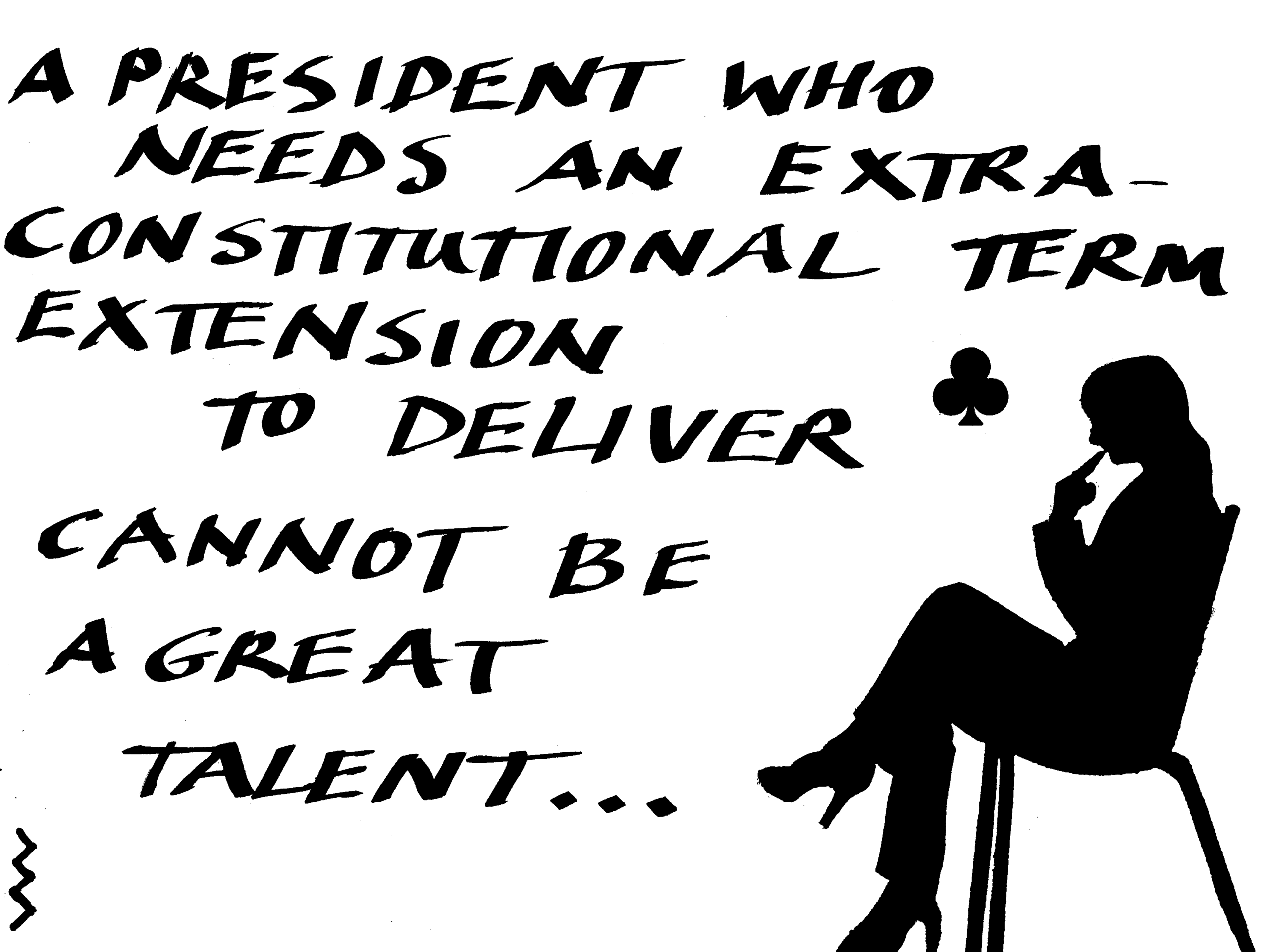
HARARE – President Emmerson Mnangagwa has signed into law constitutional amendments extending presidential terms from five to seven years, allowing him to remain in office until 2030, and abolishing the direct popular election of the president in favour of a vote by parliament.

Both houses of parliament, dominated by the ruling Zanu PF party and its proxies, approved the bill late last month. Mnangagwa’s assent to the Constitution of Zimbabwe (Amendment) Act (No. 3), 2026 – published as Act No. 6 of 2026 – was announced in a special government gazette on Tuesday.

The National Assembly voted 226 to 41 on June 30 to accept the changes proposed by the Senate, which had passed the bill 75 votes to four on June 24.

The raft of changes, labelled a “constitutional coup” by critics, extends the presidential and parliamentary terms from five to seven years, meaning the last of Mnangagwa’s constitutionally limited two terms, due to end in 2028, is now extended to 2030.

The new section 92 does away with direct presidential elections, introduced in 1987, replacing them with election by MPs and Senators sitting jointly after every general election or whenever a vacancy arises.

A candidate needs more than half of the valid votes cast by lawmakers to win, with a run-off between the top two candidates if no-one secures a majority in the first round. The Zimbabwe Electoral Commission will administer the process.

A person elected president must give up their seat in parliament, and any vacancy in the presidency must be filled within 30 days during which no law introducing “substantive policy changes” may be passed.

Human rights lawyer Doug Coltart has warned that the same provisions open the way for a president to begin a fresh seven-year term whenever elected by parliament, potentially allowing lawmakers “to continually renew their own mandate without ever returning to the electorate.”

“It’s an interpretation that we are now going to have to fight,” Coltart said.

Tendai Biti, leader of the Constitution Defenders Forum, said: “These amendments shift power and control to the few rag tag bandits that have made billions from looting the state.

“They create a clear pathway to power for syndicates and fat cats, unapologetic gold smugglers using expensive private jets to ferry gold bars from different disparate African state houses to the murky corridors of Dubai’s underworld.

“They allow the complete privatisation of power, pushing away power and legitimacy from millions of Zimbabweans to those that will be able to control the process and outcomes of any party primary election process. Democracy has been commodified.”

Fadzayi Mahere, a former opposition MP, wrote on X: “Today is a dark, dark day for our nation. A black cloud hangs over us. Our democracy has been in a coma for years but today, it breathes its last. Mourn we must. Tragedy, thy name is Zimbabwe.”

Section 120 is amended to expand the Senate from 80 to 90 members, adding a new category of 10 senators appointed directly by the president “for their professional skills and other competencies” after consultation with the National Assembly – a provision critics say further tilts the upper chamber toward the executive.

A new section 43A strips the Zimbabwe Electoral Commission of its long-standing role over the voters’ roll, transferring responsibility for registering voters and compiling and maintaining voters’ rolls and registers to the Registrar General. Correspondingly, section 239 is amended to repeal several of ZEC’s functions outright.

A separate new section 159A creates a Delimitation Commission to take over the redrawing of electoral boundaries from ZEC, chaired by a sitting or former Supreme Court judge (or someone qualified for that role) appointed after consultation with the Judicial Service Commission, alongside five other members with expertise in demography, public administration, cartography and a representative of the National Chiefs Council. The timeline for completing delimitation exercises is also extended from six to eighteen months.

The Act creates a new post of Judge President of the Supreme Court, who will head that court under the Chief Justice, who remains head of the judiciary overall and in charge of the Constitutional Court. The Constitutional Court’s minimum bench is set at five judges besides the Chief Justice and Deputy Chief Justice, and it gains a new discretionary jurisdiction to hear “any other matter” if it grants leave to appeal on a point of law of general public importance.

Public interviews for judicial officers have been scrapped. The president will now appoint the Chief Justice, Deputy Chief Justice, the two Judge Presidents and all other judges after consulting the JSC.

Part 6 of Chapter 12 of the Constitution, which established the National Peace and Reconciliation Commission, is repealed entirely, with related conflict-resolution and healing functions folded into the Zimbabwe Human Rights Commission’s mandate. The Zimbabwe Gender Commission, by contrast, survives, its proposed repeal in the original bill was dropped after a National Assembly amendment retained it, which the Senate subsequently endorsed.

Section 277 introduces gender and youth quotas for local councils elected through proportional representation, at least 30 percent women and 10 percent youth aged 18 to 35, while section 285 extends the term of the National Council and provincial assemblies of chiefs from five to seven years, mirroring the changes to presidential and parliamentary terms.

The changes have been sharply criticised by opposition figures, lawyers and church leaders. The Zimbabwe Heads of Christian Denominations, an umbrella grouping of the Evangelical Fellowship of Zimbabwe, the Zimbabwe Catholic Bishops’ Conference, the Zimbabwe Council of Churches and UDACIZA, warned in a February pastoral statement that the amendments should not be enacted without a referendum, cautioning that bypassing Mnangagwa’s own past pledges to respect term limits “would deeply wound the nation’s trust.”

The Zimbabwe Council of Churches separately called the bill “morally indefensible” in April, while six war veterans and other applicants have mounted Constitutional Court challenges arguing the changes to entrenched term-limit provisions can only be made through a referendum under section 328.

Justice minister Ziyambi Ziyambi has countered that lengthier terms for the president and parliament will remove “toxicity” from local politics.

“That five-year election cycle has proved too short for the work of building and developing the nation,” he told MPs.

“The divisive method of electing the president and the restless electoral cycle within which we have done that, do not stand apart. They reinforce one another to the detriment of the national interest in general and the development of the country in particular. That is the mischief which parliament has a constitutional duty to remedy.”

Zimbabwe’s opposition, weakened by years of repression and tainted elections, charges that the amendments will further entrench Zanu PF’s grip on power.

Mnangagwa, 83, came to power in 2017 in a military-backed coup that ousted Robert Mugabe at the age of 93 after 37 years in power.

The post Mnangagwa signs law extending his rule to 2030, scrapping direct presidential vote appeared first on Zimbabwe Situation.

Drug and cybercrime surge fuels court backlog as JSC steps up recruitment

25 new magistrates sworn-in Source: Drug and cybercrime surge fuels court backlog as JSC steps up recruitment – Zimbabwe News Now A new magistrate takes her oath in front of Chief Magistrate Vongai Guwuriro Muchuchuti HARARE — A growing number of drug-related and cybercrime cases is piling pressure on Zimbabwe’s magistrates’ courts, prompting the Judicial […]

The post Drug and cybercrime surge fuels court backlog as JSC steps up recruitment appeared first on Zimbabwe Situation.

25 new magistrates sworn-in

Source: Drug and cybercrime surge fuels court backlog as JSC steps up recruitment – Zimbabwe News Now

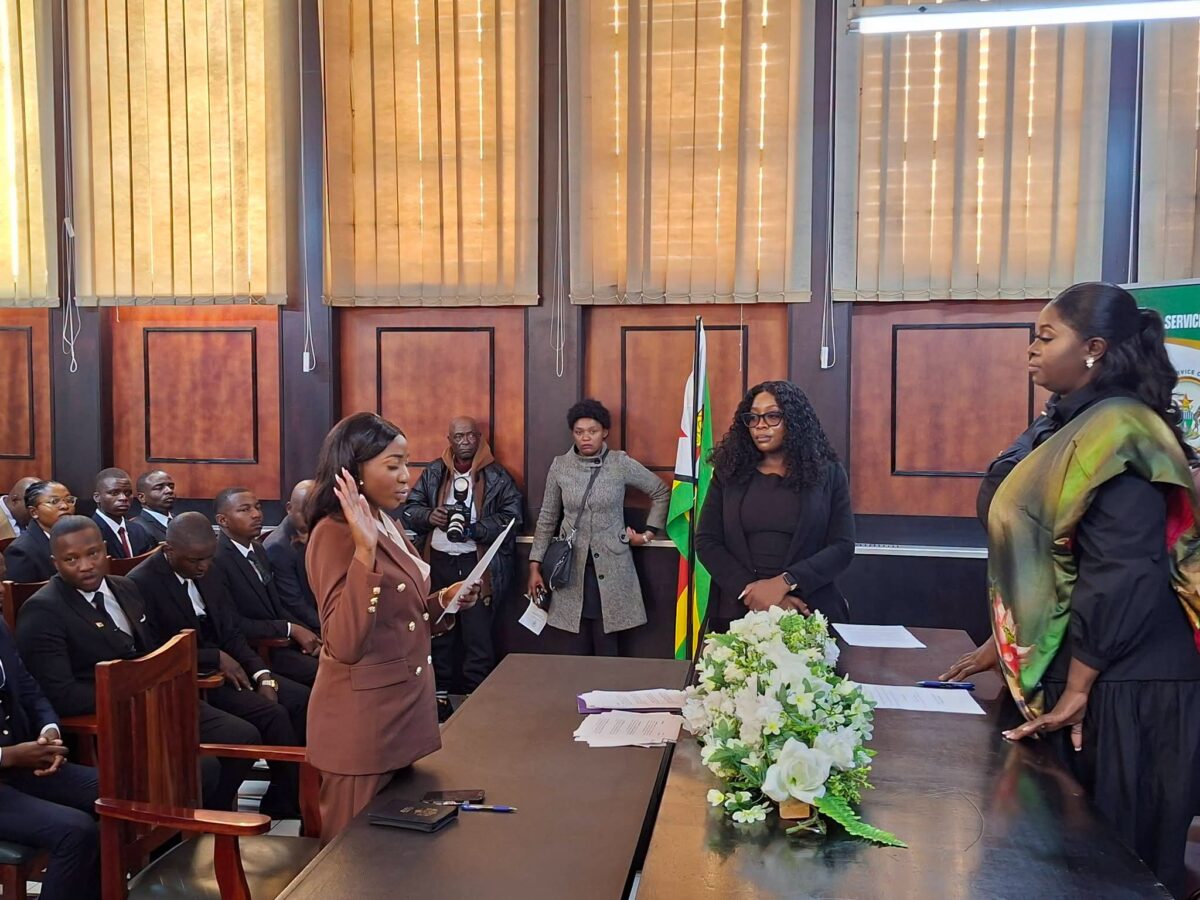
A new magistrate takes her oath in front of Chief Magistrate Vongai Guwuriro Muchuchuti

HARARE — A growing number of drug-related and cybercrime cases is piling pressure on Zimbabwe’s magistrates’ courts, prompting the Judicial Service Commission (JSC) to intensify recruitment and decentralise court services to tackle the backlog.

Chief magistrate Vongai Guwuriro Muchuchuti told journalists at the swearing-in ceremony of 25 magistrates in Harare on Monday that the changing nature of crime has significantly increased the workload facing magistrates across the country, saying the backlog was “also influenced by what is happening in the country.”

“We are receiving a significant number of drug-related cases, as well as many cases involving digital crimes,” she said. “We must therefore be prepared to deal with these emerging offences.”

Muchuchuti said the JSC was implementing several measures to reduce delays in the justice system, describing the swearing-in and capacitation of additional magistrates as “one of the measures the Commission is taking to address the backlog,” alongside the decentralisation of courts as “another key intervention.”

Authorities were also establishing mobile courts to improve access to justice in busy urban areas, she added.

“These are some of the measures the Judicial Service Commission is putting in place to deal with the case backlog so that we can effectively manage the workload coming before our courts and ensure that we are ready to adjudicate all cases brought before us,” she said.

The latest remarks come months after the JSC swore in 17 new magistrates in March as part of efforts to strengthen the country’s judicial capacity. At the time, Muchuchuti said the new magistrates would be deployed across Zimbabwe to ease mounting pressure on the courts, telling reporters they would go “to various stations throughout the country” as the JSC continued “to capacitate our courts in terms of recruiting more magistrates so that it can balance with the workload which is there.”

Zimbabwe had about 268 magistrates in March against a required establishment of 300.

The post Drug and cybercrime surge fuels court backlog as JSC steps up recruitment appeared first on Zimbabwe Situation.

CAB3 signing into law – Zimbabwe officially becomes a pariah state

Source: CAB3 signing into law – Zimbabwe officially becomes a pariah state There are days a nation hides in shame – and today is one of them. Today’s signing of the Constitution of Zimbabwe Amendment (No. 3) Act, 2026 (No. 6), into law marks a devastating turning point, signaling our nation’s official entry into a […]

The post CAB3 signing into law – Zimbabwe officially becomes a pariah state appeared first on Zimbabwe Situation.

Source: CAB3 signing into law – Zimbabwe officially becomes a pariah state

There are days a nation hides in shame – and today is one of them.

Today’s signing of the Constitution of Zimbabwe Amendment (No. 3) Act, 2026 (No. 6), into law marks a devastating turning point, signaling our nation’s official entry into a modern pariah state and the global “league of shame”.

If you value my social justice advocacy and writing, please consider a financial contribution to keep it going. Contact me on WhatsApp: +263 715 667 700 or Email: mbofana.tendairuben73@gmail.com

This is a profoundly dark day for the people of Zimbabwe.

It represents the structural dismantling of democracy as we know it, sacrificed completely to entrench the self-serving power and greed of a ruling elite determined to rule without accountability.

By stripping citizens of the right to directly elect the head of state, decimating the independence of the judiciary, and extending terms of office, the enactment of this legislation cements a grim reality where the state belongs to the few, while the general populace is left entirely in the cold.

History warns us where this path leads.

Zimbabwe is not the first nation to witness its leaders hollow out supreme laws for personal survival.

In Russia, constitutional manipulations systematically extended presidential term limits, effectively locking in an immovable autocracy that has crushed civil dissent and drained national resources into geopolitical conflicts.

In Venezuela, repeated constitutional rewriting consolidated absolute executive control over independent courts and electoral bodies, resulting in a catastrophic economic collapse, historic hyperinflation, and a massive humanitarian crisis that forced millions to flee their homeland.

In Togo, recent structural amendments replaced direct presidential elections with a parliamentary system designed explicitly to ensure the ruling dynasty’s permanent survival.

In every instance, the story remains the same: when a constitution is hijacked to protect power, the people pay with their freedom, their stability, and their futures.

This tragedy feels especially painful when we look back at the origins of our current legal framework.

When the 2013 Constitution was enacted, it was celebrated as a historic triumph, having been met with an overwhelming 94 percent approval by the people of Zimbabwe.

It was supposed to be a sacred contract, built to safeguard our fundamental liberties and guarantee a progressive future.

Yet, after successive amendments, this document has never once been amended for the explicit benefit of ordinary citizens.

No rights have been added to secure our human dignity.

No structural mechanisms to advance public welfare or economic protection have been introduced.

Instead, nearly all of these interventions have been single-mindedly designed to consolidate power for the ruling elite.

​We have watched the removal of the presidential running mate clause and the systematic expansion of executive power in directly appointing senior judges.

Now comes the ultimate insult: a sweeping term limit extension to seven years, coupled with an explicit clause ensuring that current incumbents bypass the safeguards of Section 328(7) to benefit directly from the change.

Rather unimaginatively, all of these aggressive changes have been routinely touted by state machinery as necessary measures for “promoting development, stability, and continuity.”

The glaring, painful irony is that while these amendments have accelerated, ordinary Zimbabweans have sunk deeper into absolute destitution.

Today, general poverty grips 80 percent of the population, and nearly half our people face the daily misery of extreme poverty.

Our youth remain trapped in a catastrophic cycle of jobless desperation, with unemployment hovering at over 90 percent.

For over a generation, the only shred of hope for our young people has been to leave the country entirely.

But that desperate escape route is closing fast, evidenced by the sharp rise in anti-migrant sentiment and structural crackdowns in neighboring nations like South Africa.

After all these years of legal engineering, our public hospitals still lack essential medications, basic bandages, and lifesaving equipment, forcing ordinary citizens to needlessly lose their lives to preventable ailments.

While the general populace suffers, the fat are getting fatter.

The enactment of these changes occurs against a backdrop of a disgusting increase in state corruption.

Every single day, the public is deeply insulted by individuals connected to power who shamelessly flaunt their ill-gotten wealth on social media and in our streets.

This display of luxury is a slap in the face of the poor, whose lives have been systematically decimated by the relentless looting of national resources—wealth that should have built schools, funded clinics, and rescued our economy.

True constitutionalism looks entirely different.

In post-apartheid South Africa, constitutional developments and judicial interpretations have repeatedly expanded social and economic rights, ensuring access to housing, water, and healthcare for historically marginalized communities.

In Kenya, the landmark 2010 Constitution decentralized power to local counties, bringing resources directly to local communities and creating a highly independent judiciary to check executive overreach.

In Ecuador and Bolivia, progressive constitutional changes directly integrated environmental protections and indigenous rights into the supreme law, ensuring that natural resources benefited the broader population rather than multinational cartels.

Tragically, we have gone in the exact opposite direction.

We, the people of Zimbabwe, have watched and allowed the systematic destruction of our democracy—a democracy that was sacrificed for by tens of thousands of liberation heroes, activists, and ordinary citizens who shed blood for the right to self-determination.

By allowing our supreme law to be reduced to a tool for elite convenience, we have broken faith with that history.

This is, indeed, a very dark day for Zimbabwe.

  • Advertise your business, products, or services on my WhatsApp Channel with over 10k followers. For bookings, contact me on WhatsApp: +263 715 667 700 or Email: mbofana.tendairuben73@gmail.com
The post CAB3 signing into law – Zimbabwe officially becomes a pariah state appeared first on Zimbabwe Situation.