Work on Mabvuku interchange progresses

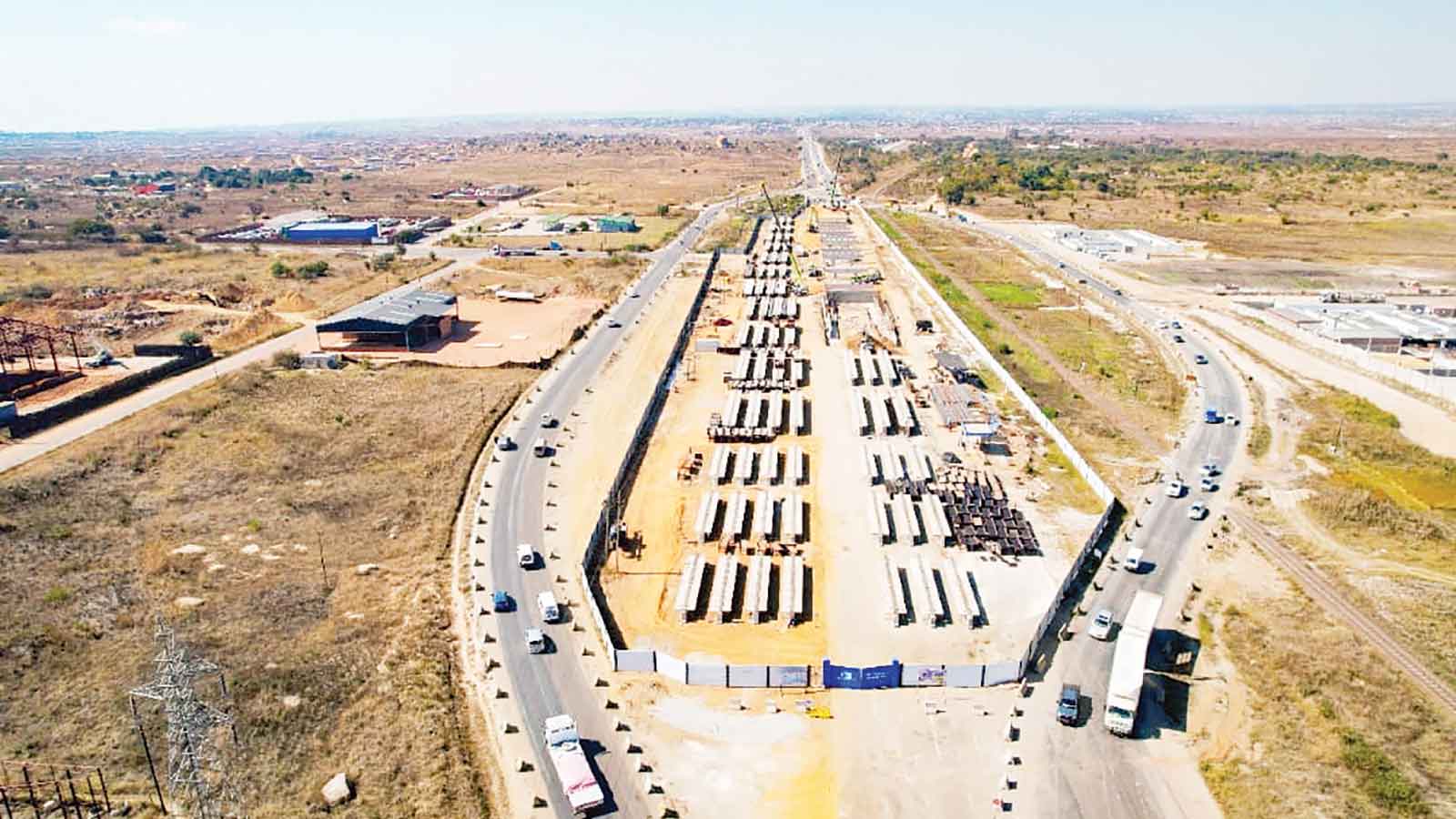
Source: Work on Mabvuku interchange progresses – herald This aerial photograph shows progress at the Mabvuku Interchange which is under construction in Harare. – Picture: Wilson Kakurira Freeman Razemba Senior Reporter THE construction of Mabvuku Interchange is advancing steadily, underscoring the Government’s commitment to modernising and expanding Zimbabwe’s national road network. Situated along the busy […]

The post Work on Mabvuku interchange progresses appeared first on Zimbabwe Situation.

Source: Work on Mabvuku interchange progresses – herald

Freeman Razemba

Senior Reporter

THE construction of Mabvuku Interchange is advancing steadily, underscoring the Government’s commitment to modernising and expanding Zimbabwe’s national road network.

Situated along the busy Harare–Mutare Highway, the project is designed to ease traffic congestion and improve safety on one of the country’s key transport corridors.

In a statement, the Ministry of Transport and Infrastructural Development said the bridge was shaping up.

“Construction of the Mabvuku Interchange continues to make remarkable progress. Precast beams have been completed and lined up for installation. Bridge support structures are taking shape, while structural works are progressing steadily.”

Works completed so far include steel girder installation, reinforcement works and deck slab preparations, with teams working tirelessly to deliver this transformative infrastructure project.

A steel girder is a large primary horizontal support beam that forms the structural “skeleton” of a building or bridge, bearing the weight of smaller secondary beams.

The Mabvuku Interchange follows closely on the heels of the Trabablas Traffic Interchange, which was commissioned by President Mnangagwa last year.

That interchange seamlessly links Simon Mazorodze, High Glen, and Chitungwiza Roads. Like its predecessor, the Mabvuku project is part of a nationwide drive to decongest roads, reduce road carnage and modernise transport systems in alignment with the country’s Vision 2030.

In a related development, a detour was recently constructed at the Msasa Interchange construction site. This critical phase is intended to facilitate the smooth diversion of traffic, allowing accelerated works to proceed on the main interchange infrastructure.

Looking ahead, four more such structures are in the pipeline as part of broader efforts to ease congestion, cut accident rates, and upgrade the nation’s infrastructure.

The planned interchanges include, Mabvuku junction (Harare Drive–Mutare Road), Harare Drive–Liberation Legacy Way, Nemakonde Way–Harare Drive, Sam Nujoma–Harare Drive, Westgate Traffic Circle, Kuwadzana Traffic Circle and Churchill Road–Liberation Legacy Way

These projects reflect the Second Republic commitment to building a modern, efficient and safe road network that supports Zimbabwe’s economic growth and urban development goals.

The post Work on Mabvuku interchange progresses appeared first on Zimbabwe Situation.

China, Brazil and African agriculture: what has changed?

Source: China, Brazil and African agriculture: what has changed? | zimbabweland A decade ago, a group of us published a Special Issue of the journal World Development discussing the results of collaborative research undertaken through the ESRC-funded ‘China and Brazil in African Agriculture’ project. The project looked at the imprint of Chinese and Brazilian agriculture focused projects, alongside […]

The post China, Brazil and African agriculture: what has changed? appeared first on Zimbabwe Situation.

Source: China, Brazil and African agriculture: what has changed? | zimbabweland

A decade ago, a group of us published a Special Issue of the journal World Development discussing the results of collaborative research undertaken through the ESRC-funded ‘China and Brazil in African Agriculture’ project. The project looked at the imprint of Chinese and Brazilian agriculture focused projects, alongside state-business partnerships, as well as other relationships, including informal migration, technology transfer, training etc.. We worked across Ethiopia, Ghana, Mozambique and Zimbabwe with a great team.

What has happened since? I invited authors of the papers from 2016 to reflect on what has changed. The short answer is, a lot. But there are some interesting dynamics. A series of eight blogs were recently posted on the IDS website, and I including the links below. They are worth a read, as these wider geopolitical relations shape what is possible in places like Zimbabwe. China of course dominates but Brazilian tractors have also been a feature (with a rather sorry example from our study area in Mvurwi in the lead image).

The relentless rise of China means that the portfolio of Chinese investments in Africa has expanded. The agricultural technology exchanges, education/training efforts and informal Chinese migration to Africa that we focused on in the Special Issue articles have continued, as Henry Tugendhat and Dawit Alemu discuss for Chinese sponsored agriculture training. In addition, new forms of state-business relationship and commercial partnership are emerging, as discussed by Jing Gu and Zhang Chuanhong. Chinese research partnerships have shifted too, as China Agriculture University colleagues, Xiuli Xu and Tang Lixia, discuss in new blogs.

Brazil has changed too over this period and so the relationships with Africa. Our project took place following Lula’s second presidential term, with much optimism about bi- and trilateral collaboration. This included the More Food International initiative, discussed in a 2016 article. This was reversed dramatically with the change in political leadership after 2019, and the Bolsonaro administration abandoned most of these efforts. Attempts to revive Brazil-Africa relations in Lula’s third term have been constrained by lack of funding, but also a switch in focus with new technological partnerships emerging with China, rather than simply emphasising the export of Brazilian equipment to Africa, as Lidia Cabral and Arilson Favareto discuss.

Attempts to attract Brazilian agribusiness to Africa, on the assumption that Brazilian agronomic and business expertise could easily be transferred along similar latitudes, included the notorious ProSAVANA project in Mozambique. Even though the ProSAVANA project ‘failed’ its continued legacies persist in an afterlife of small projects influencing the performance of development along the whole Nacala corridor, as described by Euclides Gonçalves and Alex Shankland in a new blog.

Over the last decade, then, the once much-hyped ‘South-South’ cooperation (with the prospect of ‘trilateral’ linkages with Western aid donors, such as the UK or Japan) described by Kojo Amanor and Sergio Chichava in their 2016 article has changed significantly. A new geopolitics and massively increased economic power mean that China is very much centre stage in relationships with Africa, while Brazil now takes more of a backseat, despite its aspirations. Western donors have, at the same time, retreated with declining commitments to aid funding. Although much has changed, key aspects of the political dynamics and uneven power relations remain the same, making South-South cooperation in a new geopolitical era never completely mutual and always contested.

Here are the new blogs. Do have a look!

South-South Cooperation: Lessons from China, Brazil and African research partnerships – Institute of Development Studies

From seeds to garden: Understanding South-South cooperation – Institute of Development Studies

The ‘South’ turning to the South: Sharing China’s development experience – Institute of Development Studies

From market access to strategic openness: The new China–Africa business relationship – Institute of Development Studies

Beyond the monolith: Evolving trends in China-Africa agricultural partnerships – Institute of Development Studies

What happened to Brazil’s More Food International? Tractors, family farming and unfinished struggles – Institute of Development Studies

Agricultural development in Mozambique since the contestations around ProSAVANA – Institute of Development Studies

Changes in China’s training courses for African officials – Institute of Development Studies

Link to the full seriesUnderstanding China and Brazil’s changing roles in Africa – Institute of Development Studies

This blog was written by Ian Scoones and first appeared on Zimbabweland

The post China, Brazil and African agriculture: what has changed? appeared first on Zimbabwe Situation.

Chivayo award: how Africa’s leadership awards became a playground for the wealthy and corrupt

Source: Chivayo award: how Africa’s leadership awards became a playground for the wealthy and corrupt There are ironies in this world that defy belief. Tendai Ruben Mbofana The recent conferment of the Africa Inspiring Change Maker Award upon controversial Zimbabwean tenderpreneur Wicknell Chivayo in Morocco marks a deeply troubling paradigm shift for the continent. If […]

The post Chivayo award: how Africa’s leadership awards became a playground for the wealthy and corrupt appeared first on Zimbabwe Situation.

Source: Chivayo award: how Africa’s leadership awards became a playground for the wealthy and corrupt

There are ironies in this world that defy belief.

Tendai Ruben Mbofana

The recent conferment of the Africa Inspiring Change Maker Award upon controversial Zimbabwean tenderpreneur Wicknell Chivayo in Morocco marks a deeply troubling paradigm shift for the continent.

If you value my social justice advocacy and writing, please consider a financial contribution to keep it going. Contact me on WhatsApp: +263 715 667 700 or Email: mbofana.tendairuben73@gmail.com

For a platform that positions itself as a prestigious beacon of leadership, honoring a convicted fraudster and scandal-riddled figure exposes a rot that has quietly hollowed out Africa’s modern awards industry.

What was once intended to be a sacred recognition of selfless service, intellectual brilliance, and moral fortitude has been systematically degraded into a superficial showcase.

Today, the once-reputable title of “change maker” is no longer earned through consistent, systemic societal transformation.

It is increasingly granted based on a narrow, highly performative criteria that prioritizes raw wealth and political proximity over genuine community impact.

To understand why this choice is so mischievous, one must question the very nature of the “philanthropic work” the organizing committee sought to honor.

In the public record, Chivayo’s benevolence is defined almost entirely by a flamboyant car-buying spree and massive cash handouts targeted at prominent figures, internet influencers, and political loyalists.

This is not philanthropy; it is a calculated public relations campaign designed to buy social validation and demonstrate unyielding alignment with political power.

Genuine humanitarianism is measured by structural, life-changing interventions in communities that have been abandoned by the state.

Yet, where are the hospitals Chivayo has equipped in a country where thousands die each year due to the unavailability of cancer machines, and where desperate patients are forced to buy their own paracetamol, antibiotics, and bandages?

Which disenfranchised community has he helped access running water, in a nation where gross administrative incompetence has left rural outposts forgotten and major towns going for months or years without a single drop of the precious liquid?

The dissonance between this award and the reality on the ground becomes even more egregious when contrasted with the infrastructural deficits that continue to plague ordinary citizens.

There are generations of Zimbabweans who have never seen an electric light in their homes, living in total darkness while resources meant for national development vanish into thin air.

It is impossible to separate the celebration of such a figure from the infamous legacy of the Gwanda Solar Power Plant, where an advance payment of at least $5 million was dished out without a bank guarantee for a project that has never seen the light of day.

The proposed site remains an overgrown plot of bushes, a monument to stalled progress and unfulfilled promises.

For a continental summit to overlook these glaring contradictions and brand the face of such a legacy as an “inspiring change maker” is an insult to the millions of Africans who continue to suffer from chronic power shortages, broken healthcare, and collapsed infrastructure.

This brings us to a broader, equally corrosive phenomenon: the structural vulnerability of modern leadership summits to monetary considerations.

While there is no direct evidence that this specific award in Marrakech was a pay-to-play transaction, it is a documented reality that the business model governing private continental awards is heavily shaped by financial muscle.

Hosting lavish galas at five-star resorts requires immense capital, creating an environment where organizers naturally prioritize and court affluent delegates who can pay premium fees, fund massive entourages, and provide corporate sponsorships.

Figures with immense financial resources, regardless of the opaque origins of their wealth or their standing with the judiciary, find a ready-made laundromat in these continental awards.

By purchasing expensive corporate tables, funding delegation fees, and providing substantial sponsorship packages, individuals with checkered pasts effectively purchase a seat alongside genuine diplomats, activists, and heads of state.

The organizers, blinded by the immediate glitter of financial backing, willingly provide the stage, the trophy, and the unearned validation.

This disturbing trend highlights how easily private non-governmental organizations, business networks, and continental summits have abandoned rigorous ethical vetting in favor of financial opportunism.

The ultimate consequence of this monetization of merit is that it relies on a highly superficial and deeply manipulative form of philanthropy used as a shield against public scrutiny.

When platforms rely on the financial patronage of the very people they are meant to vet, the selection process inevitably tilts toward those with the deepest pockets.

The tragedy of this dynamic is the dilution through proximity it inflicts.

By placing a legally compromised individual on the same stage as legitimate human rights defenders and honest entrepreneurs, the value of the honor is completely annihilated.

It signals to the next generation of Africans that integrity is entirely optional, provided you possess enough financial clout to command the room.

Furthermore, when award committees compartmentalize a recipient’s public donations away from the actual mechanics of how that wealth was extracted, they become complicit in a dangerous charade.

They award the spectacle of giving while deliberately ignoring the victims of the underlying corruption.

This opportunistic charity does not heal a nation.

It merely buys the applause necessary to drown out the echoes of institutional malfeasance, transforming accountability into a public relations commodity.

Africa cannot afford to let its highest honors be reduced to commercial commodities.

When the definition of a “change maker” becomes untethered from moral character and structural development, we lose our collective ethical compass.

Prestigious summits and regional institutions must realize that their credibility is not a renewable resource.

Once it is bartered away for momentary social prestige or corporate underwriting, it is gone forever.

We must demand an absolute return to uncompromising vetting processes, where a nominee’s actual, verifiable impact on human life is scrutinized far more intensely than their public displays of wealth.

If Africa is to truly inspire genuine, lasting change, its institutions must stop kneeling at the altar of raw wealth and political proximity.

It is time to fiercely reclaim our platforms of honor.

True excellence must be measured by the depth of one’s character and tangible contribution to the common good, not the extravagance of a personal fortune.
The post Chivayo award: how Africa’s leadership awards became a playground for the wealthy and corrupt appeared first on Zimbabwe Situation.

Real wealth is never kept in cash: The flaunting of millions in Zimbabwe is not a sign of success but of criminality

Source: Real wealth is never kept in cash: The flaunting of millions in Zimbabwe is not a sign of success but of criminality When a country becomes a huge crime scene, it is clear to everyone. Tendai Ruben Mbofana The public display of immense wealth by individuals close to Zimbabwe’s ruling elite has transcended mere […]

The post Real wealth is never kept in cash: The flaunting of millions in Zimbabwe is not a sign of success but of criminality appeared first on Zimbabwe Situation.

Source: Real wealth is never kept in cash: The flaunting of millions in Zimbabwe is not a sign of success but of criminality

When a country becomes a huge crime scene, it is clear to everyone.

Tendai Ruben Mbofana

The public display of immense wealth by individuals close to Zimbabwe’s ruling elite has transcended mere opulence; it has become a grotesque theater of impunity.

If you value my social justice advocacy and writing, please consider a financial contribution to keep it going. Contact me on WhatsApp: +263 715 667 700 or Email: mbofana.tendairuben73@gmail.com

Over the past few years, the nation has witnessed a surreal parade of self-proclaimed “tycoons,” “tenderpreneurs,” and flamboyant religious leaders splashing staggering sums of hard cash.

From purchasing fleets of luxury vehicles as casual gifts to a controversial cleric handing his wife one million dollars in physical banknotes, the message is clear: in Zimbabwe, cash is king, and accountability is dead.

These individuals routinely defend their fortunes by pointing to vague business empires and shrewd investments.

Yet, to anyone with a rudimentary understanding of global finance and corporate governance, these displays do not reflect legitimate wealth creation.

They raise immediate, glaring red flags.

It is safe to assume that even someone like Elon Musk, the richest person in the world with a net worth fluctuating around the trillion-dollar mark, does not keep fifty thousand dollars in hard currency sitting around his house.

His immense wealth is entirely tied up in equity, primarily massive stock holdings in Tesla and SpaceX, meaning his net worth is fundamentally woven into the global financial architecture.

True wealth is systemic, tied up in liquid markets, real estate, corporate equities, treasury bonds, and tightly monitored bank accounts.

Keeping vast amounts of physical cash is a structural necessity for those dealing in the proceeds of crime.

Cash leaves no digital trail.

It bypasses formal banking systems designed to flag suspicious transactions, making it the preferred medium for money laundering, gold smuggling, and public tender fraud.

Legitimate multi-millionaires and billionaires do not store millions of dollars in physical cash inside their homes.

The fact that these individuals possess millions in hard cash is circumstantial evidence of a shadow economy, one that was laid bare to the world in investigative reports like Al Jazeera’s Gold Mafia.

When a public contractor secures a multi-million-dollar state tender for infrastructure, fails to deliver the project, and subsequently spends tens of thousands on luxury items, the math is not difficult to do.

This is the brazen looting of national resources, converted into physical dollars to insulate the perpetrators from legal and financial scrutiny.

In any functioning democracy with robust institutions, the public flashing of illicitly obtained cash would instantly trigger a swift, multi-agency response.

Financial Intelligence Units, tax authorities, and anti-corruption bureaus would launch asset forfeiture investigations, demanding a clear, auditable paper trail of every single dollar.

But in Zimbabwe, the state response is a chilling, complicit silence.

The lack of appetite to investigate these individuals confirms the complete capture of state institutions by a patronage network.

The law is weaponized against political dissent, while those who fund and flatter the ruling elite are granted absolute immunity to flaunt the spoils of corruption.

Perhaps the most tragic dimension of this crisis is the normalization of the spectacle.

There is no longer any sense of shame.

These individuals flaunt their ill-gotten gains in full view of millions of citizens who are struggling to survive amidst grinding poverty, collapsing healthcare, and broken public infrastructure.

Even more distressing is the psychological capture of the victims themselves.

It is common to see impoverished Zimbabweans on social media passionately defending these elites, praising their “generosity” and arguing that they have the right to spend “their money” however they please.

These cheering citizens appear utterly blind to the fact that this is, in reality, their own stolen public money.

It is the very wealth that should have equipped our derelict hospitals and schools, rehabilitated our crumbling roads, and brought clean running water into every home.

This reaction is a symptom of collective trauma and structural poverty.

When a population is subjected to decades of economic deprivation, the perception of success becomes warped.

Wealth is no longer viewed as the product of institutional fairness, hard work, or systemic economic growth.

Instead, it is seen as a lottery won through proximity to political power.

The poor defend the corrupt because they have normalized corruption as the only viable path to survival, hoping that some of the crumbs from the high table might fall their way.

Zimbabwe cannot afford to continue normalizing this economic vandalism.

The celebration of unaccountable wealth erodes the moral fabric of society and kills the incentive for honest enterprise.

The international community, financial watchdogs, and, most importantly, the citizens of Zimbabwe must see these displays for what they truly are: not symbols of success, but crime scenes in plain sight.

Until the country demands that wealth be verified by production and law rather than proximity to power, the nation’s wealth will continue to bleed into private pockets.

The tragic result is a majority left to starve while applauding their own captors.

The post Real wealth is never kept in cash: The flaunting of millions in Zimbabwe is not a sign of success but of criminality appeared first on Zimbabwe Situation.

What will be the Consequences for Zimbabwe when CAB3 Passes?

President Emmerson Mnangagawa has summoned the National Assembly for an extraordinary sitting on 30 th June to consider amendments proposed by the Senate to the Constitutional Amendment Bill No.3. This follows the passage of the Bill on Wednesday through the Senate, 74 in favour and 4 against. Before the Bill can be presented to the […]

The post What will be the Consequences for Zimbabwe when CAB3 Passes? appeared first on The Zimbabwe Mail.

President Emmerson Mnangagawa has summoned the National Assembly for an extraordinary sitting on 30 th June to consider amendments proposed by the Senate to the Constitutional Amendment Bill No.3.

This follows the passage of the Bill on Wednesday through the Senate, 74 in favour and 4 against. Before the Bill can be presented to the President for assent, the changes proposed by the Senate must be ‘’considered’’ by the National Assembly.

THE DEBATE over Constitution Amendment Bill No. 3 is beginning to feel uncomfortably familiar. Not because Zimbabweans are law experts, but because the atmosphere surrounding it carries echoes of something many recognise instinctively. It resembles a pungwe. As I wrote this, ominous thunder rolls across the Mutare plateau in the dead of winter [so my mother told me], hail falling on the Highlands in June, a month when the sky has no meteorological business producing any of it. What was happening outside is, by every climatological measure, an anomaly.

Pungwe, was a feature of Zimbabwe’s liberation war, a gathering of rural civilians by insurgents, political education by night, compliance enforced, attendance not optional, agreement not negotiable. Whether the comparison is entirely fair is almost beside the point. The fact that so many people are making it should concern us all. When the dry season thunders, something has gone wrong with the natural order. Zimbabwe should pay attention to both warnings simultaneously. The events of 4 June only reinforced that perception. Parliamentary proceedings were reportedly suspended after Members of Parliament received death threats.

Even members of the ruling party acknowledged receiving threats. Constitutional amendments are not normally debated in an atmosphere where legislators are worried about their fate. The bill will pass. ZANU-PF possesses the parliamentary majority required to ensure that outcome. The Law Society of Zimbabwe says it is unconstitutional. Catholic bishops have rejected it clause by clause. War veterans have challenged it in the Constitutional Court. None of that will alter the final vote. Instead of debating whether CAB3 should pass, we should be asking what happens after it does. What exactly changes, who benefits, and who pays?

The legal position is not ambiguous, whatever the ruling party claims. The Law Society’s formal submissions were unequivocal: the term-extension clauses cannot apply to a sitting officeholder without a national referendum, and the drafters knew it. Their solution was to insert a “notwithstanding” provision that simply decrees the relevant constitutional safeguard does not apply. The government’s counter- argument, that the bill changes the electoral cycle rather than term limits, is semantic gymnastics. President Emmerson Mnangagwa’s term expires in 2028. Under CAB3 it runs to 2030. The constitution addresses substance not labels.

Only three thousand people were against changes to the constitution? Believe it if you want to. Supporters point to the public consultation as evidence of overwhelming support. Parliament’s committees reported more than half a million submissions in favour and fewer than three thousand opposed. Perhaps those figures are accurate. Perhaps they are not. Yet even if entirely correct, what do they prove? Zimbabwe is not a country in which political opinion is always expressed freely; with the seated memory of consequences overlap. The public hearings were marred by intimidation. Armed police were deployed at lawyers’ offices. Civil society withdrew entirely, declaring the
process fundamentally flawed. Attendance and agreement are not always the same
thing.

The pungwe functioned to plan. Here the argument must be made honestly. Is this not simply Africa doing what Africa does best? Liberation movements across the continent have often transformed wartime legitimacy into long-term political dominance. Constitutions are amended. Incumbents seek advantage. Zimbabwe is hardly unique in that trajectory. Nor can the opposition entirely escape responsibility for its present condition. The Citizens Coalition for Change fractured through personality-driven dysfunction that made ZANU-PF’s coerced unity look like a political asset. If no realistic electoral challenge exists, some will argue that CAB3 merely formalises what is already visible to everyone.

That argument is tempting. It is also incomplete. Constitutions are not written for today’s politicians. They are written for our tomorrows. Their purpose is not to protect strong oppositions but to constrain powerful governments, including future ones
whose character we cannot yet know. The architecture CAB3 builds makes that point concretely.

Strip away the constitutional language, and what CAB3 actually builds is a self- perpetuating apparatus. The voters’ roll moves from an independent electoral commission to the Registrar-General, a direct presidential appointee. The popular election of the president is replaced by a parliamentary vote, meaning ZANU-PF’s legislators choose the head of state. The National Peace and Reconciliation Commission is dissolved. Gukurahundi’s unresolved wound does not disappear with

it. It waits, in Matabeleland and beyond, for the conditions that reopen it. The path to permanent one-party autocracy is not a risk of CAB3. It is its very objective in poor disguise.

Perhaps the most significant consequence has received surprisingly little attention. CAB3’s supporters present it as a mechanism for stability. It may instead generate instability considerably more dangerous than any electoral contest. The cold war between the incumbent and the aspiring presidential candidate is no secret. Vice President Constantino Chiwenga put President Mnangagwa in State House in November 2017.

Gratitude in ZANU-PF politics has a remarkably short shelf life. The 2030 agenda is partly an instrument for keeping the one in office past the point at which the other is expected to inherit. . . .  he put Emmerson Mnangagwa where he is today – but for how much
longer?

The military-linked old guard has been angered by Mnangagwa’s embrace of politically connected businessmen who have grown conspicuously, indeed boastfully, wealthy through proximity to state power; men whose business empires expanded through influence over resource allocation and concessions never competitively tendered. The blueprint is not designed for Zimbabwe. It is designed for the people already positioned inside it.

When succession depends upon parliamentary arithmetic rather than a national vote, the decisive contest moves inside the ruling party itself, where it has no constitutional rules, no public accountability, and military institutional interests actively in play. Zimbabwe has already experienced one transition driven by internal power struggles. CAB3 recreates those structural conditions. Not because anyone necessarily plans a repeat, but because the mechanism produces that outcome as a logical probability rather than a remote contingency.

Over the last eighteen months Zimbabwe assembled something it has not possessed for much of the past quarter century, a degree of genuine economic credibility. Inflation stabilised. The ZiG performed better than most expected. The IMF approved a staff-monitored programme, the most credible anchor the economic narrative has carried in two decades, explicitly benchmarking governance reforms alongside fiscal consolidation. Foreign reserves backing the ZiG grew from USD 276 million in April 2024 to USD 1.2 billion by December 2025. Real progress carefully built. CAB3 does not detonate that achievement immediately. It undermines it through a vice grip closing from both sides at once.

The Western jaw tightens because governance conditionality is embedded in the relationships Zimbabwe needs most. Foreign capital has no ideology. It has risk assessments. Zimbabwe has just moved in the wrong direction on every metric that matters. The IMF programme benchmarks governance reform, not as an aspiration but as condition. Paris Club debt restructuring, against USD 13 billion in arrears to multilateral creditors, requires confidence in institutional stability that a government bypassing its own constitutional safeguards is not projecting.

The white farmer compensation bonds carry this at a particular and bitter angle. The Global Compensation Deed, USD 3.5 billion agreed for improvements on seized farms, was presented as Zimbabwe’s good-faith return to contractual norms. Bonds were the instrument imposed upon them, redeemable against a sovereign credibility that CAB3 directly undermines.

The Chinese jaw closes from the other side. China does not require democratic institutions or constitutions that constrain executive power. A government that has neutralised its own constitutional safeguards and concentrated resource allocation in a small patronage network is, from Beijing’s perspective, a more efficient counterparty than a democracy with parliamentary oversight. The Chinese resource extraction model operates through exactly this framework; bilateral, state-to-state, negotiated with the executive, secured against sovereign debt through resource collateral. Zimbabwe holds the world’s second largest platinum group metal reserves. Its lithium is globally strategically critical. Western governments are spending hundreds of billions to secure supplies outside Chinese control. Those terms have just become measurably more favourable to Beijing.

That architecture has willing and well-rewarded local participants. They are structurally positioned as intermediaries between Chinese resource capital and Zimbabwean state assets; skimming from arrangements that bypass every accountability mechanism the constitutional order once provided. CAB3 does not create that network. It makes it permanently untouchable. The vice closes when both jaws move together, and these men profit from both movements simultaneously. Zimbabwe’s platinum and lithium belong to Zimbabweans. CAB3 is a tool for ensuring the benefit does not.

Perhaps none of this will prove decisive. Perhaps CAB3 merely confirms a destination towards which Zimbabwe has been travelling for many years, the horse having bolted somewhere between Gukurahundi in 1983 and the farm seizures of 2000. Ordinary Zimbabweans cannot be blamed for prioritising school fees and survival over constitutional theory. A population where visible dissent carries documented personal consequences is not passive out of indifference. It is making a rational calculation. Blaming Zimbabweans for that mistakes the effect for the cause.

But the horse-bolted argument has a limit that CAB3 forces into view. It dismantles the constitutional framework itself; at the precise moment when genuine recovery had, for the first time in a generation, become a credible possibility rather than a diplomatic fiction. The pungwe ends at dawn. The villagers go home. Nobody asks what they actually thought, because the point was never their opinion. The point was their presence,

recorded as consent. Parliament will pass CAB3. The president will sign it. The lawyers will keep arguing in courts that will resolve nothing in time. The true verdict will not be delivered by judges or politicians. It will arrive slowly, through investment
decisions quietly made elsewhere, through debt negotiations that stall without explanation, through succession battles that have no constitutional resolution, and through the patience of ordinary Zimbabweans who have absorbed worse and are being asked to absorb this.

The people who will pay that price are not the people who choreographed the dance. In Zimbabwe, they never are. But there is a broader warning in this moment that extends beyond economics, beyond constitutional theory, beyond compensation bonds and lithium concessions. A government that passes CAB3 with the ease of a knife through butter, that dismisses every legal, ecclesiastical and civic objection without pausing for breath, is a government that has discovered dissent is irrelevant.

The constitutional manipulation does not stop at CAB3. It has no reason to. That is not a political party governing a country. That is a regime managing a population; and regimes of that character do not bend the rules for the national interest. They bend them for themselves. That is the one conclusion that should frighten everyone, regardless of politics, regardless of tribe, regardless of whether the horse bolted yesterday or forty years ago.

By Tim Mutsekwa [LLB LAW -HON / POLITICAL SCIENCE]

The post What will be the Consequences for Zimbabwe when CAB3 Passes? appeared first on The Zimbabwe Mail.