Source: 10 new senators sworn in despite court challenges to CAA3 ⋆ Pindula News Ten senators appointed by President Emmerson Mnangagwa following the enactment of the controversial Constitution of Zimbabwe Amendment (No. 3) Act were sworn into Parliament on Tuesday, 1 September 2026. The new senators include businessman and ZANU PF Central Committee member Kudakwashe […]
Ten senators appointed by President Emmerson Mnangagwa following the enactment of the controversial Constitution of Zimbabwe Amendment (No. 3) Act were sworn into Parliament on Tuesday, 1 September 2026.
The new senators include businessman and ZANU PF Central Committee member Kudakwashe Tagwirei, as well as former ministers and senior party officials.
The others are Jabulani Sibanda, Mary Mliswa, Nokuthula Matsikinyere, Godwills Masimirembwa, Lucy Chitaga, General Gibson Mashingaidze, Makhosini Hlongwane, Brilliant Dube and Irene Mutumbwa.
The ZANU PF-led government has moved to implement some of the sweeping changes introduced by the enactment of the controversial Constitution of Zimbabwe Amendment (No. 3) Act.
Among the changes already underway is the appointment and promotion of 14 judges under the amended provisions, which alter the process and tenure for judicial appointments.
The government has also commenced the transfer of key electoral functions from the Zimbabwe Electoral Commission (ZEC) to the Registrar-General’s Office.
Source: ZRP releases names of Mwazha Church congregants killed in Chivhu accident ⋆ Pindula News The Zimbabwe Republic Police (ZRP) has released the names of 25 of the 28 victims of a fatal road traffic accident involving members of the African Apostolic Church (Paul Mwazha Church) that occurred on 28 August 2026. In a statement […]
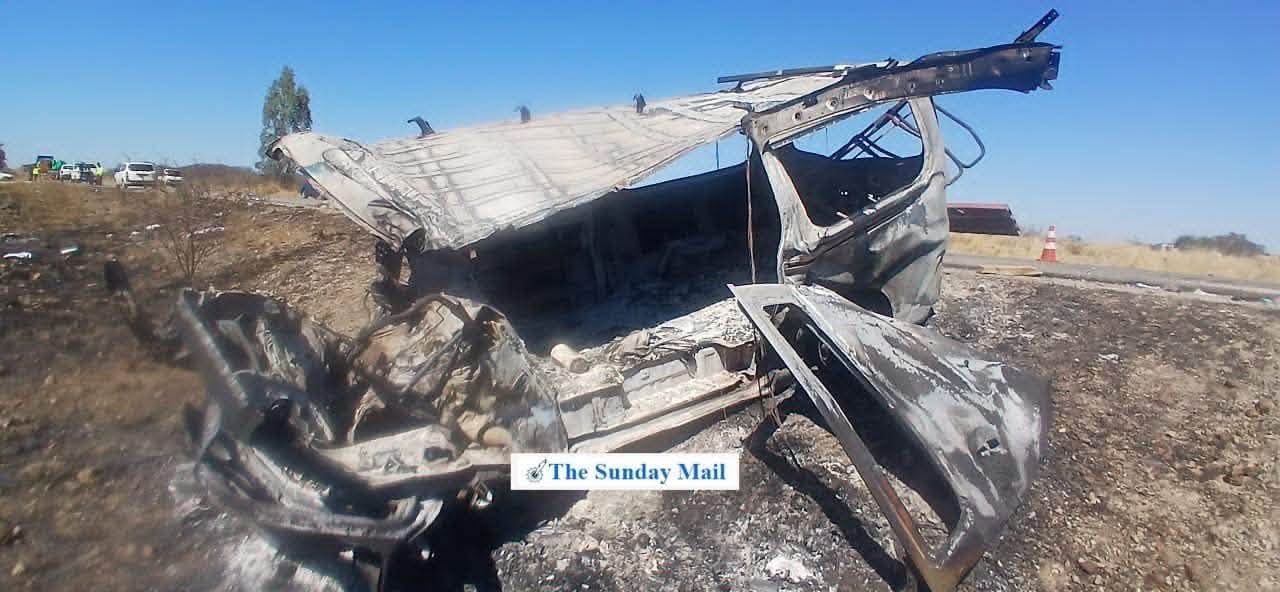
The Zimbabwe Republic Police (ZRP) has released the names of 25 of the 28 victims of a fatal road traffic accident involving members of the African Apostolic Church (Paul Mwazha Church) that occurred on 28 August 2026.
In a statement issued on Tuesday morning, ZRP spokesperson Commissioner Paul Nyathi said the accident happened at around 8.30 pm at the 132km peg along the Harare-Masvingo Road in Chivhu.
He said the death toll has risen from 27 to 28 after one of the injured passengers who had been admitted to Chitungwiza General Hospital died.
Nyathi said the remaining three victims were burnt beyond recognition and their identities have not yet been established.
“CID Forensic Department has obtained forensic samples from the three unidentified remains for analysis to enable the identification process to be concluded,” he added.
“The Police will only release the identities of the three victims once the DNA forensic examination has positively confirmed their identities.”
Commissioner Nyathi urged Zimbabweans to avoid driving at night due to poor visibility, and appealed to church leaders and conference organisers to ensure congregants do not travel at night and avoid hiring or boarding vehicles that do not comply with road safety standards.
The names of 25 victims who have been identified by their next of kin are:
Tanaka MAGIYA, a male juvenile, approximately 11 years, of Chakahwata Village, Seke.
Talent MAGIYA, a male juvenile, approximately 13 years, of Chakahwata Village, Seke.
Adiel MAGIYA, a female infant, approximately two years, of Chakahwata Village, Seke.
Nenyasha MAGIYA, a female infant, approximately four years, of Chakahwata Village, Seke.
Mellisa MAGIYA, a female adult, approximately 39 years, of Chakahwata Village, Seke.
Rumbidzai KASHONGO BONDA (29), a female adult of Zhanje Village, Dema, Seke.
Believe BONDA (10), a male juvenile of Zhanje Village, Dema, Seke.
Tehila BONDA, a female infant, approximately two years, of Zhanje Village, Dema, Seke.
Tavonga BONDA, a male juvenile, approximately eight years, of Zhanje Village, Dema, Seke.
Wisdom MASAVA (13), a male juvenile of House Number 286, Phase 1, Dema Location, Seke.
Devine MASAVA (9), a male juvenile of House Number 286, Phase 1, Dema Location, Seke.
Jonathan MARAHWA (34), a male adult of Dema, Seke.
Moline CHAMBOKO (57), a female adult of Mutevera Village, Chief Neshanndge, Sadza.
Plaxecedes NYAMAYARO, a female adult, approximately 68 years, of Marikopo Village, Chief Seke, Seke.
Humfrey CHIKAKA (44), a male adult of Dema, Seke.
Lizzy NHEMA (38), a female adult of Dema, Seke.
Tawanda MUPANDAWANA, a male juvenile, aged two years, of Collins Farm Village 2A, Gutu.
Wisdom CHIKAKA (10), a male juvenile of Churu Farm, Glenview, Harare.
Kuzivakwashe CHIKAKA (12), a male juvenile of Churu Farm, Glenview, Harare.
Tariro CHIKAKA (14), a female juvenile of Churu Farm, Glenview, Harare.
Shamiso CHIKAKA, a female juvenile, aged eight years, of Churu Farm, Glenview, Harare.
Idyai MUNYANYIWA (52), a female adult of Munyanyiwa Village, Chief Ziki, Bikita.
Bernenia ZVOMUYA (63), a female adult of Murwirashava Village, Chief Seke, Dema.
Christine NYAKUZVIRANGA (68), a female adult of Matonga Village, Chief Seke, Dema.
Itai FUSIRAI (46), a male adult of Masiiwa Village, Chief Seke, Dema
Investigators seize 3,600kg of sugar with false packaging Source: Woman ran massive Tongaat Hulett sugar scam out of Southlea Park residence, court hears – Zimbabwe News Now Tongaat Hulett sugar HARARE – A 34-year-old Harare woman appeared in court on Monday over an alleged counterfeit sugar operation in which she was repackaging sugar into fake […]
HARARE – A 34-year-old Harare woman appeared in court on Monday over an alleged counterfeit sugar operation in which she was repackaging sugar into fake 2kg Tongaat Hulett bags, a court heard on Monday.
Spiwe Mutandwa of Budiriro was charged with fraud after the Zimbabwe Anti-Corruption Commission (ZACC) raided a house in Southlea Park and recovered 3,600 kilogrammes of sugar, counterfeit packaging and equipment believed to have been used in the operation.
Mutandwa was granted US$200 bail by Harare magistrate Tapiwa Kuhudzai.
The National Prosecuting Authority said the investigation began after ZACC received complaints that some sugar being sold in shops was underweight.
On August 29, ZACC allegedly received information that Mutandwa was repackaging sugar at a residence in Southlea Park.
Investigators conducted surveillance before raiding the premises later that day.
“During the operation, a Toyota Dyna truck was found parked at the premises,” the prosecution said.
“A search of the vehicle was conducted, resulting in the recovery of a consignment of sugar packed in 2kg bags bearing the Tongaat Hulett brand.”
The prosecution alleges the packaging was a replica of that ordinarily used by Tongaat Hulett for its sugar products.
A search of the premises allegedly uncovered empty 2kg bags bearing the Tongaat Hulett branding, as well as equipment including sealers, three blowers and a weighing scale.
The prosecution said the equipment was believed to have been used to repackage the sugar.
Mutandwa allegedly represented the repackaged sugar, whose source was not disclosed in court, as genuine Tongaat Hulett product without the company’s knowledge, authority or consent.
Prosecutors allege the operation was intended to deceive consumers about the sugar’s identity, origin, quantity and authenticity.
The alleged scheme also had the potential to cause financial prejudice to consumers and damage the reputation and goodwill associated with the Tongaat Hulett brand, the court heard.
Mutandwa is represented by lawyer Nicholas Chikono.
Source: Starlink Closes In on Fibre as Zimbabwe’s VSAT Subscriptions Hit Record 86,488 – Space in Africa Starlink has narrowed the gap to the fibre subscriber base in Zimbabwe, driving the country’s VSAT subscriptions to a record 86,488 in Q1 2026, according to POTRAZ’s Q1 2026 sector report. The figure sits just 17 subscriptions behind the […]
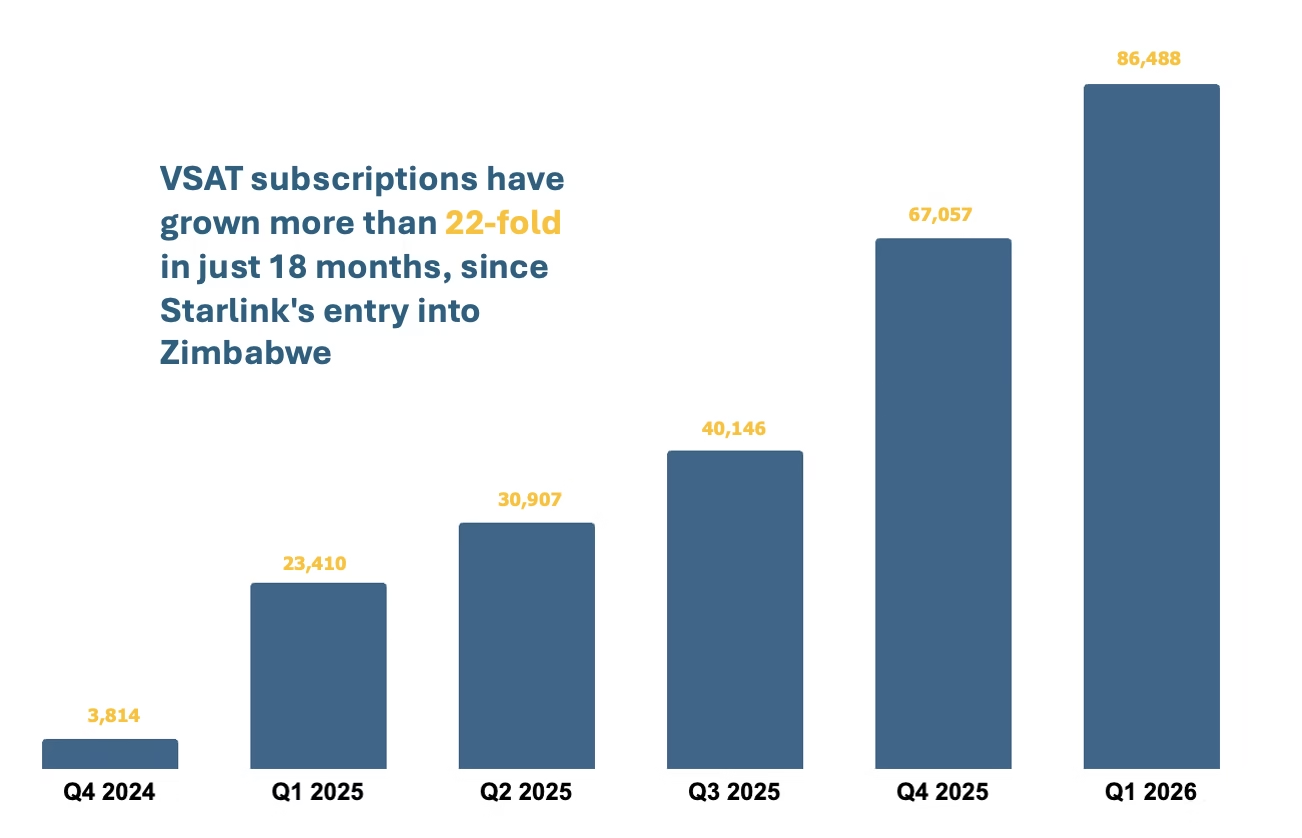
Starlink has narrowed the gap to the fibre subscriber base in Zimbabwe, driving the country’s VSAT subscriptions to a record 86,488 in Q1 2026, according to POTRAZ’s Q1 2026 sector report. The figure sits just 17 subscriptions behind the country’s 86,505 active fibre connections, marking one of the clearest signs yet of how rapidly Elon Musk’s satellite internet service has reshaped Zimbabwe’s broadband market.
Growth trend in Zimbabwe’s VSAT subscriptions (including Starlink). Data source: POTRAZ. Illustration: Space in Africa.
VSAT subscriptions grew 28.98% quarter-on-quarter, from 67,057 in Q4 2025 to 86,488 in Q1 2026, making it the fastest-growing internet technology provider in the country. That growth rate is nearly three times that of fixed LTE, the second-fastest-growing technology over the same period. Every other provider in the quarter. The pattern points to a shift in consumer preference toward Starlink’s combination of higher speeds and comparatively affordable pricing, and suggests the service is not just adding new broadband users but actively pulling users away from competing options.
Before Starlink’s entry into Zimbabwe, VSAT subscriptions were a negligible slice of the broadband market. In the quarter Starlink launched, the category jumped from 3,814 to 23,410 subscriptions. That step change, sustained across every subsequent quarter, is what allows VSAT subscription data to be treated, but cautiously, as a useful proxy for Starlink’s footprint in the country, even though POTRAZ does not report Starlink subscriptions as a standalone line item.
Starlink’s Growth in Context
Using that proxy, Starlink added 19,431 users in Zimbabwe in the last single quarter alone, a scale of growth that took Kenya, one of the continent’s more digitally advanced markets, roughly 12 months to match. On that single-quarter metric alone, Zimbabwe’s Q1 2026 Starlink subscribers would rank among the largest in Africa, trailing only larger and more established markets such as Nigeria, Zambia, Ghana and Kenya.
The milestone cements Zimbabwe as Starlink’s fastest-growing market in Africa, with its subscriber base recording an average quarterly growth rate of more than 100% since launch. It also gives Zimbabwe the second-largest reported Starlink subscriber base on the continent, behind Nigeria’s 98,642 subscriptions in Q2 2026. However, the comparison is not on a like-for-like quarterly basis. Nigeria’s figure is for Q2 2026, one quarter ahead of Zimbabwe’s Q1 2026 data, while Nigeria’s Q1 2026 subscriber figure was not publicly released by the Nigerian Communications Commission.
That gap, however, is narrower than it looks. Even a modest 20% quarter-on-quarter increase, well below Zimbabwe’s latest growth rate of 28.98%, would put its Q2 2026 VSAT subscriptions at well over 100,000, surpassing Nigeria’s reported Q2 2026 count. At that pace, Zimbabwe would not just be closing the gap with Africa’s largest Starlink market, but would be on track to overtake it.
On a broader scale, Starlink’s subscriber base in Zimbabwe now surpasses that of New Zealand, which recorded 85,000 subscribers in Q2 2026, putting Zimbabwe among Starlink’s larger markets globally. At its current growth trajectory, Zimbabwe could also overtake the UK’s 110,000 subscribers, recorded in Q4 2025. Reaching that level would place Zimbabwe’s subscriber base ahead of a significantly more mature Starlink market, highlighting the unusually rapid pace of adoption in the Southern African country.
Reshaping Zimbabwe’s Broadband Market
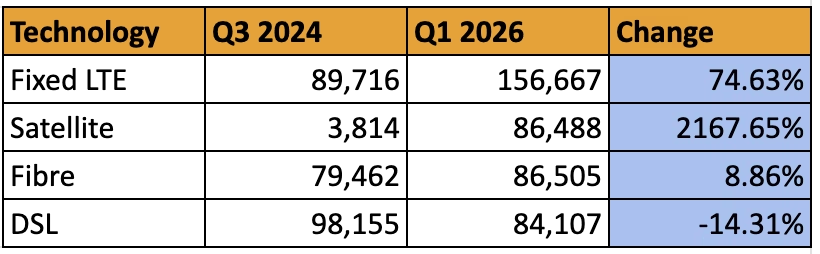
Zimbabwe’s fixed broadband market grew from 286,271 subscribers in Q3 2024 to 417,892 in Q1 2026, an increase of 131,621 connections. Satellite accounted for nearly two-thirds of the net increase, adding 82,674 subscribers, while fixed LTE contributed another 66,951. Fibre, by comparison, added just 7,043 subscribers, while DSL lost 14,048 connections over the period.
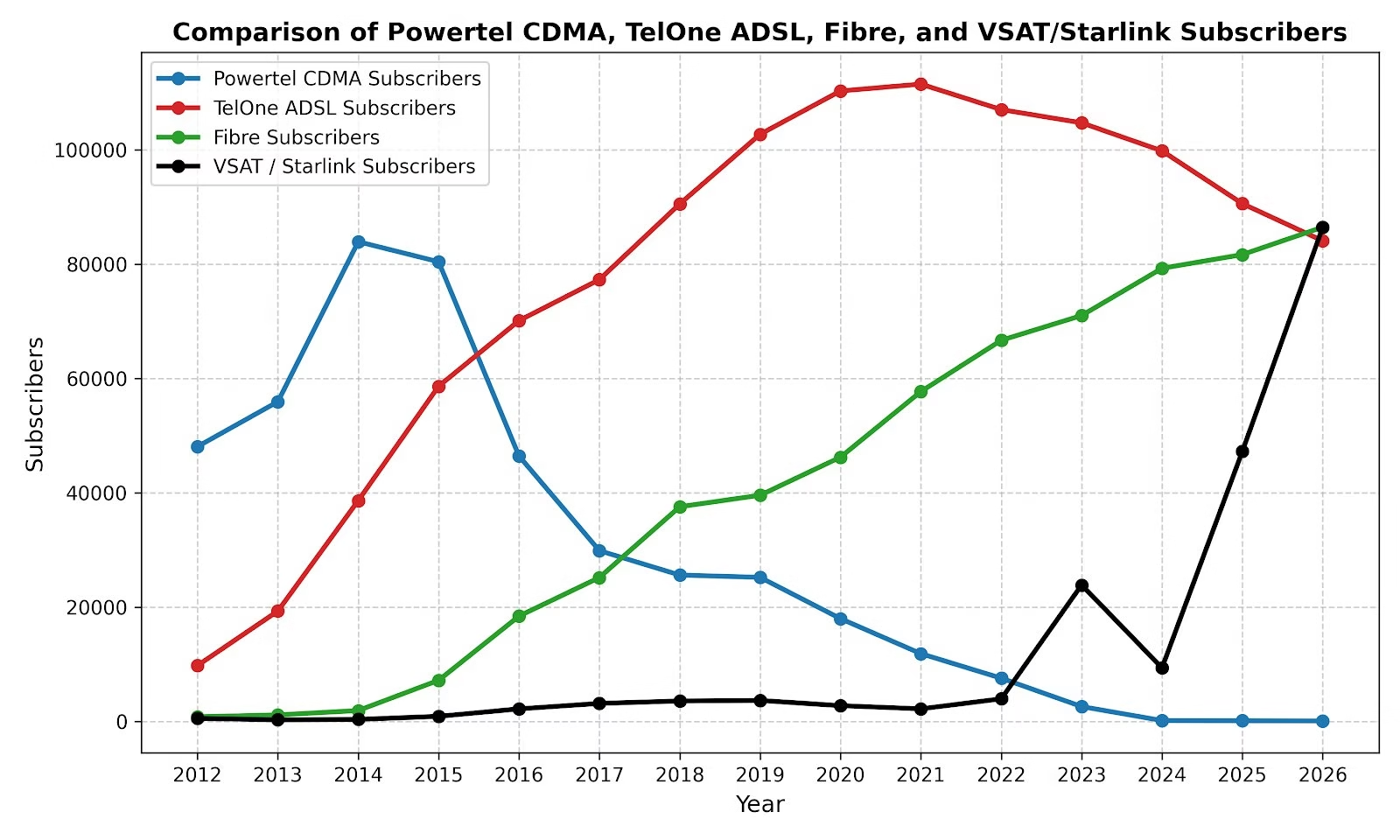
The shift is also becoming evident at the provider level. Starlink has overtaken TelOne’s ADSL subscriber base, underscoring how quickly satellite connectivity has gained ground among Zimbabwean internet users. At the broader technology level, however, satellite and fibre remain neck and neck, separated by just 17 subscriptions.
Image courtesy of Willard Shoko. Based on data published in POTRAZ quarterly reports.
That breakdown complicates a simple reading of the data as “fibre being replaced by Starlink”. Fibre did not shrink, but it grew by 7,043 subscribers over the same period, while satellite gained 82,674. That makes the rise of satellite look less like a direct substitution for fibre and more like a combination of two things: the expansion of the addressable broadband market itself and the erosion of DSL’s base, which lost subscribers outright. Consumers appear to be sorting across technologies on price, availability and performance rather than migrating from a single incumbent option.
Why is Starlink Growing So Rapidly In Zimbabwe?
Starlink’s advantage in Zimbabwe is partly rooted in the cost and reach of terrestrial infrastructure. Fibre and fixed wireless networks require infrastructure to reach individual communities and premises, making expansion into underserved areas slower and more capital-intensive. Starlink faces less of this constraint. Once a customer has the required equipment and a clear view of the sky, the service can be activated without waiting for a new terrestrial network to be built. This gives Starlink access to customers that existing providers may be unable to serve, allowing it to add subscribers across a much wider geographic area at a faster pace.
Price has further strengthened that proposition. When Starlink launched in September 2024, its standard residential service cost USD 50 per month for unlimited data, while the Mini plan cost USD 30 per month, with advertised speeds of up to 200 Mbps and 100 Mbps, respectively. At the time, local providers were charging significantly more for comparable unlimited packages. TelOne’s top package was priced at USD 300 for up to 50 Mbps, while Liquid Home’s unlimited fibre package cost USD 439. Econet subsequently introduced an unlimited LTE package for USD 45, with speeds up to 50 Mbps. The gap has since narrowed as local providers responded to Starlink’s entry, but the initial combination of price, speed and nationwide availability gave the satellite service a significant competitive advantage.
Source: Masimirembwa pushes to end VP Chiwenga’s political career … Who controls Zanu PF when Mnangagwa eventually leaves office… President Emmerson Mnangagwa’s ally and Zanu PF Harare Provincial chairman, Godwills Masimirembwa, has tightened the political noose around Vice-President Constantino Chiwenga by endorsing Mnangagwa’s continued leadership beyond the next scheduled party congress.The move could further frustrate […]
… Who controls Zanu PF when Mnangagwa eventually leaves office…
President Emmerson Mnangagwa’s ally and Zanu PF Harare Provincial chairman, Godwills Masimirembwa, has tightened the political noose around Vice-President Constantino Chiwenga by endorsing Mnangagwa’s continued leadership beyond the next scheduled party congress. The move could further frustrate Chiwenga’s long-standing succession ambitions and deepen the factional struggle over who will eventually succeed Mnangagwa.
Zanu PF Harare Province yesterday resolved that the party’s National Congress, currently due in 2027, should be postponed to 2030 to align the party’s electoral cycle with the country’s amended constitutional framework. More significantly, the province unequivocally endorsed Mnangagwa as its preferred candidate for First Secretary and President of Zanu PF at the next congress in 2030. “We have resolved that until the next congress he remains President and First Secretary of the party and at that congress he will be our nominee as party leader,” Masimirembwa said at a Zanu PF inter-district meeting in Harare. The resolution comes against the backdrop of an increasingly bitter succession struggle within Zanu PF, with 2030 emerging as the new political battleground. The succession question has deep roots in the ruling party. The 2017 military-assisted removal of former president Robert Mugabe followed an intense struggle over who would succeed him, pitting factions around then-Vice-President Emmerson Mnangagwa against the G40 grouping associated with Grace Mugabe. Then-General Chiwenga played a central role in the military intervention that ultimately brought Mnangagwa to power. Eight years later, the two men find themselves on opposite sides of another succession contest. Mnangagwa is constitutionally due to leave office after completing his second term in 2028. However, Zanu PF has pursued constitutional changes that would shift the electoral cycle from five to seven years, effectively moving the next general elections to 2030. The amendment process has become a major flashpoint between Mnangagwa loyalists and forces perceived to be aligned with Chiwenga. For Chiwenga, the political danger is not simply that the presidential election could be delayed. By keeping Mnangagwa at the helm until 2030, his allies could also prolong the President’s control over Zanu PF structures and potentially weaken Chiwenga’s ability to position himself as the natural successor. Harare’s latest resolution therefore carries significance beyond the party’s constitutional housekeeping. It effectively signals to the Chiwenga camp that the succession question is being pushed further down the road while Mnangagwa’s political machinery remains firmly in control. The irony is that Chiwenga himself has become one of the most vocal critics of the political and economic elite he has labelled “Zvigananda” — a term he has used to describe individuals who accumulate enormous wealth through questionable or unexplained means. In 2025, Chiwenga described Zvigananda as people who grow “big tummies” through ill-gotten wealth and questionable morals, drawing a distinction between them and ordinary citizens and liberation-war veterans. Chiwenga subsequently used the term to attack what he described as phantom entrepreneurs and politically connected businesspeople whose wealth has no clear economic foundation. The term has since acquired a wider political meaning, with critics using “Zvigananda” to describe networks of politically connected elites accused of benefiting from state patronage. That rhetoric has now fed into the broader succession struggle, as rival Zanu PF factions accuse each other of using wealth, patronage and political influence to consolidate power. Harare Province’s resolutions therefore represent another front in the battle. The province also endorsed resolutions calling for the Zanu PF constitution to be reviewed and aligned with the amended Constitution of Zimbabwe, including provisions dealing with the tenure and electoral cycles of party structures. According to the province, the proposed alignment is intended to promote “constitutional harmony, institutional consistency, stability and continuity.” The province further called for the expeditious implementation of Constitutional Amendment No. 3, which has become central to the dispute over Zimbabwe’s political succession. Zanu PF Secretary for Education, Research and Ideology Charles Tawengwa said the province had requested that the party constitution be aligned with Amendment No. 3 as part of its draft resolutions to be considered at the party’s annual National Conference. “I want to commend the provincial structures for supporting the recently enacted Constitution of Zimbabwe Amendment Act No. 3,” Tawengwa said. He said the resolutions adopted in Harare were intended to advance the party’s programme while supporting the attainment of National Vision 2030. “The circular is clear; we want new resolutions that further the revolutionary process while also assessing whether our previous resolutions have been implemented,” he said. Masimirembwa thanked Harare party members for supporting the constitutional amendment. But beneath the language of constitutional alignment, party unity and Vision 2030 lies a much more consequential political question: Who controls Zanu PF when Mnangagwa eventually leaves office — and will Chiwenga still be in a position to claim the succession? With provinces increasingly declaring their support for Mnangagwa’s continued leadership, the answer is becoming less certain for his deputy. For Chiwenga, the danger is that the succession battle may be decided not at the next election, but gradually through the reshaping of Zanu PF’s structures, alliances and political timetable. That could leave the general who helped engineer the 2017 transition facing a very different battle — one in which the political machinery he helped bring to power is increasingly being turned against his own succession ambitions.
 Tongaat Hulett sugar