Civil servants to receive better pay without moving into management 

Source: Civil servants to receive better pay without moving into management – herald Sunday Mail Reporter CIVIL SERVANTS will soon be able to advance and earn better salaries while continuing to perform the work they are trained and skilled to do without necessarily having to move into management positions. The initiative, which is being rolled […]

The post Civil servants to receive better pay without moving into management  appeared first on Zimbabwe Situation.

Source: Civil servants to receive better pay without moving into management – herald

Sunday Mail Reporter

CIVIL SERVANTS will soon be able to advance and earn better salaries while continuing to perform the work they are trained and skilled to do without necessarily having to move into management positions.

The initiative, which is being rolled out after the recently completed job evaluation by the Public Service Commission (PSC), is expected to help retain specialist skills and promote professional excellence across the public service.

On the other hand, workers whose posts were assigned lower grades as a result of the exercise will retain existing salaries, allowances and other benefits. However, new entrants will earn according to the newly evaluated grade.

In a statement, the PSC said outcomes of the first comprehensive job evaluation in the nation’s public service since 2003, which resulted in a new remuneration framework, were effected from April 1 this year. The job evaluation began in 2022.

In September 2024, Cabinet approved its recommendations and directed their implementation across the public sector.

Under the parallel progression framework, workers with special skills and experience, such as teachers, engineers, nurses or technical experts, will be rewarded for being good at their jobs instead of being forced to go for supervisory or administrative positions to earn more.

“The framework is designed to recognise that not every employee’s career aspiration is to become a manager,” said the PSC.

“Many public servants develop highly specialised knowledge and technical expertise that are critical to effective service delivery. Traditionally, career advancement in many organisations has depended largely on promotion into management or administrative roles. This often meant that highly skilled professionals had to move away from the work they excelled in simply to improve their remuneration and career prospects.”

The PSC said, by providing multiple pathways for career advancement, the framework will enable public servants to grow, excel and contribute more effectively to national development and Zimbabwe’s Vision 2030 objectives.

One of the key safeguards brought by the job evaluation, it said, was the personal-to-holder principle, a provision that protects an employee’s existing salary, allowances and benefits where a job was assigned a lower grade than it previously held.

“In other words, the protection applies to the current holder of the post and ensures that they do not suffer an immediate loss of remuneration because of the job evaluation outcome,” said the PSC.

“However, once the current holder leaves the position through retirement, resignation, promotion or any other reason, the post will thereafter be filled at its newly evaluated grade. The protection applies only to the current holder and does not permanently attach to the position.”

The move was envisaged to correct historical grading anomalies, while safeguarding the legitimate interests of serving public officers.

The PSC said the job evaluation had since corrected longstanding anomalies.

“Chief directors, previously misclassified at grade F2, are now correctly placed at E4, while directors have moved from F1 to E1 and deputy directors from E5 to D1,” said the PSC.

“Skilled professionals such as engineers, teachers and human resources officers, previously inflated to Band D and E, have been correctly placed in Band C, consistent with the specialised, technocratic nature of their work.”

Concerns and appeals

To promote transparency and confidence in the process, a multi-sectoral Job Evaluation Appeals Committee has been established to consider concerns and appeals from employees and institutions.

The committee became operational on June 1, 2026 and will receive and process appeals until August 31, 2026, providing public servants with an opportunity to seek clarification and review of perceived anomalies in job grading outcomes.

“The commission has assured employees that every appeal will be considered in accordance with established job evaluation principles and procedures,” added the PSC.

“The process is governed by standard principles applicable across all evaluation methods: jobs, not people, are graded; reporting lines do not determine a grade; longevity and additional qualifications are not grounds for regrading; and no single individual may unilaterally determine an outcome.”

The job evaluation, the PSC said, was necessitated by disparities in grading structures, overlapping responsibilities and some general inconsistencies that created perceptions of inequity.

Similar jobs were often graded differently, while some employees faced limited opportunities for career growth despite possessing valuable skills and experience, it said.

“One of the most significant benefits of the exercise is the promotion of equity across the public service. Employees can now have greater confidence that grading decisions are based on objective criteria applied consistently across ministries, departments and agencies. The job evaluation exercise is also expected to strengthen organisational effectiveness. By aligning grades with responsibilities, Government institutions can establish clearer reporting structures, eliminate duplication of roles and improve accountability.”

The post Civil servants to receive better pay without moving into management  appeared first on Zimbabwe Situation.
All set for hero Maj-Gen Dzihwema burial tomorrow 

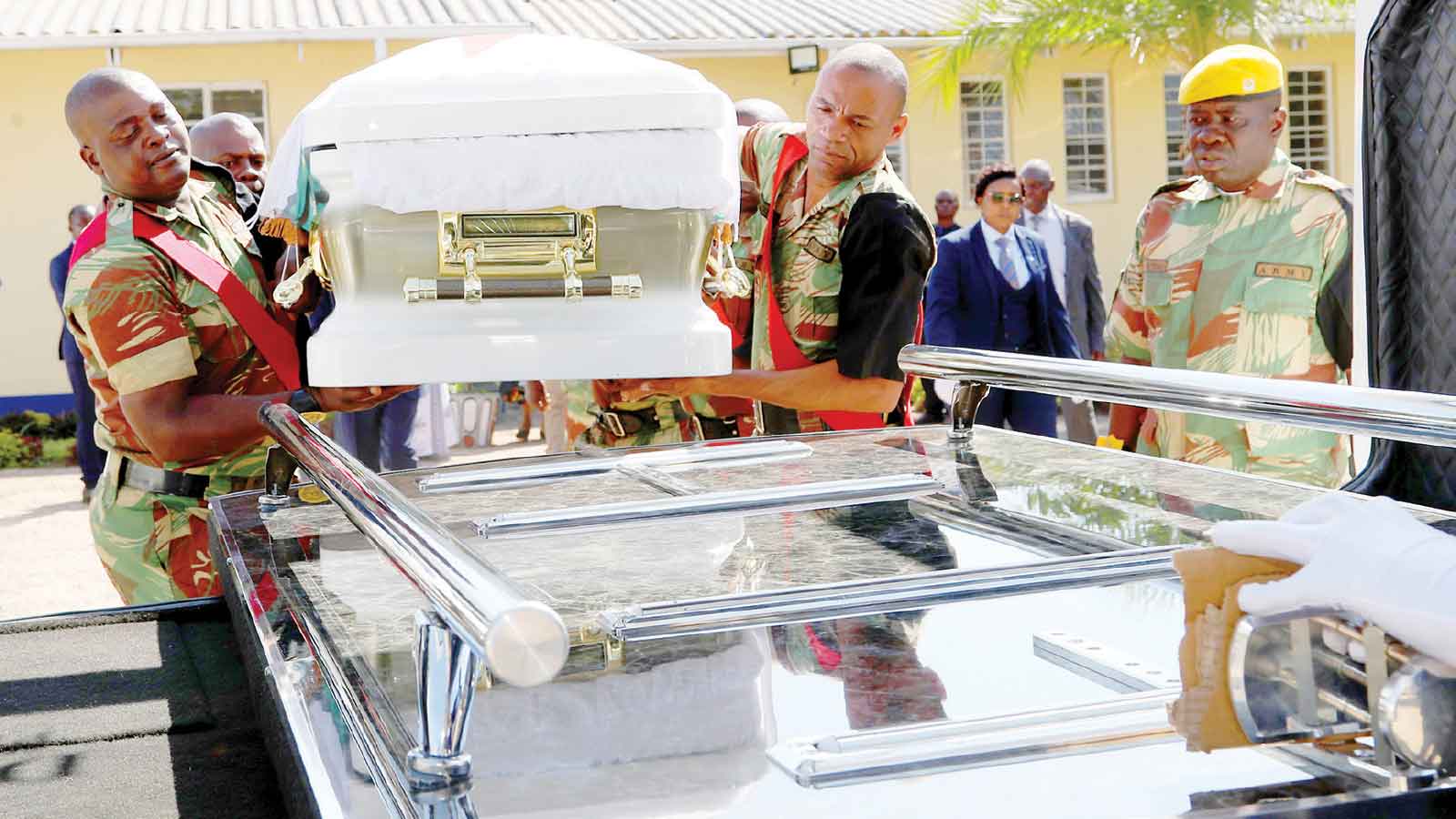
Source: All set for hero Maj-Gen Dzihwema burial tomorrow – herald Zimbabwe National Army pallbearers carry the casket of Major-General (Retired) Evaristo Dzihwema into a hearse at the Charles Gumbo Barracks in Harare, before it left for his farm in Norton, Mashonaland West province, yesterday. — Picture: Joseph Manditswara Debra Matabvu and Freeman Razemba PRESIDENT […]

The post All set for hero Maj-Gen Dzihwema burial tomorrow  appeared first on Zimbabwe Situation.
Source: All set for hero Maj-Gen Dzihwema burial tomorrow – herald

Debra Matabvu and Freeman Razemba

PRESIDENT MNANGAGWA will tomorrow preside over the burial of national hero Major-General (Retd) Evaristo Dzihwema at the National Heroes Acre in Harare.

Maj-Gen (Retd) Dzihwema died on June 25 in India, where he was receiving medical treatment.

He was 63.

His body was repatriated to Zimbabwe on July 1.

Permanent Secretary in the Ministry of Home Affairs and Cultural Heritage Ambassador Raphael Faranisi said all was in place for the national hero’s burial tomorrow.

“Preparations are on course and are now at an advanced stage. President Mnangagwa is expected to preside over the burial process of the national hero,” he said.

“Buses will be provided to ferry mourners from his home village in Rusape as well as other provinces. These arrangements are being done by the Ministry of Local Government and Public Works.”

Yesterday, Maj-Gen (Retd)Dzihwema’s body was taken to his farm in Norton, where relatives, friends and the Mashonaland West province community paid their last respects.

The body returned to Charles Gumbo Barracks before departing for his rural homestead in Kamusoko village, Tanda, Makoni district, where it lay in state.

In a statement, the Ministry of Home Affairs and Cultural Heritage said the body is expected to return to Harare today ahead of burial tomorrow.

“On Sunday, the 5th of July 2026, the late Major-General (Retd) Evaristo Dzihwema will be flown back to Harare for a church service at St Martin’s Anglican Church in Hatfield,” the statement reads in part.

“Following the service, the body will be taken to his Zimre Park residence at number 5535, Platinum Road, where it will lie in state ahead of burial.

“Monday, the 6th of July 2026 is the burial day and gates at the National Shrine will be opened at 6am. Members of the public are invited to come out in their numbers to give a resounding and befitting send-off to this great son of the soil.”

Maj-Gen (Retd) Dzihwema joined the liberation struggle in 1978 after being assaulted by Rhodesian Security Forces while travelling to obtain a juvenile registration certificate.

The incident strengthened the young Dzihwema’s resolve to take up arms and join thousands of other young Zimbabweans fighting for the country’s independence.

After undergoing military training in Mozambique, Maj-Gen (Retd) Dzihwema was deployed to the operational front, where he served alongside several prominent liberation war commanders before Zimbabwe attained independence in 1980.

Following independence, he joined the Zimbabwe National Army and steadily rose through the ranks to become a major-general, serving in numerous command and staff appointments. He occupied several strategic positions, including Company Brigade staff officer, director of procurement, director of finance and director-general responsible for personnel within the Zimbabwe Defence Forces (ZDF).

Following his retirement from active military service in December 2017, Maj-Gen (Retd) Dzihwema joined the Ministry of Youth, Indigenisation and Economic Empowerment as principal director before later transferring to the Ministry of Veterans of the Liberation Struggle Affairs, where he served as chief director until his death.

The accolades he earned during his distinguished career included the Liberation Medal, Independence Medal, Ten-Year Service Medal, Long and Exemplary Service Medal, Mozambique Campaign Medal, Democratic Republic of Congo Medal and the Grand Commander of the Zimbabwe Order of Merit.

Maj-Gen (Retd) Dzihwema is survived by his wife Alice and three sons.

The post All set for hero Maj-Gen Dzihwema burial tomorrow  appeared first on Zimbabwe Situation.

‘SUPPORT RETURNEES WITH PROGRAMMES TO BOOST ECONOMY’

Source: ‘SUPPORT RETURNEES WITH PROGRAMMES TO BOOST ECONOMY’ – herald President Mnangagwa Debra Matabvu PRESIDENT MNANGAGWA has directed that Zimbabweans returning from South Africa be welcomed home with dignity and supported through reintegration programmes designed to enable them to contribute to the growing economy. This comes as the Government is preparing to receive an increased […]

The post ‘SUPPORT RETURNEES WITH PROGRAMMES TO BOOST ECONOMY’ appeared first on Zimbabwe Situation.

Source: ‘SUPPORT RETURNEES WITH PROGRAMMES TO BOOST ECONOMY’ – herald

Debra Matabvu

PRESIDENT MNANGAGWA has directed that Zimbabweans returning from South Africa be welcomed home with dignity and supported through reintegration programmes designed to enable them to contribute to the growing economy.

This comes as the Government is preparing to receive an increased number of returnees following the intensified crackdown on undocumented migrants.

However, the authorities believe returning Zimbabweans will play a key role in accelerating the country’s economic transformation, with their skills expected to bolster strategic sectors such as horticulture, mining and manufacturing.

In an interview with The Sunday Mail, Deputy Chief Secretary in the Office of the President and Cabinet (Presidential Communications) Mr George Charamba said the returnees presented an opportunity to harness skills acquired outside the country to support national development.

As of Thursday, the Government had facilitated the repatriation of 11 065 Zimbabweans, with a further 47 703 citizens returning home through self-repatriation efforts, bringing the cumulative total of returnees to 58 768.

Of the 11 065 who have been repatriated, 2 449 are male adults, while 3 661 are female adults. There are also 2 407 male minors, 2 540 female minors and eight unaccompanied minors.

“We were given a very strong statement by His Excellency, the President, on Monday to communicate that every Zimbabwean is welcome to come home,” Mr Charamba said.

“This is their country, this is their home and we proudly receive our citizens back.

“Government is doing all it can to ensure their comfortable and dignified return but also to their long-term reintegration into wider society. They are coming back to a changed country. The economy is growing and creating new opportunities, which means Zimbabwe’s capacity to absorb its returnees is very much enlarged.”

He said the diverse skills and expertise possessed by returning Zimbabwean nationals should be harnessed across various sectors of the economy to drive productivity, stimulate economic growth and foster national development.

“There is recognition that these returnees are bringing in unique skills, including in the horticulture industry,” Mr Charamba added.

“With the new China policy of zero tariffs, it means our horticulture industry has to perform. The skills that Zimbabwean returnees wield are badly required back home so that Zimbabwe can meet her export quota.

“Our push for beneficiation, it means that we will have an immediate direct link between mining and industrialisation. It will also mean less of Zimbabwean minerals going down south as matte.

“Each time we are sending down matte instead of platinum, instead of rhodium, instead of gold, instead of lithium sulphate or lithium carbonate, it means we are exporting jobs which Zimbabweans move down south to claim back. So, the issue of beneficiation is going to be a turning point in terms of the economy’s capacity to absorb those that are coming back home.”

Influx

He attributed the influx of Zimbabweans from South Africa to the crackdown on farms, penalties by the South African government on employers of undocumented migrant workers and landlords, who are now finding it impossible to house Zimbabwean tenants.

“What we need to appreciate as Zimbabweans is that the numbers of returnees are very unstable and they keep swelling,” he added.

“We have tried to get to the bottom of that phenomenon, and we have since established that the crackdown on migrants is unrelenting and ever-expanding.

“Firstly, the crackdown of migrants has extended to farming areas, so that has been a new source of returnees.

“Secondly, the crackdown has also been extended to penalties slapped on employers of migrant workers — very hefty penalties.

“The erstwhile employers have become agents of eviction. They are now throwing their erstwhile employees in the street for fear of being slapped with hefty penalties by the government.

“The third dimension of landlords, and it is exactly the same reason that has influenced employers.

“The landlords have been kicking out their tenants. The last one is the generalised sense of insecurity which is forcing out Zimbabweans and other nationalities from their hideouts and delivering themselves to repatriation centres.”

Mr Charamba said areas where this has been rampant include Western Cape province, Durban and Pietermaritzburg. This has resulted in Zimbabwean nationals turning to repatriation centres in these areas, he added.

He said that although repatriation centres had been established in areas such as the Western Cape and Durban, South African clearance teams remained understaffed in other parts of the country, slowing down the repatriation.

“The other complicating factor is that the journey of returnees has multiple detours,” he added.

“We have had instances where we had to move returnees from repatriation centres into Johannesburg, where there are more clearance centres.

“The clearing teams of the South African government have been lean in some areas and stronger in others.

“Through our consulate, we have had to move Zimbabwean nationals from areas of lean service to areas of stronger service.

“Johannesburg being the leading centre, we moved returnees from Durban and Cape Town to Johannesburg for clearance.

“Then Zimbabwean Government then mobilised transport for the returnees to Musina. So, this has tended to complicate matters.

“The South African government has been very insistent that everyone moving from their territory must be accounted for from the perspective of crime because they do not want criminals to escape the dragnet.

“So, they have been very insistent that everyone must be cleared.”

The Zimbabwean Embassy and its consulates continue to provide humanitarian assistance to distressed citizens by distributing food, toiletries, temporary shelter and coordinating transport to the border.

Government-hired buses, supplemented by donations from philanthropists such Messrs Kudakwashe Tagwirei and Paul Tungwarara, as well as development partners, are supporting the repatriation programme. Additional buses and ambulances are boosting operations.

Development partners, including the World Food Programme (WFP), UNICEF, No-One Sleeps Hungry, Life Foundation and the Adventist Relief and Development Agency, have also provided food, blankets, transport and other essential services to ensure the safe, orderly and dignified return and reintegration of Zimbabwean returnees.

The post ‘SUPPORT RETURNEES WITH PROGRAMMES TO BOOST ECONOMY’ appeared first on Zimbabwe Situation.

How Zimbabwe’s culture of “life presidency” breeds future leaders who don’t value the smooth transfer of power

Source: How Zimbabwe’s culture of “life presidency” breeds future leaders who don’t value the smooth transfer of power We become who we grow up watching. Tendai Ruben Mbofana When Zimbabwe attained independence in 1980, the generation born into the dawn of the new republic was given a proud and historic title: the “bornfrees.” If you […]

The post How Zimbabwe’s culture of “life presidency” breeds future leaders who don’t value the smooth transfer of power appeared first on Zimbabwe Situation.

Source: How Zimbabwe’s culture of “life presidency” breeds future leaders who don’t value the smooth transfer of power

We become who we grow up watching.

Tendai Ruben Mbofana

When Zimbabwe attained independence in 1980, the generation born into the dawn of the new republic was given a proud and historic title: the “bornfrees.”

If you value my social justice advocacy and writing, please consider a financial contribution to keep it going. Contact me on WhatsApp: +263 715 667 700 or Email: mbofana.tendairuben73@gmail.com

They were meant to inherit a nation defined by self-determination, democratic vibrancy, and the unlimited promise of a free society.

Instead, nearly half a century later, this demographic finds itself trapped in a bizarre political time warp.

For a Zimbabwean bornfree, the entire concept of state authority, national leadership, and executive power has been completely embodied by just two men.

The recent passage of the Constitutional Amendment (No. 3) Bill—also known as CAB3—through its final parliamentary hurdles brings this generational tragedy into sharp focus.

By extending presidential terms from five to seven years and replacing the direct popular vote with parliamentary selection, the political elite have systematically consolidated executive control.

This legislative maneuver ensures that the last of President Emmerson Mnangagwa’s constitutionally permitted terms stretches to 2030, mirroring the 37-year iron grip of his predecessor, Robert Mugabe.

For the youth of Zimbabwe, the horizon of political change has once again been pushed out of reach, reducing the constitutional right to vote to a mere formality.

To appreciate how truly anomalous this setup is, one only needs to look across the border or across the ocean.

Since 1994, South Africa has seen five different presidents navigate the challenges of democratic governance, demonstrating that a nation can experience deep political shifts without collapsing.

In Botswana, citizens have witnessed smooth, constitutionally mandated transitions of power from one president to the next since independence, a testament to the fact that leadership is a temporary mandate, not a personal inheritance.

Yet in Zimbabwe, an entire generation is likely to grow old and die having witnessed only two faces on the national currency and at the head of the state.

As a matter of fact, among all the liberation movements in Southern Africa, only the ZANU-PF regime has refused to preside over a system of regular leadership renewal.

In fact, we are already witnessing this disturbing phenomenon playing out in the opposition, where there has also never been a smooth transfer of power.

​It has become normalized that the party leader is the sole face, the Alpha and Omega, whose absence is seen as the death of the entire organization.

This is not stability; it is a profound stagnation that chokes the life out of a nation’s potential.

The deepest danger of this political freeze goes beyond economic mismanagement or international isolation.

The true tragedy is psychological and educational.

This institutional inertia effectively grooms a generation that has never seen, felt, or understood how a healthy democracy functions.

When an entire society is denied the experience of a regular, peaceful, and routine transfer of power, the democratic process begins to feel like an abstract myth.

Regular leadership change acts as a vital societal pressure valve, offering a renewal of hope and a chance for national recalibration.

Without it, the youth are stripped of their political agency, left with the soul-crushing impression that the state exists entirely independent of its citizens’ choices.

Worse still, this environment normalizes authoritarian longevity.

When a life presidency or an indefinitely extended tenure is the only reality on display, it begins to look like the default layout of governance.

This dangerous normalization risks cultivating a future breed of leaders who inherit a deeply warped political mindset.

Growing up in a system where power is viewed as a permanent possession rather than a temporary public trust, tomorrow’s leaders are being conditioned to believe that clinging to office by any means necessary is simply how a country is supposed to be run.

The culture of the “big man” politics is passed down like an institutional heirloom, ensuring that the vice of political entitlement outlives the individuals currently practicing it.

A nation cannot genuinely progress toward modernity when its political structures remain stubbornly frozen in the past.

While global trends shift rapidly and the youth navigate an increasingly interconnected world, Zimbabwe’s political reality remains stubbornly archaic.

CAB3 is presented by its architects as a tool for policy continuity and long-term stability, but for the bornfree generation, it is a barrier to the future.

It signals that their aspirations, their votes, and their voices are secondary to the preservation of power.

If Zimbabwe is ever to break this cycle, it must realize that true strength lies in the fluidity of democratic renewal, not the brittle permanence of prolonged rule.

The bornfrees deserve to see a country where leadership changes, because only then will they truly believe that their future can change too.

The post How Zimbabwe’s culture of “life presidency” breeds future leaders who don’t value the smooth transfer of power appeared first on Zimbabwe Situation.

Has AI now created a world of fake or unreliable evidence?

Source: Has AI now created a world of fake or unreliable evidence? Our fast-changing world can be a terrifying place. Tendai Ruben Mbofana Over the recent past, the Zimbabwean public square has been repeatedly rocked by spectacular, damning audio recording leaks. If you value my social justice advocacy and writing, please consider a financial contribution […]

The post Has AI now created a world of fake or unreliable evidence? appeared first on Zimbabwe Situation.

Source: Has AI now created a world of fake or unreliable evidence?

Our fast-changing world can be a terrifying place.

Tendai Ruben Mbofana

Over the recent past, the Zimbabwean public square has been repeatedly rocked by spectacular, damning audio recording leaks.

If you value my social justice advocacy and writing, please consider a financial contribution to keep it going. Contact me on WhatsApp: +263 715 667 700 or Email: mbofana.tendairuben73@gmail.com

We have listened with dropped jaws to the captured voices of prominent individuals seemingly implicating themselves in controversial activities, questionable financial dealings, or deeply embarrassing private utterances.

These leaked phone conversations and clandestine recordings instantly trigger national shockwaves and dominate the cultural discourse.

They are weaponized by various actors for an array of motives, whether to genuinely expose wrongdoing, settle personal scores, or leverage compensation under the threat of releasing even more damning material.

Yet, almost as predictably as these leaks surface, a standardized defense mechanism has emerged from the political and economic elite.

Almost without exception, the implicated individuals confidently dismiss the recordings as malicious fabrications, claiming to be the helpless victims of artificial intelligence and sophisticated voice-cloning technology.

This local phenomenon perfectly illustrates a profound crisis that has begun to dismantle the very foundations of modern evidence gathering worldwide.

For generations, the legal architectures of the world relied on a basic, unspoken promise: that the human eye and ear could serve as final arbiters of truth.

If an investigator held a photograph of a break-in, or if a jury listened to an audio tape of a suspect confessing to a crime, digital media carried almost insurmountable weight.

We have now entered an era where this historic baseline of trust has completely evaporated.

The rapid democratization of generative AI has turned digital media into a malleable fluid, allowing anyone with a smartphone to produce flawless, highly convincing fake images, videos, and voice recordings out of thin air.

The threat to justice unfolds as a terrifying double-edged sword.

On one side is the nightmare of fabricated guilt.

A vindictive spouse can now quite easily generate a realistic video of domestic abuse to manipulate a custody battle, or a bitter resident can create a photographic masterpiece of their neighbor breaking into a house.

Because modern diffusion models generate media that easily fools the human eye, a single malicious actor can initiate a wrongful arrest or an unwarranted prosecution based entirely on synthetic lies.

On the other side of the sword lies what legal scholars call the “liar’s dividend,” which is exactly what we are witnessing play out in real-time.

Because the general public is now hyper-aware that AI can clone a human voice or fabricate a video, actual perpetrators of serious crimes are handed a universal escape hatch.

If a corrupt official is genuinely caught on tape taking a bribe, or if an abuser is recorded by their victim, they no longer need to explain away their actions.

They merely need to look at the undeniable proof and declare it an AI-generated fiction designed to frame them.

By poisoning the trustworthiness of all digital files, AI allows criminals to manufacture reasonable doubt where absolutely none should exist.

The resulting impact on criminal evidence gathering is exhausting.

Traditional policing relied heavily on digital footprints to establish timelines and verify testimonies.

In an AI-saturated world, investigators can no longer take any digital exhibit at face value, forcing law enforcement to exhaust scarce state resources verifying files that used to speak for themselves.

Conversely, the high bar now required to prove a digital file is authentic threatens to stall the wheels of justice entirely, leaving genuine victims struggling to prove their cases with evidence that cautious judges are increasingly hesitant to admit.

Addressing this existential threat to truth requires a complete overhaul of how the legal system handles digital evidence, combining technological innovation with rigorous systemic reform.

To begin with, our courts can no longer look at a piece of digital evidence and simply take it at face value.

The old days of assuming a recording is real just because we can see or hear it are officially over.

Today, the responsibility must fall squarely on whoever brings a photo, video, or audio clip into a courtroom to prove beyond a doubt where it came from and that it has not been tampered with.

This means judges and investigators will have to rely heavily on expert analysis to catch the invisible, microscopic mistakes that AI makes—like unnatural shadows in a video or tiny glitches in a cloned voice that the human ear cannot pick up.

We need to remember that AI is not perfect; it makes errors and cannot always produce a flawless product.

No picture, video, or voice clone can ever be a seamless imitation.

At the same time, we need to look at how these files are created in the first place to protect the truth.

Imagine if every smartphone or recorder could put an invisible, unalterable digital stamp on a photo or voice note the exact second it is captured, locking in the date, time, and location.

If anyone tries to alter that file later or use AI to change it, that digital stamp would instantly break, sounding the alarm to investigators that the evidence is a fake.

Ultimately, technology alone cannot save the integrity of our legal systems; it must be backed by fierce institutional will.

Governments must establish clear, updated statutory frameworks specifically governing machine-generated evidence.

In tandem, there must be severe, public legal consequences for individuals caught intentionally fabricating deepfakes to mislead law enforcement or manipulate judicial outcomes.

The era where seeing was believing is gone forever.

​If we are to preserve justice in an age of total synthetic realism, the rules must change.

Digital evidence can no longer be treated as absolute truth, but as a claim that must be rigorously tested and proven.

The post Has AI now created a world of fake or unreliable evidence? appeared first on Zimbabwe Situation.